Communicable Diseases
 Call Kai
 Learn
Learn Practice Test
 Spaced Repetition
 Match
Match Flashcards
 Knowt Play
1/353

354 Terms
Chain of Infection
It refers to the sequence of events that allows an infectious disease to spread from one host to another. Infection occurs when all links in the chain are present. Breaking any link can prevent disease transmission.
Infectious agent
The microorganism capable of causing disease.
Bacteria
Viruses
Fungi
Parasites
Prions
Enumerate the infectious agents
Sterilization
Disinfection
Antimicrobial therapy
Prevention of infection from infectious agents
Reservoir
The place where the microorganism lives, grows, and multiplies.
Humans
Animals
Soil
Water
Medical equipment
Examples of reservoir
Environmental sanitation
Proper waste disposal
Cleaning and disinfection of equipment
Prevention of infection from reservoir
Portal of exit
The route through which the pathogen leaves the reservoir.
Respiratory secretions
Blood
Urine
Feces
Wound drainage
Examples of portal of exit
Covering coughs and sneezes
Proper wound dressing
Safe handling of body fluids
Prevention of infection from portal of exit
Mode of Transmission
The method by which the pathogen spreads.
Direct
Indirect
Droplet
Airborne
Vector-Borne
Examples of Mode of Transmission
Handwashing
Use of PPE
Isolation precautions
Environmental cleaning
Prevention of infection from mode of transmission
Handwashing
Game Changer:
___ is the single most effective method to prevent transmission.
Portal of Entry
The route by which microorganisms enter the host.
Respiratory tract
Gastrointestinal tract
Urinary tract
Broken skin
Mucous membranes
Examples of portal of entry
Aseptic technique
Wound care
Proper catheter care
PPE use
Prevention of infection from portal of entry
Susceptible host
A person at risk of infection due to inadequate defenses.
Extremes of age
Malnutrition
Chronic illness
Immunosuppression
Stress
Risk factors for a susceptible host
Immunization
Adequate nutrition
Health promotion
Disease management
Prevention of infection to a susceptible host
Primary prevention
Secondary prevention
Tertiary prevention
3 Levels of Prevention
Primary Prevention
Actions taken before disease occurs to prevent its development. Prevent disease and promote health.
Examples
• Immunization
• Health education
• Proper nutrition
• Regular exercise
• Smoking cessation
• Use of seat belts
• Hand hygiene
Nursing Activities
• Community education
• Vaccination campaigns
• Lifestyle counseling
Secondary prevention
Actions taken to detect disease early and initiate prompt treatment. Early diagnosis and treatment.
Examples
• Blood pressure screening
• Blood glucose testing
• Mammography
• Pap smear
• Colonoscopy
• Tuberculosis screening
Nursing Activities
• Screening programs
• Early case finding
• Diagnostic testing
Tertiary prevention
Actions taken after disease has occurred to prevent complications and restore function. Reduce disability and improve quality of life.
Examples
• Cardiac rehabilitation
• Physical therapy
• Occupational therapy
• Dialysis
• Support groups
Nursing Activities
• Rehabilitation
• Patient education
• Long-term care management
Prevent disease
Early detection
Rehabilitation
Game Changer:
Primary Prevention = ___
• Vaccination
• Health promotion
Secondary Prevention = ___
• Screening
• Diagnostic tests
Tertiary Prevention = ___
• Prevent complications
• Restore function
Transmission-Based Precautions
These are additional infection-control measures used along with Standard Precautions for patients known or suspected to be infected with highly transmissible pathogens.
Contact Precautions
Droplet Precautions
Airborne Precautions
3 Categorizations of Transmission-Based Precautions
Standard Precautions (Applied to All Patients)
Assume that all blood, body fluids, secretions, excretions, non-intact skin, and mucous membranes may contain infectious organisms.
Components
• Hand hygiene
• Personal protective equipment (PPE)
• Safe injection practices
• Respiratory hygiene/cough etiquette
• Proper disposal of sharps
• Environmental cleaning
Contact Precautions
Used for infections transmitted through direct or indirect contact with the patient or contaminated objects.
PPE Required
• Gloves
• Gown
Room Placement
• Private room preferred
• Cohort with patients having the same infection if necessary
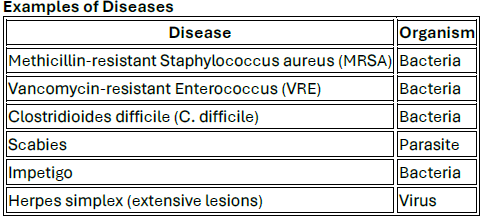
Examples of diseases where we apply contact precautions
C. difficile
Game Changer:
For ______, wash hands with soap and water because alcohol-based hand rubs are less effective against spores.
• Wear gloves before entering room
• Wear gown if contact with patient/environment is anticipated
• Use dedicated equipment when possible
• Perform hand hygiene before and after patient contact
Nursing Interventions for contact precaution
Droplet precautions
Used for infections spread through large respiratory droplets (>5 microns) produced by coughing, sneezing, or talking.
• Transmission Distance - Typically within 3–6 feet (1–2 meters).
PPE Required
• Surgical mask
Room Placement
• Private room preferred
• Maintain spatial separation

Examples of diseases where we apply droplet precautions
• Wear surgical mask when within 3–6 feet of patient
• Encourage respiratory hygiene
• Limit patient transport
• Place mask on patient during transport
Nursing Interventions for droplet precaution
Airborne precaution
Used for infections spread by airborne droplet nuclei (<5 microns) that remain suspended in the air for long periods.
PPE Required
• N95 respirator (or higher-level respirator)
Room Placement
• Negative-pressure isolation room (Airborne Infection Isolation Room)
6
How many feet away do you need to be in an airborne precaution?
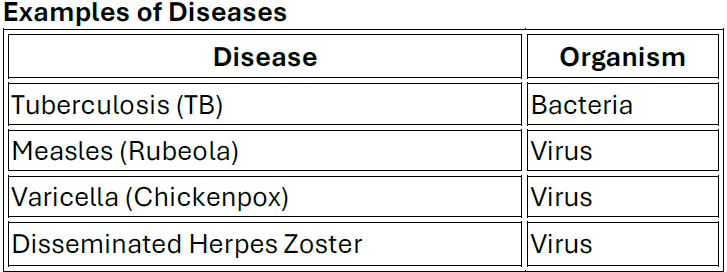
Examples of diseases where we apply airborne precautions
• Wear N95 respirator before entering room
• Keep room door closed
• Limit patient transport
• Place surgical mask on patient during transport
Nursing Interventions for airborne precaution
Tuberculosis (TB)
It is a chronic communicable disease caused by Mycobacterium tuberculosis that primarily affects the lungs but may also involve other organs such as the kidneys, bones, meninges, and lymph nodes.
Pulmonary Tuberculosis
Game Changer:
Most common and most infectious form of TB.
Location
Disease Activity
Drug resistance
Infectiousness
4 Classifications of Tuberculosis
Pulmonary Tuberculosis (PTB)
• Most common form of TB
• Involves the lungs
• Usually contagious when active
Signs and Symptoms
• Cough >2 weeks
• Hemoptysis
• Chest pain
• Night sweats
• Weight loss
• Low-grade fever
Extrapulmonary Tuberculosis (EPTB)
TB that occurs outside the lungs
Lymph nodes
Bones (Pott’s disease)
Kidneys
Meninges
Pleura
Pericardium
Common sites of extrapulmonary TB
Enlarged lymph nodes
Manifestation of TB in the lymph nodes
Back pain and deformity
Manifestation of TB in the bones
Hematuria
Manifestation of TB in the kidneys
Meningitis symptoms
Manifestation of TB in the Meninges
Pleural effusion
Manifestation of TB in the Pleura
Pericarditis
Manifestation of TB in the pericardium
infectious
Extrapulmonary tuberculosis is usually less _____ than pulmonary tuberculosis.
Active
Game Changer:
• Latent TB is asymptomatic and noninfectious.
• ___ pulmonary TB is contagious.
Latent Tuberculosis Infection (LTBI)
Characteristics
• TB bacteria present in the body
• No symptoms
• Not contagious
• Positive TST or IGRA
• Normal chest X-ray
Active Tuberculosis Disease
Characteristics
• Organisms actively multiplying
• Symptoms present
• Infectious (especially pulmonary TB)
• Abnormal chest X-ray
• Positive sputum studies
Drug-Susceptible TB
Responds to standard RIPE therapy.
Rifampicin/rifampin
Isoniazid
Pyrazinamide
Ethambutol
Streptomycin
Meaning of RIPES
Multidrug-Resistant Tuberculosis (MDR-TB)
Resistance to:
Isoniazid (INH)
Rifampin (RIF)
Characteristics
• More difficult to treat
• Longer treatment duration
• Higher mortality risk
Extensively Drug-Resistant Tuberculosis (XDR-TB)
MDR-TB plus resistance to additional second-line anti-TB drugs.
Characteristics
Very limited treatment options
Severe public health concern
Open TB
Characteristics
• Positive sputum smear
• Organisms present in secretions
• Highly infectious
Nursing Priority
• Airborne precautions
Closed TB
Characteristics
• Negative sputum smear
• Organisms not readily transmitted
• Less infectious
Pulmonary Tuberculosis (PTB)
Extrapulmonary Tuberculosis (EPTB)
Classification of TB according to Location
Latent Tuberculosis Infection (LTBI)
Active Tuberculosis Disease
Classification of TB according to Location
Drug-Susceptible TB
Multidrug-Resistant Tuberculosis (MDR-TB)
Extensively Drug-Resistant Tuberculosis (XDR-TB)
Classification of TB according to Drug Resistance
Open TB
Closed TB
Classification of TB based on Infectiousness
Pulmonary Tuberculosis
Respiratory Symptoms
• Persistent cough (>2 weeks)
• Hemoptysis
• Chest pain
• Dyspnea
• Night sweats
• Weight loss
• Fever
• Fatigue
• Anorexia
Chronic cough + Night sweats + Weight loss.
Game Changer:
What are the Classic Triad?
Sputum Culture
Game Changer:
Gold Standard for Confirming Tuberculosis
Sputum Acid-Fast Bacilli (AFB)
Sputum Culture
Mantoux Test (Tuberculin Skin Test)
Interferon-Gamma Release Assay (IGRA)
Chest X-Ray
Diagnostic evaluation for Tuberculosis
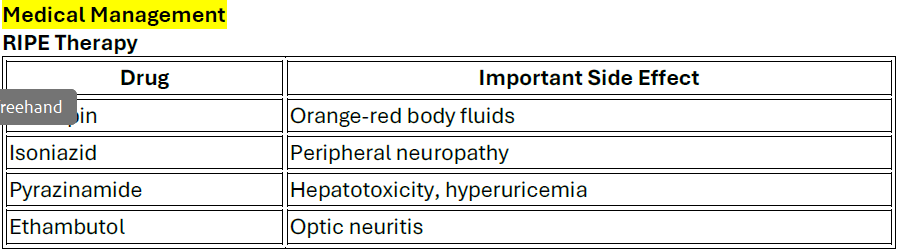
Important side effects of RIPE Therapy
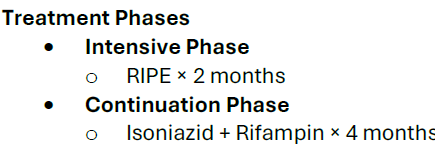
Treatment phases of RIPE Therapy
Directly Observed Therapy (DOT)
Purpose
• Ensure compliance
• Prevent resistance
• Improve cure rates
Nutrition
• High-calorie diet
• High-protein diet
• Adequate hydration
Take Vitamin B6 (Pyridoxine)
Health teaching for Isoniazid use
Expect orange-red urine, tears, and sweat
Health teaching for rifampin use
Report visual changes immediately
Health teaching for Ethambutol use
TB
Game Changer:
It is transmitted by airborne droplets, requires N95 and negative-pressure isolation, sputum culture is the gold standard, and RIPE therapy is the standard treatment regimen.
Dengue Fever
It is an acute viral infection caused by the Dengue virus, transmitted primarily by the bite of infected Aedes aegypti and Aedes albopictus mosquitoes.
It is a major public health concern in tropical countries, including the Philippines.
Dengue Virus (DENV)
Causative Agent of Dengue
Four serotypes:
DENV-1
DENV-2
DENV-3
DENV-4
Aedes aegypti mosquito
▪ Vector that bites during daytime
▪ Breeds in stagnant clean water
▪ Most active during early morning and late afternoon
Cytokines
Proteins that help control inflammation in your body. They allow your immune system to fight germs and other substances
Dengue Without Warning Signs
Dengue With Warning Signs
Severe Dengue
WHO Classification of Dengue
Dengue Without Warning Signs
Classification of Dengue
Symptoms
• Fever
• Headache
• Retro-orbital pain
• Muscle and joint pain
• Rash
• Nausea and vomiting
• Persistent vomiting
• Severe abdominal pain
• Clinical fluid accumulation
• Mucosal bleeding
• Restlessness
• Lethargy
• Hepatomegaly
• Increasing hematocrit with decreasing platelets
Warning Signs of Dengue
Severe Bleeding
Severe Plasma Leakage
• Dengue shock syndrome (DSS)
Severe Organ Involvement
• Liver failure
• Myocarditis
• Encephalopathy
Sever Dengue Manifestations (BPO)
Febrile Phase
Critical Phase
Recovery Phase
3 Phases of Dengue
Febrile Phase
Duration: 2–7 days
Manifestations
• High fever (40°C)
• Severe headache
• Retro-orbital pain
• Myalgia
• Arthralgia
• Rash
Critical Phase
Duration: 24–48 hours
• Occurs when fever starts to decrease.
Manifestations
• Plasma leakage
• Bleeding
• Shock
• Hemoconcentration
Recovery Phase
Manifestations
• Reabsorption of fluids
• Improved appetite
• Increased urine output
• Stable vital signs
Breakbone Fever
Game Changer:
Dengue
• Febrile Phase is "____" because of severe muscle and joint pain.
• Critical Phase is Most dangerous phase
CBC
NS1 antigen test
Dengue Serology
Torniquet test
Diagnostic evaluation for dengue
Plasma leakage
Game Changer:
Rising hematocrit + falling platelet count =
Fluid management
Game Changer:
___ is the cornerstone of dengue treatment.
bleeding risk
Game Changer:
For a person with dengue, Avoid
• Aspirin
• Ibuprofen
• NSAIDs
Rationale: Increased ___
Assess
Fluid Monitoring
Bleeding Precautions
Promote rest
Patient Education
Nursing management for Dengue
Avoid:
IM injections
Rectal temperatures
Aspirin-containing drugs
Use:
Soft toothbrush
Electric razor
Bleeding Precautions for Dengue
Dengue Hemorrhagic Fever (DHF)
Dengue Shock Syndrome (DSS)
Dengue complications
Dengue Hemorrhagic Fever (DHF)
• Increased vascular permeability
• Thrombocytopenia
• Hemorrhage
Dengue Shock Syndrome (DSS)
• Massive plasma leakage
• Hypovolemic shock
Signs
• Narrow Pulse Pressure: Early sign of shock
• Hypotension
• Cold Clammy Skin
• Tachycardia
Retro-orbital pain
Game Changer:
___ is a classic symptom of Dengue
Critical
Game Changer:
The ___ phase of Dengue begins when the fever subsides and is the most dangerous stage.