CH32 - Structure determination
 Call Kai
 Learn
Learn Practice Test
 Spaced Repetition
 Match
Match Flashcards
 Knowt Play
1/7

There's no tags or description
Looks like no tags are added yet.
Name | Mastery | Learn | Test | Matching | Spaced | Call with Kai | Chat |
|---|
No analytics yet
Send a link to your students to track their progress
8 Terms
How does NMR work?
A magnetic field is applied to a sample, surrounded by a source of radio waves and a radio receiver, which generates an energy change in the nuclei of atoms in the sample that can be detected. Electromagnetic energy is emitted, which can be interpreted by a computer.
The importance of C13 in NMR:
Carbon 12, does not have an electron spin, as there are an equal number of protons and neutrons the spins cancel out.
While Carbon 13 has a spin, however the chance of carbon 13 in the environment is very rare, so instruments are very sensitive.
How can shielding of electrons, effect how it absorbs energy?
Carbon with different functional groups, feel the magnetic field differently, this is because the nuclei are shielded by the electrons surrounding them.
Nuclei with more electrons around them are better shielded, so smaller the magnetic field felt by the nucleus, lower the frequency at which it resonates.
About standardising Chemical shift:
Chemical shift is measured in parts from million
TMS compound is used, as a standardised 0, so it can be used universally (as a means of calibration)
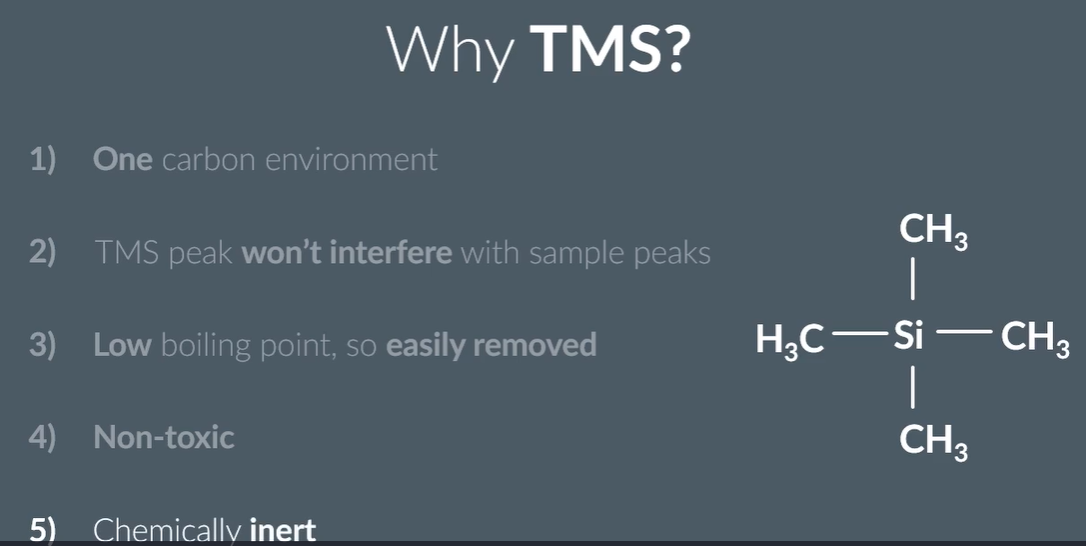
The key idea, different environments, will give chemical shift values
If carbon next to a lot of electronegative atoms, these will draw electrons away from the carbon being bonded, which deshields the carbon, feeling a greater magentic field
Why is proton NMR easier to use than carbon NMR?
Nearly all hydrogen atoms are H1 so they will have a electron spin, without there being any cancellations.
While for carbon NMR, C13 is very rarely found in environment
Key ideas behind proton NMR:
The greater the electron density around the proton, the smaller the chemical shift
The area under each peak represents the hydrogen atoms producing it.
About spin-spin splitting in proton NMR:
The hydrogens are effected by the neigbouring hydrogens, which are on the neighbouring carbon.
If there are no neighbouring hydrogens, this will form a singlet.
If there is one neighbouring hydrogen, this will form a Doublet.
This is because there are two outcomes either the hydrogen will have a spin up (towards magnetic field) or a spin down (against the magnetic field)
If there is two neighbouring hydrogens, this will form a Triplet.
n = hydrogens on the adjacent carbon atom
n + 1 = The number of peaks it will split up into
The type of solvent used for proton NMR:
The solution must not contain any protons, or else the signal from hydrogen atoms in the solution will swap out from the signals of sample
D = deuterium is used an isotope of H which does not form a signal
CCl4 => to dissolve non-polar sunstances
CDCl3 => to dissolve polar substances