Attentional Capture + Distractor Suppression
 Call Kai
 Learn
Learn Practice Test
 Spaced Repetition
 Match
Match Flashcards
 Knowt Play
1/10

There's no tags or description
Looks like no tags are added yet.
Name | Mastery | Learn | Test | Matching | Spaced | Call with Kai |
|---|
No analytics yet
Send a link to your students to track their progress
11 Terms
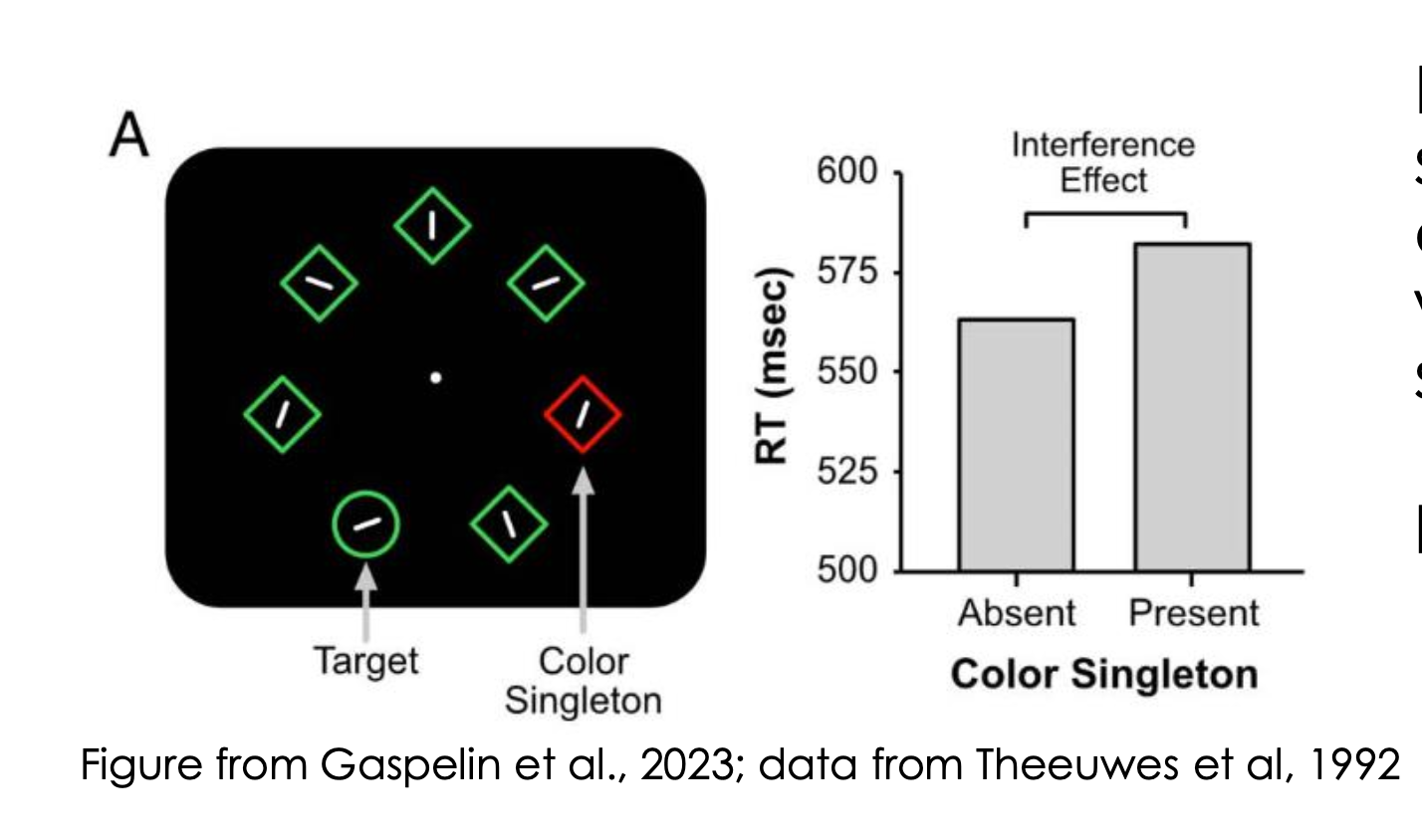
Findings on research about colour singletons and attentional capture (1) + what it suggests (1)
Reaction times for identifying line orientation are slower when there is a colour singleton present
indicating how salient stimuli capture our attention + interfere with processing
**supports that we have limited attentional resources
Significance of distractor suppression (1)
In addition to attentional selection, is important for attention to function effectively
2 inhibitory mechanisms + related ERP
Inhibition of return (IOR)
Active distractor suppression
IOR description
After attention is briefly captured by a cue, there is a short delay in our attention returning to the same location
IOR function (1)
Encourage exploration and avoid distraction by the same stimulus (don’t want to ‘waste’ limited neural resources on it, since it probably hasn’t changed)
Research findings supporting active suppression of salient distractors (2)
• People fail to see a probe that appears on a salient distractor → area is actively being suppressed, rather than just ‘not seeing it’
• People fail to look first at the salient distractor
Distractor Positivity (PD) def (1) + property (1)
A specific ERP component associated with the active suppression of salient distractors
Contralateral (brain activity on the right if distractor is on left of visual field)
Significance of emotion in relation to distraction?
Emotional stimuli are more distracting than neutral stimuli (but note that neutral stimuli can still be somewhat distracting)
Example of emotional distraction (name)
Emotion-induced blindness
Emotion-induced blindness description
Emotional distractor causes an observer to miss a subsequent target which is followed in quick succession
How biased competition model in conjunction with EEG evidence can explain emotion-induced blindness (1)
A larger N2 response to emotional distractor leads to smaller N2 response to actual target (limited resources) → poorer performance/identification of target