Bio Final
 Call Kai
 Learn
Learn Practice Test
 Spaced Repetition
 Match
Match Flashcards
 Knowt Play
1/539

There's no tags or description
Looks like no tags are added yet.
Name | Mastery | Learn | Test | Matching | Spaced | Call with Kai |
|---|
No analytics yet
Send a link to your students to track their progress
540 Terms
Who was Jean-Baptiste de Lamarck?
First scientist to propose species change over time with a mechanism
Lamarck’s two principles
Use and disuse
Inheritance of acquired characteristics
Why was Lamarck wrong?
Traits acquired during life are NOT genetically inherited
What were early beliefs about species?
Species are fixed
Designed for a purpose
Who was Charles Darwin?
Scientist who proposed natural selection
What voyage shaped Darwin’s ideas?
HMS Beagle (5-year journey)
Observations from South America
Fossils resemble living species
Marine fossils on mountains
Species match environment
Why are the Galápagos Islands important?
Unique (endemic) species
Similar to mainland species
What did finches demonstrate?
Adaptation to environment (beak differences)
What is the Tree of Life?
All organisms share a common ancestor
Define evolution
Change in allele frequency over time
Define adaptation
Trait that increases survival & reproduction
Define natural selection
Individuals with beneficial traits reproduce more
Define fitness
Reproductive success
darwin Observations
-Variation
-Overproduction of offspring
darwin Inferences
-Better traits → more survival/reproduction
-Traits accumulate over generations
What is a gene pool?
All alleles in a population
gene
dna
allele
type of gene
Define population
Same species in same area that interbreed
Community
multiple species (living)
ecosystem
living + nonliving
genetic variation
differences in DNA
evolution needs
genetic variation
3 types of variation
mutation
gene duplication
sexual reproduction
microevolution
change in allele frequency in population
Mutation
Random DNA change
Genetic drift
Random allele change
Gene flow
Movement of alleles between populations
Sexual selection
Traits increase mating success
Founder effect
Small group forms new population
Bottleneck effect
Population shrinks → variation lost
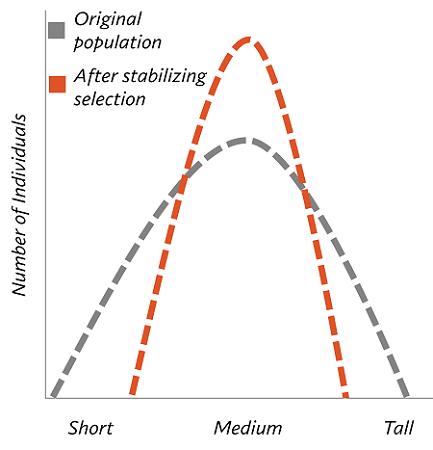
stabilizing selection
favors average
lower variation
mean constant

Directional selection
favors one extreme
mean shifts

Disruptive selection
Favors both extremes
Variation ↑
Hardy-Weinberg equation
p2+2pq+q2=1
What is 2pq?
Heterozygotes
What does p + q = 1 mean?
Total allele frequency = 100%
5 conditions for equilibrium
No mutation
No selection
Large population
No gene flow
Random mating
r-strategy traits
Many offspring
Low survival
Unstable environment
K-strategy traits
Few offspring
High parental care
Stable environment
speciation
one species splits into two
macroevolution
evolution above species level
Biological Species Concept (BSC)
interbreed and produce viable, fertile offspring
biological species concept requirement
reproductive isolation/no gene flow
Morphologicla species concept
defined by physical traits
morphological species concept used for:
fossils
asexual organisms
Lineage species concept
smallest branch on phylogenetic tree
reproductive isolation
cant interbreed
habitat isolation
species live in diff enviornments; prezygotic
temporal isolation
breed at different times; prezygotic
behavioral isolation
different mating behaviors; prezygotic
mechanical isolation
physical imcompatibility
gametic isolation
gametes cant fuse
reduced hybrid viability
hybrid doesnt form well; postzygotic
reduced hybrid fertility
hybrid sterile; post zygotic
hybrid breakdown
offspring weak; post zygotic
Biological species concept limits
fossils
asexual
hybrids
Allopatric speciation
Geographic separation
isolate
mutate
selection
reproductive isolation
Sympatric speciation
Occurs in same geographic area
polyploidy
habitat differentiation
sexual selection
polyploidy
cells contain more than two complete sets of chromosomes; reproductive imcompabibility
habitat differentiation
different resource use
sexual selection
mate preference
Adaptive radiation
Rapid formation of many species
new niches
extinction
new traits
Punctuated equilibrium
rapid evolution then stability continusly
Extinction
All members of species die
radiometric dating
Uses radioactive decay to determine absolute age
Krakatau effect
lowered temp 1.2 Celcius
crataceous extinction
asteroid impact
What caused oxygen buildup?
Photosynthetic prokaryotes
When did life first appear?
3.8 billion years ago
stromatolites
Layered rock structures formed by prokaryotes
when did eukaryotes appear
1.5 billion years ago
endosymbiont theory
chlorophylls engulfed prokaryotes → became organelles
when was multicellularity
1.3 billion years ago
what limited multicellularity
global ice age
Cambrian Explosion
535-525 Million years ago
Rapid diversification of animal phyla
dinosaurs extinct
65.5 MYBP
basal taxon
Lineage that diverged earliest
polytomy
Unresolved evolutionary relationship
clade
Common ancestor + ALL descendants
systematics
Study/classification of biodiversity
homologous trait
Trait shared due to common ancestry
homology
Similarity from shared ancestry
plesiomorphy

Ancestral trait
apomorphy
Derived trait
synapomorphy
Shared derived trait
autapomorphy
Derived trait unique to one taxon
convergent evolution

Independent evolution of similar traits
Divergent evolution
from one common ancestor diverge
analogous structures
Same function, different origin
homoplasies
Similar traits NOT from common ancestry
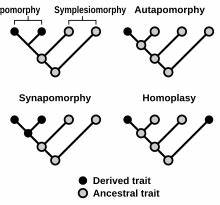
evolutionary reversal
Derived trait → ancestral trait
Paraphyletic
Missing some descendants
Principle of parsimony
Simplest explanation is most likely
Order of classification
Domain → Kingdom → Phylum → Class → Order → Family → Genus → Species
symbiosis
Close interaction between different species (“living together”)
Mutualism
+/+ both species benefit
Commensalism
+/0 one benefits, other unaffected