International economies
 Call Kai
 Learn
Learn Practice Test
 Spaced Repetition
 Match
Match Flashcards
 Knowt Play
1/120

There's no tags or description
Looks like no tags are added yet.
Name | Mastery | Learn | Test | Matching | Spaced | Call with Kai |
|---|
No analytics yet
Send a link to your students to track their progress
121 Terms
Globalisation
Refers to the increased integration between countries economically, socially and culturally
Key characteristics of globalisation
Increased trade as a proportion of GDP (world trade is growing faster than world GDP)
Increased FDI (Foreign direct investment)
Increased capital flows between countries
Increased movement of people between countries
Foreign direct investment (FDI)
When a company establishes operations (e.g opening a factory) in another country or acquires physical assets or a stake in an overseas company.
Capital flows
Refers to all the money moving between countries as a consequence of investment flows into and out of countries around the world.
Causes of globalisation
A decrease in transport costs (containerisation and economies of scale)
A decrease in the cost of communications (the internet)
A reduction in world trade barriers (tariffs etc.)
Deregulation of many financial markets resulted in the expansion of global financial services
The growth of trading blocs.
The increased importance of global companies or TNC’s (TNC’S have undertaken FDI, which involves offshoring)
Offshoring
Companies transferring manufacturing to a different country.
Impact of globalisation on individual countries
With lower trade barriers and increased trade, countries can specialise in producing goods in which they have a comparative advantage.
This results in higher world output, and therefore an increase in living standards.
However, a country which doesn’t have a competitive advantage may rely increasingly on imports, causing a deterioration of the current account in it’s balance of payments
Also higher risk of contagion
Contagion
When economic shocks spread from one country to to others due to global interconnectedness.
Stakeholders impacted by Globalisation
Individual countries
Governments
Firms
Consumers
Workers
Environment
Impact of globalisation on Governments
Tax revenues will increase, which may be used on public services such as health and education, or for infrastructure.
However some TNCs engage in a form of tax avoidance known as transfer pricing.
Impact of globalisation on producers
Firms will be producing on a larger scale, and so benefit from economies of scale, and higher profits.
Impact of economies of scale on consumers
Consumers can expect lower prices (increased consumer surplus, and greater choice)
Impact of globalisation on workers
Increased employment opportunites
However, TNC’s may exploit workers in developing countries by paying low wages for long working hours.
Impact of globalisation on the environment
There’ll be increased external costs, as increased trade means increased use of transport
Impact of international trade on prices and variety
Prices and variety would both rise
Absolute advantage
Occurs when a country is able to produce a product using fewer factors of production than another country
Comparative advantage
A theory that states a country should specialise in the goods and services that it can produce at the lowest opportunity cost
Assumptions of comparative advantage
Transport costs are zero
No account taken for the moving of goods/services between the countries. The extent of this issue depends on a countries location
There is perfect knowledge
Suggests each country knows what it has a comparative advantage in, and also the comparative advantage of other countries
Constant costs of production
The theory doesn’t take into account economies of scale that can be achieved with greater output
Assumes easy factor substitution
Assumes countries can easily switch between production factors to respond to global conditions
Constant returns to scale
When output rises in the same proportion to inputs
Limitations to the theory of comparative advantage
Over dependence
Creates a dependence on other countries which generates vulnerability
e.g european countries relying on gas from russia before the war has cost them now
Environmental damage
The impact of negative externalities of production are not considered
The theory assumes all costs of production are considered
In reality, there may be harmful society costs
Distribution of income
GDP/Capita is likely to increase but the distribution of this is likely to be given to wealthier sections of the population (bc they own more resources)
Structural unemployment
There may be a net increase in employment
But, when a country specialises, key industries shut down which leads to structural unemployment, as they may be unable to move into other occupations
Advantages of specialisation and trade
Higher living standards and employment resulting from an increase in world output
Lower prices, increased choice
economies of scale
reduction in power from domestic monopolies
Disadvantages of specialisation and trade
A trade deficit if imports value more than exports, as a result of uncomp goods
Increased unemployment as a result
Increased risk of contagion
TNCs may become global monopolies
Patterns of trade
The nature of trade between two countries and how this changes overtime
Factors influencing patterns of trade
Comparative advantage
The growth in exports of manufactured goods, especially from low wage countries to developed economies
The growth of global supply chains
The growth of trading blocs and bilateral agreements
Changes in relative exchange rates
Terms of trade formula
(index of export prices/ index of import prices) x 100
Terms of trade
Measures the price of a countries exports relative to the price of it’s imports
Factors influencing a country’s terms of trade
The country’s rate of inflation relative to other countries
The country’s productivity rate relative to other countries
Tariffs
exchange rate
The effect of an increase in a country’s terms of trade
Higher living standards- (the country can import more for a given quantity of exports)
Deterioration in the current account for its balance of payments (the goods are less competitive)
Trading blocs
Groups of countries that agree to remove or reduce the trade barriers between themselves
Examples of trade blocs
The EU
USMCA (United States, Mexico and Canada)
ASEAN (Association of South East Asian Nations)
Types of trading blocs
Free trade areas
Customs unions
Common markets
Monetary unions
Free trade areas
In these trade blocs, trade barriers are removed between members but each member can impose trade restrictions on non members
Customs union
There is free trade between countries, but they have a common external tariff to non members
Common markets
This has the same characteristics as a customs union, but it also involved the free movement of factors of production between countries
Monetary unions
These are custom unions which adapt a common currency, for example the Eurozone.
Trade diversion
When trade is diverted from a more efficient exporter to a less efficient producer
Costs of regional trade agreements
Trade Diversion (Trade will switch from a low cost producer outside the trade bloc to a high cost producer inside the bloc)
Distortion of comparative advantage, trade barriers against non members are likely to cause a decrease in specialisation and to a fall in world output.
Transition costs
These are one off costs associated with changing menus, price lists and slot machines when the new currency is introduced.
Costs of monetary unions
Transition costs
Loss of independent monetary policy (countries no longer have control over their own interest rates)
Loss of exchange rate policy (countries no longer have their own currencies
Trade creation
This occurs when trade is created as a result of the formation of a free trade agreement between a group of countries by the establishment of a trade bloc
Benefits of regional trade agreements
Trade creation (as a result of a reduction in trade barriers.)
Increase in FDI (TNC’s would have unrestricted access when selling goods to consumers within the bloc)
Increase in economic power (A larger trading bloc might be in a better position to negotiate trade agreements with other countries and trading blocs
Benefits of monetary unions
Elimination of transaction costs
Price transparency
Elimination of currency fluctuations between member countries.
Transaction costs
Costs involved in changing currencies when goods are imported or exported.
The role of the World Trade Organisation
To promote free trade
To settle disputes between member countries
Possible conflicts between regional trade agreements and the WTO
Regional trade agreements restrict trade with non-member countries, which conflicts with the aim of the WTO
Reasons for restrictions on free trade
To correct a deficit in the trade in goods and services balance
To prevent dumping
To reduce unemployment
Reduce the risk of disruption from problems faced by the global economy
To prevent sectoral imbalance
To prevent the monopoly power of global companies.
Dumping
When a country or firm sells a product in a foreign market at a price lower than it charges in its home market, or even below the cost of production
Sectoral imbalance
International specialisation of trade means that those countries with the comparative advantage will be developed.
Particular reasons developing countries may restrict trade
To protect infant industries (a developing industry that needs government protection to grow)
To limit monopsony power of firms in developed economies
Protectionism
Methods of restricting free trade
Types of protectionism
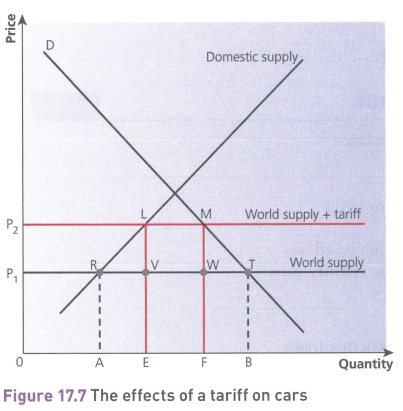
Tariffs
Quotas
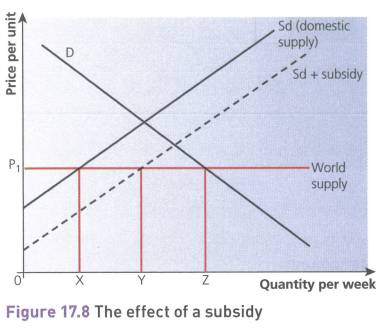
Subsidies to domestic producers
Non-tariff barriers
Tariffs
Taxes on imported goods
Quotas
Limits on the physical quantity of a product which may be imported
Subsidies to domestic producers
Grants given by the government to domestic firms
Non-tariff barriers
Health and safety regulations
Environmental regulations
Labelling of products
Bureaucracy (e.g require importers to complete forms)
All these may raise the cost of imports and/or deter importers from importing to the country.
The impact of protectionist policies on consumers
Tariffs and quotas result in higher prices, and a reduction in both consumer surplus and consumer choice.
The impact of protectionist policies on producers
They face less competition and have less incentive to produce at lowest average cost. Further, they may cause retaliation by other countries which might impose protectionist measures.
The impact of protectionist policies on Governments
The government would receive tax revenue
The impact of protectionist policies on living standards
Specialisation is reduced, lower output
The balance of payments
A record of all financial transactions between one country and those in the rest of the world.
Components of balance of payments accounts
The current account
The financial and capital account
The current account of balance of payments
Shows a country’s day to day transactions with other countries
The capital and financial accounts
Shows long term investments and short term capital flows
Elements of the current account
Trade in goods balance
Trade in services balance
Investment income (now called primary balance)
Current transfers (now called secondary balance)
Trade in goods balance
The value of goods exported - The value of goods imported
If the result is negative, then it’s a current account deficit and vice versa
Trade in services balance
The value of services exported - The value of services imported
If the result is negative, then it’s a current account deficit and vice versa
Investment income (primary balance)
Income earned from assets overseas - income paid to foreigners for assets owned in the UK
If the result is negative, then it’s a current account deficit and vice versa
Current transfers (Secondary balance)
Payments received from foreign institutions (e.g the EU) - Payments given abroad (e.g to the EU or aid to foreign countries)
If the result is negative, then it’s a current account deficit and vice versa
Current account deficit
When more money is flowing out the country than it is flowing in
Current account surplus
When more money is flowing into the country than it is flowing out
Elements of the capital and financial account
Foreign direct investment
Portfolio investments in shares and bonds
Short-term capital flows
Changes in foreign currency reserves.
Foreign direct investment
Investment by foreign companies into the UK - investment by UK companies abroad
Portfolio investment in shares and bonds
Purchase of UK shares and bonds by foreigners minus purchase of foreign shares and bonds by UK citizens
Short term capital flows
Often referred to as hot money flows
Hot money flows into the UK minus flows out of the UK into other countries
Hot money
Money that moves between countries for short periods of time, usually less than a year
The balance of payments and ‘balancing’
Since the balance of payments is a set of accounts, it needs to balance.
For example, If there is a current account deficit, there needs to be a financial and capital account surplus.
Causes of deficits in the current account
Relatively low productivity
The relocation of many manufacturing industries from developed countries where labour costs are significantly lower, such as China.
An increase in the country’s exchange rates against that of other countries
Continuous economic growth, resulting in an increase in imports.
A cause of a surplus is the opposite of above.
Measures to reduce a country’s imbalance of the current account
Expenditure reducing policies
Expenditure switching policies
Devaluation/depreciation
Supply side policies
Expenditure reducing policies
Polices designed to reduce AD, e.g deflationary fiscal and monetary policy.
Expenditure switching polices
Policies designed to alter the pattern of a country’s expenditure between domestic and imported goods and services.
Supply-side policies
Often viewed as the most effective way of reducing current account deficits.
These could include
Cut in corporation tax
Improved infrastructure
Provision of superfast broadband
Training and education
Reduction in regulation and red tape
Reduction in employers national insurance contributions
Improved/ subsidised childcare provision
A current account surplus could be reduced by reversing the above measures
Global trade imbalances
Occur when some countries have large current account deficits and others have large current account surpluses
Why a persistent current account deficit is undesirable
It indicates that the country’s goods and services are uncompetitive.
In turn, it may result in an increasing rate of unemployment.
In a system of floating exchange rates, It could result in the depreciation of the exchange rate.
Why a current account deficit may not be seen as a major problem
It’s caused by imports of capital goods
It’s only a short run problem
It can be financed easily if there’s inflows into the financial account.
Why a persistent current account surplus may be undesirable
It could result in inflation, since AD is rising
It may imply that living standards are falling, since there are fewer goods and services available for domestic consumption
It could cause an appreciation in the value of the country’s currency.
It might cause other countries to impose restrictions on imports.
Exchange rates
The rate at which one currency exchanges for another
Trade weighted index
When one currency is measured against a basket of other currencies, with each other currency weighted on it’s share of a country’s trade.
Exchange rate systems
Floating
Fixed
Managed
Floating exchange rate
Under this system, the exchange rate is determined by market forces, i.e supply and demand.
Fixed exchange rate
When the country’s currency is fixed against those of other currencies.
Managed exchange rate
This is essentially a floating exchange rate, but one which the central bank is subject to intervene with in order to influence the exchange rate of a country’s currency.
Revaluation
When a country decides to increase the exchange rate of its currency under a system of fixed exchange rates
Appreciation
An increase in the exchange rate of a country’s currency under a system of floating exchange rates
Devaluation
When a country decides to decrease the exchange rate of it’s currency under a system of a fixed exchange rate.
Depreciation
A decrease in the exchange rate of a country’s currency in the system of a floating exchange rate.
Factors influencing a floating exchange rate
Relative interest rates
Relative inflation
Speculation
Current account balance
FDI
Relative inflation’s influence on exc rate
If a country has a higher inflation rate than it’s competitors, then it’s purchasing power will fall, and in the long term, the value will fall.
This may be explained in terms of PPP
Current account balance’s influence on exc rates
The supply of a country’s money increasing relative to the demand for it, results in a depreciation in it’s currency.
Foreign direct investment
A country which is a net recipient of FDI, will see increased demand for it’s currency, so the value of it increases.
Speculation
This arises for a number of reasons, e.g the expected state of the economy. Greater pessimism about the future state of the economy will cause the country’s exchange rate to appreciate.