AP Psychology - Motivation & Emotion
 Call Kai
 Learn
Learn Practice Test
 Spaced Repetition
 Match
Match Flashcards
 Knowt Play
1/53

There's no tags or description
Looks like no tags are added yet.
Name | Mastery | Learn | Test | Matching | Spaced | Call with Kai |
|---|
No analytics yet
Send a link to your students to track their progress
54 Terms
motivation
a need or desire that energizes and directs behavior
extrinsic motivation
type of motivation in which a person performs an action because it leads to an outcome that is separate from or external to the person.
intrinsic motivation
type of motivation in which a person performs an action because the act itself is rewarding or satisfying in some internal manner.
instincts
the biologically determined and innate patterns of behavior that exist in both people and animals.
need
a requirement of some material (such as food or water) that is essential for survival of the organism
drive
a psychological tension and physical arousal arising when there is a need that motivates the organism to act in order to fulfill the need and reduce the tension (ex: thirst)
drive-reduction theory
approach to motivation that assumes behavior arises from physiological needs that cause internal drives to push the organism to satisfy the need and reduce tension and arousal. Maintain homeostasis.
primary drives
those drives that involve needs of the body such as hunger and thirst
acquired (secondary) drives
those drives that are learned through experience or conditioning, such as the need for money or social approval
homeostasis
process by which organisms maintain a relatively stable internal environment
stimulus motive
a motive that appears to be unlearned but causes an increase in stimulation, such as curiosity
arousal theory
theory of motivation in which people are said to have an optimal (best or ideal) level of tension that they seek to maintain by increasing or decreasing stimulation
Yerkes-Dodson law
law stating performance is related to arousal; moderate levels or arousal lead to better performance than do levels of arousal that are too low or too high. This effect varies with the difficulty of the task: Easy tasks require a high-moderate level whereas more difficult tasks require a low-moderate level
incentives
things that attract or lure people into action, a pull.
self-actualization
according to Maslow, the point that is seldom reached at which people have sufficiently satisfied the lower needs and achieved their full human potential
weight set point
the particular level of weight the body tries to maintain
basal metabolic rate (BMR)
the rate at which the body burns energy when the organism is resting
leptin
a hormone that signals the hypothalamus that the body has had enough food, secreted by fat cells - reduces the appetite while increasing the feeling of being full.
emotion
the "feeling" aspect of consciousness, characterized by a certain physical arousal, a certain behavior that reveals the emotion to the outside world, and an inner awareness of feelings
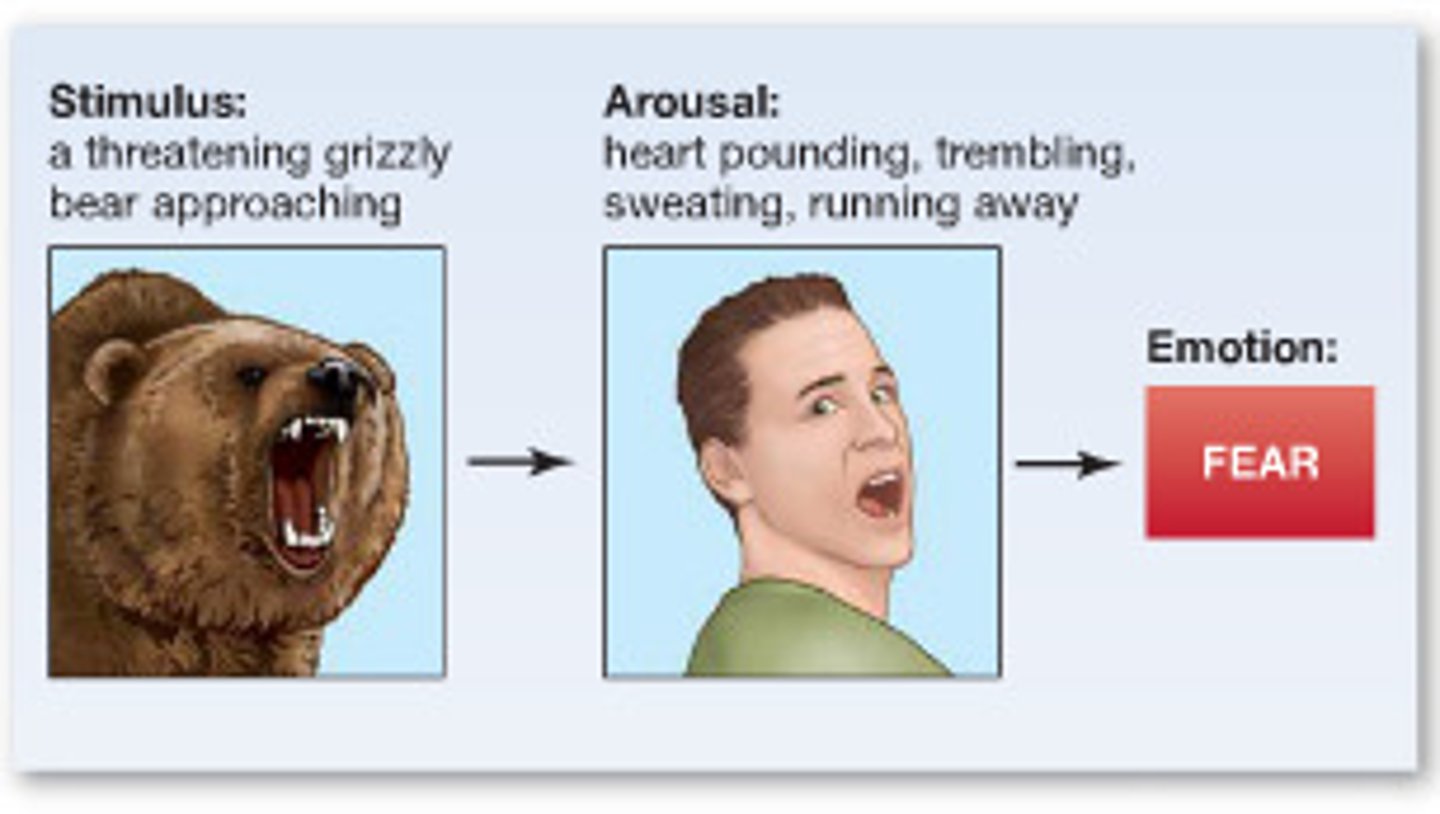
James-Lange theory of emotion
theory in which a physiological reaction leads to the labeling of an emotion. I am afraid because I am shaking
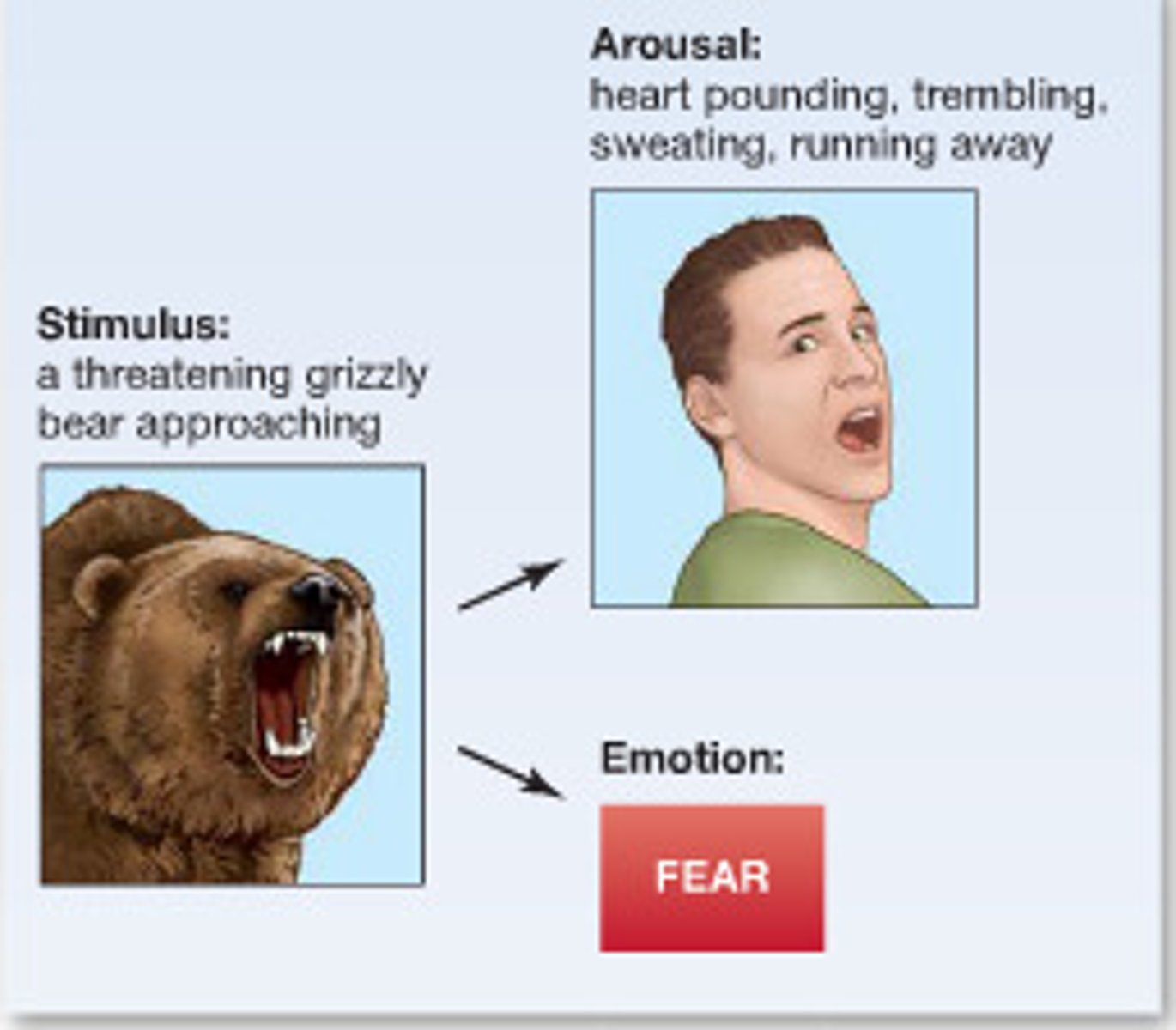
Cannon-Bard theory of emotion
theory in which the physiological reaction and the emotion are assumed to occur at the same time. I am shaking and afraid at the same time
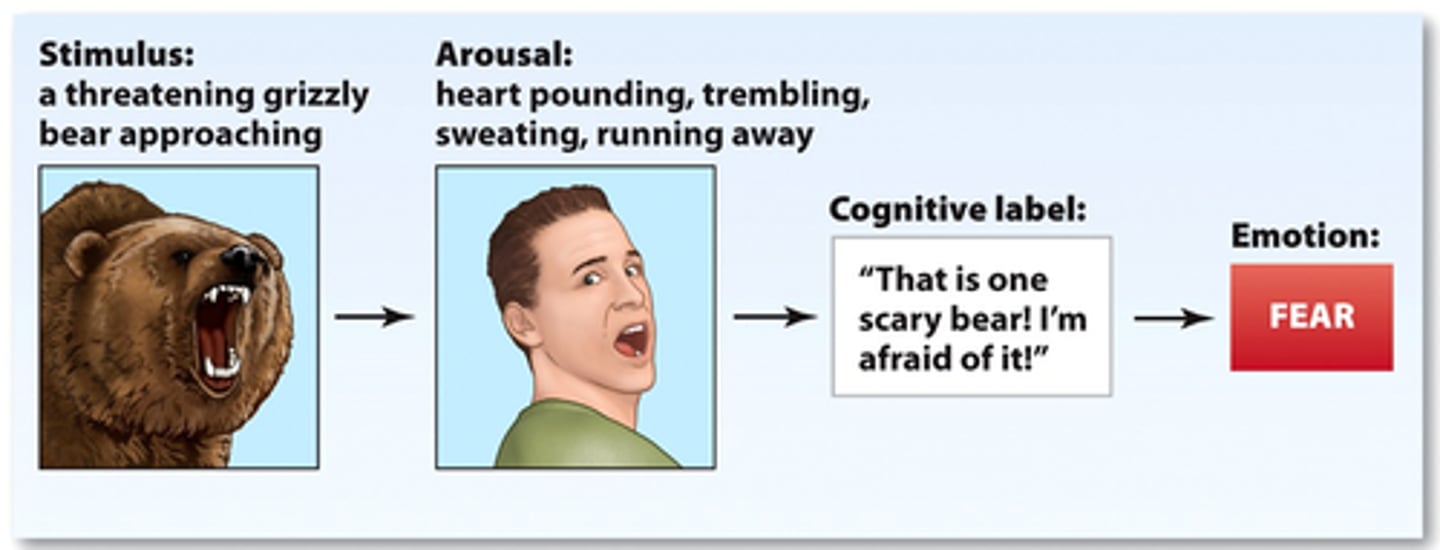
Schachter's cognitive arousal theory/
Singer and Schachter's Two Factor
theory of emotion in which both the physical arousal and the COGNITIVE LABEL of that arousal based on cues from the environment must occur before the emotion is experienced
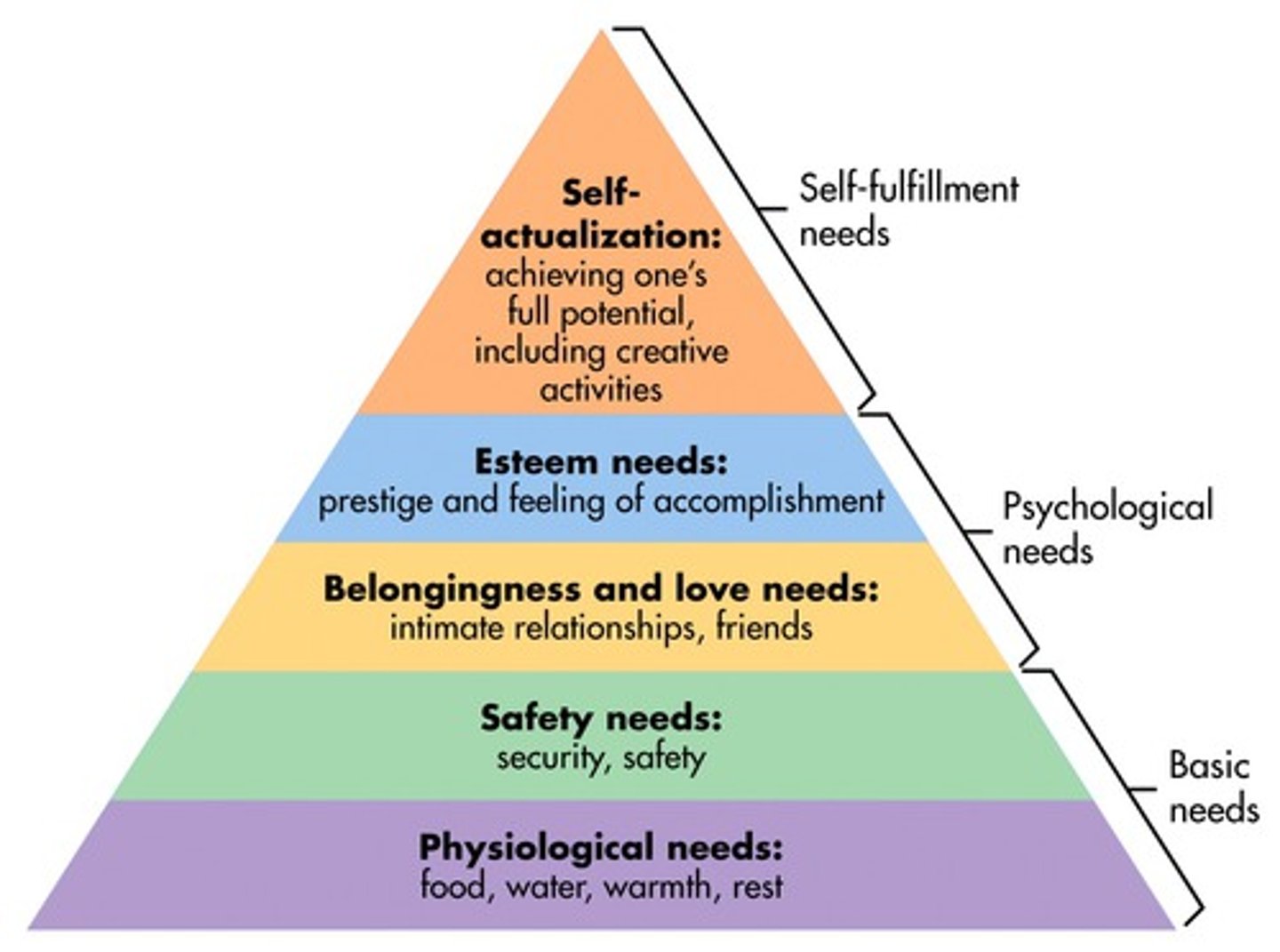
Maslow's Hierarchy of Needs
Humanist theory of motivation that says we must first fulfill lower level needs before achieving personal fulfillment and self actualization
Physiological-Safety-Belongingness and Love-Esteem-Cognitive-Self Actualization
hypothalamus
several maintenance activities (eating, drinking, body temperature), helps govern the endocrine system via the pituitary gland, and is linked to emotion and reward.
Achievement motivation
a desire for significant accomplishment: for mastery of things, people, or ideas; for attaining a high standard
Adaptation-Level Phenomenon
our tendency to form judgments (of sounds, of lights, of income) relative to a neutral level defined by our prior experience
Catharsis
emotional release. ie. "releasing" aggressive energy (through action or fantasy) relieves aggressive urges.
Glucose
A simple sugar that is an important source of energy.
Polygraph
a machine, commonly used in attempts to detect lies, that measures several of the physiological responses accompanying emotion
Ekman
Changes in facial expression brings about emotion like changes in the body
Izard
Believes the infants can express several basic emotions as early as 10 weeks of age
self-transcendence
according to Maslow, the striving for identity, meaning, and purpose beyond the self
self-concept
all our thoughts and feelings about ourselves, in answer to the question, "Who am I?"
ideal self
one's perception of whom one should be or would like to be
self-image
the characteristics that a person sees in himself or herself (inner self)
self esteem
one's feelings of high or low self-worth
love and belonging needs
A person's need to have affectionate relationships with people and to have a place in a group. Middle of Maslow.
Physiological Needs (Maslow)
the lowest level of Maslow's hierarchy - needs for food, water, air, sleep, and other survival needs
Ostracism
deliberate social exclusion of individuals or groups.
Motivational Conflict Theory
balance motivations that are approach-approach, avoidance-avoidance, approach-avoidance, multiple approach/avoidances
boredom susceptibility
An aversion to repetitive experiences, routine work, and predictable people, and a reaction of restless discontent when exposed to such situations
Ghrelin
A hunger-arousing hormone secreted by an empty stomach
affect
Appearance of observable emotions
spillover effect
when one emotion continues from one situation to another; more happy about getting job after running as opposed to just waking up
Opponent Process Theory of Emotion
Emotional events elicit two competing
processes:
- The primary- or A-process that is immediately elicited by the event
• e.g., taking an exam elicits an unpleasant Astate
- An opponent- or B-process that is the opposite of the A-process and counteracts it
• e.g., the pain during the exam (A-state) creates a pleasant relief response (B-state) following the exam
Lazarus theory of emotion
The theory that a cognitive appraisal is the first step in an emotional response and all other aspects of an emotion, including physiological arousal, depend on it.
Zajonc; LeDoux Theory
some embodied responses happen instantly, without conscious appraisal
facial feedback hypothesis
emotional expressions can cause the emotional experiences they signify
behavior feedback effect
the tendency of behavior to influence our own and others' thoughts, feelings, and actions
display rules for emotion
cultural rules specifying what emotions should and should not be expressed under what circumstances
Elicitors of Emotion
Internal and external events that trigger biological changes that are the basis of emotions
Sensation-Seeking Theory
A theory that proposes that one's level of need for varied or novel experiences is the basis of motivation
Adventure Seeking (exploration)
The anxiety of doing something new makes me feel excited and alive.
When I have free time, I want to do things that are a little scary.
I prefer friends who are excitingly unpredictable.
self-determination theory
Deci and Ryan's theory asserting that all humans have three basic, innate organismic needs: competence, relatedness, and autonomy.