Cavities, Organization, and tissue
 Call Kai
 Learn
Learn Practice Test
 Spaced Repetition
 Match
Match Flashcards
 Knowt Play
1/26

There's no tags or description
Looks like no tags are added yet.
Name | Mastery | Learn | Test | Matching | Spaced | Call with Kai |
|---|
No analytics yet
Send a link to your students to track their progress
27 Terms
What are the 5 levels of organization?
Cells, tissues, organs, systems, organism
Body Cavities
Fluid filled spaces that suspend and protect organs
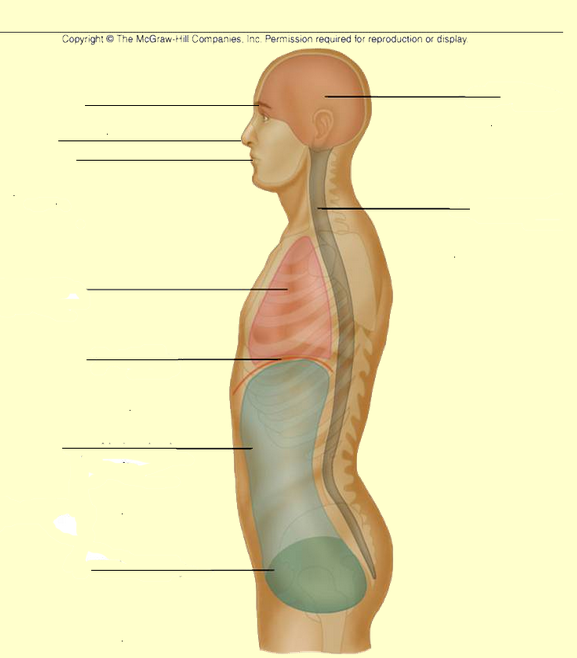
Name the cavities in numerical order (where lines point to). 1-6 are at ventral and go from anterior to posterior, same for 7-8 and are at dorsal. (NOTE: the line pointing to the red line between the red and blue area isn’t a cavity but is still supposed to be listed)
Ocular, nasal, oral, thoracic, diaphragm, abdominal, pelvic, cranial, spinal.
What organs are in the abdominal cavity?
Liver, spleen, stomach, gall bladder, small intstine.
What organs are in the cranial cavity
brain
What organs are in the pelvic cavity
Urinary bladder, urterus, urethra, rectum, anal cavity, reproductive organs
What organs are in the spinal cavity?
Spinal cord
What organs are in the thoracic cavity?
Lungs, trachea, thymus gland, heart
What are the functions of cell junctions
to connect the cells of animal tissues to one another
What are the 4 types of body tissues
Epithelial, connective, muscle, nervous
What is extracellular fluid and what are its functions?
Body fluid that isn’t inside cells. Serves as the body’s internal environment that provides substance for survival and carries cellular waste away.
Epithelial Tissue (what it is and examples)
Sheetlike animal tissue: covers outer body surface and lines internal tubes and cavities. Includes skin, hair, nails
Simple epithelial tissue vs stratified?
Simple is singularly layered, stratified is multilayered.
Difference between exocrine and endocrine glands?
Exocrine glands use ducts and tubes to transport secretions. Endocrines glands are hormones and use secretions that are transported in blood (digestive enzymes, earwax, breast milk)
Why are skin and lung cancers some of the most common types of cancers in animals?
Epithelial cells are constantly being replaced and repaired. More cell divisions = higher chance of cancer
What is loose connective tissue?
Most abundant in vertebrates. Underlies most epithelial, surround nerves and blood vessels. Holds abdominal organs in place and stores fluid.
What is dense irregular connective tissue?
Makes up deep skin layers, underlies the lining of the gut, and forms a protective capsule around the kidneys and testes.
What is dense regular connective tissue?
Main tissue in ligaments and tendons. (ligaments connect bone to bone, tendon is skeletal muscle to bone)
What is adipose tissue? (connective tissue)
Main energy reservoir (fatty acids) and cushions or protects body parts. Insulation (blubber retains heat in marine animals)
What is cartilage? (connective tissue)
This and bone are the main components of vertebrate skeletal systems. Supports the nose, throat, outer ears. Covers bones and reduces friction. Shock absorbers or between segments of backbone.
What is bone tissue? (connective tissue)
Connective tissue; bone cells secrete and surrounded by a collagen-rich matrix (calcium and phosphorus). Main tissue of bone
What is blood tissue? (connective tissue)
Circulatory fluid. In vertebrates, fluid connective tissue. Consists of plasma red and white blood cells, and platelets.
What are skeletal muscles? Voluntary or involuntary? (muscle tissue)
Voluntary. reflex activated long multinucleated cylindrical cells with striations. Primary tissue for movement (attached to bones via tendons). Protect internal organs, support joint stability, generate heat when you shiver.
What are cardiac muscles? Voluntary or involuntary? (muscle tissue)
Involuntary. Striated and exclusively found on the heart’s wall. Responsibly for pumping blood.
What are smooth muscles? Voluntary or involuntary? (muscle tissue)
Involuntary. Cells with single nucleus, tapered ends, no striations. In walls of arteries, digestive tract, reproductive tract, bladder, and other organs. Contracts.
What are neurons?
One of the cells that make up communication lines of a nervous system, transmitting signals across the brain, spinal cord, and rest of the body.
What are neuroglia?
Act as supportive framework for the nervous system. Surround, protect, nourish, and insulate neurons.