Unit 3 - Evolution
 Call Kai
 Learn
Learn Practice Test
 Spaced Repetition
 Match
Match Flashcards
 Knowt Play
1/91

Name | Mastery | Learn | Test | Matching | Spaced | Call with Kai | Chat |
|---|
No analytics yet
Send a link to your students to track their progress
92 Terms
Abiogenesis
The idea that life evolved naturally from nonliving matter
Spontaneous Generation
An early theory that things could just spawn into existence
Omne vinem ex vivo
An early theory of the origin of life, “Life only comes from life”
Warm little pond
An idea that there was a place where all necessary conditions for protein synthesis were found. Proposed by Darwin
Primordial soup
A place where molecules react with each other until complex molecules are produced. Proposed by Alexander Oparin
Miller Urey Experiment
A model of the water cycle under early earth conditions. The experiment showed synthesis of complex molecules like amino acids in just a week
Panspermia
The idea that life exists all throughout the universe and life on Earth was started by spores on asteroids
Directed panspermia
The idea that spores were brought to Earth by intelligent life 👽
RNA world hypothesis
The idea that life began with a single RNA molecule that could replicate itself on its own (RNA molecules can pretty much do that). At some point, spontaneous polymerization occured and ribonuclease and ribozymes were formed
Ribozymes
a folded chain of RNA capable of guiding a chemical reaction. Can even synthesize nucleotides
Evolution
A heritable change in the characteristics of a population throughout generations
Erasmus Darwin
Darwin’s father who wrote a book called “Zoonomia” which discussed how species could “transmute” (change) into other species
HMS Beagle
The ship on which travelled the world
Fossil
A preserve of the remains of a dead organism
On the Origin of Species by Means of Natural Selection
Darwin’s first book, published in 1859
The Descent of Man
Darwin’s second book, published in 1871
Adaptations
Characteristics that make it easier for an organism to survive and produce healthy offspring in a certain environment
Descent with modification
All organisms descended from a common ancestor and changed over time
Survival of the fittest
Natural selection favors the “fittest”, meaning the ones that can best reproduce and survive (not necessarily related to strength)
M. VIDA
The steps of natural selection, stands for Mutation, Variation, Inheritance, Differential survival and reproduction
*Mutation - a random genetic mistake that can be inherited. Most of the time, it has no effect, yet might lead to a new trait
Variation - the fact that inhabitants of a population differ in traits due to differences in genotype (e.g. all humans look different)
Georges Cuvier
Studied paleontology and fossils. Collected evidence that some organisms had gone extinct
Charles Lyell
Principle of uniformitanism. Argued that geological forces are constant and the same ones that were active millions of years ago are still active today.
James Hutton & Charles Lyell
They hypothesized that earth is very old, as geological forces act very slowly
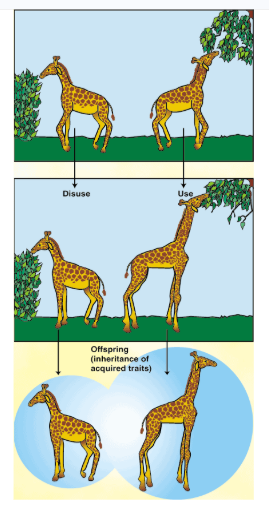
Jean-Baptiste Lamarck
Theory of acquired characteristics - organisms acquire certain traits during their lifetime and then pass them onto their offspring - NOT TRUE!!!!!!
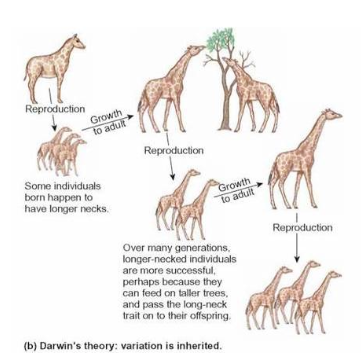
Differential survival and reproduction
Some individuals that are born with a certain trait are more likely to survival in a certain environment and thus pass them forward to their offspring
Thomas Malthus
An economist who published a book saying that humans were born faster than they were dying and there would not be enough food for everyone at some point
Selective breeding
A method of artificial selection that allows only organisms with certain characteristics to survive
Artificial selection
Humans selecting organisms with beneficial traits and breeding them
Struggle for existence
Members of a population compete for resources. This competition influences which traits survive in an organism
Carbon dating
A way to tell how old a fossil is. Basically, organisms have two kinds of carbon atoms - Carbon-12 and Carbon 14. As carbon-14 is unstable, though, after an organism dies those atoms begin decaying. Scientists can tell how old a fossil is by the amount of carbon-14 left
Microevolution
Small changed within a single population over a short period of time, observable (e.g. antibiotic resistance)
Macroevolution
May concern multiple species, large-scale change over a long period of time, a cumultaive of many small changes, not observable directly (e.g species evolving)
Industrial melanism
Pollution or industrialization causes a change in environment, which leads to different traits becoming beneficial and, therefore, surviving. (e.g. a lake becomes darker due to pollution, which makes it easier for darker bugs to not be seen and they survive better)
The five evolution mechanisms/factors
Genetic drift, non-random mating/sexual selection, mutation, gene flow/migration, natural selection
Mutation
Caused by a mutagen or a random mistake during meiosis
Gene Flow
Organisms relocate and take their allele frequencies with them
Genetic Drift
A random event causes a change in allele frequency
Founder effect
A population moves away and colonizes a new area
Bottleneck effect
A disaster occurs, killing off a huge part of a certain population
Non-random mating
The individuals pick their own partner
Random mating
individuals don’t show a preference for partners
Cladogram/Phylogenetic Tree
A diagram that represents the evolution and ancestry of species
Homologous parts
Body parts with similar structure but different function. Come from a common ancestor
Analogous parts
Body parts that have similar function but different structure, no common ancestor
Vestegial
Body parts that once had a function but have become useless with evolution
Comparative Physiology
Predicting ancestry through function of body parts
Comparative Anatomy
Predicting ancestry through structure of body parts
Comparative Embryology
predicting ancestry through the way an embryo forms
Guide fossil
A widespread fossil that can be used as a time marker for specimens around it
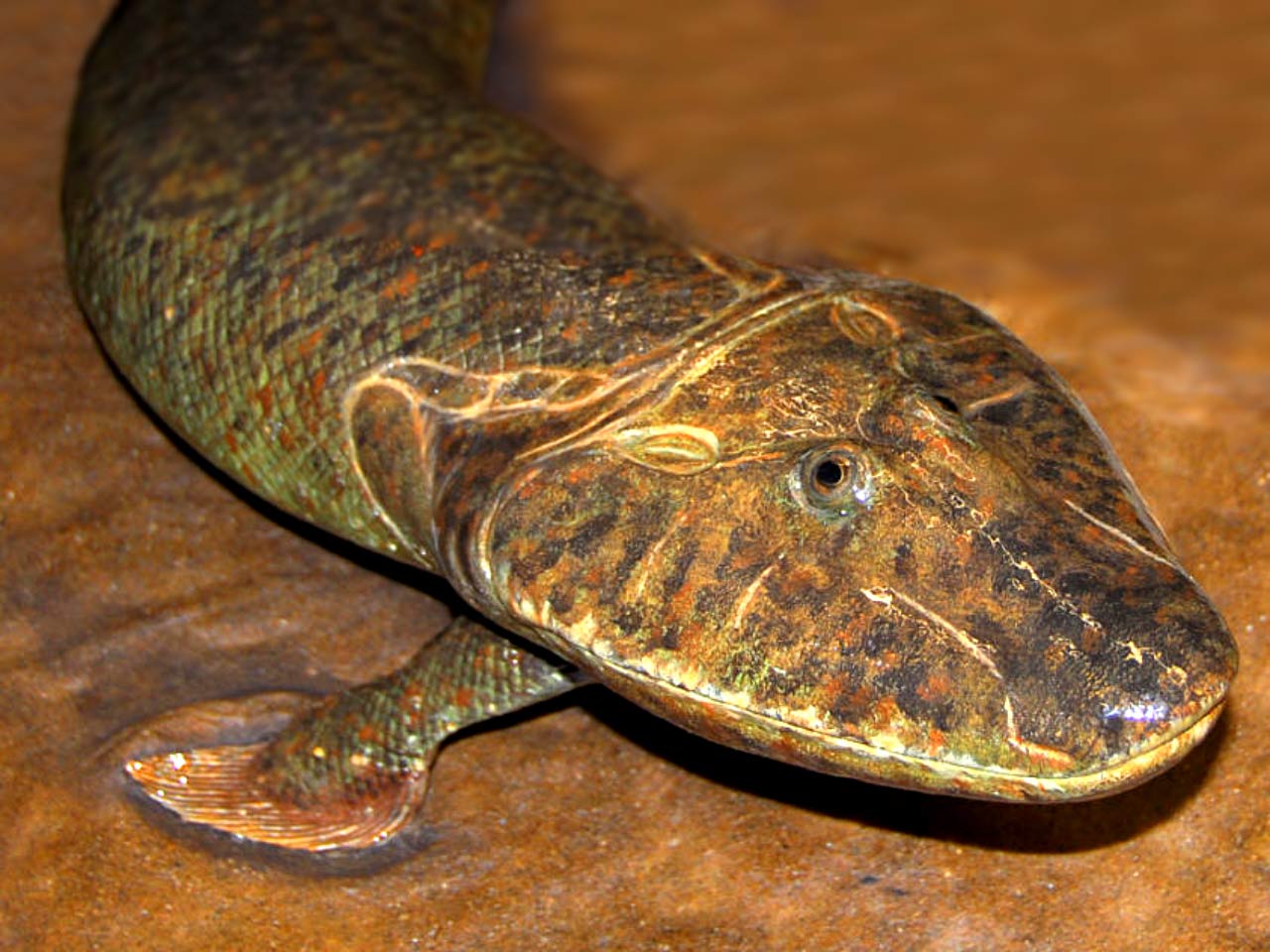
Transitional fossil
A fossil that shows the link between two species. E.g. tiktaalik, which shows both fish and amphibian features (and is soooo cute)
Extinction
Elimination of a species from Earth
Mass extinction
When lots of species go extinct globally ==> prompt new evolution surges
Divergent evolution
One species evolves into different traits, results in homologous structures
Convergent evolution
Unrelated species form similar traits, results in analogous structures
Parallel evolution
Independent evolution of similar traits in related species (e.g. similar body shape of most mammals)
Adaptive radiation
The rapid diversification of a species, often as a result of occupying new territories (radiation sounds like rapid!!)
Coevolution
When an interaction between two species influences their evolution
Mutualistic coevolution
Coevolution that is beneficial for both species (e.g. flowers and bees)
Antagonistic/competetive coevolution
Evolution between predator and prey, parasite and host, ect.
Gradualism
When evolution occurs gradually over a long period of time through an accumulation of small changes
Punctuated equilibrium
When long periods with no change are interrupted by sudden rapid change
Selection pressures
Environmental factors that influence natural selection
Directional selection
When one extreme phenotype is favored over all other (e.g. very tall giraffes, very small bugs)
Disruptive/diversifying selection
When both extremes of a certain phenotype are favored over intermediates (e.g. both black AND white moths are favored, but not grey ones)
Stabilizing selection
When intermediate phenotypes are favored over extremes (e.g. grey moths are favored over black or white ones) ! can lead to the loss of the phenotype over time !
Opsins
Proteins in the eyes that distinguish color. Monkeys have two, while humans have three. As the most recently evolved human opsin gene is right next to the one for another opsin, it is believed that the gene was duplicated and then acquired mutations which made it code for a different protein.
Hominidae
The human family
Genus Homo
The human genus. Present with increased brain size and show signs of intelligence like tool use
Sapiens
The human species
Hominid
All of the great apes
Hominin
Any hominid that was bipedal (could walk on two legs)
Characteristics of apes
Excellent vision, 360 degree shoulder movement, 5 fingers with nails, upright posture, few offspring, complex social groups, large brains
When did the common ancestor of chimpanzees and humans live?
7 million years ago
Sahelanthropus
6-7 mya. Debatable whether or not this was a hominin. Their foramen Magnum is located forward, which suggests they walked upright - probably the first bipedal apes! Knowing their environment, they were likely vegetarian. Very small brains
Genus Australopithecus
(4.5 - 2 mya) They had small brains - bipedalism evolved before brains. They were also good at climbing and were most likely vegetarian. (Lucy!)
Ardipithecus
Lived 4.5-2 mya. It has some characteristics of humans, who could walk on two legs, as well as some characteristics of chimpanzees who walk on four legs, and can climb really well. The fact that they present with both characteristics suggests they could not walk on two legs as well as we can.
Homo Habilis
(2.4 - 1.5 mya) “Habilis” means handy. They created simple tools and probably had an omnivorous diet, as their teeth suggest they ate tougher food.
Homo Erectus
(1.8 million - 200,000 ya, longest surviving) “Upright man”. They were the first to migrate out of Africa and spread towards Europe and Asia. They used more complex tools like spears, axes, ect. They used fire, which meant that they could consume more meat. Homo erectus underwent adaptive radiation as they had to adapt to the different environments of eurasia
Homo Neanderthalis
(400,000 - 40 000 ya) Humans’ closest extinct relative. Their diet was about 80% meat and their brains were very large. They created things such as jewelry, cave art, and even had their own language. Their nose was broad, in order for them to be able to humidify the air. They were short & stocky
Hypotheses for extinction of neanderthals
They interbred with Homo sapiens
Climate change
Outcompeted by Homo sapiens
Homo Sapiens
(~300,000 ya) Us : ) Created agriculture and were able to settle down and had more time for innovation, which leads us to today
Homo Floresiensis
Went extinct 17,000 ya. Lived in Indonesia; a result of the adaptive radiation of Homo Erectus (the other result is Homo neanderthalis). They were very short and were adapted to island living
Anthropology
The study of human growth and evolution (anthropogenesis)
Race
A social construct, not a biological concept. It is based on common characteristics between people like skin color and appearance, and varies among different cultures and people.
Autosomal DNA tests
Ancestry tests that only go back 5-7 generations, or 200 years
Mitochondrial DNA tests
Ancestry tests that show mitochondrial DNA, which is only inherited from our mothers. Usually goes back over 10,000 years, it has gone back 200,000.
Ancestry
Determined by genetic mutations, geographical isolation, genetic drift, ect.
Melanin
A pigment that gives your skin its color and protects it from UV rates. Created by cells called melanocytes and stored in vesicles of the skin cells called melanosomes
Melanomas/skin cancers
Cancers that develop from melanocytes
Where was the first genus Homo fossil discovered?
Central & East Africa (Today’s Ethiopia)
Homo Heidelbergensis
The first to use fire, lived at the same time as Homo Erectus and Homo Neanderthalis
General order of hominin evolution
Sahelanthropus - Ardipithecus - Australopithecus - Homo habilis - Homo erectus - Homo Neanderthalis - Homo sapiens