Unit 3: Cellular energetics
 Call Kai
 Learn
Learn Practice Test
 Spaced Repetition
 Match
Match Flashcards
 Knowt Play
1/34

There's no tags or description
Looks like no tags are added yet.
Name | Mastery | Learn | Test | Matching | Spaced | Call with Kai |
|---|
No analytics yet
Send a link to your students to track their progress
35 Terms
Activation Energy
This initial energy input, which is later paid back as the reaction proceeds
Transition State
To get the bonds into a state that allows them to break, the molecule must be contorted (deformed, or bent) into an unstable state(this is what it is, a unstable state)
Catalysis
The process of speeding up a reaction by reducing its activation energy
Catalyst
the factor that's added to lower the activation energy
Enzyme
Biological catalysts, proteins that catalyzed particular chemical reactions
Enzymes are usually proteins, though some ribonucleic acid (RNA) molecules act as enzymes too.
Substrate
To catalyze a reaction, an enzyme will grab on (bind) to one or more reactant molecules.
Active Site
The part of the enzyme where the substrate binds
Induced Fit
an enzyme changes shape slightly when it binds its substrate, resulting in an even tighter fit. This adjustment of the enzyme to snugly fit the substrate is called this
When an enzyme binds to a substrate….
the activation energy lowers, so the reaction speeds up
Regulatory molecules
Enzyme activity may be turned "up" or "down" by activator and inhibitor molecules that bind specifically to the enzyme.
Cofactors
Many enzymes are only active when bound to non-protein helper molecules known as cofactors.
Compartmentalization
Storing enzymes in specific compartments can keep them from doing damage or provide the right conditions for activity, enzymes needed for specific processes can be kept in the places where they act, ensuring they can find their substrates readily, don't damage the cell, and have the right microenvironment to work well.
Feedback inhibition
Key metabolic enzymes are often inhibited by the end product of the pathway they control (feedback inhibition)
Activators
Molecules that increase the activity of an enzyme
Inhibitors
Molecules that decrease the activity of an enzyme
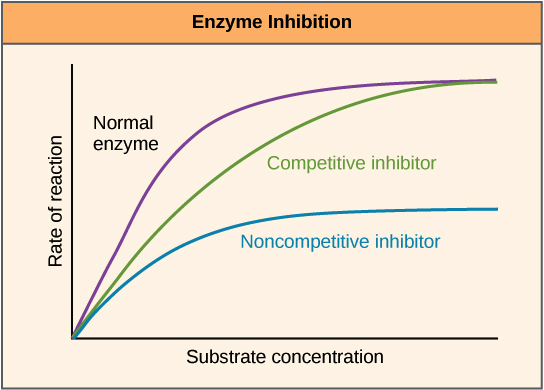
Non-competitive Inhibitor
the inhibitor doesn't block the substrate from binding to the active site. Instead, it attaches at another site and blocks the enzyme from doing its job. This inhibition is said to be "noncompetitive" because the inhibitor and substrate can both be bound at the same time.
Competitive Inhibitor
Binding to an enzyme and block binding of the substrate, for example, by attaching to the active site.
Noncompetitive rate of reaction vs. Competitive rate of reaction vs. normal enzyme
Allosteric regulation
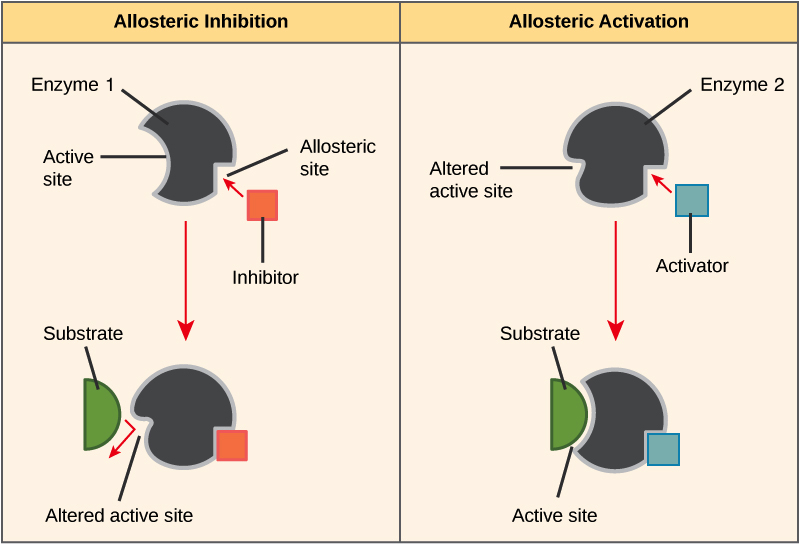
any form of regulation where the regulatory molecule (an activator or inhibitor) binds to an enzyme someplace other than the active site
Allosteric Site
The place where the regulator binds
Allosteric Activation vs. Allosteric Inhibitation
Cooperitivity
the substrate itself can serve as an allosteric activator: when it binds to one active site, the activity of the other active sites goes up
Cofactors
non-protein helper molecules
like iron and magnesium
Coenzymes
subset of cofactors that are organic (carbon-based) molecules
like vitamin C
First committed step
first step that’s effectively irreversible
Initial Velocity
the amount of product produced per unit time at the start of the reaction
Saturated
meaning that all available enzyme molecules are already tied up processing substrates
Maximum Velocity
maximum rate of reaction is characteristic of a particular enzyme at a particular concentration