CS22001 - Database Systems
 Call Kai
 Learn
Learn Practice Test
 Spaced Repetition
 Match
Match Flashcards
 Knowt Play
1/281

There's no tags or description
Looks like no tags are added yet.
Name | Mastery | Learn | Test | Matching | Spaced | Call with Kai |
|---|
No analytics yet
Send a link to your students to track their progress
282 Terms
How can you show a model of a relational database?
An ERD (entity relationship diagram)
What is a general rule for determining entities?
Look for nouns
What is a general rule for determining attributes?
Find info that each entity would contain
What is a general rule for determining relationships?
Look for verbs
What are the steps for creating a database?
Requirements, Conceptual Design, Logical Design, Physical Design, Verification, Maintenance
Which step does an ERD fall under?
Conceptual Design
What is a weak entity?
An entity that would not exist without another
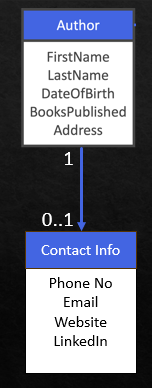
Which entity is a weak entity?
Contact Info
What is 1NF?
Every attribute in that relation is single-valued attribute
What is 2NF?
Every non-primary-key attribute is fully functionally dependent on the primary key
What is 3NF?
No transitive dependency for non-prime attributes
What is a candidate key?
A minimal set of attributes which uniquely identifies each record
What is a composite key?
A candidate key which consist of two or more attributes
What is a primary key?
A candidate key which is selected to uniquely identify each record
What makes a good primary key?
One attribute, a numerical attribute, named sensibly
What is a foreign key?
When one table has the primary key
What is the purpose of a foreign key?
Allows tables to be linked without physically storing the relationship
What is a requirement of a joining table?
Both entities have many to many relationships
What is the purpose of a joining table?
To model many-to-many relationships by breaking them into two one-to-many relationships
When does an insertion anomaly occur?
Specific data cannot be added to a table without the presence of unrelated or incomplete data
When does an update anomaly occur?
When data is duplicated (redundant) across multiple records, and updating only some - but not all - of those records leaves the database in an inconsistent state
When does a deletion anomaly occur?
When deleting a record from a database unintentionally removes other crucial, unrelated data, causing loss of information
What is CRUD?
Create, read, update, delete
Create in SQL (2)
CREATE
INSERT INTO
Read in SQL
SELECT
Update in SQL
UPDATE
Delete in SQL
DELETE
Example insert in SQL
INSERT INTO Staff (Name, Address, Phone) VALUES ('Daniel Rough', 'Room 2.07', '384145')Example update in SQL
UPDATE Staff SET Address = 'Room 2.05’, Phone ='123456' WHERE Name ='Daniel Rough'Example delete in SQL
DELETE FROM Staff WHERE Name ='Daniel Rough'Select statement format in SQL
SELECT columns
	FROM TableName
	WHERE condition
Keywords SQL (6)
SELECT, FROM, WHERE, GROUP BY, ORDER BY, LIMIT
SELECT Aggregates in SQL
COUNT, SUM, AVG, MIN, MAX
What kind of join is this?
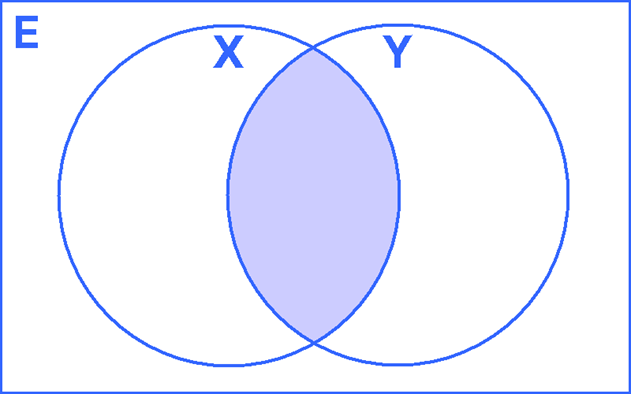
INNER
What kind of join is this?
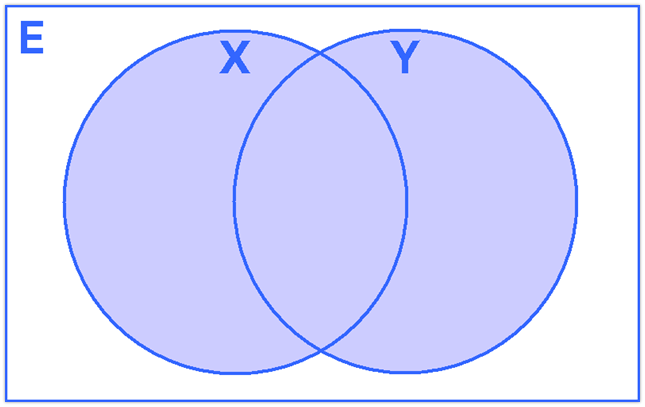
FULL OUTER
What kind of join is this?
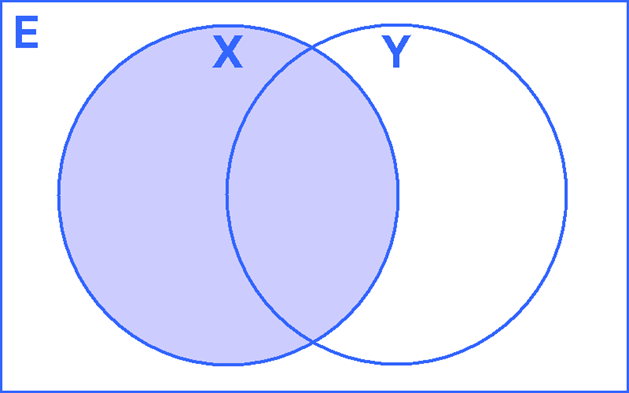
LEFT OUTER
What kind of join is this?
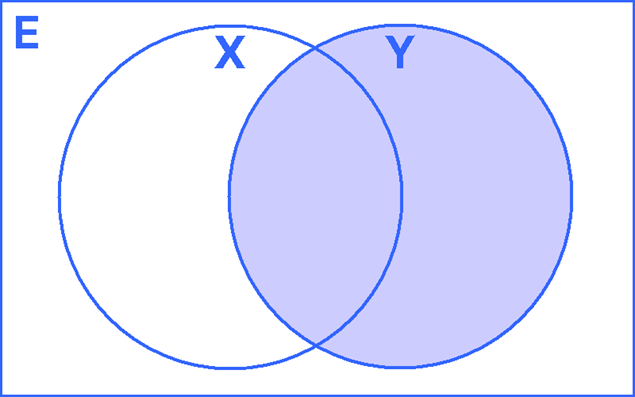
RIGHT OUTER
What is a view?
The dynamic result of one or more relational operations operating on the base relations to produce another relation
True/False views are read only
False (can be read only or updateable)
Why are views useful? (2)
To hide complexity and increase security
What does a horizontal view do?
Restricts the rows (records) of a table
What does a vertical view do?
Restricts the columns (attributes) of a table
Digression
Each column must have a specified type, such as numeric, string, date/time or binary. Choosing the correct data type is critical for performance, storage efficiency, and data integrity
What CRUD for vertical view?
CRUD
What CRUD for horizontal view?
RU
What is a transaction?
A sequence of one or more SQL operations treated as a single, atomic logical unit of work
What are the two possible outcomes of a transaction?
Commit, rollback
What is integrity in databases?
Accuracy and reliability of the data
What is Domain Integrity?
A set of database rules ensuring data accuracy, validity, and consistency within a specific column
Why cant an INT variable store ‘Hi’?
Domain integrity
What does Domain Integrity restrict?
Input values (to allowed types, formats, or ranges)
Why is Domain Integrity useful?
It acts as a primary defence against invalid data entry (maintaining reliable database functionality)
What are the requirements for Entity Integrity? Every entity must have a:
Primary Key
True/False primary keys must be NOT NULL
True
What does Referential Integrity do?
Ensures data consistency by guaranteeing that relationships between tables remain valid
What is an example needing Referential Integrity?
Assigning an order to a non-existent customer
What is User Defined Integrity?
A set of customised rules, constraints, or validation criteria
What does ACID stand for?
Atomicity, Consistency, Isolation, Durability
What is atomicity?
Either all the operations in a transaction are successful, or none of them are
What is consistency?
A transaction always leaves the database in a consistent state - no integrity constraints are violated and the new updated records are immediately available
What is isolation?
Transactions should execute as if there are no other concurrently running transactions
What is durability?
Once a transaction has committed, it is not lost due to any subsequent failure
What does LUW stand for?
a Logical/Least Unit of Work
What does LUW mean?
Either everything is completed or nothing is
T/F a transaction is a LUW
True
What are the steps (keywords) of transactions in SQL?
START TRANSACTION, COMMIT, ROLLBACK
What does START TRANSACTION indicate in SQL?
The entry point of a LUW
What does COMMIT indicate in SQL?
The end point and makes changes in LUW permanent and logged
What does ROLLBACK indicate in SQL?
Undoes all committed changes in LUW back to the START
What is the end result of ROLLBACK in SQL?
No change - like the transaction never started
What does concurrency control allow?
Multiple transactions or processes to run simultaneously without interfering with each other
What potential problems does concurrency control solve? (4)
Lost update, uncommitted dependency, inconsistent analysis, deadlock
What is the lost update problem?
When two or more transactions select the same record, read it, and then update it simultaneously one transaction overwrites the other and the first update is lost
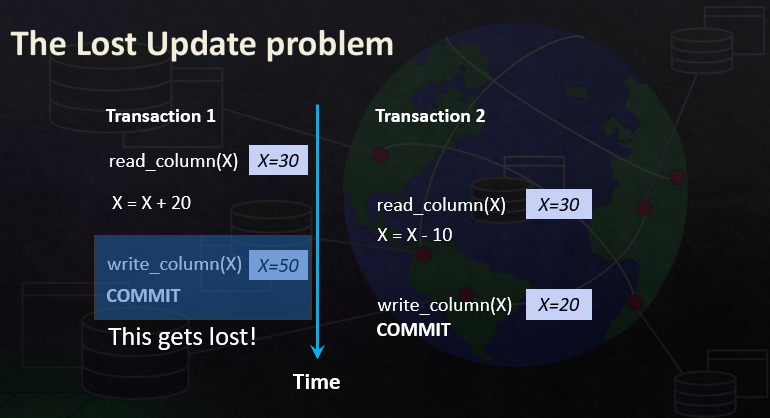
What is the uncommitted dependency problem?
When a transaction reads data that is later modified by another transaction before the first transaction commits
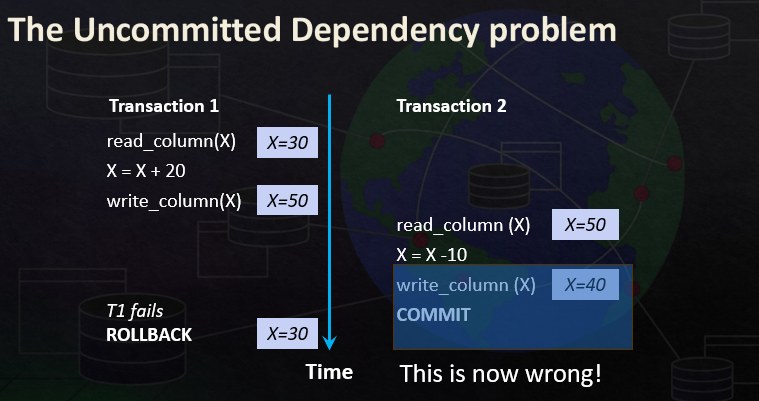
What is the inconsistent analysis problem?
Where one transaction reads data while another modifies it
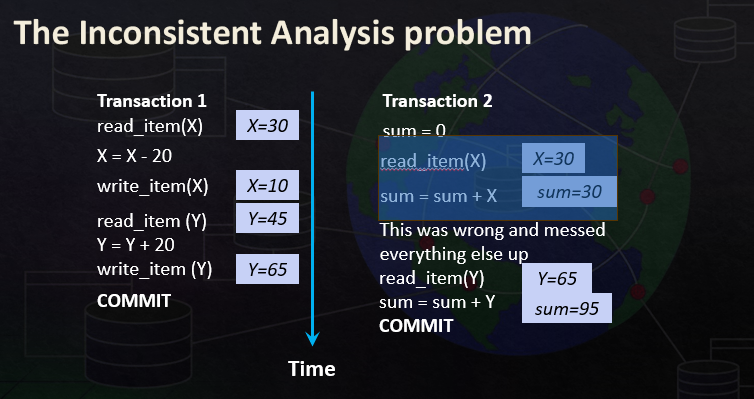
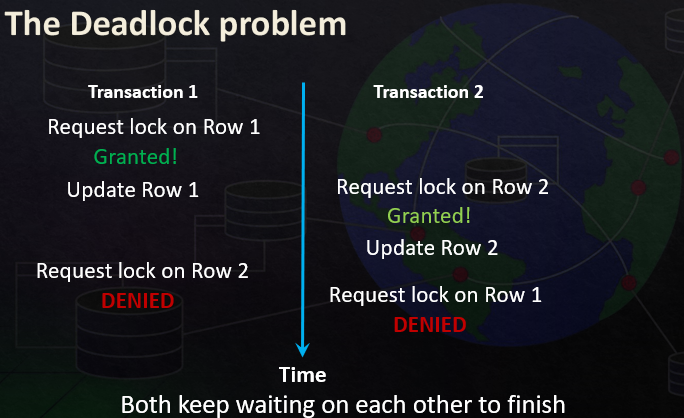
What is the deadlock problem?
When both transactions keep waiting on each other to finish
Why is security of data important?
Data is valuable and private, and unauthorised users can damage database integrity
What is a threat (according to that book)?
Any situation or event, whether intentional or accidental, that may adversely affect a system and consequently the organisation
Name 3 types of security
Data, network, physical
What are the worst causes of bad security?
Weak authentication, poor database configuration, SQL injection
How can SQL injection be prevented?
Prepared statement, input sanitisation,
What do prepared statements do?
Separates the query structure (the SQL) from the actual data (user input)
What does the input WHERE UserID = 456 OR 1=1 look up when prepared statements are used?
UserID that is ‘456 OR 1=1’
What does the input WHERE UserID = 456 OR 1=1 look up when prepared statements are NOT used?
Nothing as 1=1 is always true
What is input sanitisation?
The security process of cleaning, filtering, or modifying user input to ensure only valid characters are input
What is the definition of a distributed database?
A logically inter-related collection of shared data (and a description of this data), which is physically distributed over a computer network
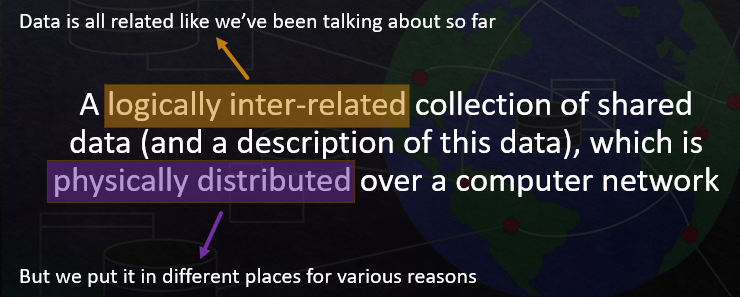
What is the definition of a DDBMS (Distributed Database Management System)?
A software system which permits the management of the distributed database and makes the distribution transparent to users
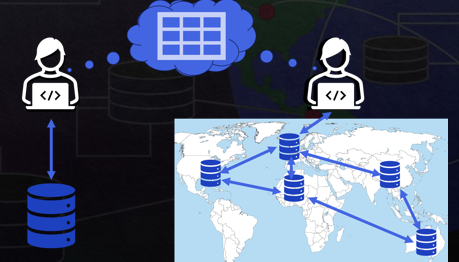
Fill in the blanks:
Data is split into ………(1)
………(1) may be ……….(2)
Fragments are allocated to ……(3)
….. (3) are linked by a communications …….(4)
fragments, replicated, sites, network
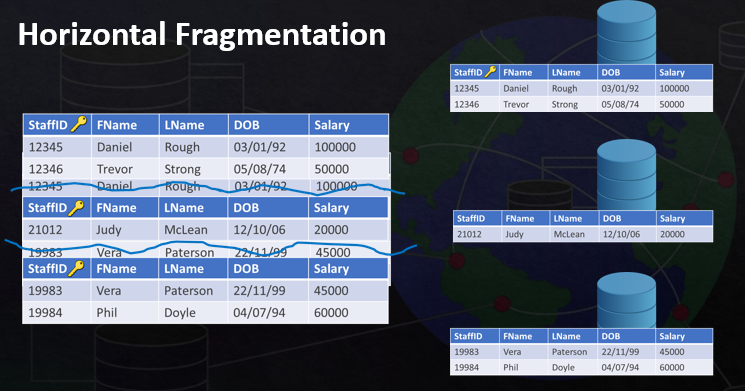
What is horizontal fragmentation?
Splitting tables up by records (rows)
What is vertical fragmentation?
Splitting up tables by attributes (columns)
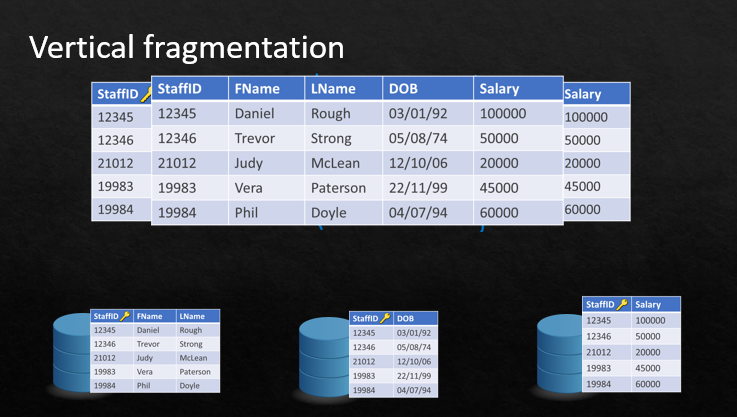
What is hybrid fragmentation?
Splitting up tables by records and attributes
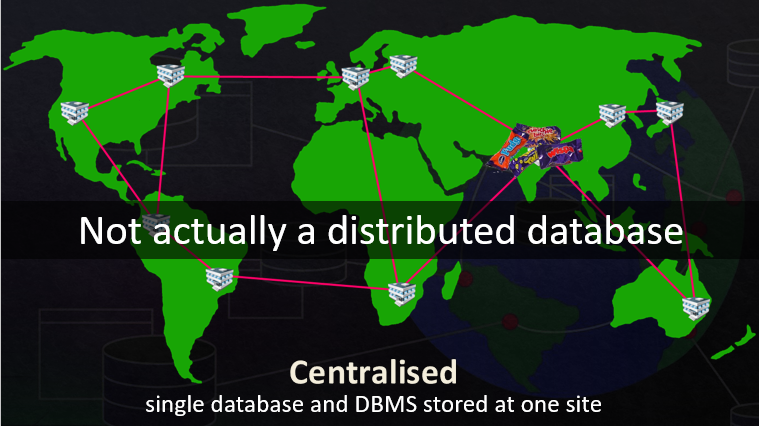
What is a centralised database?
A single database and DBMS stored at one site with users distributed across the network
What are the two main types of distributed database?
Partitioned, complete
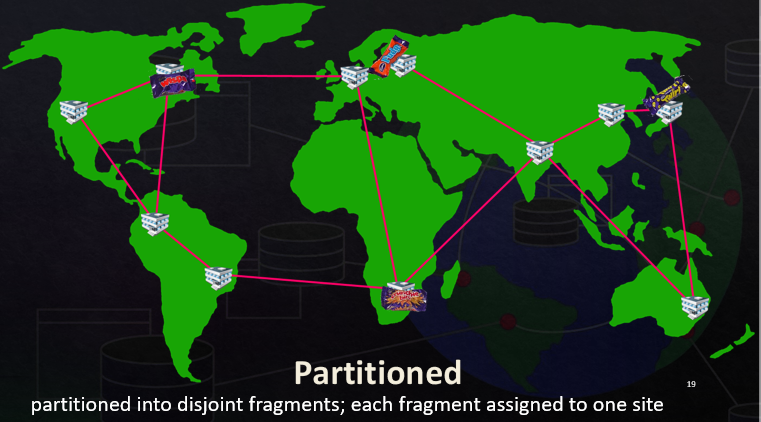
What is partitioned replication in a distributed database?
Database is partitioned into disjoint fragments; each fragment is assigned to one site
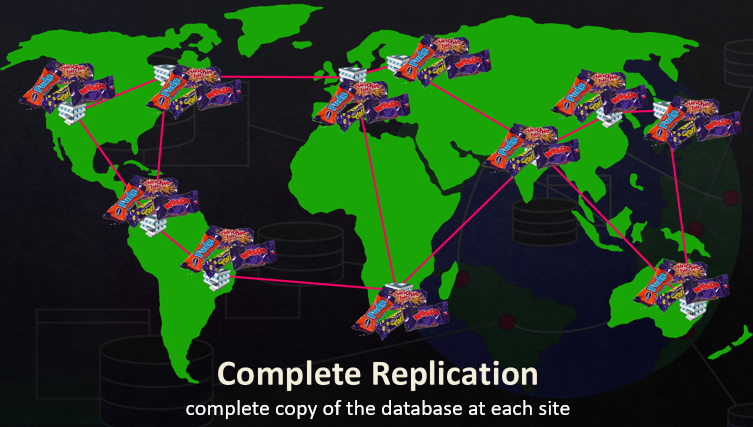
What is complete replication in a distributed database?
A complete copy of the database is maintained at each site
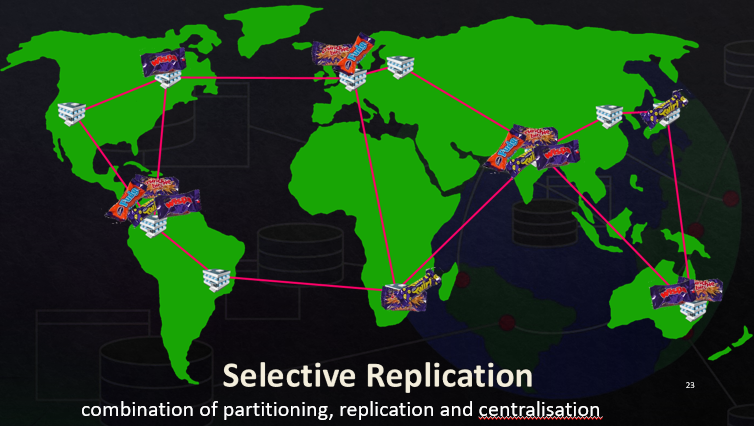
What is selective replication in a distributed database?
A combination of partitioning, replication and centralisation
Centralised comparison: Locality of reference, Reliability & Availability, Performance, Storage Costs, Communication Costs
Lowest, Lowest, Unsatisfactory, Lowest, Highest
Partitioned comparison: Locality of reference, Reliability & Availability, Performance, Storage Costs, Communication Costs
High, Low for item; high for system, Satisfactory, Low, Low
Complete replication comparison: Locality of reference, Reliability & Availability, Performance, Storage Costs, Communication Costs
Highest, Highest, Best for read, Highest, High for update; low for read
Selective replication comparison: Locality of reference, Reliability & Availability, Performance, Storage Costs, Communication Costs
High, OK for item; high for system, Satisfactory, Average, Low