germany and the growth of democracy, 1890 - 1929
 Call Kai
 Learn
Learn Practice Test
 Spaced Repetition
 Match
Match Flashcards
 Knowt Play
1/53

There's no tags or description
Looks like no tags are added yet.
Name | Mastery | Learn | Test | Matching | Spaced | Call with Kai |
|---|
No analytics yet
Send a link to your students to track their progress
54 Terms
what problems were there with the way kaiser wilhelm ruled germany?
he dissmised Otto von Bismark in 1908 - because he thought he could rule by himself and felt threatened by Bismarks power
He was prone to mood swings and violent rages - might have been a repressed homosexual and born without a left hand. he would have periods where he would focus on one idea and if anyone messed with it then he would go into a violent rage. This shows he is a weak ruler because he cant take advice from his ministers who are more capable than him.
how powerful was the reichstag?
they could discuss, amend and vote on new legislation, but it could not decide on the topics in question. That was under the control of the kaiser
It was during germanys industrial revoltion and the kaiser and the right wingers were not happy. The rightwingers werent happy because they were not getting richer and had to pay more taxes so they joined together to pass government laws
the left wing party appealed to germanys growing number of industrial workers
the largest political group was the SPD (working class)
To what extent had Germany caught up with the rest of the world?
In 1875, Britain produced 47% of the worlds iron and 40% of its steel but by 1914, germany was producing more than twice as much steel
the telephone had been developed by a british inventor, but by 1914 germanys telephone system was more advanced than any other country
Electrical goods had been developed and sold in britain and the usa in the 1880s but by 1914 germany were producing a third of the worlds electrical goods
although britians chemical industry was well established by 1880, in 1914, germany led the world in the chemical and steel industries
why did socialism and the cause of social reform grow in germany?
In 1871, germany was dominated by nobles and landowners who had money and power
then the people with power gave the poor money to stop them from revolting because they knew a revolution would come
By 1912, germany had brought in many social reforms, such as the development of the pensions in 1889 and national insurance schemes, These schemes benefitted working class rather than middle and upper classes. the SPD won almost a third of the reichstag seats.
It was a good change because if you were working class, you now have a pension and you dont have to work till you die, rely on your children or starve. The kaiser passed the right because he didnt want a revolution/ he was worried about a revolution
why was prussian militarism a problem before 1914?
prussians dominated the german army
the noble army was suppourted by noble men, landowners and conservatives so democratic, political parties found it hard to develop
the german army had a special status within germany because it was so widely admired
suggestions that the german army could be used to expand germanys territory made germanys neighbours (especially france and russia) nervous, so they made alliances
It was hard to criticise the german army becasue it was widely admired by civillians
why were germanys navy laws a problem before 1914?
Germanys navy laws were designed to have two effects on britain. A large ship would need to be built to match the british royal navy which would 1. if they defeated the british navy they could achieve worls power and 2. a large ship building programme would frighten the british government
The effect of the first navy law in 1898 was that it allowed for the addition of seven battleships but it wouldnt worry britiain because it wouldnt be enough to match the british or the french
The effect of the second navy law in 1900 worried britain more becasue germany doubled their fleet so now they have 38 battleships. It was clear to the british that they were not just patrolling, their primary objective was rivalling the brits
A naval arms race developed between britain and germany in the early 20th century because both countries wanted to dominate the seas. Britain wanted to maintain its long standing naval superiority while germany under wilhelm aimed to build a powerful navy to challenge the british dominance
the role of the kaiser in all of this was his suppourt of the naval expansion and he thought it was the key to fulfilling his ambitions for germany.
In what ways were the lives of german people affected by WWI?
World War I went from 1914 to 1918
starvation - there was a shortage of food so people were surviving on turnips and bread
disease - a deadly flu epidemic swept the country
workers and strikes - sailors on ships (in the navy) refused orders because they no longer wanted to fight
economic problems - war pensions would cost the country a fortune in the future. They lent money and might not get it back. They borrowed money and needed to pay it back
politics - there was mutiny and revolution and ex- soldiers felt betrayed by politicains so refused to suppourt them
what was the ‘stab in the back theory’?
It was a theory that scheidemann, ebert, socialist and communist strikers and rich jewish business men were the reason germany lost ww1
Why would army leaders like Ludendorff and von hindenburg put forward the ‘stab in the back’ theory?
it say that it wasnt their fault they lost the war
this idea was popular amongst civillians because their family and friends that died in this war didnt die for nothing if they believed this theory
this theory was a problem for ebert and his government because it de-legitimized their authority, presented them as traitors, and provided a powerful propaganda tool for right-wing extremists
when and why did the german monarchy end
The German monarchy ended on November 9, 1918, when Kaiser Wilhelm II abdicated following military defeat in WWI, the Kiel naval mutiny, and widespread revolutionary unrest. Facing collapse, the Kaiser fled to the Netherlands, allowing Friedrich Ebert of the SPD to lead a new provisional government, creating the democratic Weimar Republic
why was eberts position a difficult one
many german business men had made a lot of money during the war and many workers had been paid badly during the war so successful business would be vital to future german success and prosperity
the new government had to find huge sums to pay for pensions so this probably meant raising taxes. So ebert needed german people to buy german made goods in order to restore prosperity and employment
conservative figures such as army officers and judges were still very infulential in germany so ebert needed conservative support in order to keep germany stable and defeat extremists and cooperating with conservatives meant that ebert lost the trust of some left wingers who he felt was betraying them
Eberts government got the blame for germanys humiliation at the end of the war so many conservatives felt that germany had only lost the war because they had been betrayed and the politicians who had signed the Armistice of november 1918 were called the november criminals by conservatives
The kaiser and his generals hindenburg and ludendorff, knowing the war was lost had started peace talks. Eberts government had agreed to ceasefire (armistice) which had ended the fighting in the war.
Eberts post war problems in order
faced armed revolts from left wing communists who wanted to overthrow
there was no final peace agreement so britain and france could still attack
kasiers flight meant there was no accepted constitution for germany
germany did not have the money to pay back its debts or fund the pension benefits it needed to pay
what did the treaty of versailles do to germany?
they were to have no tanks or submarines so the allies were safe from germany
all of germanies colonies (in africa) were taken away and given to britain and france
germany had to pay compensation (reparations) to the british and french because germany had to accept full blame for starting the war
germany lost land in the east (west prussia)
germany lost land to the west
they were to have a small army of only 100,000 men
small navy with only 35,000 men and 36 ships in total
Why did the germans hate the treaty of Versailles?
lots of land was taken away so they lost lots of agriculture, factories, mines and people. So less workers, less income and less produce
there was no negotiation. It was a ‘diktat’
germany had lost loads of men and in the treaty germany had to pay reparations to the allied forces so they could pay for damage and pensions when germany had their own to deal with
what is a constitution
a set of rules by which a country is governed
why is the way germany was governed between 1919 and 1933 known as the weimar republic?
they met in a small town called weimar just outside of berlin instead of berlin Berlin was thought to be too violent and unstable. Streets were dangerous because people were running around with machine guns looking for ebert. Weimar was nice with lots of hotels. People would mock ebert for running away
what was the main aim of weimar
they attempted to set up a democratic system in the world where no one could gain too much power
what is proportional representation?
if a party gained 20% of votes, they gained 20% of the seats in the parliament/reichstag
what were the strengths and weaknesses of the weimar republic?
proportional representation - fair and democratic but some areas wouldnt’t have a seat to represent them
universal suffrage - fair vote, women could vote, no weakness
the chancellor needed to suppourt 50% of the reich to govern effectively - no extreme legislation but weak and unstable government, extermists
central berlin government and 17 more scattered around - more people have their say but only one main gov
president could rule by decree in emergency - decisions could be made urgently but their could be backlash folowing the decision is power was misused
how did the weimar republic deal with left wing opposition?
Eberts party,SPD, was commited to improving conditions for workers but he wasnt changing things enough for left wingers who wanted germany to be communist. They attempted a revolution in 1919 because they wanted equality with no governments but their policies were not popular with the majority of german workers
what happened during the spartakist uprising
Karl Leibknecht and Rosa Luxembourg led it
their primary objection was germany to be self-ruled
the freikorps - anti-communist ex-soldiers had formed themselves into a vigilante (freedom fighters) group
the freikorps took action against the spartakists becasue they felt betrayed and believed they started the war
the freikorps succeded and shot the spartakist leaders without trial
what happened during the bavarian soviet republic?
the bavarian soviet republic was a short lived, radical soviet republic in germany and they were able to set it up because the governments minds were elsewhere so didnt pay attention
the freikorps were motivated by a sense of duty and combat and they percieved the bavarian soviet republic as a threat to germany from revolutionary forces.
After, many leaders were arrested, executed, or went into hiding
why was the ruhr of particular importance to ebert?
it was the industrial heartland of germany producing a substantial portion of the countries steel and coal etc, Control over the ruhr meant stability and the ability to suppourt the governments efforts to rebuild the nation and pay reparations for the treaty of Versailles
why was the KPD particulalry strong in the ruhr
because of the high conc of industrial workers in the reigon. the wants of industrial workers lined up with communist policies
what happened to the communists
they faced violence from government forces. In march 1920, the government used the freikorps to supress a major uprising led by the KPD known as the ruhr uprising. Many communists were arrested, killed or forced underground which led to a significant set back for communist movements in germany
what is a putsch
an attempt to seize power by force
examples of right wing opposition towards the weimar republic
the kapp putsch
the munich putsch
murders by right wing extermists
the kapp putsch
In 1920, Dr Wolfgang Kapp led 5,000 freikorps into Berlin in a rebellion known as the Kapp putsch. He wanted to take over the whole country and make the army strong again.
So Ebert fled from Berlin
But the Kapp putsch were defeated becasue of workers strikes. They didnt have the supourt of the workers and they all went on strike. Resulting in no gas, water, electricity or trains.
After 10 hrs as Germanys new leader, Kapp gave in and fled abroad.
Right wing extremist murders
Walter Rathenaw (foreign minister of ebert) and Matthias Erzberger (man who signed the armistice) were targets of right wing extremists becasue they worked for ebert. They were ‘november criminals’ and they were also jewish.
The murderers got sent to prison for only 4 years
The occupation of the ruhr, 1923
French and Belgian troops occupied germanys industrial heartland after germany missed reparation payments. This caused strikes, economic collapse and severe hyperinflation. The crisis showed weimars weakness.
Germany couldnt fight back militarily so instead they ordered workers to strike and disobey the french (passive resistance). But this led to the french arresting strikers, killing 132 people, and expelling over 150,000 residents.
what is hyperinflation?
when a countrys currency becomes worthless becasue there is no connection between its value and the value of things for sale in shops
what caused Germanys hyperinflation in 1923?
germanys economy was in chaos after WW1
reparations were fixed at 6.6 billion
germany payed the first installment
then they failed to pay the second installment
the french and belgians were sent into the ruhr
the german government ordered a policy of passive resistance
french and belgian troops acted against the strikers with great force
the german government couldnt pay pensions or its own employees, or the strking workers
the german government printed money
the value of money decreased as prices rose
hyperinflation took hold
how were different classes affected by hyperinflation 1923 and how did that change thieir view on the government?
factory worker - they were gaining wages but prices rose faster than wages could be adjusted. They were angry with the government even though they were better off.
A pensioner, paid weekly - they were badly affected becasue they had a fixed income and didnt work so couldnt get any more money. The government wee unpopular amongst pensioners because the pensioners couldnt buy what they needed
A salaried civil servant - same as factory worker
Farmer who had borrowed a large sum - happy becasue it was easy to pay off debt, so sort of liked the government
Middle class family who had saved a large sum - all their savings could have bought them a house but now has lost value so gov were very unpopular
a retired person living on a fixed annuity - fixed income like pensioner and annuity never goes up so very angry with gov
landowner living on rents from property - they can respond by putting up rent so thats good.
what was the munich putsch november 1923?
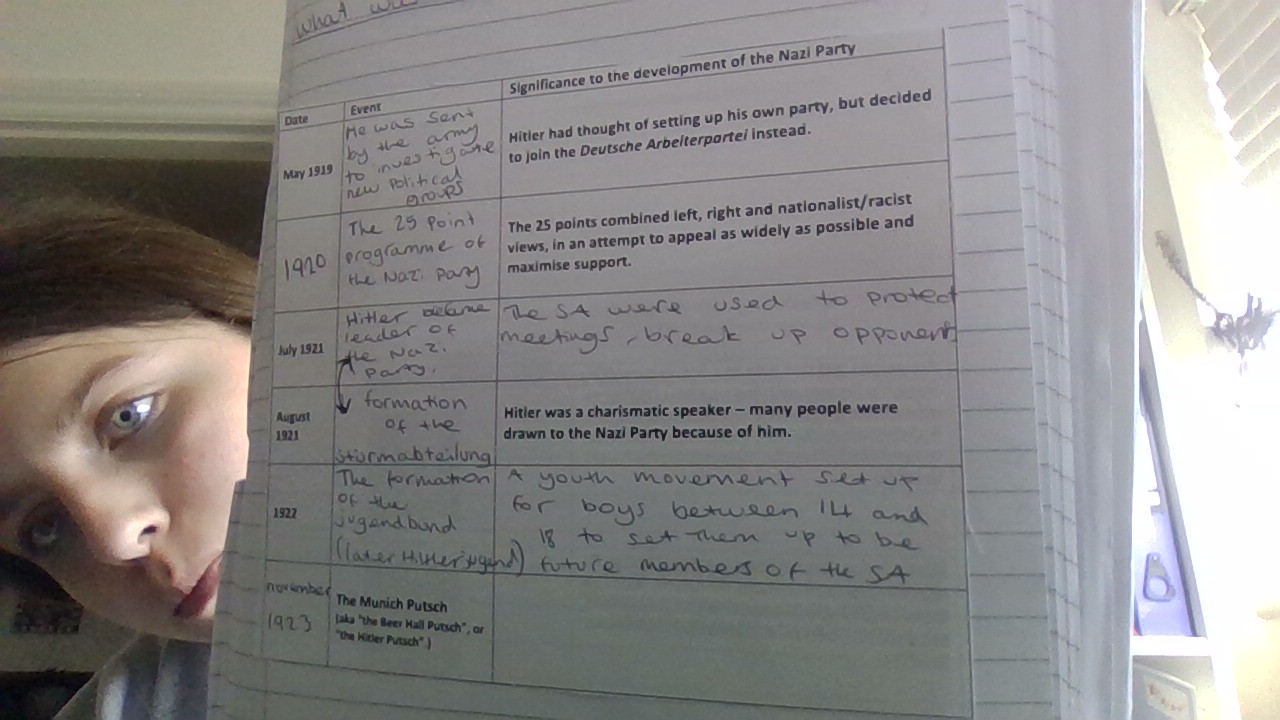
what happened during the munich putsch?
The nazi party were a growing party in 1923. Bigger than they were before but defenitley not the biggest
Hitler tried to seize power in november 1923 and not earlier becasue they gov were in an economic crisis in nov 1923 so they were distracted and Hitler could slide under the radar
Gustav Ritter Von Kahr was head of Bavarian government and he spoke at beer halls in munich
Erich Ludendorff was a great german war hero who knew about Hitlers plan to try and take over Germany. When Hitler interrupted the beer hall in munich, Ludendorff walked in afterwards and said he suppourted Hitler. He was a nazi stormtrooper and was one of the reasons Hitler got so much publicity
why did the munich putsch attempt nov 1923 fail and what happened to the 2 leaders?
The nazis didnt have enough suppourt and the police stopped them. On the day, Hitler got squashed by a fallen man and dislocated his shoulder. He gets bundled up and taken off in a car with his body guards and arrested a few days later. Ludendorff walked straight into the police/shooters. This scene didnt put Hitler in a great light.
In what ways was the munich putsch a setback for the nazis.
They were a small party so loosing members wasn’t great (16 members were killed)
it showed the public they were weak and a failure because of their failed launch
The way Hiter escaped implied that he is selfish and didnt help the wounded. This will make the public not want to vote for him because he acted fro himself and not the party
Hitler was put on trial for treason which is bad publicity becasue he is meant to be working for the government and not against
Hitler was jailed for 5 years which was bad becasue he was the most valued member of the nai party and drew all the attention
In what ways was the munich putsch of assistance to the Nazis
The nazis could have used the victims as martyrs. Small party making headlines, gets the spotlight.
hitler escaped, could have been shot
hitler was put on trial for treason - good publicity, bold leader and risk taking and risk reputation for the party.
hitler was jailed for 5 years - good publicity showing the leader would risk livlihood to spread the partys beliefs
To what extent did the Weimar republic recover in the period 1924-1929 (stresemann era)? STRENGTHS
strengths:
Germany was accepted into the League of Nations as a permanent member. Good for foreign affairs
The majority of political parties cooperated between 1924-29. Political strength
Germany were the forefront of cultural life in terms of architecture, modern art and cinema
Germany signed the Locarno treaties with France, Belgium, Poland, poland and Czechoslovakia, accepting their post-war borders. Foreign Affairs Strength
As a result of the Dawes Plan, Germany restarted reparations, so France and Belgium left the Ruhr. Economic strength
Unemployment levels fell due to the public work scheme. Economic strength
Stresemann and Hjalmar Schacht introduced a new currency, the Rentenmark in nov 1923 which restored faith in the German currency.
Germanys industrial production had regained 1913 levels and trade with the rest of the world was also recovering and germany was making money.
Stresemann negotiated the young plan, which cut reparation payments and spread them over a much longer period. Economic strength
The nazi and communist parties stopped trying to take power by force as they did not have enough suppourt to make them credible. Political strength
To what extent did the Weimar republic recover in the period 1924-1929 (stresemann era)? WEAKNESS
Many germans felt they were gaining nothing from the economic boom of the 1920s - particulalry farmer and middle class members who lost thier savings
between 1923 -29, chancellor ship changed 5 times and there were 9 different governments because they were so weak
germans felt that they had not really lost the war so they should not be paying reparations at all and it should be on freindly terms
many conservatives viewed stresemann as a traitor for working with the enemies of germany
On eberts death, Hindenburg was elected president but he was not commited to the weimar republic or democracy in general
germanys prosperity rested on american short term loans which could be called in at any moment
unemployment never dipped below 1.25 million so there were some people who never found a job between the end of ww1 and the beginning of the depression
many outside the major cities looked on weimars exciting, adventurous cultural life as shocking and degenerate and blamed the government for allowing it
the reichstag elections in 1928, 30% of the votes went to parties opposed to the existance of the weimar republic
What were the Weimar republics weak spots in politics?
The kaiser ran away pre war and left them with many problems and there was no good way to deal with it
people didnt trust the gov
extremist parties
short lived gov
What were the Weimar republics weak spots in economy?
Hyperinflation was one of the biggest problems that germany faced post war
shaken faith for gov
they still had reparations to pay
pensions to pay
strikes
What were the Weimar republics weak spots in foreign affairs?
Germany had very little allies after the war because they had failed to pay the second installment of reparations
wasnt part of the league of nations
What were the Weimar republics weak spots in cultural life?
there was a pandemic of the spanish flu which killed many germans and left some malnourished with weak resistance to germs
virtually no censorship so you want write, build and make what you want
cabaret
encouraged many avant-garde (risky) artists but upset many conservative rural elders.
what was the wall street crash?
wall street is where the US stock exchange is therefore wall street is the short hand for the US economy
the crash was when the values of stocks and shares dropped dramatically in the autumn of 1929
individuals and businesses were ruined
the effects were slow but very widespread
what were the effects of the wall street crash in the USA?
businesses went bankrupt so laid off workers
so less money circulating
so demand fell
so businesses went bankrupt
what were the effects of the wall street crash outside the USA?
many us banks had loaned money overseas, and called in their loans, causing companies to go bankrput
many us companies had overseas subsidaires which went out of business when the parent company in the us went bankrupt
demand for foreign goods (especially luxury items) from the us declined sharply
and all this lead to sharp rises of unemployment in many countries
the rentenmark
Introduced by Gustav Stresemann in November 1923, the Rentenmark was a temporary currency used to halt Germany's hyperinflation crisis. Backed by land and industrial goods rather than gold, it restored confidence in the economy, paving the way for the new, stable Reichsmark in 1924, and helping initiate the "[Golden Age]".
the new reichsmark
The introduction of the new Reichsmark (and the interim Rentenmark) in late 1923, led by Gustav Stresemann, stabilized Germany's currency after hyperinflation.
the dawes plan 1924
The 1924 Dawes Plan, led by American banker Charles Dawes and German Foreign Minister Gustav Stresemann, restructured German reparations to ease economic crisis. It reduced annual payments, restructured the Reichsbank, and secured $800 million (or ~25 billion marks) in US loans, triggering economic recovery and the "Golden Era" (1924-1929).
the young plan 1929
The 1929 Young Plan, led by American Owen Young, significantly reduced Germany's World War I reparations from billion to billion, extending the payment period to 59 years (until 1988). Designed to aid Weimar Germany's financial stability, it lowered taxes and eased payments, though it was largely rendered void by the 1929 Wall Street Crash.
culture in weimar during the stresemann era
During the Stresemann era (1924–1929), Germany experienced a "Golden Age" of cultural flowering, driven by economic recovery, social freedom, and the abolition of censorship. Berlin became a global center for pioneering art, cinema, and architecture—notably the Bauhaus movement—while Americanized jazz and cabaret thrived
continuing opposition to the weimar republic during the stresemann era
Despite the "Golden Age" of relative stability (1924-1929) brought about by Gustav Stresemann, the Weimar Republic continued to face significant opposition from both the left and right, as well as structural weaknesses. While the period saw economic recovery and improved international relations, many Germans remained opposed to the democratic government.
the extent of recovery in Weimar Germany by 1929
Between 1924 and 1929, Weimar Germany experienced a "Golden Age" of economic and political recovery driven by Gustav Stresemann, characterized by a new currency (Rentenmark), economic stability through Dawes/Young Plans, and reduced extremist influence. However, this recovery was shallow, relying heavily on foreign loans, with high unemployment and agricultural depression revealing a fragile foundation