Electrolyte and Water Absorption
 Call Kai
 Learn
Learn Practice Test
 Spaced Repetition
 Match
Match Flashcards
 Knowt Play
1/14

There's no tags or description
Looks like no tags are added yet.
Name | Mastery | Learn | Test | Matching | Spaced | Call with Kai |
|---|
No analytics yet
Send a link to your students to track their progress
15 Terms
Driving force for water absorption
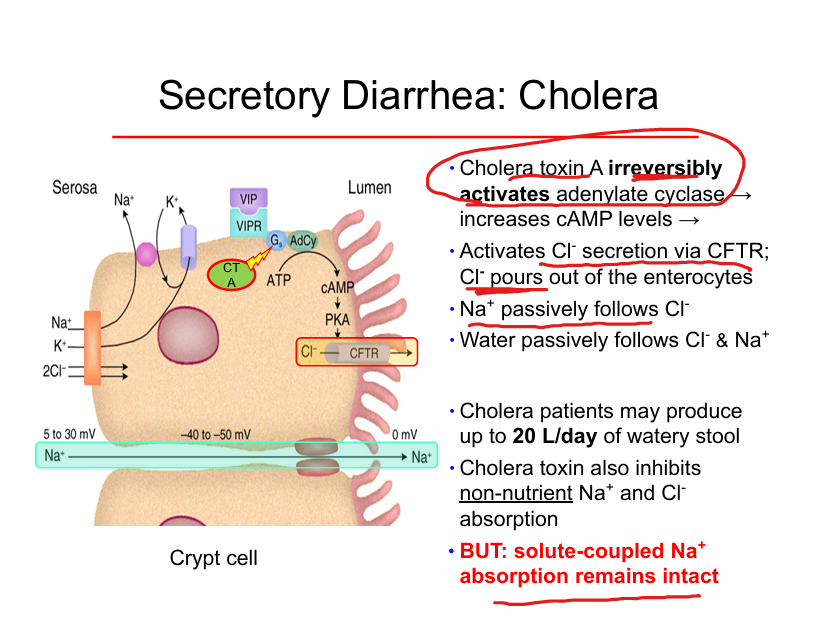
Sodium absorption is the main driver; water follows Na+ via osmotic and hydrostatic gradients. "Main driving force for water absorption."
Sites of absorption vs secretion in intestine
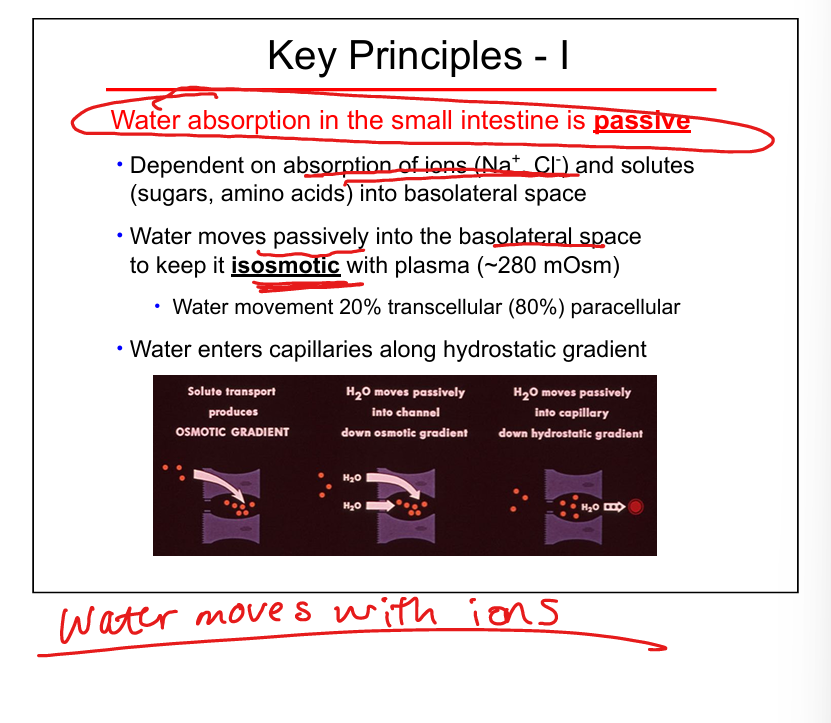
Villi = absorptive zone (nutrients, solutes, low water permeability). Crypts = secretory zone (high water permeability). "Villi – Absorptive zone… Crypts – Secretory zone."
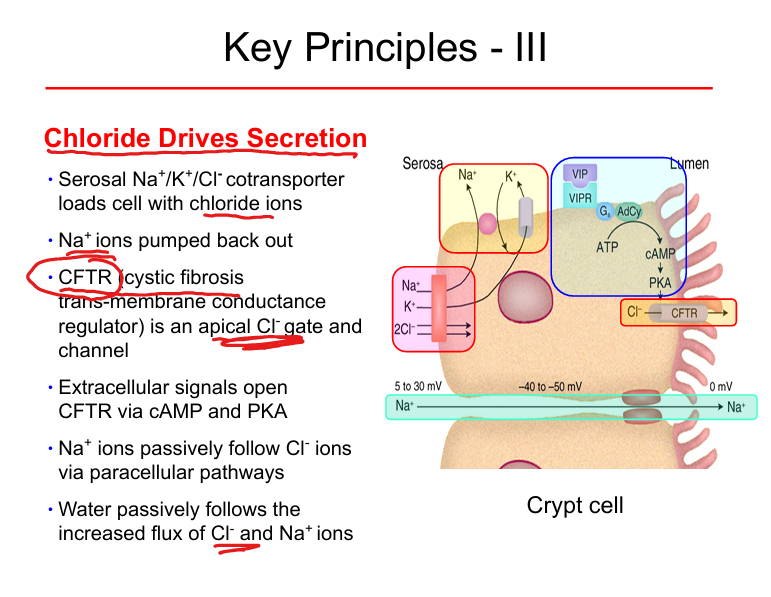
Mechanism of chloride‑driven secretion
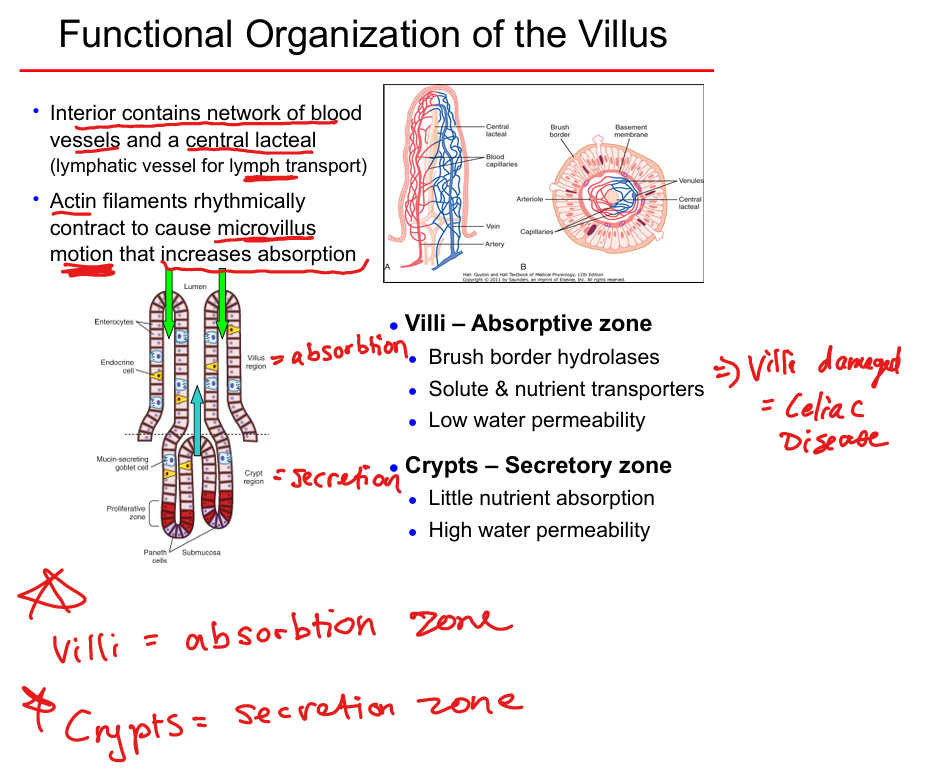
Serosal NKCC loads Cl–; CFTR secretes Cl– when activated by cAMP/PKA; Na+ and water follow paracellularly. "CFTR… is an apical Cl– gate… extracellular signals open CFTR via cAMP and PKA."
Effect of Cl secretion on diarrhea
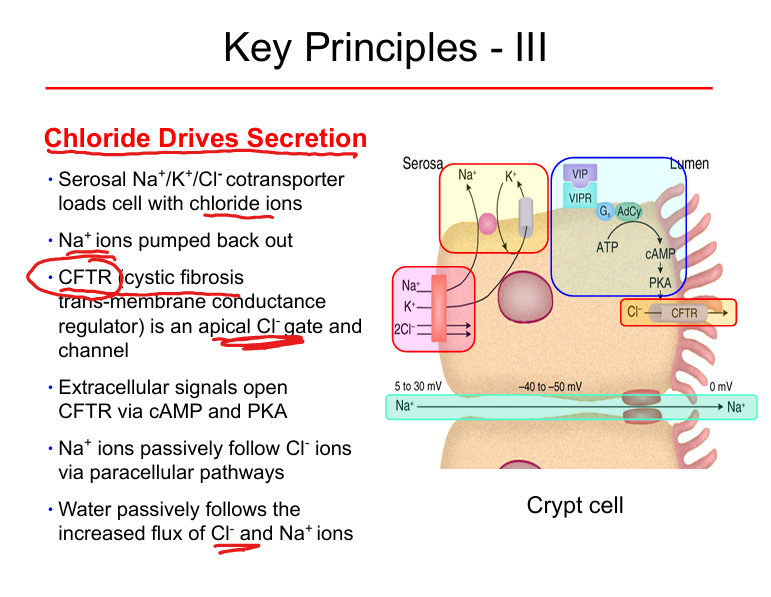
Increased Cl– secretion → increased Na+ and water efflux → secretory diarrhea. "Water passively follows the increased flux of Cl– and Na+ ions."
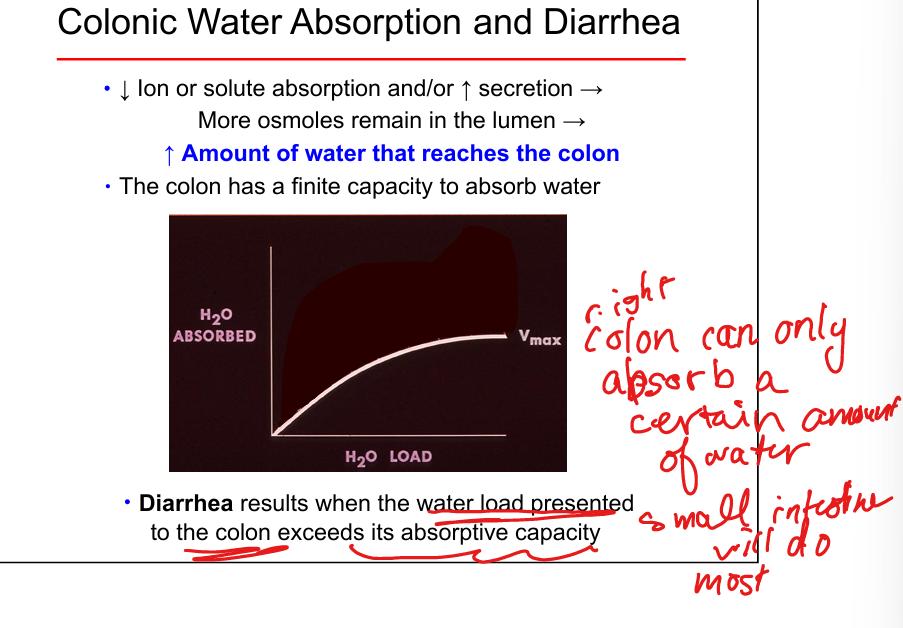
Colon absorptive capacity
Colon (right colon) has finite water absorption; diarrhea occurs when water load exceeds capacity. "Diarrhea results when the water load… exceeds its absorptive capacity."
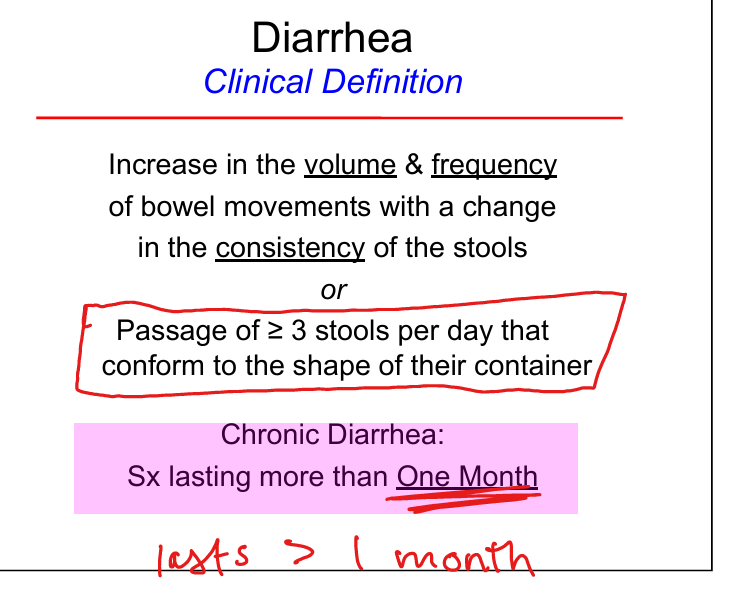
Definition of diarrhea. Chronic?
3 loose stools/day that conform to the shape of their containerChronic = >1 month.
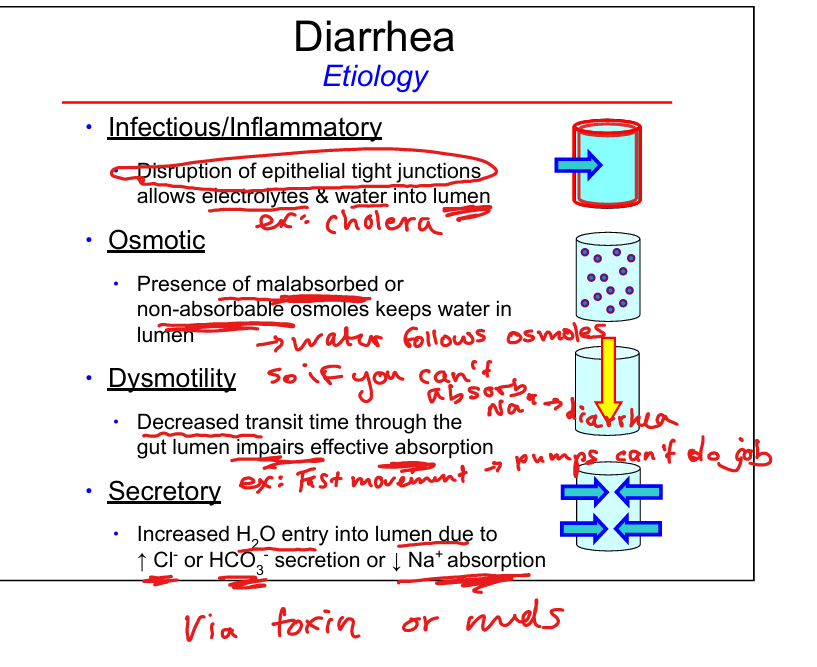
Infectious diarrhea mechanism
Disruption of epithelial tight junctions → electrolytes & water leak into lumen.
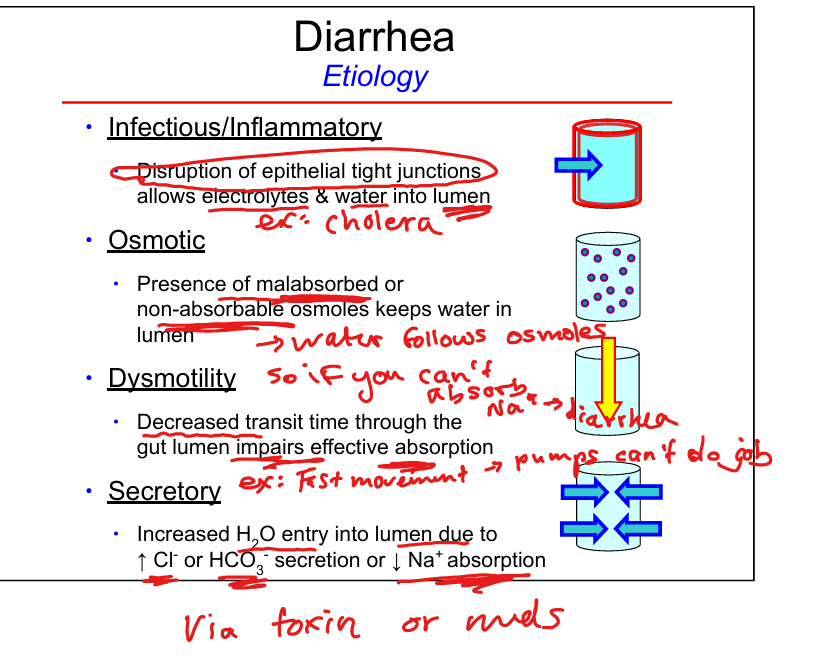
Osmotic diarrhea mechanism
Malabsorbed or non‑absorbable osmoles retain water in lumen. Improves with fasting.
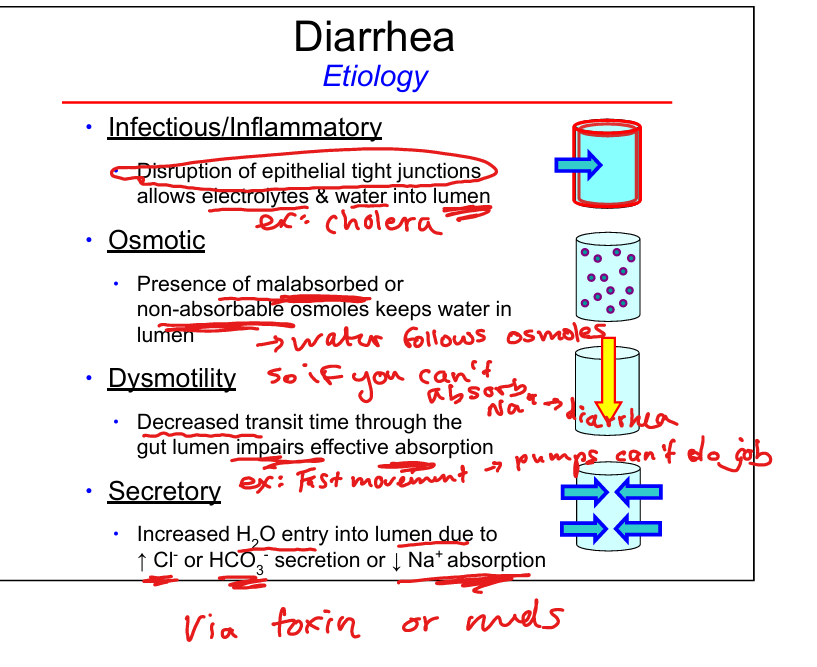
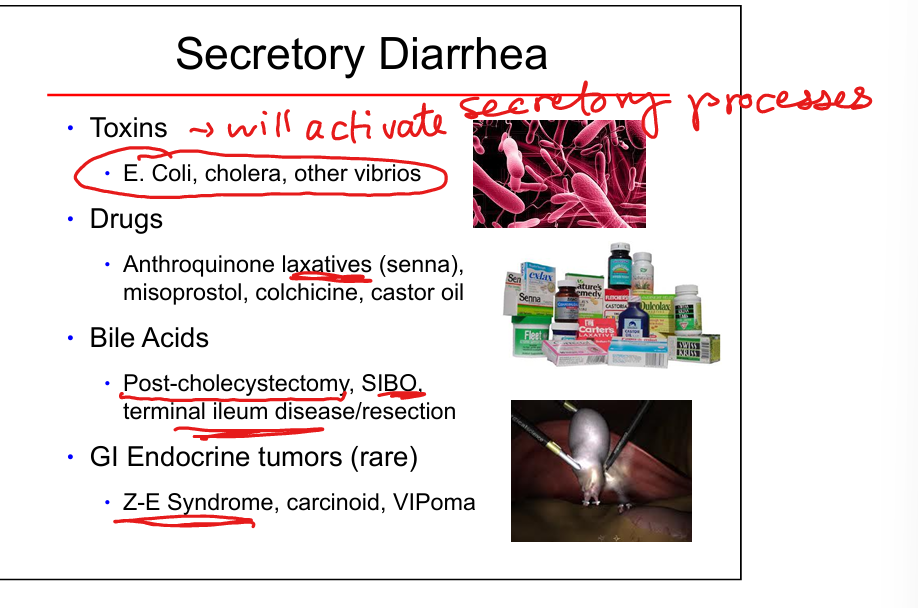
Secretory diarrhea mechanism
Increased Cl– or HCO3– secretion or decreased Na+ absorption; persists during fasting. "Increased H2O entry… due to ↑ Cl– or HCO3– secretion or ↓ Na+ absorption."
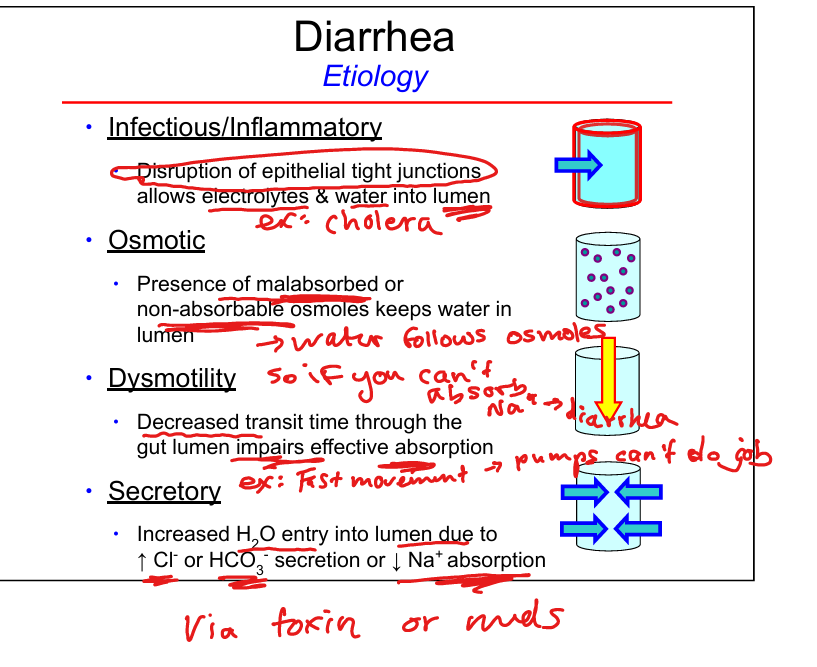
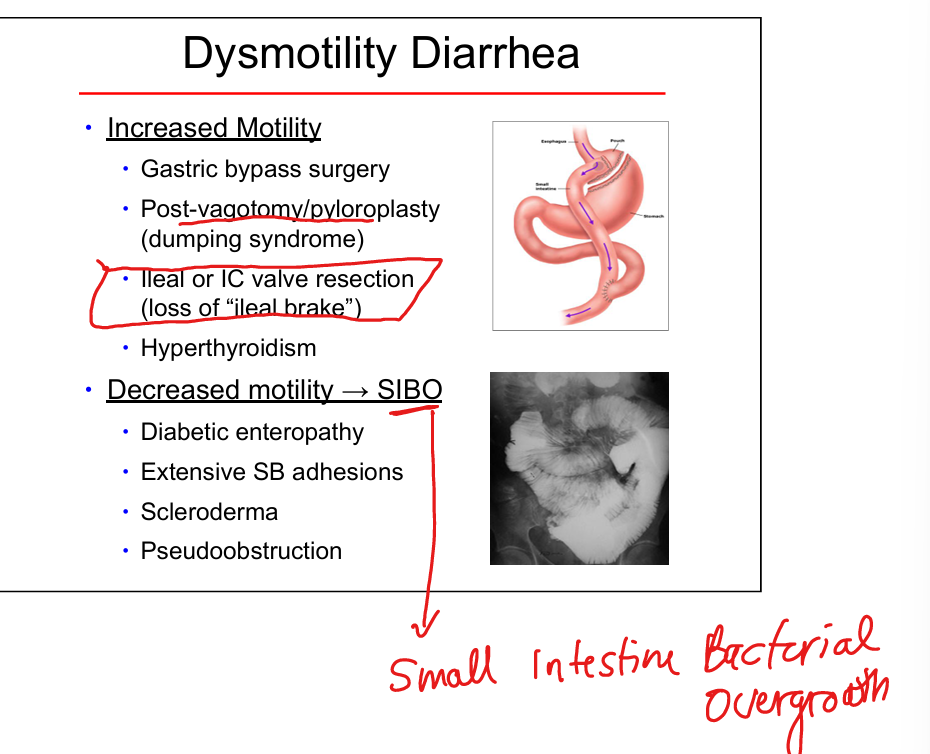
Dysmotility diarrhea mechanism
Fast transit → impaired absorption; slow transit → SIBO(small intestine bacterial overgrowth). "Decreased transit time… impairs effective absorption."
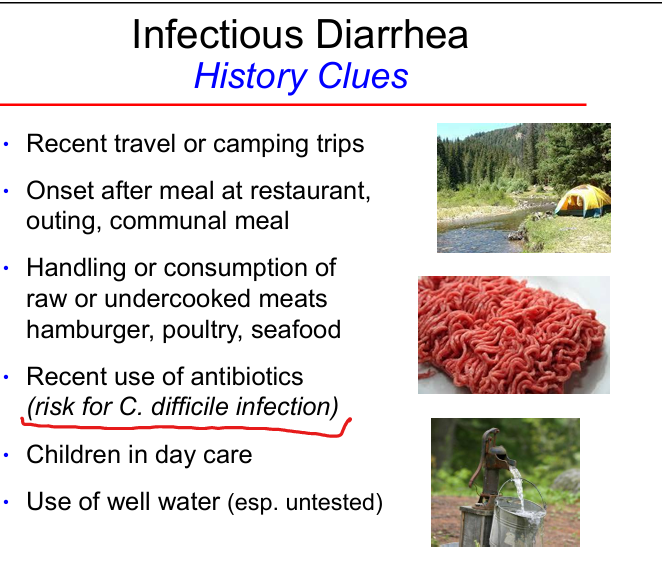
Historical clues: infectious
Recent travel, restaurant outbreaks, raw meats, daycare, well water, recent antibiotics.
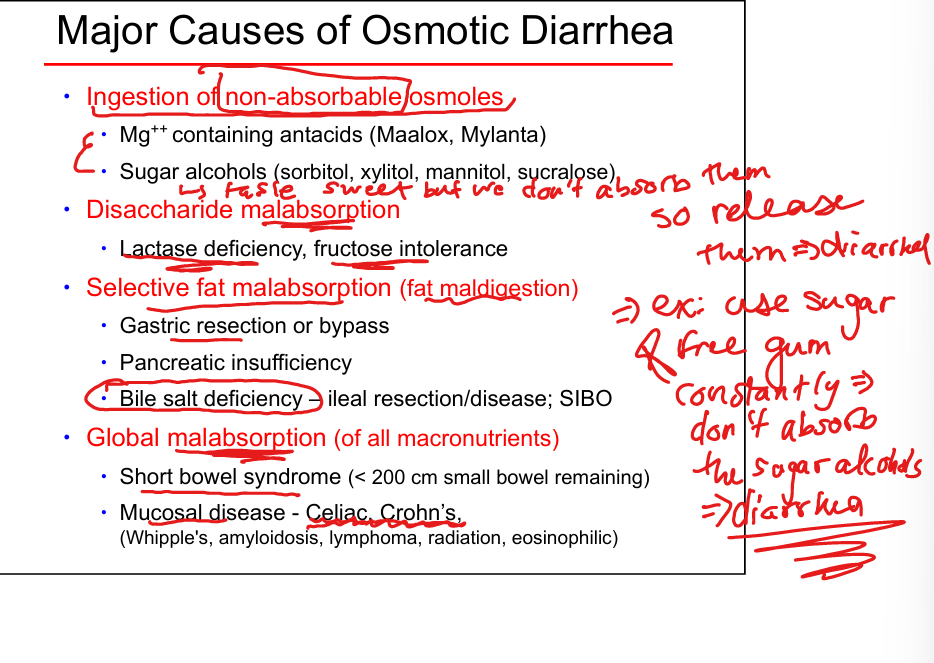
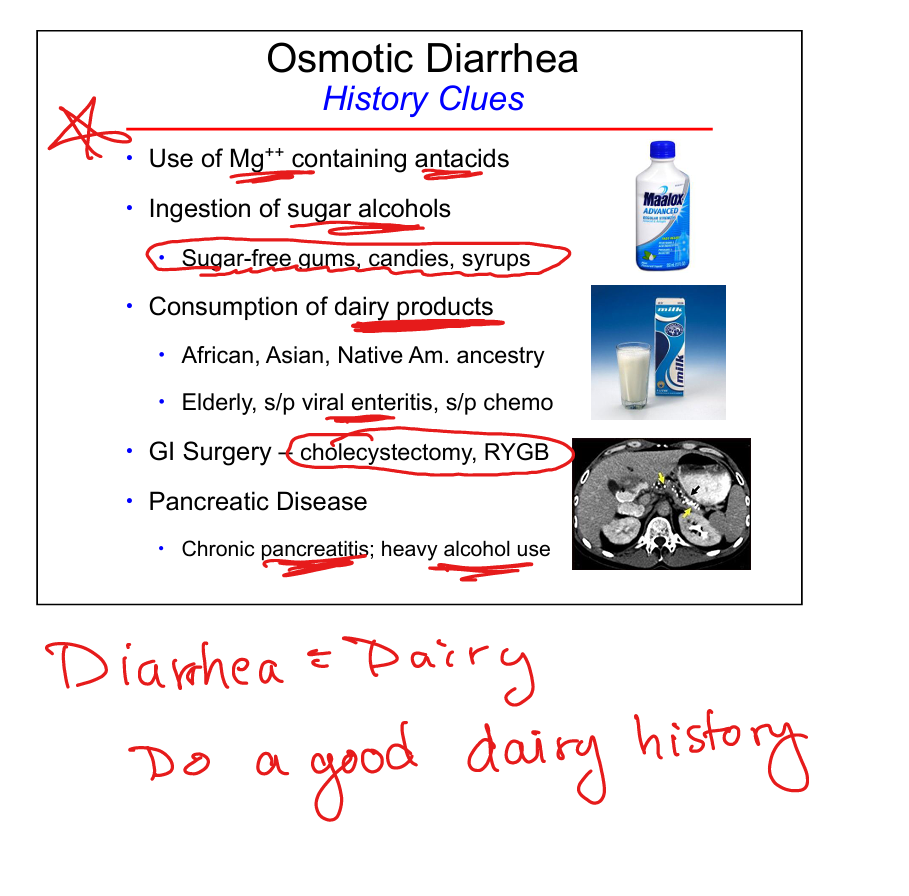
Historical clues: osmotic
Mg antacids, sugar alcohols, dairy ingestion, pancreatic disease, GI surgery.
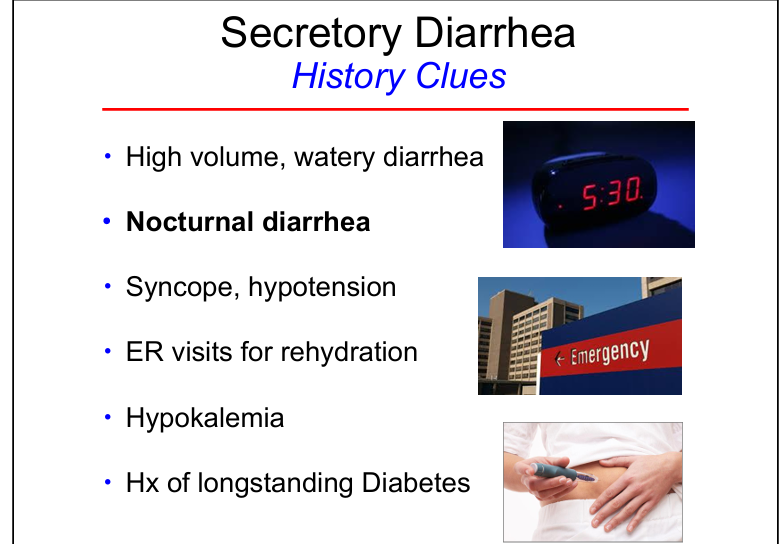
Historical clues: secretory
High‑volume watery stools, nocturnal diarrhea, hypokalemia, diabetes, dehydration.
Historical clues: dysmotility (inc vs dec)
Post‑vagotomy, gastric bypass, hyperthyroidism, diabetic enteropathy, adhesions, SIBO.
Cholera mechanism (secretory diarrhea)
Cholera toxin irreversibly activates adenylate cyclase → ↑ cAMP → massive CFTR Cl– secretion.