Ecology
 Multiple Choice & FRQ
 Call Kai
1/104

Earn XP
Name | Mastery | Learn | Test | Matching | Spaced | Call with Kai | Chat |
|---|
No analytics yet
Send a link to your students to track their progress
105 Terms
Biosphere
global ecosystem
sum of all ecosystems and landscapes
Biome
major life zones characterized by vegetation type (terrestrial) or physical enviornment (aquatic)
Biotic factors
living factors; anything organic (C+H)
other organisms that are part of an individuals environment
predation/herbivory, pollinators, food resources, parasites/pathogens, competing organisms
abiotic factors
nonliving facotrs that influence the distribution and abundance of organisms
temperature, water, oxygen, salinity, sunlight, rock, soil, pH
ecotones
area of integradation between 2 biomes
can be wide or narrow
shore, where prairie meets forest
inclination
the tilt of the Earth in the celestial orbit
23.5 degrees
reason for seasons
interspecific competition
individuals of different species compete for the same limited resources in an ecosystem
negatively impacts both species’ growth, reproduction, and survival
shapes niches and drives evolution
intraspecific competition
members of same species compete for limites resources necessary for survival and reproduction
primary mechanism for population regulation
oligotrophic
nutrient-poor and oxygen-rich lakes
lower surface area relative to depth
may become more eutrophic over time as runoff adds nutrients and sediment
lower decomposable organic matter in bottom sediment
Eutrophic lake
nutrient-rich and often depleted of O2 in deepert zone in summer
higher decomposable organic material in bottom sediment
high rates of decomposition in deeper layers → periodic O2 depletion
Desert
30 degrees N/S of Equator
low and unpredictable rainfall
temps vary seasonally and daily
low, widely scattered vegetation → C4 or CAM plants
nocturnal species with water conservation adaptations
Taiga/Northern coniferous forest
largest terrestrial biome
precipitation varies
cold winters, warm summers
cone-bearing trees that prevent snow build up
lower biodiversity
migratory birds, large mammals
affected by logging
climate
long-term prevailing weather conditions in an area
seasonality, bodies of water, mountains
most significant influence on distribution of organisms on land
microclimate
localized patterns in climatic conditions
environmental features can alter it
cast shade, change evaporation, impact wind, change temp
prairies (temperate grasslands)
highly seasonal precipitation (dry winter, wet summer)
cold winter, hot summer
grasses and forbs adapted for periodic droughts and fires
large grazing mammals and burrowing mammals
converted to farmland
temperate deciduous forest (temperate broadleaf forest)
high precipitation year-round
cool winter and hot summer
distinct vertical layers
animals make use of layers
epiphytes - plants growing on other plants (nonparasitic)
trees drop leave in autumn
hibernating animals and migratory birds
Tundra (Arctic/Alpine)
mid-high precipitation (depending on location)
very cold winters and cool summers
mostly herbaceous vegetation and dwarf shrubs
permafrost limits large vegetation
large mammals and migratory birds
affected by oil/mineral extraction
estuaries
transition between river (fresh) and sea (salt)
salinity varies spatially and with tides
nutrients from river → one of most productive biomes
network of channels, islands, levels, and mudflats
saltmarsh grasses and algae
worms, oysters, crabs, fish, water fowl
Benthic Zone
bottom of all aquatic zones (sea floor)
sand and sediment (organic/inorganic)
communities of organisms called benthos
consume detritus (dead organic matter)
aphotic zone
lower region where little light penetrates
low levels of photosynthesis
abyssal zone at the very bottom (oceans)
photic zone
upper region of water with sufficient light for photosynthesis
littoral zone
shallow, well-lit water close to shore
rooted and floating plants
limnetic zone
farther from shore and water too deep for rooted aquatic plants (lakes)
phytoplankton and cyanobacteria
thermocline (metalimnion)
narrow layer of abrupt temperature change that separates more uniform upper layer from uniformly cold layer
epilimnion
top most layer of lake
summer: warmest, most photosynthesis, most O2
winter: coldest
hypolimnion
deepest layer of the lake
summer: coldest, nutrient-rich, decomposition→O2 depleted
pelagic zone
photic+aphotic zone
open water
mixed by wind and ocean currents (turnover in spring/fall)
high O2 and low nutrient concentration
phytoplankton
zooplankotn, squid, fish, turtles, marine mammals
population
group of individuals in the same species living in the same area
rely on the same resources and influenced by similar environmental factors
demography
study of vital statistics of populations and how they change over time
birth, death, migration (immigration/emmigration)
focus on female
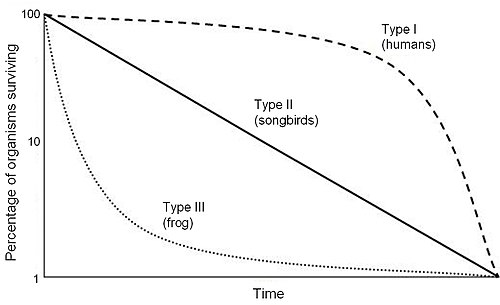
survivorship curve
plot of proportion or number in a cohort still alive at each age
Type 1 - low initial death rates
large mammals
few children, take good care of them
Type 2 - constant death rates
Type 3 - high initial death rates
many children, little care
metapopulations
members of lacal populations are linked
migration
local population within it occupy discrete patches of suitable habitats
if one population goes extinct, patch may be colonized by other populations
source-sink metapopulations
quality of patches vary linked by dispersal
source - high-quality, B>D, net exporters
rescues sink populations from extinction
sink - low-quality, D>B, net importers
generation time
time between two consecutive generations (birth of individual to birht of its offspring)
slow ←→ fast forms a continuum
helps estimate extinction
varies by size, environment, density
fecundity
potential to produce offspring
physiological maximum potential productive output
inversely related to parental care
different from fertility (actual number of offspring produced)
mortality
death rate in a population
altricial species
aniamls born or hatched underdeveloped
helpless
mature with the help of their parents
i.e. songbirds, dogs, marsupials
precocial species
young are relatively mobile from birth
open eyes, hair/down, large brains, mobile
ready to leave a few days from birth
i.e. horses, ducks, turtles
k-selected species
selection for traits beneficial at high densities
dnsity near carrying capacity
higher competition between individuals
i.e. mature trees in an old growth forest
r-selected species
selection for traits that maximize reproductive success in uncrowded environments (low densities)
lower competition
usually areas being recolonized
i.e. weeds growing in abandoned agricultural field
Allee effect
positive relationship between individual fitness and size of population
small populations struggle to survive → extinction
mate limitation, cooperative defense, environmental conditioning, genetic drift
strong correlation → spreads more slowly
Density dependent limiting factors
death/birth rates change as density changes
regulates population
limited resources, predation, disease, territoriality, intrinsic factors, toxic waste
density independent limiting factors
birth/death rate changes due to a factor unrelated to population density
i.e. weather events, pollution, natural disasters
inconsistent - not good at regulating population
semelparity
organism that undergo one-shot pattern of big-bang reproduction
i.e. salmon produce thousands of eggs in one reproductive opportunity before it dies
one reproductive cycle before death
iteroparity
repeated reproduction
i.e. oak trees producing acorns every year
multiple reproductive cycles
biotic potential
maximize reproductive capacity of a population under ideal environmental conditions
peak birth rate, lowest mortality, unlimited resources
exponential growth w/o carrying capacity
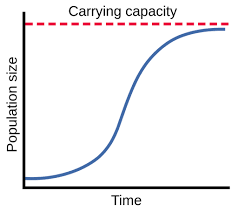
carrying capacity
maximum population a particular environment can sustain
varies with abundance of limited resources
k
logistic growth curve
popualtion grwoth slows as population approaches carrying capacity
clumped spacing
individuals aggregated in patches
most common
mating behavior or increased effectiveness of predation or defense
i.e. fungi on a log
uniform spacing
individuals are evenly spaced
caused by direct interaction between individuals in a population
inhibition of nearby growth or territoriality
i.e. nesting penguins
random spacing
unpredictable spacing
position is independent of other individuals
absence of strong attraction or repulsion among individuals
factors are constant across area
i.e. windblown dandelion seeds
exponential growth curve
population experiences ideal consitions and members are free to reproduce at physiological capacity
increases at a constant proportion at each instant in time
dN/dt=rN
life history
traits that affect an organism’s schedule of reproduction and survival
1) when reproduction begins
2) how often organism reproduces
3) how many offspring per reproduction cycle
community
group of populations of different species living in close enough proximity to interact
fundamental niche
niche potentially occupied by that species
realized niche
portion of fundamental niche a species actually occupies
because of competition, realized niche is often different than fundamental niche
resource partitionioning
differentiation of niches that enables similar species to coexist in a community
niche
set of biotic and abiotic resources an organism uses in its environment
character displacement
tendency for characteristics to diverge more in sympatric populations than allopatric species
predation
+/- interaction in which one species (predator) kills and eats the other (prey)
adaptation of both prey and predator are refined through natural selection
Batesian mimicry
palatable/harmless species mimics unpalatable/harmful species it is not closely related to
i.e. caterpillar that looks like venomous snake
caused by natural selection
Mullerian mimicry
2+ unpalatable species resemble each other
i.e. cuckoo bee and yellow jacket
symbiosis
any relationship between 2+ organisms that live closely together
species evolve together
i.e. commensalism, mutualism, parasitism
commensalism
+/0 interaction where one species benefits and the other is neither harmed nor benefited
i.e. flowers that need shade living in a forest with tall tress
proto-cooperation
+/+ interaction where both species benefit from the interaction but it is not required for either species’ survival
facultative mutulaism
i.e. rhino and bird
mutualism
+/+ interaction where both partners benefit
common in nature
can also cause negatives but benefits>costs
parasitism
+/- interaction where parasite derives nourishment from host organism which is harmed in the process
ectoparasite
parasite that feed on the external surface of a host
i.e. ticks, lice
endoparasite
parasite that live within the body of the host
i.e. tapeworms
parasitoids
insects that complete larval development within the body of another insect, eventually killing it, and is free living as an adult
larva in host → host dies
more like predator relationship
usually wasps
ecological succession
turnover of species in disturbed area
primary succession
life colonizes distrurbed area that was lifeless - no soil
prokaryotes, protists, lichens, and mosses
make environment more favorable (sometimes)
secondary succession
colonize region that already had life that was cleared by disturbance that leaves soil intact
i.e. fire
keystone species
exert strong control on community structure by pivotal ecological role
not usually dominant - (most by biomass)
help maintain biodiversity and structure
biodiversity
entire variety of life
genetic variation
species variation
ecosystem variation
aposematic coloration
warning coloration
cryptic coloration
camoflauge
herbivory
+/- interaction where plant is severly damaged
species richness
number of different species in community
relative abundance
percent each species represents among total individuals
species diversity
species richness + species abundance
trophic structure
structure of feeding relationships that determines energy flow
disturbance
an event that changes a community by removing organisms or altering resource availability
ecosystem
sum of all organisms living in a given area and the abiotic factors they interact with
biogeochemical cycles
nutrient cycle with biotic/abiotic factors
global - cycles of gasseous elements in the atmosphere or elements in water
local - heavier elements transported as dust and absorbed by plants
aquifers
underground water reserves
part of water cycle
nitrogen fixation
conversion of N2 to forms that can be used to synthesize organic nitrogen compound (NH3)
major pathway for nitrogen into the ecosystem
natural: bacteria, lightning, volcanoes
human: fertilizers, factories
nitrification
how nitrogen becomes usable for plants
Ammonia (NH3) →→ Nitrate (NO3-)
primary producer
autotrophs
supports all other life
photosynthesis or chemosythisis
plants, algae, prokaryotes
consumers
heterotrophs
levels above primary producer
herbivore
primary consumer
eats plants
decomposer
detriviores
consumers that get energy from detritus
convert organic matter from all trophic levels to inorganic compound usable by primary producers
detritus
nonliving organic matter
dead organisms, feces, fallen leaves, wood
fungi, prokaryotes, earth worms
food chain
transfer of energy upward from its source in plants and autotrophs (primary producer) → herbivores (primary consumer)→ carnivores (secondary, tertiary, and quaternary consumers)
trophic levels
position an organism occupies in a food chain
trophic cascade
simplified top-down model
N←P←H←C
Species turnover
replacement of species or change in community composition over time
photoautotrophs
use light energy to make organic materials
plants, algae
chemoautotrophs
use chemical energy to make organic materials
thermal vents
heterotrophs
depend directly or indirectly on the outputs of primary producers for their source of energy
consumers
detritivores
decomposers