Contracts
 Call Kai
 Learn
Learn Practice Test
 Spaced Repetition
 Match
Match Flashcards
 Knowt Play
1/103

There's no tags or description
Looks like no tags are added yet.
Name | Mastery | Learn | Test | Matching | Spaced | Call with Kai |
|---|
No analytics yet
Send a link to your students to track their progress
104 Terms
Hawkins v. McGee
Communicating an intention doesn't require actually possessing that mental state
Those communications must do more than simply express an intention, make a prediction, or express optimism
Did the Doctor make a legally enforceable promise?
Warranty ≠ promise
Warranty is a promise that at a given moment something will be true, not future looking
There is no promise in the prediction alone
However, doctor’s guarantee is more likely a promise
Greater measure of certainty, less predictive
The words “I promise” aren’t alone dispositive, but help show promise
This guarantee was used to solicit employment
Function of promise is to give assurances, guarantee creates assurance and right to complain for failure to uphold assurance
Subjective intent not important here, expression of intent enough
Promise
a manifestation/expression/communication of an intention to do something, so made as to justify a belief that a commitment has been made (RST §2(1))
You can manifest intent without actual intent
There is a gap between the manifestation and commitment
An expression of intent does not alone always justify another’s belief that a commitment has been made
Objective v. subjective legal standards
Objective - the applicability of the standard does not necessarily depend on mental states
Subjective - the applicability of the standard depends on mental states
Spooner v. Reserve Life Ins.
bonus was illusory promise
Two types of illusory promises:
Performance isn’t guaranteed such that no legal right to complain exists
Promised performance is so indefinite there is no way to enforce it
Does not mean overly vague
Indefinite = absolutely no detail such that there is no administrative standard
Illusory promises either reserve the rights not to perform or are too radically indefinite to be enforced (really high bar for the second prong, even best efforts clauses can be enforceable)
Elements of an enforceable promise
Substantive
Consideration OR
Promissory estoppel
Procedural
Mutual assent
Consideration
Historically - whatever the reason the court gave that would justify enforcing the promise
now:
bargain theory
benefit detriment test
bargain theory
Consideration = a promise or performance given in exchange for a promise in return
Did the promisor make the promise to get something from the promisee? AND
Did the promisee give something in order to get the promise?
If yes to both, there is bargained for exchange
Excludes gift/gratuitous promises
Only by looking at the reasons of each party can we figure out if it is a quid pro quo exchange
Subjective standard
Conjunctive test
benefit detriment test
Did the promisor obtain a benefit by making a promise? OR
Did the promisee suffer a detriment as a result of the promise?
Detriment = at a minimum, giving up a legal right to do something
If legal right is already lost (illegal), the no consideration
Benefit = legal gain of some sort
Can’t just be good feeling of giving something
Objective test, disjunctive test
relationship between bargain theory and BD test
In BD, if promisor (who by nature incurs obligation) receives benefit, then both tests are satisfied
Can be deduced objectively
Same is true for promisee who faces a detriment
BD is a shortcut for bargain theory
But on its own fails to weed out conditional gift promises
Hamer v. Sidway
Is the promisee to pay $5000 conditional on the nephew’s behavior an enforceable promise?
Using bargain theory, there appears to be a reciprocal motive of exchange (money for behavior)
Each promised to obtain the other promise
Using benefit detriment test, promise enforceable bc the nephew suffered a detriment as a result of the promise
Adequacy of consideration
“[A] mere pretense of bargain does not suffice, as where there is … where the purported consideration is merely nominal. In such cases there is no consideration....” (RST §71)
Courts generally reject the restatement view
Peppercorn theory - not the court’s business as to inquire to the adequacy of consideration, you are entitled to receive as little as you like to give up something, so long as there is some legal value being exchanged
Moore v. Elmer
Clairvoyant woman predicts death, man promise mortgage if prediction is true, promise made after prediction is given
Is promise supported by consideration?
Under bargain theory, the promise is not given to induce a reciprocal promise (made after prediction), so no consideration
Under benefit detriment test, promisor doesn’t receive a benefit (already got prediction) and promisee doesn’t suffer a legal detriment
Because promise made after service, no consideration
Rule: past consideration is no consideration at all
Mills v. Wyman
Is the promise by senior Wyman an enforceable promise to pay Mills for caring for his son? Is there consideration?
Bargain theory:
Father doesn’t give promise to induce a promise in return, only promising payment for prior services
BD test:
Wyman doesn’t get benefit in result of promise, benefit already gotten
Mills doesn’t suffer detriment as result of promise, he has already incurred detriment of caring for Wyman’s son
Moral consideration:
Doesn’t apply bc no pre-existing legal obligation
Exceptions to past consideration rule—moral consideration:
Post bankruptcy discharge
Promise to pay for past debt after going bankrupt
Debts incurred during infancy, that are later promised
That are later revived by a promise made at a later date
Statutes of limitations
You owe money, statute of limitations passes, but make promise to pay, again enforceable
Originally had bargained for exchange, but operationally no longer enforceable
New promise revives bargain
Webb v. McGowin
Pine blocks case
Webb exception
If a person obtains a material benefit, and thereafter promises to pay for it, then this promise is presumptively enforceable
Meant to prevent unjust enrichment
What is a material benefit?
Court emphasizes pecuniary or measurable monetary value as material
Alaska Packers v. Domenico
If parties enter a new agreement under which one party agrees to do no more than he was already obligated to do under an existing contract, is the new agreement enforceable?
No, lacks consideration
Despite a bargained for exchange, fails BD test
Company (promisor) obtains no new legal benefit
The benefit of services already established
Employees (promisee) take on no new legal detriment
Peppercorn theory could be used to establish consideration
Could also waive right to sue for breach of contract (mutual rescission)
If both parties waive right, old contract invalid
Then could establish new contract
Bargain theory argument fails because there was no voluntary bargain
Was coercive
Pre-existing duty rule
The performance or promise to perform a pre-existing legal duty does not constitute consideration
Problems with pre-existing duty rule
Too strict: requires new consideration for even reasonable, noncoercive contract modification
Too lax: easily circumvented, given the peppercorn theory
The distinction from valid and invalid renegotiations
If a voluntary waiver of right to sue, and a new contract is formed, that contract may be enforceable
If involuntary/coerced, then unlikely to be enforced
Restatement's approach to pre-existing duty rule
“A promise modifying a duty under a contract not fully performed on either side is binding … if the modification is fair and equitable in view of circumstances not anticipated by the parties when the contract was made” (RST §89(a))
Presumption is modification is enforceable unless it fails to meet condition
Not anticipated = subjective
Fair and equitable = objective
Coercion falls under this condition
Further factors:
Financial strength of parties
Formality of modification
More formal = more fair
Reliance on performance
Catch all
““[T]he [i] relative financial strength of the parties, [ii] the formality with which the modification is made, [iii] the extent to which it is performed or relied on and [iv] other circumstances may be relevant to show or negate imposition or unfair surprise.”
Duty must be existing
How to interpret “either”?
Essentially means both according to the courts
To have a duty to modify, there must first be an existing duty
"if one party to a contract has fully performed, a promise of additional performance by that party made in order to induce the other party to perform, is clearly without consideration, even under the Restatement, Second approach"
Rejects mutual rescission when “the rescission and new agreement are simultaneous, and because if logically carried out it might uphold unfair and inequitable modifications"
Elements of 89(a), simplified
Both parties must still have contractual duties to perform
The modified duty must be fair and equitable, given
Circumstances not anticipated by the parties when the contract was made
UCC solution to pre-existing duty rule
“An agreement modifying a contract within this Article needs no consideration to be binding…” UCC § 2-209(1).
Essentially there is no pre-existing duty rule
Goods under Article 2 of UCC
“‘Goods’ means all things (including specially manufactured goods) which are movable at the time of identification to the contract for sale other than the money in which the price is to be paid ….” --UCC s. 2-205 (in short: tangible goods).
Why created pre-transaction?
If not already created, contract is really about the service of creating the goods
First question you should ask yourself is if this is governed by article 2 or not
When does art 2 apply vs CL
If more specific rule under article 2, it will displace CL and apply
Involving purchase or sale of goods
If open question, no specific rule, apply background CL rule
Default v mandatory rules
Mandatory
Non-negotiable by law
– Parties can’t voluntarily choose to ignore them or waive their applicability
• Examples:
– Consideration Requirement
– Mutual Assent
– Duty of good faith and fair dealing
Likely explicitly identified
Default
Negotiable by law
– Parties may choose to dispense with them or alter them
• Examples:
– Interpretive sources
– Which contract law governs
– Notice of acceptance by performance
Used when a party is silent on a matter
Ambiguity v. vagueness
Ambiguity - whether there are independent, discrete meanings of terms
Vagueness - borderline cases
Rules vs. standards
What is difference?
Rules - more precise (less vague)
Applicability turns on matters of fact
Numerical predicates often an indicator
Standards - more vague
Applicability turns on value judgments
"reasonable, justifiable, or feasible"
Why is matters?
Rules
• Decisions made “upstream” by officials making the rule.
• Little downstream discretion of officials who apply them.
• Inevitable under-inclusiveness and over-inclusiveness problems.
• Costly to produce.
Standards
• Decision-making authority delegated “downstream” to officials applying it.
• Lots of official discretion downstream.
• Inevitable indeterminacy problems.
• Cheaper to produce.
Promissory Estoppel
Promissory estoppel is concerned about future oriented events
Reliance on a promise, leading to injury
Lots of overlap between PE and BD
Breach of contract provides more damages than PE
PE only restore to standing prior to injury, no expectation damages
Only get what you spent in reliance
Promissory estoppel elements
Restatement elements (RST §90(1))
Is there a promise?
Could the promisor reasonably foresee that the promisee would rely on that promise?
Did the promisee reasonably rely on that promise?
Can injustice be avoided only by enforcing the promise?
Ricketts v. Scothorn
Promissory Estoppel: Having intentionally influenced the P to alter her position
for the worse on the faith of the note being paid when due, it would be grossly
inequitable to permit the maker or his executor to resist payment on the
ground that the promise was given without consideration
Kadimah Toras Moshe v. DeLeo
Why no reliance?
Changing the budget is only an expression of desire/hope to use
Not sufficient to establish legal detriment or reliance
Had they begun spending with expectation of increased funds, then more likely reliance
What about charitable subscription? RST §90(2)
A charity doesn’t have to establish reliance
Only three elements:
Promise
Reasonably foresee reliance
Can injustice be avoided only by enforcement
Court says no injustice regardless bc no reliance
Despite not being an element, now factor for injustice
Framework for establishing “injustice” (PE)
Promisee’s interest: what harms, if any, did the promisee actually suffer in relying on the promise?
More suffering = more likely to be injustice
Promisor’s interest: why did the promisor break the promise?
Better reason for breaking = less likely to be injustice
Public policy interests: how would enforcing the promise affect public policy?
Oral = less likely to be enforced
establishing mutual assent
Mutual assent typically established through offer and acceptance
RST §22(1) - “the manifestation of mutual assent to an exchange ordinarily takes the form of an offer or proposal by one party followed by an acceptance by the other party or parties”
Lucy v. Zehmer
Is the objective, outward expression of a party’s intent to be bound in an agreement, as opposed to that party’s subjective mental assent to the agreement, all that matters when determining the existence of a valid and enforceable contract?
Zehmer’s subjective intent makes no difference
What is important is that a reasonable person in the offeree’s position would understand the offer to be an offer
Lucy thought it was a valid offer
Cannot change terms after acceptance already made to valid offer
Normal objective rule:
“The ‘reasonable meaning’ of outwardly expressed words and deeds determines whether a party intended to assent, not what the person actually intended.”
Lucy exception
“If the words or other acts has but one reasonable meaning, his undisclosed intention is immaterial except when an unreasonable meaning which he attaches to his manifestation is known to the other party”
Reasonable person standard immaterial
Lucy Exception
The understanding of a reasonable person controls EXCEPT when one party knows that the other party has an unreasonable understanding that the first one assented/believes they made an offer. Then can be used to validate or invalidate a contract depending on which party had the unreasonable belief.
RST §26 (offers)
a communication is not an offer “if the person to whom it is addressed knows or has reason to know that the person making it does not intend to conclude a bargain”
Subjective inquiry
Offers ( RST §24)
RST §24 - “an offer is a manifestation of a willingness to enter into a bargain, so made as to justify another person in understanding that his assent to that bargain is invited and will conclude it.”
Objective rule
Zehmer manifested his willingness to bargain, despite no intent
Someone must also be justified in believing their assent would conclude the bargain
Decided by Southworth factors
Southworth v. Oliver (Southworth factors)
Southworth factors (for distinguishing offers from preliminary negotiations)
Language of commitment used?
A specific person named?
Distinguishes from ads and other solicitations for offers
Definiteness - how much is left open for negotiation?
More left open or vague, less likely to be an offer
And vice versa
Catchall - a reasonable person in the circumstances would have understood it to be an offer?
Lefkowitz v. Great Minneapolis Surplus Store
In general, ads are not offers
Just offers for preliminary negotiations
All ads manifest a willingness to bargain
Perhaps two part rule for ads:
Ads are not offers, unless
They are clear and definite, leaving nothing open to negotiations
Price terms, quantity, kind, etc. included
Not every condition can be included, but some more damning that others
Ex. price missing more likely to make not an offer than payment terms
This is a unilateral contract
Only way to accept is to perform on its terms
Leonard v. PepsiCo
Is the commercial an offer?
Generally no, and here no
Ad is not clear, definite, explicit
No time place manner description of instruction
Lot left open to negotiation
Ultimately though, what drives court’s decision is belief ad is a joke
A reasonable person wouldn’t construe this to be an offer
UCC approach to offers
Article 2 UCC §2-204(3) - “even though one or more terms are left open a contract for sale does not fail for indefiniteness if the parties (offeror) have intended to make a contract and there is a reasonably certain basis for giving an appropriate remedy”
Offers are possible despite open ended terms if party who manifests willingness to bargain truly intended for statement to be an offer
Article 2 UCC §2-305
§2-305(1) - “the parties if they so intended can conclude a contract for sale even though the price is not settled”
This is a default rule, can add language that makes it not an offer
§2-305(4) - “where, however, the parties intend not to be bound unless the price be fixed or agreed and it is not fixed or agreed there is no contract”
To express, must use language indicating not an offer
Other open terms
Place of delivery missing? Not necessarily fatal, see UCC 2-308
Time of delivery? Again, not a problem, see UCC 2-309
Bottom line: apply the restatement definition of "offer" and the Southworth factors regardless of whether UCC applies
Just know that, if the UCC applies, the communicator might still have made an offer despite the undefined terms
Essentially add an intent analysis
Revocation of Offers
RST §36 - an offeree’s power of acceptance may be terminated by revocation by the offeror
Direct v. Indirect revocation
Directly - offeree must “receive” communicated intent to revoke
Control or possession can be receipt, not a pure subjective (knowledge) requirement, objective receipt
What does it mean to receive?
A written revocation, rejection, or acceptance is received when the writing comes into the possession of the person addressed or an agent of the person addressed
Objective standard, person doesn’t have to know, just have possession (capacity to know?)
Indirectly - definite action inconsistent w/ intention to enter contract and offeree “acquires” reliable info on this
Subjective receipt
RST §43 - “an offer terminates when the offeror takes definite action inconsistent with an intention to enter into the proposed contract and the offeree acquires reliable information to that effect.”
For indirect revocation
Solicitation of other potential business partners or buyers not enough to satisfy definite action inconsistent with intent to enter contract
If you actually sell, that is sufficient (see Dickinson)
Dickinson v. Dodds
Did Dickinson accept Dodd’s offer before Dodds revoked it?
Did Dickinson directly revoke?
No, no communication to offeree from offeror
This is a case about indirect revocation
Learns from third party
Was there mutual assent or meeting of the minds?
Before attempted acceptance, Dickinson knew Dodds had sold to someone else
No meeting of the minds, no subjective mutual assent to contract
If offeree knows subjective that the offeror has sold the offered good to someone else, there can be no acceptance\
Bc knowledge of sale, no acceptance
UCC 2-205 Exception for firm offers
Under CL, for promise to keep an offer open to be binding, must have consideration
Must be enforceable promise on its own, typically satisfied with peppercorn theory
Under UCC, promises to keep offers open are binding, even without consideration
They are binding for the time period stated in the promise
If no time stated, the offer will remain available for a "reasonable time” not to exceed 3 months
Default rule, can be contracted around
“Reaonable time” = standard
No more than 3 months = rule
Such promises must be signed separately by the offeror
Must be in writing, independent of other contract
Shows evidence of firm offer
Accepting offers
Acceptance = manifestation of assent to offeree's terms, as required by the offer
If not stipulated directions for assent, can be done different ways
2 main ways to accept:
Via communication
Via performance
RST §50 - "manifestation of an assent to the terms thereof made by the offeree in a manner invited or required by the offer”
If accepting, follow directions of how to accept outlined in offer (if present)
Embry v. Hargadine
Does McKittrick’s response count as acceptance?
Yes, reasonable person would conclude it to be an acceptance
“If what McKittrick said would have been taken by a reasonable man to be employment, and Embry so understood it, it constituted a valid contract of employment for ensuing year”
Acceptance relies on objective intent manifested by offeree, and subjective understanding of assent by offeror
Embry exception:
If a party claims there is a mutual (objective) assent, then that party better (subjectively) believe it
If the offeror does not subjectively believe there to be an assent, then the assent will not be enforceable, even if a reasonable person would conclude it to be
Similar language to Lucy exception but slightly different
While the Lucy exception focuses on avoiding exploitation of others, this exception is best understood as avoiding exploitation of the court
Still, subjectively intending not to assent doesn't defeat mutual assent–at least if you wish to deny that mutual assent exists
Objective standard applies
Ardente v. Horan
Counter offers operate as rejections of previous offer and a creation of a new offer
Did the letter operate as an acceptance or counter offer?
Not acceptance because request was framed as confirmation that items were included in deal
Details of deal aren’t finalized, still negotiating
Items requested are challenging to replace or obtain
Decreasing apparent willingness to do deal without them
so no acceptance, only counter offer
Communication must be “definite and unequivocal” to count as acceptance
Addition terms will not void the acceptance if they are “clearly independent” of the acceptance
Mirror image rule
In general, manifestation of assent must reflect exactly the terms stipulated by the offer to count as a valid acceptance (RST §59)
In Ardente, P could unequivocally assent and then create a new offer to purchase items
Failing to do so invalidates assent
RST § 61 - acceptance v. counter offer
RST §61 - “an acceptance which request as change or addition to the terms of the offer is not thereby invalidated unless the acceptance is made to depend on an assent to the changed or added terms.”
White v. Corlies
Is purchasing lumber and beginning work acceptance?
No, to be a valid acceptance by performance, a reasonable person must interpret the behavior as assent
The contractor was doing as he always would, regardless of acceptance, so unlikely to be sure that is was an acceptance
Not capable of putting the offeror on notice
To accept via performance, it must be the type of performance that would be capable of putting the offeror on notice
Ex. Bringing the lumber to job site
Notice of acceptance via performance
Can accept via performance but very vulnerable
Even if you provide notice, if you know or have reason to know offeror can’t learn of acceptance, existing legal obligation might disappear
RST §54(2)
If an offeree who accepts by performing has reason to know that the offeror has no adequate means of learning of the performance with reasonable promptness and certainty, the contractual duty of the offer is discharged unless . . .
The offeree exercises reasonable diligence to notify the offeror of acceptance, or
The offeror learns of the performance within a reasonable time, or
The offer indicates that notification of acceptance is not required
Limitations to acceptance
Generally, accepting requires following the manner of acceptance stipulated by the offer
Under the common law's mirror image rule, an acceptance that adds conditions or materially changes terms = counter offer, and thus rejection of original offer (Ardente)
But clearly independent or immaterial requests do not void an acceptance (Ardente)
Acceptance by performance
To successfully accept by performance, that performance must "indicate or set into motion an indication" of acceptance (White v. Corlies and Tifft)
If someone accepts by performance, their contract is vulnerable to discharge (RST §54(2))
Know the three ways that the contract can be protected against discharge (RST §54(2))
When is acceptance complete?
To be binding as an acceptance, assent must be manifested in a way that, “in the usual course of events” would be “communicated” to the offeror “in some reasonable time” (White v. Corlies and Tifft)
Mailbox rule
“A letter received by mail containing a proposal, may be answered by letter by mail, containing the acceptance. And in general, as soon as the answering letter is mailed, the contract is concluded.”
Carlill v. Carbolic Smoke Ball
Acceptance?
Carlill manifested with performance
Bought smoke ball, used it as directed, contacted company for reward
This was consistent with the manner stipulated by offer
Offer doesn't stipulate much, just use the smoke ball as directed, contracted the flu, and contracted within reasonable amount of time
Why was prior notice not required?
Offer itself did not explicitly require it
Not implied because it would defeat the purpose of the offer/promise to require it
Would add unnecessary burden, wouldn’t want to give notice before performance when performance only way to assent
Which performance = acceptance?
Court concluded that purchase and proper use was the requisite performance
Restatement/Carlill on Notice
“Where an offer invites an offeree to accept by rendering a performance, no notification is necessary to make such an acceptance effective unless the offer requests such a notification.” RST §54(1)
If acceptance via performance is only way to accept, prior notice not required unless specified
When does acceptance take effect?
In general, when manifested such that, “in the usual course of events” acceptance would be “communicated” to the offeror “in some reasonable time” ()… --White v. Corlies & Tifft
This general principle entails:
In the snail mail context, the Mailbox Rule governs.
If you want to accept by initiating performance, your activity must be capable of providing notice within a reasonable timeframe
Prior Notice of Performance
If an offer permits you to accept by performance, then no prior notice must be given before commencing performance.
Absent explicit permission to accept by performance, or explicit waiver of prior notice, permission might be implied by the nature of the offer (e.g., rewards and similar “unilateral contracts”)
More on Acceptance by Performance
If the offer is silent on manner of acceptance, offeree presumably may accept by performance.
Rewards or “prove me wrong” advertisements allow acceptance only by performance, unless otherwise specified; no prior notice needed.
To determine whether an advertisement is a reward or prove-me-wrong offer, ask whether requiring prior notice would defeat the purpose of the offer. (Carlill)
Rewards = unilateral offers that impliedly dispense of prior notice requirements and only way to accept is via performance
Valid under bargain theory
PMW = treated similarly but are technically different
Might have issues with bargain theory; what does promisor get from promise?
Courts treat them the same though for policy reasons
Prevents get out of jail cards for promisors; prevents grandiose claims without following through on promise
Battle of the Forms
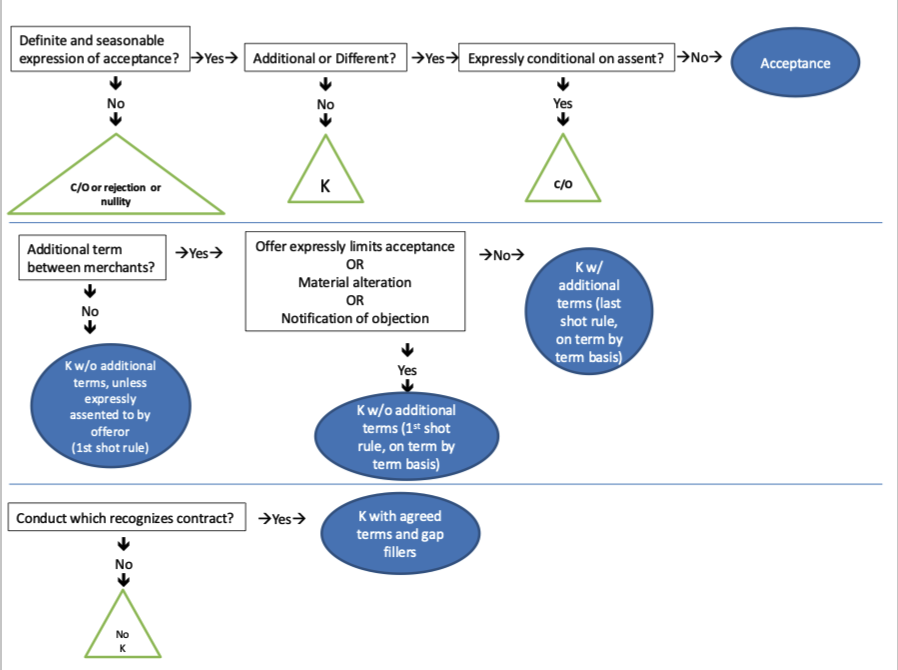
Unif. Commercial Code § 2-207 Additional Terms in Acceptance or Confirmation.
(1) A definite and seasonable expression of acceptance or a written confirmation which is sent within a reasonable time operates as an acceptance even though it states terms additional to or different from those offered or agreed upon, unless acceptance is expressly made conditional on assent to the additional or different terms.
2-207 repudiates mirror image rule
What language shows “expressly made conditional”?
Ex. “seller’s acceptance of buyer’s purchase order is expressly made conditional on buyer’s assent to terms.”
No implied conditional acceptance, must be made explicit
(2) The additional terms are to be construed as proposals for addition to the contract. Between merchants such terms become part of the contract unless:
(a) the offer expressly limits acceptance to the terms of the offer;
(b) they materially alter it; or
(c) notification of objection to them has already been given or is given within a reasonable time after notice of them is received.
(3) Conduct by both parties which recognizes the existence of a contract is sufficient to establish a contract for sale although the writings of the parties do not otherwise establish a contract. In such case the terms of the particular contract consist of those terms on which the writings of the parties agree, together with any supplementary terms incorporated under any other provisions of this Act.
Even if there is some term that might seem to not count, it might still become part of the K if the parties treat it as part of the K
Saves terms that might fail 2-207(2)
Working through battle of the forms
UCC 2-207 replaces mirror image rule for transactions involving the purchase of goods
Especially (1)
2-207(1) - a K might be formed even if the acceptance contains additional terms
2-207(2) explains when those additional/different terms become part of the K
Big question: are both parties merchants?
If yes, presume enforceable
Unless:
The offer expressly limits acceptance to the terms of the offer, or
They materially alter it, or
"the test for materially alteration is whether the additional term would result in surprise or hardship to the non-assenting party." (Bordeau bros)
Factors to consider:
"the prior course of dealing between parties"
"the number of written confirmations provided by plaintiff"
"whether the term reflects industry custom"
Notification of objection to them has already been given or is given within a reasonable time after notice of them is receive
If no, presume unenforceable
Unless both agree to terms
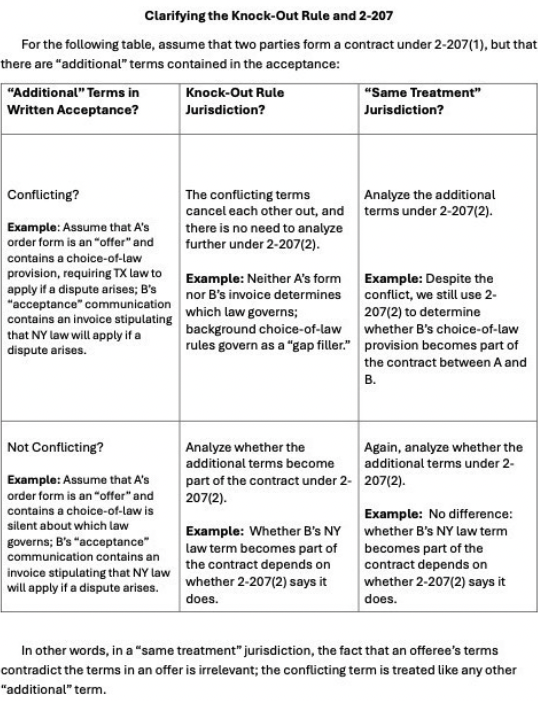
Knock-out rule and 2-207
Bourdeau Bros v. Bosseanault Family Farms
Are both parties merchants?
If one party weren’t a merchant, then additional term falls out, unless both parties agree it will be part of K (see 2-207(2))
By definition, grain merchant clearly a merchant
What about dairy farmers?
Court said yes
“If someone could reasonably expect you to have expertise in the good because of your occupation, you count as a merchant” basically
Bc both merchants, additional term is presumptively enforceable unless it falls into exception
Exception in question is “materially alter” (see 2-207 (b))
Merchant
“A person who deals in goods of the kind or otherwise by his occupation holds himself out as having knowledge or skill peculiar to the practices or goods involved in the transaction.”
What does materially alter mean?
“The test for material alteration is whether the additional term would result in surprise or hardship to the non-assenting party.”
Factors to consider:
“The prior course of dealing between parties”
If common in past dealings, less likely to surprise or burden
“The number of written confirmations provided by plaintiff”
Same idea as previous factor
“Whether the term reflects industry custom”
If reflects, less surprising
Categorical approach to determining material alteration
Examples of material alteration (UCC, 2-207 cmt 4)
“A clause negating such standard warranties as that of merchantability”
“A clause reserving to the seller the power to cancel upon the buyer’s failure to meet any invoice when due”
Examples of terms that presumptively don’t materially alter
“Interest on overdue invoices”
Industry custom, but if overly severe could be considered material alteration
“Limiting the right of rejection for defects that go beyond industry custom”
Again, if overly extreme could materially alter
Hobbs v. Massasoit Whip Co.
Rule: you can accept via silence under the following circumstances:
“Where because of previous dealings or otherwise, it is reasonable that the offeree should notify the offeror if he does not intend to accept”
Policy concern of being bombarded not applicable bc requires prior dealings
RST §69(1) (silence as acceptance)
“Where an offeree fails to reply to an offer, his silence and inaction operate as an acceptance in the following cases only:
(a) “where an offeree takes the benefit of offered services with reasonable opportunity to reject them and reason to know that they were offered with the expectation of compensation”
What does it mean to take the benefit?
Using, not just leaving it there
This exception is largely geared towards services contracts
(b) "where the offeror has stated or given the offeree reason to understand that assent may be manifested by silence or inaction, and the offeree in remaining silent and inactive intends to accept the offer”
(c) "where because of previous dealings or otherwise, it is reasonable that the offeree should notify the offeror if he does not intend to accept
Essentially Hobbs holding
ProCD v. Zeidenberg
Buy now / terms later contract is enforceable so long as there is an opportunity to refund (essentially reject license agreement)
Placing greater burden on purchaser
Nguyen v. Barnes and Noble
Is there acceptance? Under what conditions are users bound by the terms of use?
To be bound/accept, you must have notice
Types of notice:
Actual
Subjective, knowledge
Constructive
Objective (inquiry notice)
Would a reasonably prudent person understand there are binding terms and conditions
Clicking “I agree” to terms would satisfy both types and be assenting
Barnes and Noble stipulated that accessing the website was assent to the terms
Court said this isn’t controlling; not sufficient notice
There are limits on the power of offeror to stipulate manner of acceptance
Determining constructive notice is contextual, fact intensive
More obvious terms are placed/shown, more likely to be constructive notice
If “buried at bottom,” no notice (See Specht)
9th Circuit’s holding:
“[W]e therefore hold that where a website makes its terms of use available via a conspicuous hyperlink on every page of the website but otherwise provides no notice to users nor prompts them to take any affirmative action to demonstrate assent, even close proximity of the hyperlink to relevant buttons users must click on—without more—is insufficient to give rise to constructive [i.e., inquiry] notice.”
Contracts of Adhesion
Standard form agreements are most common type of contract today
Also called “boilerplate”
Standard terms, usually governing large numbers of transactions
Reduce transaction costs
But very unequal bargaining power
Drafter has almost total say over contents of bargain
“Take it or leave it”
Often difficult to understand and lengthy
Does constructive inquiry notice remove the requirement of mutual assent?
Devolution of mutual assent:
From subjective acceptance ->
To objective acceptance ->
To notice + reasonable rejectability ->
Placing burden on offeree to return if don’t agree to terms they don’t know until after purchase
To inquiry notice
Entering into contracts you may not even know about
Freedom from contracts is deteriorating
Offeror needs power to stipulate acceptance limited in order to better protect offeree
“wrap contracts”
include shrinkwraps (Hill), clickwraps, and browsewraps
Clickwraps = click I agree, assent
Shrinkwraps = buy now, read terms later (ProCD)
Can be assent if ability to reasonably reject
Browsewraps = actual vs. constructive notice (Nguyen)
Actual is subjective, knowledge inquiry
Constructive notice is a "totality of circumstances" type test, a fact specific objective inquiry
Each involves a different way to secure mutual assent