BIOCH 200 Unit 3 - Protein Structure (Question)
 Call Kai
 Learn
Learn Practice Test
 Spaced Repetition
 Match
Match Flashcards
 Knowt Play
1/42

There's no tags or description
Looks like no tags are added yet.
Name | Mastery | Learn | Test | Matching | Spaced | Call with Kai |
|---|
No analytics yet
Send a link to your students to track their progress
43 Terms
The pKa value of the -COOH group is ___, the pKa value of the -SH group is ___, the pKa value of the -NH3+ group is ___.
2, 9, 9.5
SH, OH, and COOH groups have a ___ charge when protonated and a ___ charge when deprotonated. NH2 has a ___ charge when protonated and a ___ charge when deprotonated.
Neutral, negative. Positive, neutral
At pH 7, what is the charge of a general amino acid (assuming uncharged R group)? Explain your reasoning, including protonation state of all groups.
The carboxyl group is in its deprotonated form (COO-) because the pH is greater than 2, contributing a negative charge. The amino group is in its protonated form (NH3+) because the pH is less than 9.5, contributing a positive charge. The overall charge is neutral
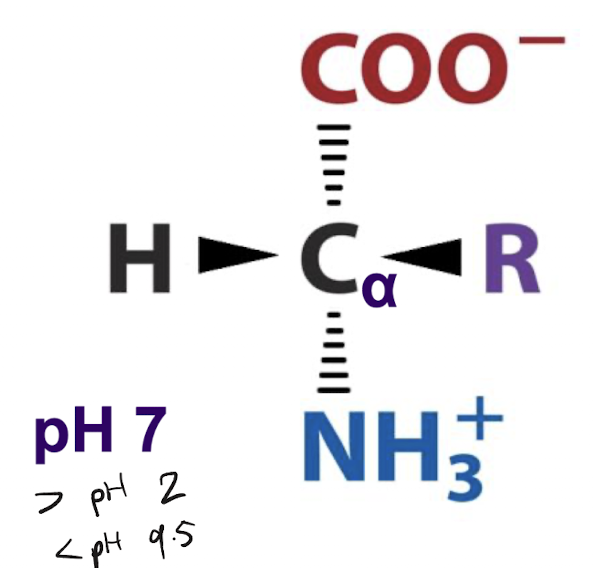
At pH 1, what is the charge of a general amino acid (assuming uncharged R group)? Explain your reasoning, including protonation state of all groups.
The carboxyl group is in its protonated form (COOH) because the pH is less than 2, contributing no charge. The amino group is in its protonated form (NH3+) because the pH is less than 9.5, contributing a positive charge. The overall charge is +1
At pH 14, what is the charge of a general amino acid (assuming uncharged R group)? Explain your reasoning, including protonation state of all groups.
The carboxyl group is in its deprotonated form (COO-) because the pH is greater than 2, contributing a negative charge. The amino group is in its deprotonated form (NH2) because the pH is greater than 9.5, contributing no charge. The overall charge is -1
What type of ion is a generic amino acid at pH 7?
Zwitterion if no charged R group
Are all polar amino acid side chains classified as polar? Why or why not?
No, while charged polar side chains are functionally polar, they are not classified as such due to having their own group (charged side chains)
Are hydrophobic amino acids soluble in water?
Yes, hydrophobic refers to the side chain. All amino acids are soluble in water due to their charged amino and carboxyl groups
Which 4 amino acids have aromatic side chains? Describe their absorbance of UV.
Phenyl/benzene in aromatic ring has resonance and thus absorbs UV.
Phenylalanine: weakly absorbs UV at 280 nm
Tryptophan: very strongly absorbs UV at 280 nm
Tyrosine: absorbs UV light at 280 nm
Histidine: weakly absorbs UV light at 280 nm
Which amino acids can be modified by phosphorylation? What is needed? How does this happen?
Serine, threonine, tyrosine. OH group needed. Phosphate is connected via a phosphoester bond
What are the conditions needed for a disulphide bond to form? In which proteins does this occur and why? How is this process reversed?
2 Cys residues must be close enough to form a bond
An oxidizing environment is required
Through an oxidation reaction, 2 H+ and 2e- are removed from the sulfhydryl groups on both Cys to form an S-S bond. This occurs in mitochondrial and extracellular proteins as these environments are oxidizing
The process is reversed through a reduction reaction that returns the H+ to the sulfhydryl groups, breaking the S-S bond. This typically happens in the cytosol, which is a reducing environment
Which amino acids are ionizable/have the capacity to be charged? Split them by comparison to pH 7.
Tyr, Cys, Lys, Arg pH > 7. Asp, Glu, His pH < 7.
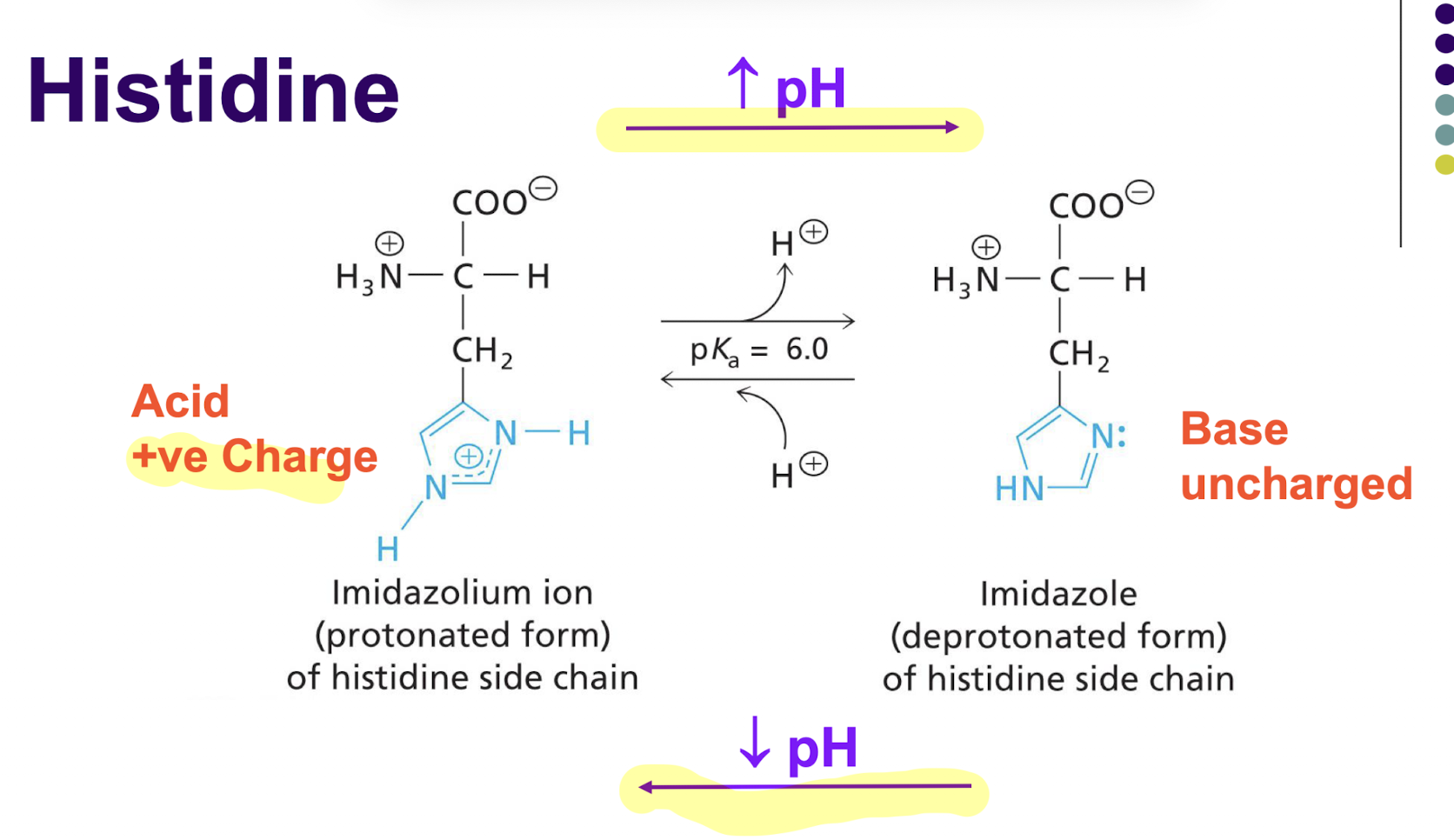
How is histidine able to act as both an acid and a base?
Its pKa is 6, meaning in physiological conditions, the nitrogenous base ion is in its protonated (acid) form at the low range of biological pH and is in its deprotonated (base) form at the high range of biological pH. The pKa will vary depending on the protein it is in and its location in a protein
Hydrophobic proteins are found on protein (surface/interior). Polar proteins are found on protein (surface/interior). Charged proteins are found on protein (surface/interior). Explain.
Protein interior is a hydrophobic environment
Hydrophobic: interior (hydrophobic interactions)
Polar: usually surface, may occur on interior (to occur in interior, needs a group to H-bond with to make it less polar)
Charged: usually surface (to occur in interior, needs a group with the opposite charge to neutralize its charge)
The carbonyl and amino groups involved in a peptide bond are (always/sometimes/never) ionizable. Why?
Never. Peptide bond is neutral and does not have a pKa between 1 and 14
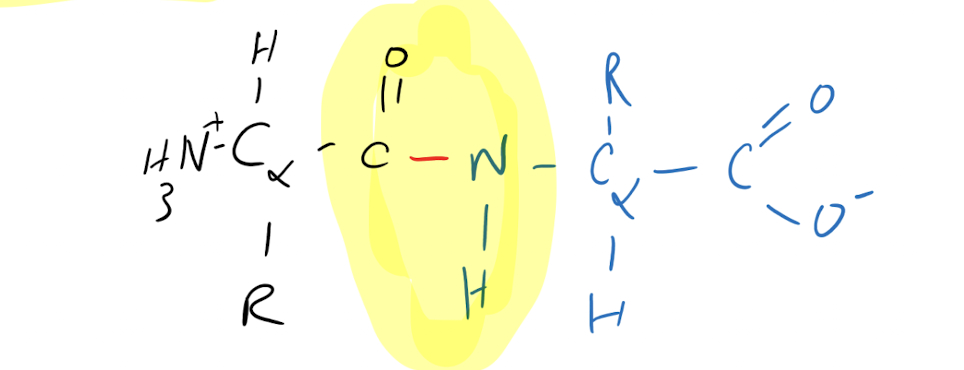
Any number of peptides joined together will have ___ peptide bonds.
n-1
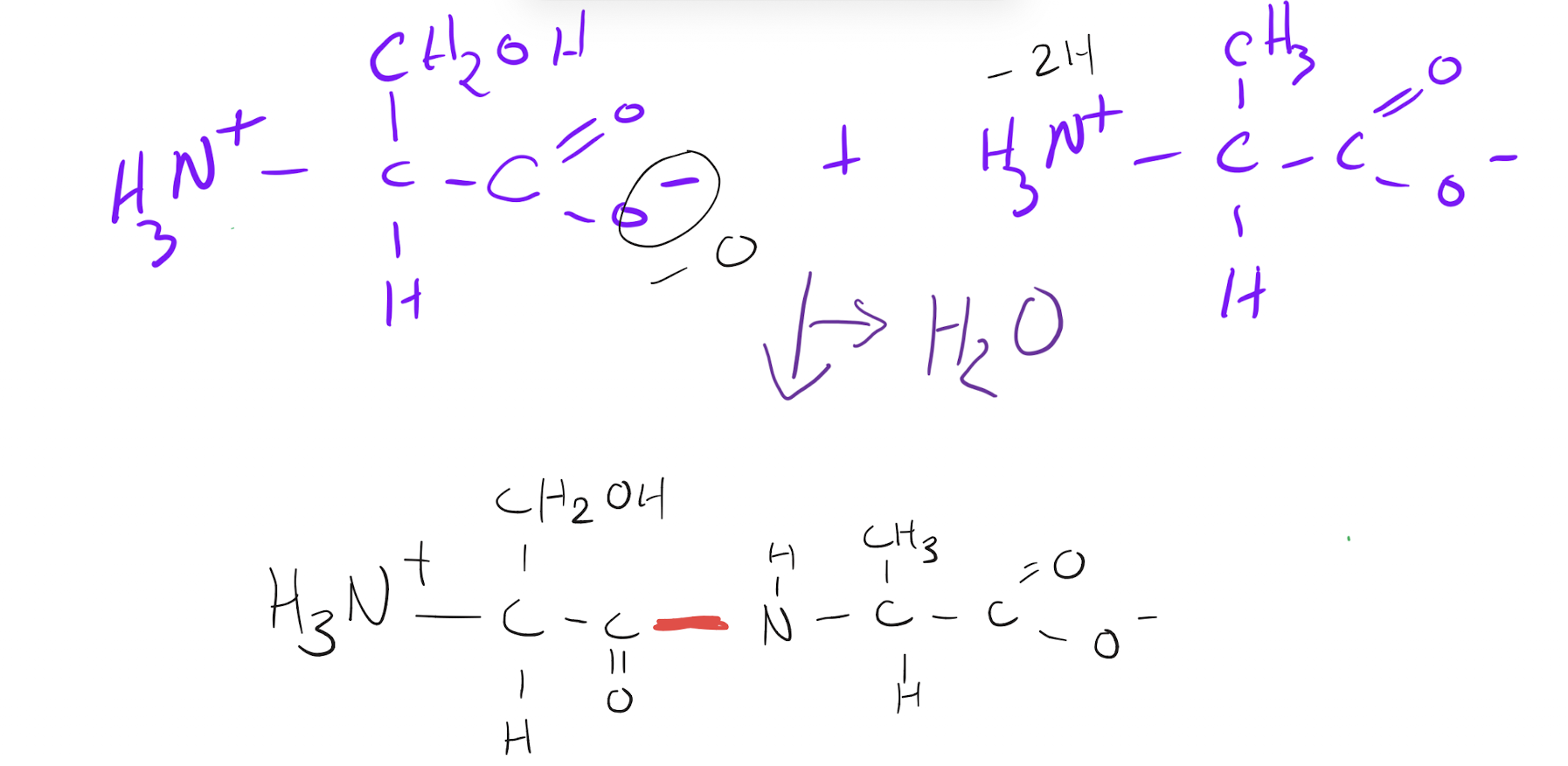
Explain the formation of a peptide bond, including functional groups and atoms.
On one amino acid, the C terminus carboxyl O is removed, and on the other 2 oxygens are removed from the amino, precipitating a water molecule in a dehydration reaction. The carbon and nitrogen are then joined together to form an amide linkage specific to amino acids
Proteins run from which terminus to which? Peptide bonds?
N to C, C to N
Which alpha carboxyl and amino groups retain their charge in a polypeptide? Why aren’t all charges retained?
Only terminal alpha carboxyl and amino groups (or side chain charges), others are eliminated by the formation of peptide bonds

What are the properties of peptide bonds?
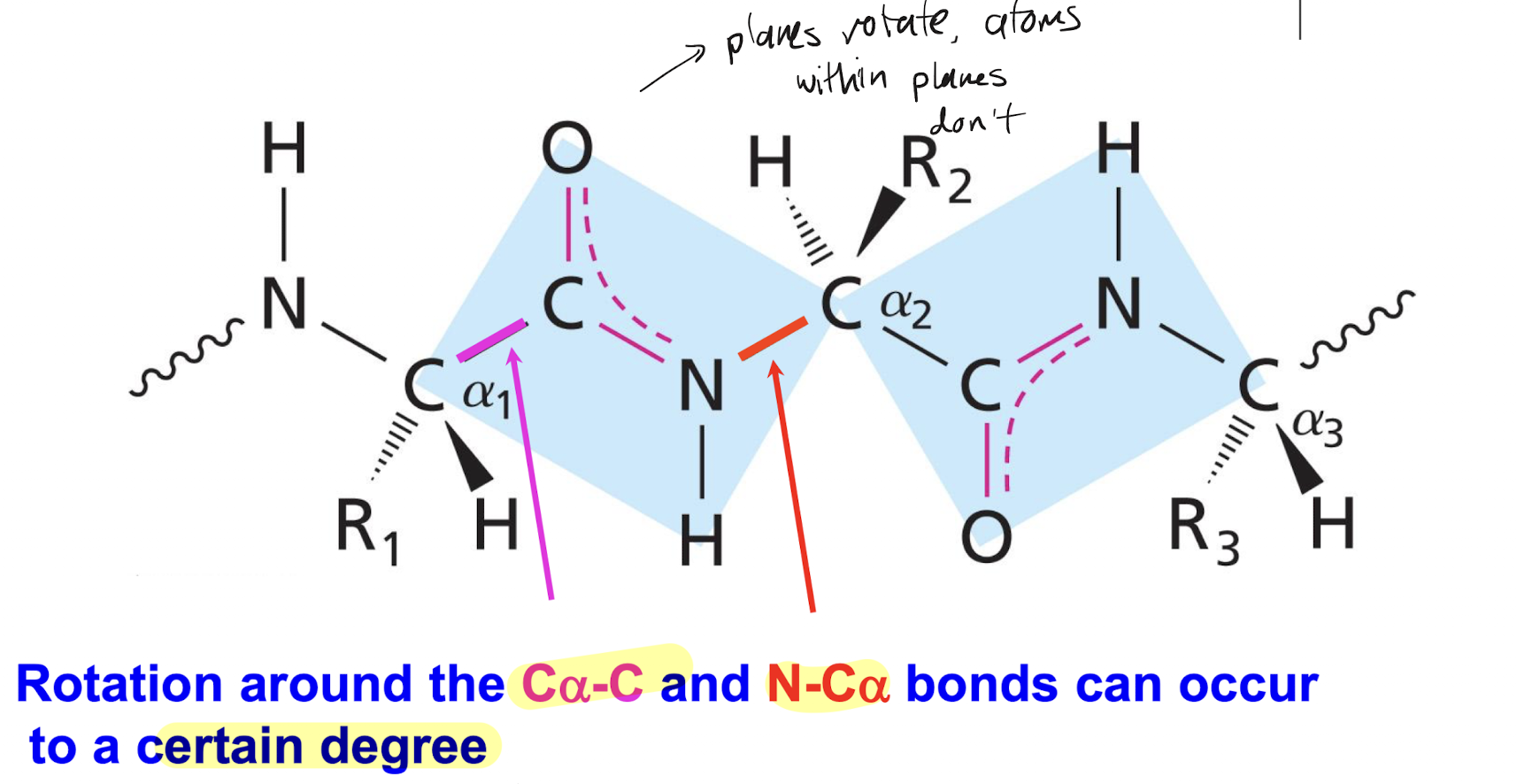
Delocalized electrons from two resonance forms → UV absorbance at 230 nm, exhibit partial double bond character with no rotation → rigid and planar (planes can rotate, atoms within planes do not rotate with respect to each other), peptide bonds are polar → functional groups are H-bond donors and acceptors and hydrogen bond with each other
Around which bonds can a polypeptide rotate? To what degree, and why?
Alpha carbon - peptide carbon, alpha carbon - peptide nitrogen (backbone bonds). To limited extent, only a couple of folding conformations (helices, strands, sheets, loops) because of steric hindrance
Regular secondary structure patterns are ___ and ___. Why are they formed by all polypeptides?
Alpha helix, beta sheet. Allow for maximum H-bonding of groups in the backbone (carbonyl and amino groups) and minimizes steric strain
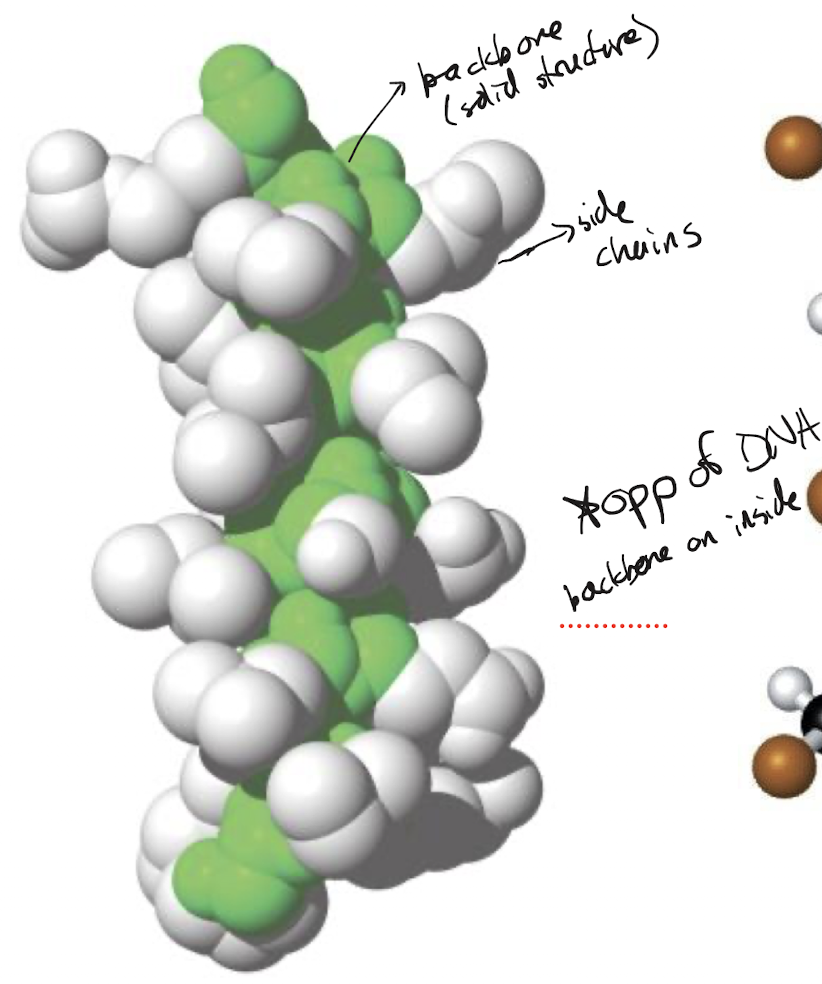
The backbone of a polypeptide is located on the (inside/outside) of the alpha helix
Inside, side chains are on the outside
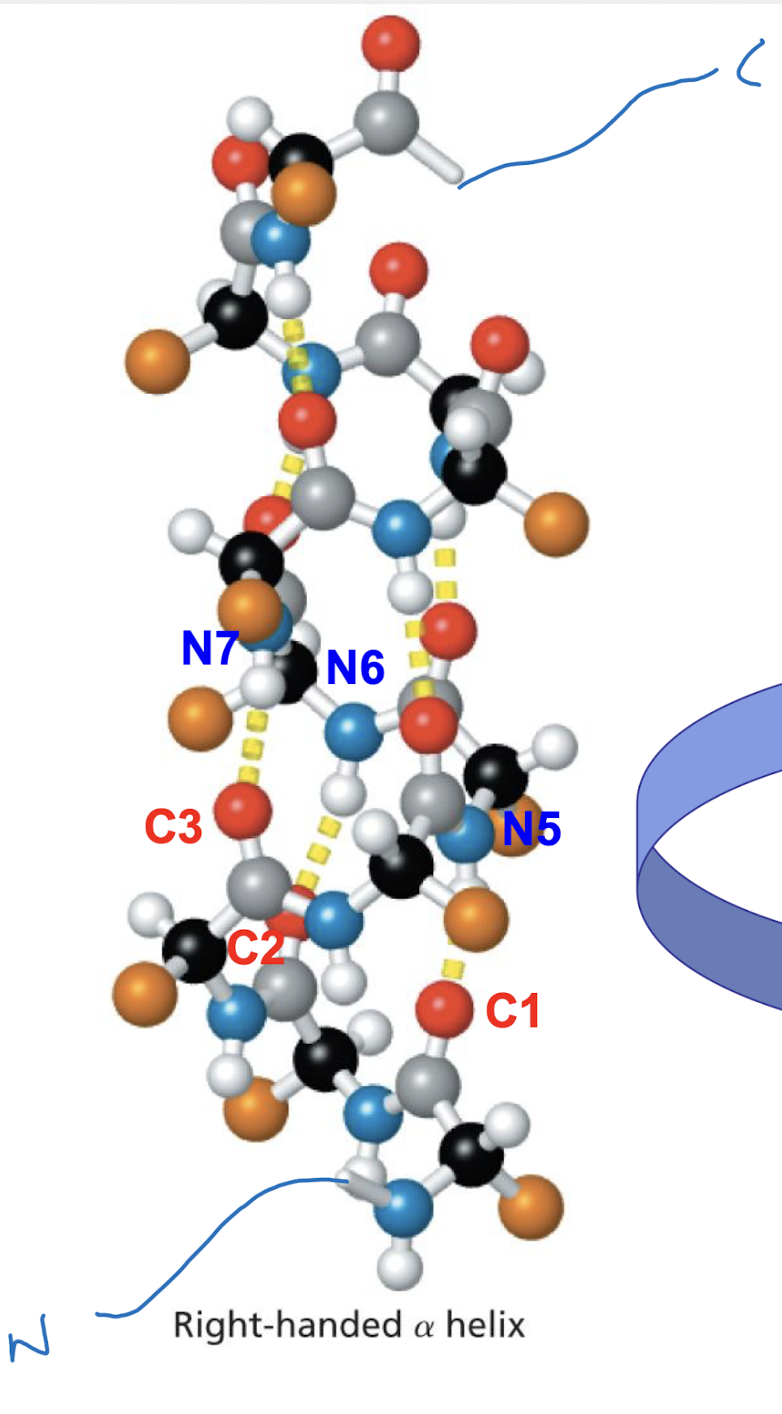
Explain how H-bonds are formed within the backbone of an alpha helix, with numbers. Which groups are not involved in this pattern and why?
Carbonyl oxygen of each residue forms an H bond with the backbone amino group 4 residues downstream: C1-N5, C2-N6, etc.
First 4 NH groups at N terminus and last 4 carbonyls at C terminus are not involved so that they can bond with other groups
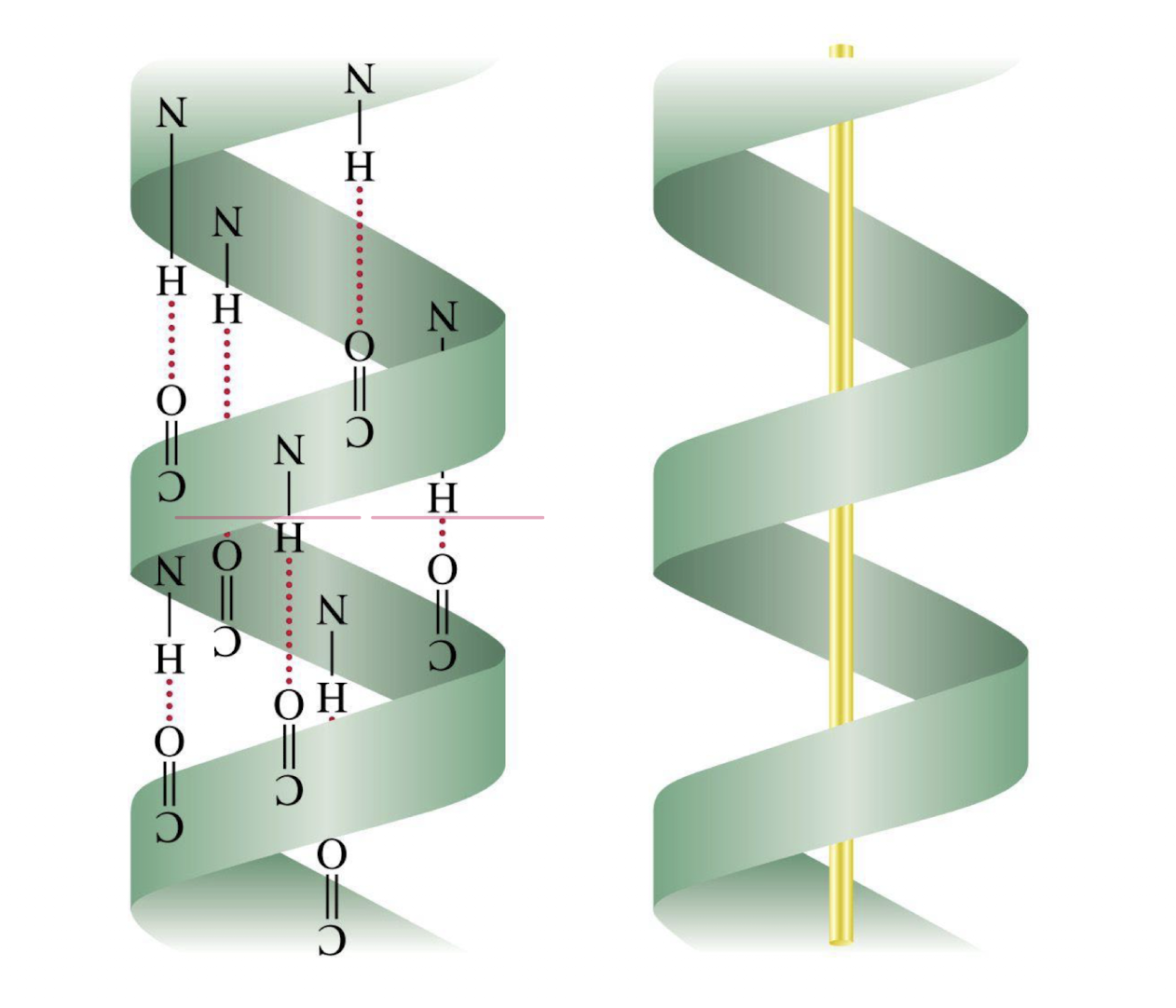
Describe the structural shape of H-bonds in an alpha helix and why they are oriented this way.
Strong, rod-like structure. Optimal distance between each other and relatively stable
Side chains in an alpha helix point in the (same/different) direction, towards ___.
Same, N-terminus
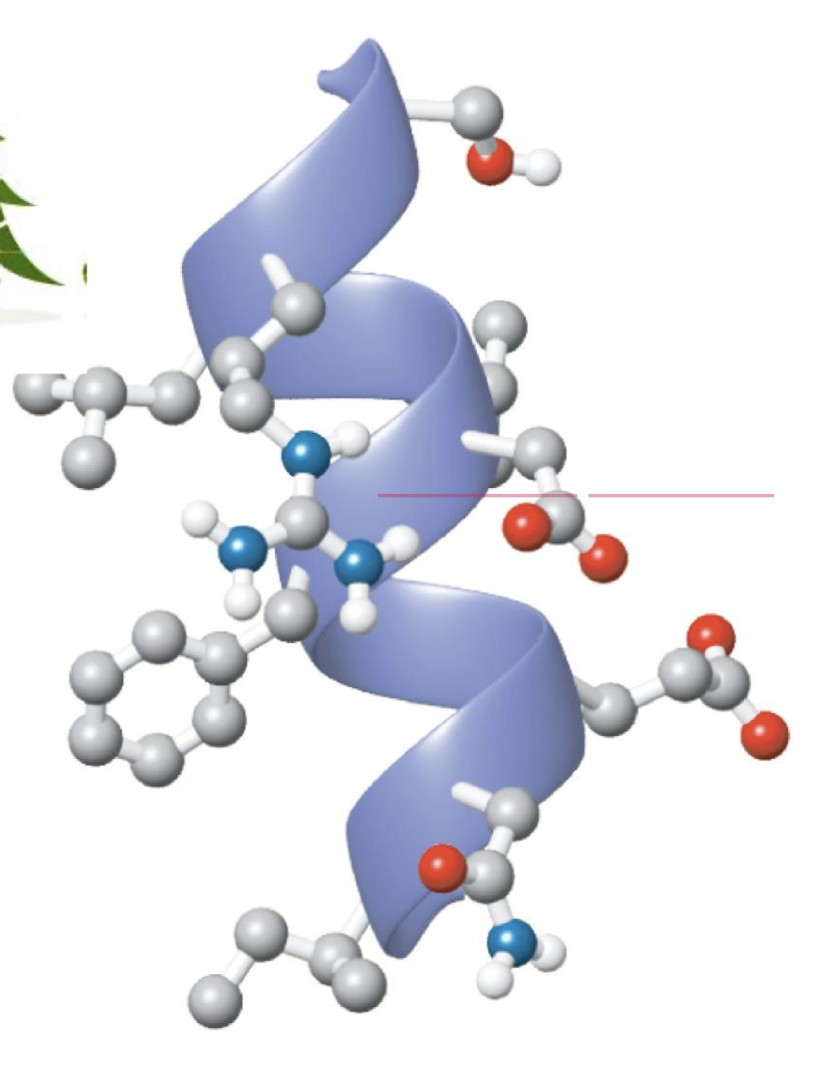
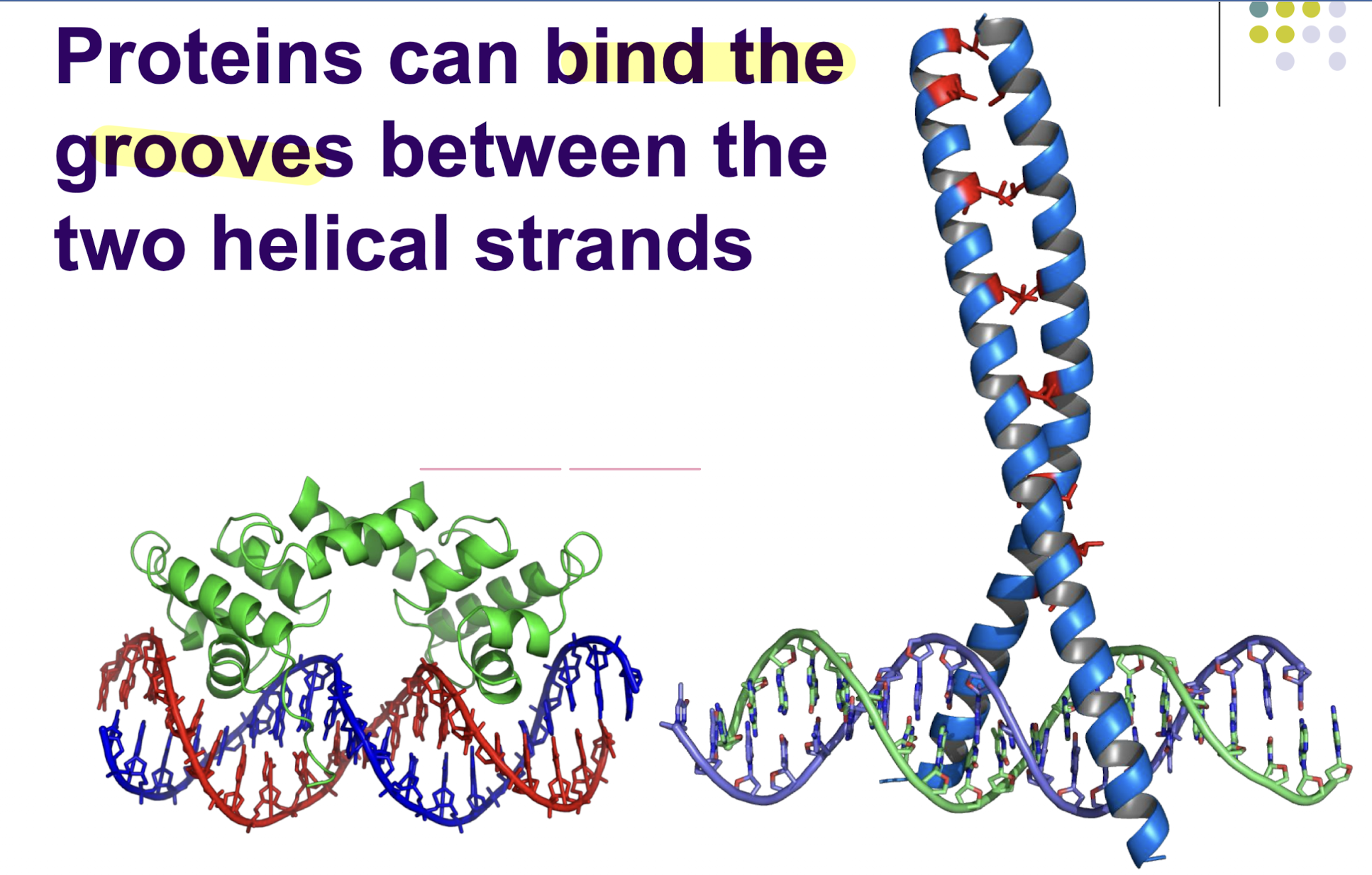
What is the diameter of an alpha helix? What bonding behaviour does this allow?
Same as major groove, allows proteins to bind with the helical grooves in between DNA strands (fits perfect) through H-bonding with non Watson/Crick functional groups in the DNA
Do amino acids have to be sequential in an alpha helix? Beta sheet?
Yes, alpha helix requires all amino acids to be connected in order to form H-bond pattern.
No, in beta sheet, beta strands are not continuous in the primary sequence and are be connected by loops (separate amino acid sequence). The protein is folded to form the sheet.
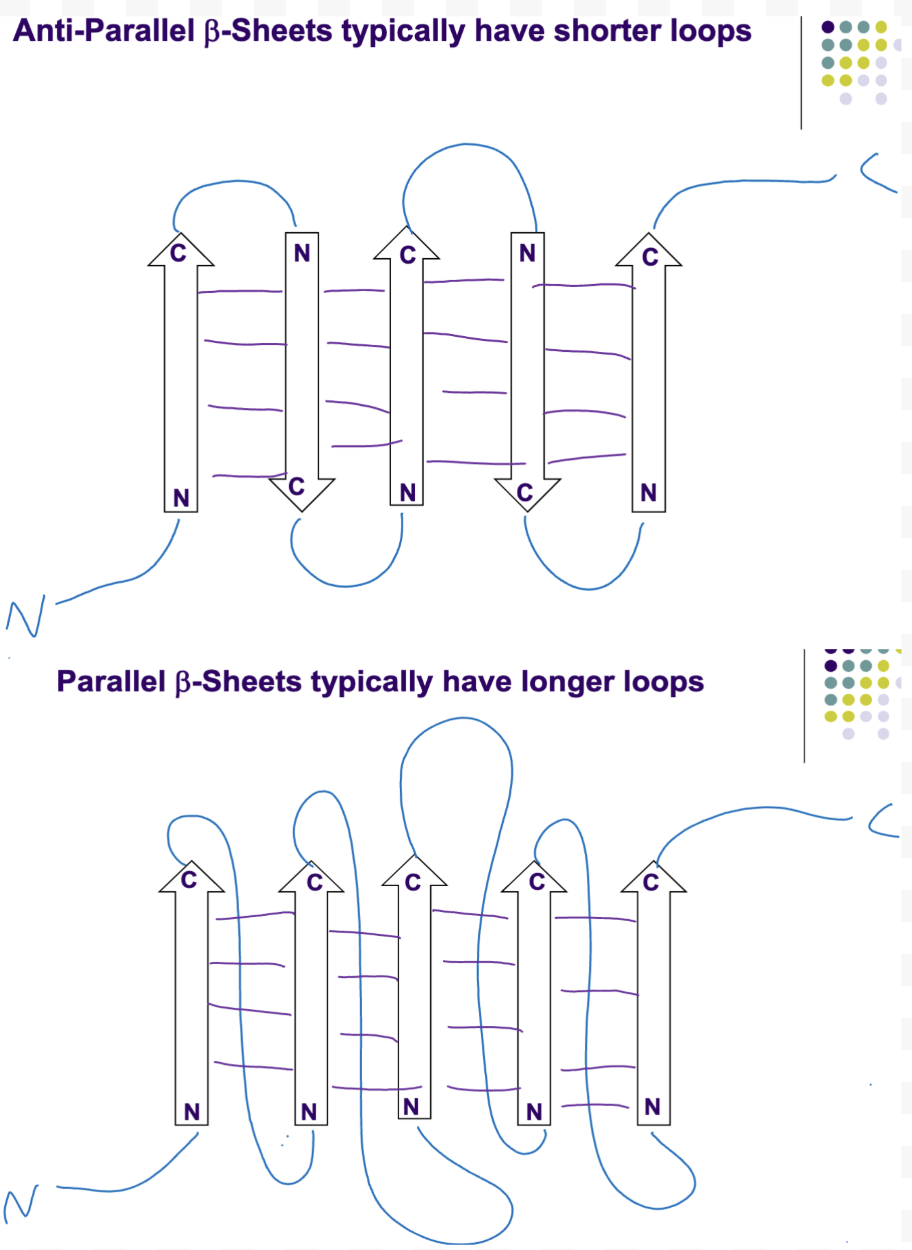
Anti parallel beta sheets have (longer/shorter) loops, while parallel beta sheets have (longer/shorter) loops. Why?
Shorter, longer. Anti parallel beta sheets have the C terminus of one strand lined up with the N terminus of the next and thus only need to travel horizontal distance. Parallel beta sheets have the C terminus of one strand in the opposite vertical direction as the N terminus of the next and thus need to travel vertically and horizontally to reach the N terminus at the opposite end.
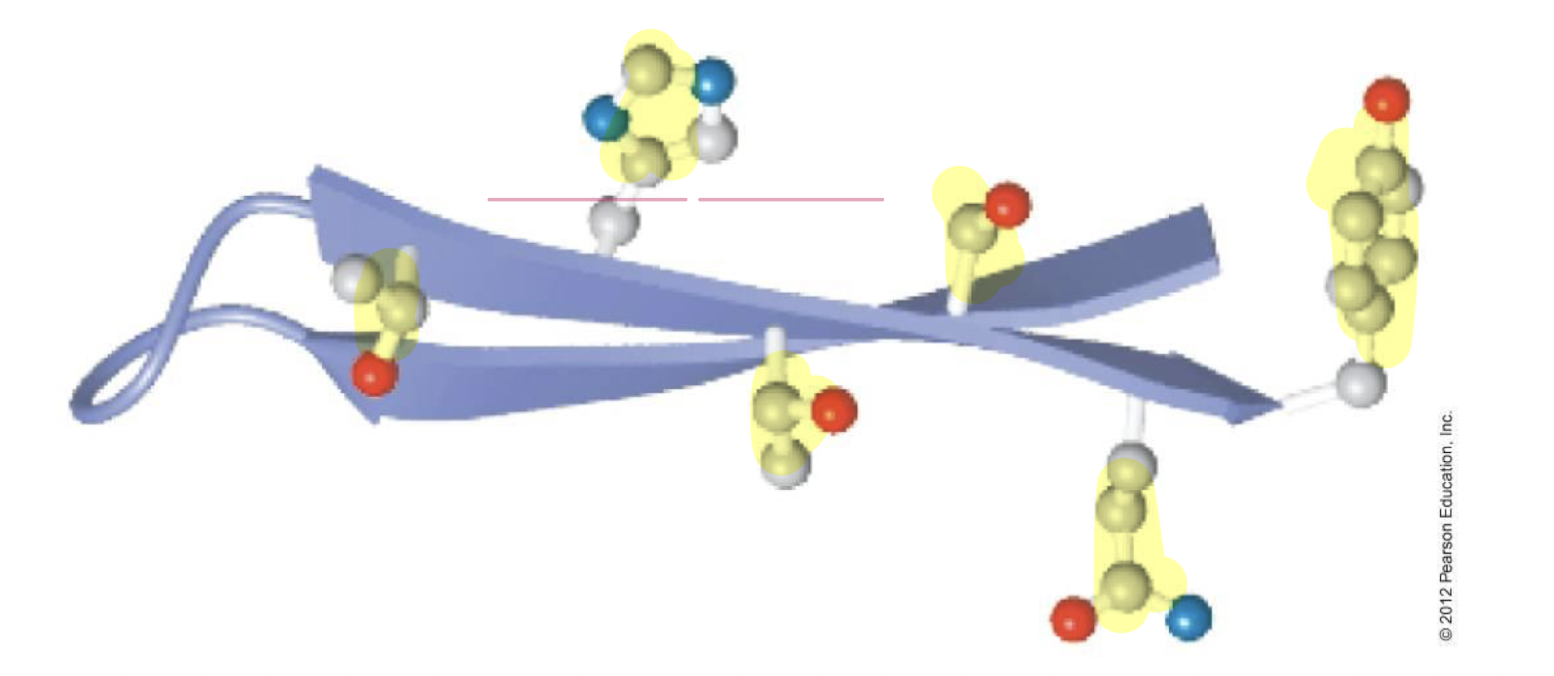
Amino acid side chains are found where in a beta sheet structure?
Above and below the plane of the sheet if bulky and branched
What force stabilizes alpha helices and beta sheets? What is the difference?
Helix: intrastrand H-bonds between backbone CO and NH groups in the helix
Helix: interstrand H-bonds between backbone CO and NH groups of neighbouring strands
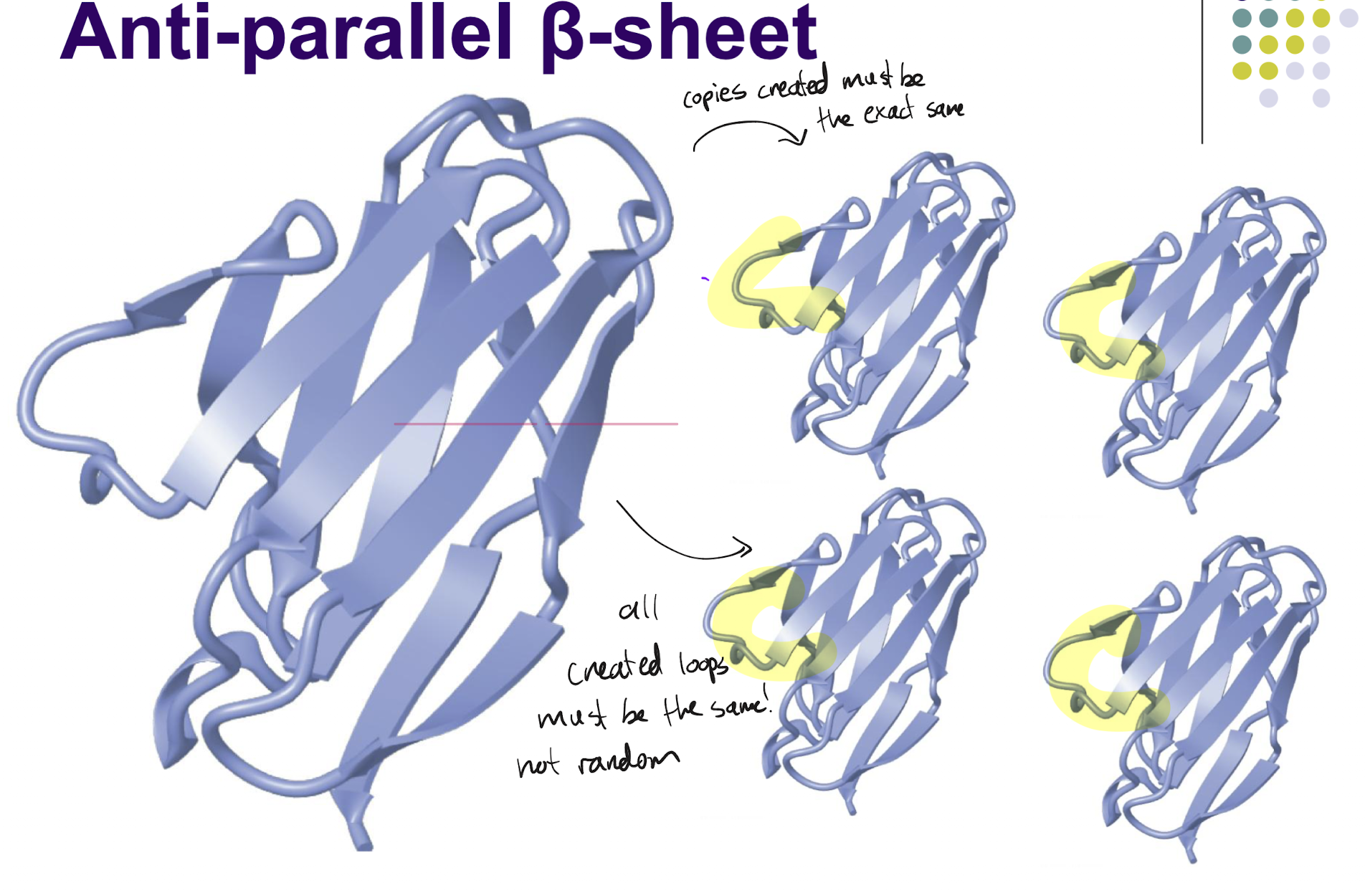
Are irregular structures like loops random/disordered? Why or why not?
No, the amino acid sequence/path of the polypeptide backbone is typically unchanging and highly specific to the structure and function of that particular protein. Thus, though the loops are different for each combination of amino acids, the specific loop needed for a specific function is used when needed and not randomly selected.
Generally, globular proteins have (polar/nonpolar) cores and (polar/nonpolar) surfaces. What are the exceptions to this?
Nonpolar, polar.
Certain membrane associated proteins (ex. ion channels) have a hydrophobic surface and polar core. Require a polar core to transport polar molecules into the cell and thus have a hydrophobic surface to interact with the hydrophobic membrane tails
Polypeptide chains that form quaternary structure will have hydrophobic surface regions
Hydrophobic side chains are likely to be found on the (interior/exterior) of a globular protein. Hydrophilic side chains are likely to be found on the (interior/exterior) of a globular protein
Interior, exterior
The stabilizing force of primary structure is ___. The stabilizing force of secondary structure is ___.
Peptide bonds, H-bonds between amino and carbonyl of backbone
The primary stabilizing force of tertiary structure is ___, which contributes what? Minor contributors are ___ and ___. What do they contribute?
Major: Hydrophobic effect: is the driving force by which soluble globular proteins adopt and maintain their tertiary structure by folding in regards to relative positions of amino acids (with polar, charged, and hydrophobic side chains) due to the hydrophobic effect
Minor: H-bonds between polar side chains/backbone groups and side chains, ion pairs, disulphide bonds (except in cytosol proteins): “fine tune” and stabilize tertiary and secondary structure
What determines tertiary structure (how the protein will fold)?
Primary structure: sequence of amino acids, which hydrophobic and which hydrophillic will determine how the protein aggregates
At pH 7, which amino acids are positively charged and which groups are negatively charged?
Positive: Arg, Lys, N terminus
Negative: Asp, Glu, C terminus
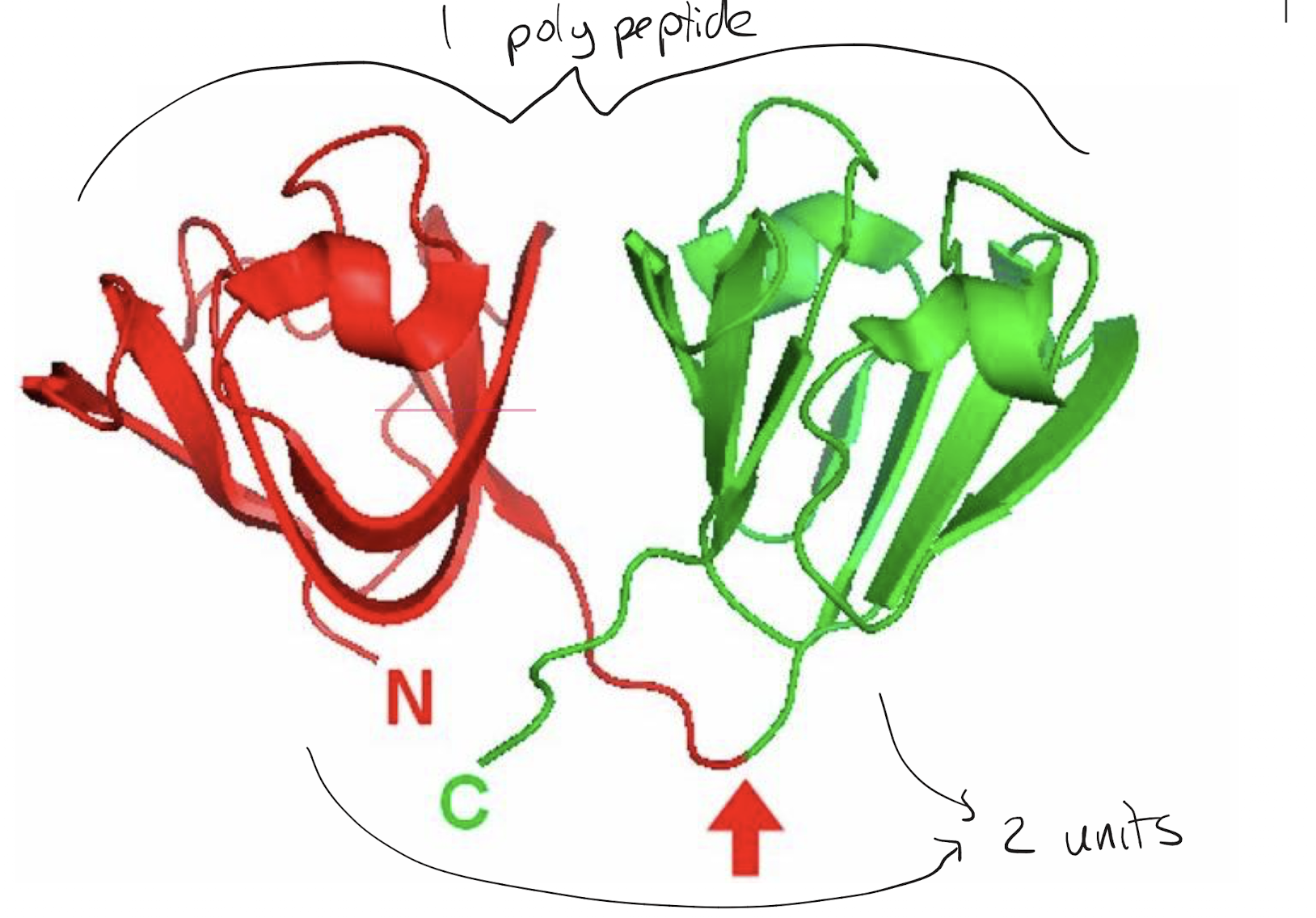
Proteins can encode/fold into two or more domains when ___.
Their chains have >200 amino acids
Globular proteins are stabilized by ___, which makes it (easy/difficult) to denature them.
Weak noncovalent forces, easy
Which noncovalent interactions are broken by the following: heat, changes in pH, changes in salt concentration, detergents, reducing agents (DTT). How?
Heat: H-bonds, ion pairs, hydrophobic interactions. High enough energy input will break all bonds
Changes in pH: H-bonds, ion pairs. Changes ionizable groups which changes charges and H+ concentration in solution
Salt: ion pairs. Salt bridges are disrupted by changing salt conc
Detergents: hydrophobic interactions. Have a polar and nonpolar section, so that nonpolar section enters core and polar section pushes the core apart
Reducing agents: disulphide bridges
What stabilizes quaternary structure?
Major: Hydrophobic effect: hydrophobic surface on oligomers pushes separate subunits together and keeps them together
Minor: H-bonds between polar side chains/backbone groups and side chains, ion pairs, disulphide bonds (except in cytosol proteins): “fine tune” and stabilize
Which amino acids are common in histones?
Lys and Arg (positively charged amino acids)