lesson 9: minority inclusion in diverse societies
 Call Kai
 Learn
Learn Practice Test
 Spaced Repetition
 Match
Match Flashcards
 Knowt Play
1/37

There's no tags or description
Looks like no tags are added yet.
Name | Mastery | Learn | Test | Matching | Spaced | Call with Kai |
|---|
No analytics yet
Send a link to your students to track their progress
38 Terms
minority groups
groups in society that have, in some way, a lower status, that are disadvantaged of stigmatized in society
these are often also numerical minorities, but not necessarily
used to denote some form of disadvantage or lower status
majority groups
relatively privileged, advantaged group members (that are usually the numerical majority)
inclusion
used to denote 2 sets of outcomes (traditionally researched separately)
Intergroup harmony
Support for social change towards equality
intergroup harmony
o Outcomes like attitudes towards other groups, orientation in general about interacting with them (avoiding or seeking contact?)
o How do we feel about these groups? How do we live together in a relatively harmonious or conflictual society (segregated or having contact?)?
support for social change towards equality
o Any range of actions or support for actions that would ultimately achieve greater equality in society
o Examples: protesting, signing demonstrations, also just supporting others or policies
o Often referred to as collective action
intergroup contact experiences
- People from different groups that come in contact with each other
- This is one of the most widely studied concepts in social psychology
intergroup contact hypothesis
contact between groups will improve intergroup relations, in particular when certain conditions are met in the context of the interaction (optimal conditions of contact):
· Equal status
· Cooperation (or a least the absence of conflict)
· Common goals
· Institutional support
positive contact
- Many minority group members regularly experience pos contact in their daily life’s
- These pos experiences can range from casual friendly interactions and encounters to really intimate and enduring friendships and higher quality contact
negative contact
- Minority group member in particular experience neg contact
- Their minority status often makes them targets for neg or hostile treatment
social identity approach
- People derive self-worth in part from their membership in valued social groups
- When one perceives ones in-group as devalued in an intergroup setting or society at large → this triggers social identity threat
negative intergoup contact
triggers social identity threat, associated with:
o Anxiety, discomfort, vigilance
o Compensatory strategies to ward off neg treatment
Also when they feel at risk
positive intergroup contact
can convey to minority group members that their minority identity is valued and that they’re seen as equals (friendship in particular)
o Feeling of belonging
o Reduced anxiety
o Better school achievement
contact
more than just casual, fleeting, friendly interactions
intergroup contact
often seen as golden standard of perfect contact
o If someone is your friend, they should threat you as equal, you shouldn’t have fights …
o But, especially for minorities, friendships are great and these things are true, but your friend might still make jokes about minority groups or drop micro-aggression into the conversation… they can still doubt if they’re seen as equals
neg contact
can cast a long shadow, overshadowing friendly interactions and thus impacting the contact orientation of minority group members and by extension their social inclusion in intergroup contexts
school diversity approaches
refer to the institutional values and rules that govern how different groups interact within the school and that create more of less supportive and inclusive diversity changes
Valuing, ignoring or rejecting cultural differences
multicultural approach
valuing
seeing different identities as an asset and respecting and valuing them
colorblindness
ignoring
most common in the US, “we don’t see color, even in the face of unequal treatment → there can’t be different treatment, because nobody sees color”
assimilation
rejecting
mandate that you have to speak a certain language at school, banning the headscarf …
(un)equal treatment of students
o To what extend is there a focus on that everybody should be treated equally?
o Policies that focus on equal treatment often covary with the multicultural policy, but in principle they could be separate
experiencing discrimination
at any point (whether it was in an in- or decreasing way), was always harmful for school outcomes as example
equal treatment
“the rules are applied equally to all students”
multiculturalism
“in my school, different cultures and religions are treated with respect” or “in my school, they take strong action against racism and discrimination”
positive diversity climate
minority perceptions that unequal treatment in condemned and cultural differences is recognized/valued
these climates are beneficial, they were associated with higher school belonging and also more task-engagement (being motivated to work and study) and they were also associated with kind of buffering or minimizing the impact of discrimination when it occurred
person-centered methods
identify latent subgroups within a population or sample (less common way to look at things in social psychology)
here: what kind of actions are people taking?
who are allies?
Lowest level of prejudice
Most likely to perceive that Muslims face systemic disadvantage in Belgium
Have friend who are Muslim and/or have an immigrant background
Most likely to have and immigrant background themselves
level of prejudice
etnic bias
difference in how they rate Belgian versus Muslim people
Sedative effect of pos intergroup contact
minority experiences of pos contact can undermine their support for social change
o Draws attention away from inequality or make it seem less possible (“I have great friends, everybody treats me fine, so maybe inequality isn’t such a big problem in society or for me personal”)
o Leads to (false) expectations of fair treatment
negative intergroup contant and support for change
Minority experiences of neg contact can promote their support for social change (makes you more aware or angry …)
omitted-variable problem
imagine you’re researching lung-cancer and you find an association/link between drinking a lot of coffee and lung-cancer → you might conclude that there’s a neg link between them and we should drink less coffee to prevent lung-cancer
This ignores the effect that maybe in this sample the people that are drinking coffee are also the people who are smoking a lot of cigarettes
So it’s actually the cigarette smoking that’s causing the lung-cancer
But if you take smoking out of the model (if you don’t consider that), you might get to a completely different conclusion
This is what can happen when we only look at pos interactions instead of also the neg ones, especially for minority groups
system-fairness beliefs
beliefs that the system/society one finds themselves in is fair
palliative effect of system justification
Benefits of looking at the bright side of life: reduced threat and uncertainty, increased life satisfaction …
One of the mechanisms that can explain that when you have pos relations, more friendships …, you come to see the society as fairer and therefore you act less
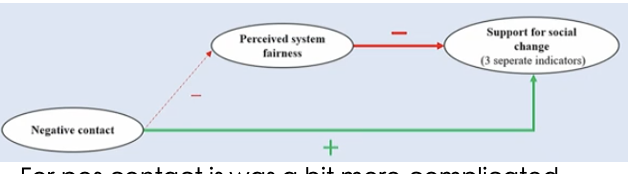
system fairness beliefs and negative contact
The more you had neg experiences, the more you support social change
But limited evidence was found that this worked via system fairness (only found in 1 of the samples
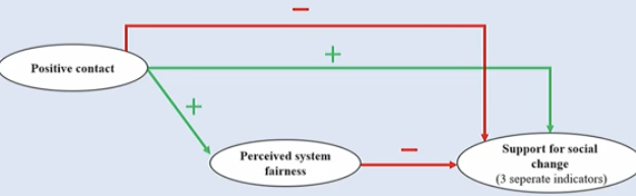
system fairness beliefs and positive contact
a bit more complicated
the more pos contact you had, the fairer you thought society was and this indirectly affected supporting social change (less support for social change)
Directly: both pos and neg associations between pos contact and support for social change, depending on the group, the country and depending on the outcome
positive intergroup contact
as a tool for intergroup harmony, and for social change:
- Reliability associated with majority support for social change
- Doesn’t reliable undermine and may promote minority support for social change
intergroup context
What kind of contact you have matters, what kind of friends you have
Majority friends who are willing to discuss and denounce inequality do NOT undermine minority support for social change
top-down norms
policies in the country, region … you live in
They inform intergroup attitudes and behaviors directly
it’s also associated with the experiences we have
more inclusive/equal policies
more equal access to rights for migrants … are associated with more pos attitudes among the population
you’re simply more likely to have more pos and more equal interactions