[PHARMACOGNOSY] Carbohydates and Related Compounds
 Call Kai
 Learn
Learn Practice Test
 Spaced Repetition
 Match
Match Flashcards
 Knowt Play
1/283

There's no tags or description
Looks like no tags are added yet.
Name | Mastery | Learn | Test | Matching | Spaced | Call with Kai |
|---|
No analytics yet
Send a link to your students to track their progress
284 Terms
a. Carbohydrates
Polyhydric aldehyde or ketone alcohols that contain C, H, and O
a. Carbohydrates
b. Lipids
c. Nucleic acid
d. Proteins
a. [Cn(H₂O)]n
General formula for carbohydrates.
a. [Cn(H₂O)]n
b. [Cn(H₂O₂)]n
c. [C(H₂O)]n
d. [C₂n(H₂O)]n
d. Carbohydrates
First products of photosynthesis.
a. Proteins
b. Lipids
c. Nucleic acids
d. Carbohydrates
e. None
Structural
Energy
Regulatory
Defense
Function of carbohydrates except:
a. Structural
b. Energy
c. Regulatory
d. Defense
e. None
c. Starch
Carbohydrate that provides energy storage in plants.
a. Glycogen
b. Cellulose
c. Starch
d. Chitin
c. Glycogen
Carbohydrate that provides energy storage in animals.
a. Starch
b. Cellulose
c. Glycogen
d. Chitin
c. Biologically active
Cell components such as glycoproteins are classified as:
a. Energy storage
b. Structural component
c. Biologically active
d. Transport
Transport
Regulatory
Immune response
Biologically active functions of carbohydrates include:
a. Transport, regulatory, immune response
b. Energy storage, structural support, catalysis
c. Photosynthesis, respiration, digestion
d. Replication, transcription, translation
c. Chitin
Structural component of fungi and crustaceans.
a. Cellulose
b. Peptidoglycan
c. Chitin
d. Glycogen
b. Cellulose
Structural component of plants.
a. Chitin
b. Cellulose
c. Peptidoglycan
d. Glycogen
c. Peptidoglycan
Structural component of bacteria.
a. Cellulose
b. Chitin
c. Peptidoglycan
d. Glycogen
d. Both a and b
N-acetylglucosamine (NAG)
N-acetylmuramic acid (NAM)
Peptidoglycan is composed of:
a. N-acetylglucosamine (NAG)
b. N-acetylmuramic acid (NAM)
c. N-acetylmannosamine
d. Both a and b
b. Sugars
Classification of carbohydrates that include:
Monosaccharides
Disaccharides
Oligosaccharides.
a. Polysaccharides
b. Sugars
c. Heteroglycans
d. Homoglycans
b. Homoglycans
Polysaccharides that contain only one type of sugar unit.
a. Heteroglycans
b. Homoglycans
c. Oligosaccharides
d. Disaccharides
d. All of the above
Starch
Cellulose
Inulin
Example of Homoglycans include:
a. Starch
b. Cellulose
c. Inulin
d. All of the above
c. Glucose units
Starch is classified as a homoglycan because it yields:
a. Fructose units
b. Galactose units
c. Glucose units
d. Sucrose units
b. Glucosan
Starch is also known as:
a. Fructosan
b. Glucosan
c. Galactosan
d. Mannosan
a. Fructose units
Cellulose is classified as a homoglycan because it yields:
a. Fructose units
b. Glucose units
c. Galactose units
d. Mannose units
c. Fructose units
Inulin is a homoglycan that yields:
a. Glucose units
b. Galactose units
c. Fructose units
d. Sucrose units
d. Heteroglycans
Polysaccharides that contain different types of sugar units.
a. Homoglycans
b. Monosaccharides
c. Disaccharides
d. Heteroglycans
d. All of the above
Gum
Mucilages
Glycosides
Examples of heteroglycans include:
a. Gum
b. Mucilages
c. Glycosides
d. All of the above
d. Monosaccharides
Simplest carbohydrate units.
a. Disaccharides
b. Oligosaccharides
c. Polysaccharides
d. Monosaccharides
b. Reducing sugars
All monosaccharides are:
a. Non-reducing sugars
b. Reducing sugars
c. Complex carbohydrates
d. Heteroglycans
b. Monosaccharides
Cannot be hydrolyzed to simple sugars.
a. Disaccharides
b. Monosaccharides
c. Oligosaccharides
d. Polysaccharides
b. Monosaccharides
______ give a positive result with Benedict's and Barfoed's tests, producing Brick red precipitate
a. Disaccharides
b. Monosaccharides
c. Oligosaccharides
d. Polysaccharides
c. Brick red precipitate
Monosaccharides give a positive result with Benedict's and Barfoed's tests, producing:
a. Blue precipitate
b. Yellow precipitate
c. Brick red precipitate
d. Green precipitate
d. Both a and b
Number of carbons in the backbone
Functional group present (aldose or ketose)
Monosaccharides are classified based on the:
a. Number of carbons in the backbone
b. Functional group present (aldose or ketose)
c. Molecular weight
d. Both a and b
b. Aldoses
Monosaccharides with an aldehyde functional group are called:
a. Ketoses
b. Aldoses
c. Glycosides
d. Polysaccharides
b. Ketoses
Monosaccharides with a ketone functional group are called:
a. Aldoses
b. Ketoses
c. Glycogens
d. Starches
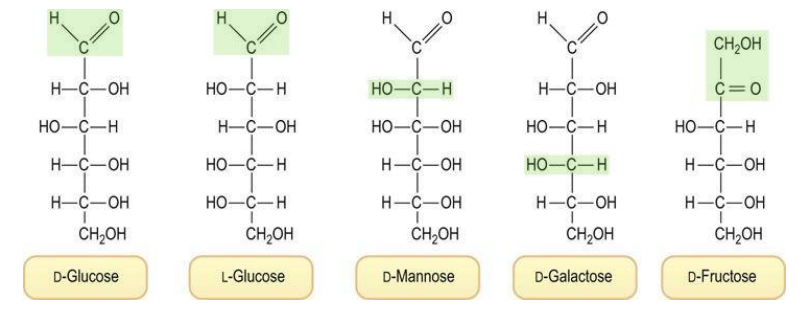
Example of Monosaccharides along with their Structure:
Xylose (Wood Sugar)
Example of Pentoses (5C)
Glucose (Physiologic Sugar)
Dextrose (D-Glucose)
Galactose (Brain Sugar)
Fructose (Levulose)
Example of Hexoses (6C) include [4]
c. Pentose
5-carbon sugar.
a. Hexose
b. Tetrose
c. Pentose
d. Triose
b. Xylose
Wood sugar.
a. Glucose
b. Xylose
c. Fructose
d. Ribose
c. Xylose
Aldehyde sugar obtained from boiling corn cobs or straw.
a. Ribose
b. Arabinose
c. Xylose
d. Lyxose
c. Xylose
Diagnostic aid for intestinal malabsorption (absorbed but not metabolized).
a. Glucose
b. Fructose
c. Xylose
d. Sucrose
c. Hexose
6-carbon sugar.
a. Pentose
b. Tetrose
c. Hexose
d. Triose
b. Hexoses
Most important monosaccharides.
a. Pentoses
b. Hexoses
c. Disaccharides
d. Polysaccharides
c. Glucose (Physiologic sugar)
Also known as “Physiologic sugar”
a. Fructose
b. Galactose
c. Glucose
d. Sucrose
b. Glucose (Physiologic sugar)
Aldohexose with an aldehyde group at C1.
a. Fructose
b. Glucose
c. Ribose
d. Xylose
b. Glucose (Physiologic sugar)
Reducing sugar as determined by Benedict's test.
a. Sucrose
b. Glucose
c. Starch
d. Cellulose
c. Linear and cyclic (boat/chair)
Glucose (physiologic sugar) occurs as _____
a. Linear only
b. Cyclic only
c. Linear and cyclic (boat/chair)
d. Branched only
b. β-D-Glucose
Most important and most abundant form of glucose.
a. α-D-Glucose
b. β-D-Glucose
c. L-Glucose
d. D-Fructose
d. All of the above
Blood sugar
Grape sugar
Physiologic sugar
Synonym for D-glucose (Dextrose)
a. Blood sugar
b. Grape sugar
c. Physiologic sugar
d. All of the above
c. D-glucose (Dextrose)
Rigorously purified glucose
a. Dextrose excipient
b. Liquid glucose
c. D-glucose (Dextrose)
d. Sucrose
c. D-glucose (Dextrose)
Used as a source of nutrient given parenterally.
a. Dextrose excipient
b. Liquid glucose
c. D-glucose (Dextrose)
d. Sucrose
b. Liquid glucose
Syrupy, colorless, tastes sweet, obtained from incomplete hydrolysis of starch.
a. Dextrose excipient
b. Liquid glucose
c. β-D-Glucose
d. Sucrose
b. Dextrose excipient
Crystalline glucose
a. Liquid glucose
b. Dextrose excipient
c. Fructose
d. Sucrose
b. Dextrose excipient
Used as a sweetening agent
a. Liquid glucose
b. Dextrose excipient
c. Fructose
d. Sucrose
b. Dextrose excipient
Used in oral glucose tolerance test (OGTT) with 75g glucose given to a fasted patient.
a. Liquid glucose
b. Dextrose excipient
c. Fructose
d. Sucrose
b. 75g
The oral glucose tolerance test (OGTT) uses how many grams of glucose given to a fasted patient?
a. 50g
b. 75g
c. 100g
d. 150g
c. Galactose
Brain sugar.
a. Glucose
b. Fructose
c. Galactose
d. Sucrose
c. Galactose
Aldohexose that is a C4 epimer of glucose.
a. Fructose
b. Mannose
c. Galactose
d. Ribose
b. Lactose
Galactose is found in milk as part of:
a. Glucose
b. Lactose
c. Sucrose
d. Maltose
b. Galactosides
Galactose is found in neuronal fibers as:
a. Glycoproteins
b. Galactosides
c. Glycolipids
d. Glucans
b. Galactosides
Found in Neuronal fibers
a. Glycoproteins
b. Galactosides
c. Glycolipids
d. Glucans
c. Mucic acid test
Test for galactose that produces mucic acid crystals.
a. Benedict's test
b. Barfoed's test
c. Mucic acid test
d. Seliwanoff's test
a. Gaucher's Disease
Deficiency of β-glucocerebrosidase leads to the accumulation of glucosyl ceramide in organs.
a. Gaucher's Disease
b. Galactosemia
c. Tay-Sachs Disease
d. Niemann-Pick Disease
b. Galactosemia
Accumulation of galactose levels in the blood.
a. Gaucher's disease
b. Galactosemia
c. Lactose intolerance
d. Diabetes mellitus
c. Fructose
Sweetest monosaccharide with a bitter aftertaste.
a. Glucose
b. Galactose
c. Fructose
d. Sucrose
c. Levulose
Fructose is also known as:
a. Blood sugar
b. Brain sugar
c. Levulose
d. Wood sugar
b. C2
Fructose has a ketone group at which carbon position?
a. C1
b. C2
c. C3
d. C4
c. Seliwanoff's test
Test for fructose that produces a pink-red or cherry red color.
a. Benedict's test
b. Barfoed's test
c. Seliwanoff's test
d. Mucic acid test
c. Fructose
Fruit sugar obtained from sweet fruits and honey.
a. Glucose
b. Galactose
c. Fructose
d. Lactose
c. Fructose
_______ is obtained from the inversion of aqueous sucrose, which produces Glucose and fructose
a. Glucose
b. Galactose
c. Fructose
d. Lactose
c. Fructose
Used as food for Diabetes mellitus (DM) patients
a. Glucose
b. Galactose
c. Fructose
d. Lactose
c. Fructose
Used as an ingredient in infant feeding formula
a. Glucose
b. Galactose
c. Fructose
d. Lactose
c. High fructose sweeteners
Obtained from the isomerization of glucose from Streptomyces spp.
a. High glucose sweeteners
b. High sucrose sweeteners
c. High fructose sweeteners
d. High lactose sweeteners
b. Fructose injection
Less commonly used than glucose/dextrose.
a. Dextrose injection
b. Fructose injection
c. Lactose injection
d. Sucrose injection
d. Honey
Contraindicated in infant patients due to increased risk of Clostridium botulinum (infant botulism).
a. Sucrose
b. Fructose
c. Glucose
d. Honey
b. Disaccharides
Composed of 2 monosaccharide units joined by a glycosidic bond.
a. Monosaccharides
b. Disaccharides
c. Oligosaccharides
d. Polysaccharides
b. Glycosidic bond
Disaccharides are composed of 2 monosaccharide units joined by a ______
a. Peptide bond
b. Glycosidic bond
c. Ester bond
d. Hydrogen bond
b. Disaccharides
Formed via dehydration synthesis.
a. Monosaccharides
b. Disaccharides
c. Pentoses
d. Hexoses
a. Sucrose
Glucose + Fructose
a. Sucrose
b. Trehalose
c. Maltose
d. Lactose
e. Lactulose
e. b and c
Trehalose
Maltose
Glucose + Glucose
a. Sucrose
b. Trehalose
c. Maltose
d. Lactose
e. b and c
d. Lactose
Glucose + Galactose
a. Sucrose
b. Trehalose
c. Maltose
d. Lactose
e. Lactulose
e. Lactulose
Fructose + Galactose
a. Sucrose
b. Trehalose
c. Maltose
d. Lactose
e. Lactulose
a. α(1,2).
Sucrose
a. α(1,2)
b. α(1,1)
c. α(1,4)
d. β(1,4)
b. α(1,1)
Trehalose
a. α(1,2)
b. α(1,1)
c. α(1,4)
d. β(1,4)
c. α(1,4)
Maltose
a. α(1,2)
b. α(1,1)
c. α(1,4)
d. β(1,4)
d. β(1,4)
Lactose
a. α(1,2)
b. α(1,1)
c. α(1,4)
d. β(1,4)
d. β(1,4)
Lactulose
a. α(1,2)
b. α(1,1)
c. α(1,4)
d. β(1,4)
a. Anomeric alcohol group
Sugars are consider reducing if they don't have this group.
a. Anomeric alcohol group
b. Electron withdrawing group
c. Carbonyl group
d. Formyl group
d. a and b - Sucrose and Trehalose are not reducing sugar
Sugar without anomeric OH group.
a. Sucrose
b. Trehalose
c. Glucose
d. a and b
e. All
f. None
The following are non reducing sugars except:
a. Stachyose
b. Sucrose
c. Verbascose
d. Trehalose
e. Raffinose
f. None
a. -onic acid
Oxidation of reducing sugar result to:
a. -onic acid
b. -uronic acid
c. -aric acid
d. a and b
e. b and c
f. All
d. 4
How many carbon of erythrose?
a. 1
b. 2
c. 3
d. 4
b. I, II
Triose:
I. Glyceraldehyde
II. Dihydroxyacetone
III. Erythrose
IV. Erythrulose
V. Threose
a. I, II, III, IV
b. I, II
c. III, IV, V
d. II, III, IV
e. I, V
c. III, IV, V
Tetrose:
I. Glyceraldehyde
II. Dihydroxyacetone
III. Erythrose
IV. Erythrulose
V. Threose
a. I, II, III, IV
b. I, II
c. III, IV, V
d. II, III, IV
e. I, V
e. None
Pentose except:
a. Arabinose
b. Xylose
c. Ribose
d. Ribulose
e. None
e. None
Hexose except:
a. Dextrose
b. Levulose
c. Galactose
d. Manose
e. None
a. Sedoheptulose
An example of heptose.
a. Sedoheptulose
b. D-glycerol-D-mannoctulose
c. Galactose
d. Arabinose
b. D-glycerol-D-mannoctulose
Monosaccharide present in avocado.
a. Sedoheptulose
b. D-glycerol-D-mannoctulose
c. Galactose
d. Arabinose
e. Neuraminic acid
e. Neuraminic acid/Sialic acid
Nonose:
a. Sedoheptulose
b. D-glycerol-D-mannoctulose
c. Galactose
d. Arabinose
e. Neuraminic acid/Sialic acid
a. Aldopentose
Xylose is a
a. Aldopentose
b. Aldohexose
c. Ketopentose
d. Ketohexose
b. Xylose
Wood sugar.
a. Glucose
b. Xylose
c. Fructose
d. Methanol
b. Xylose
Obtained from boiling corn cobs and straw.
a. Glucose
b. Xylose
c. Fructose
d. Methanol