Sound and Waves
 Call Kai
 Learn
Learn Practice Test
 Spaced Repetition
 Match
Match Flashcards
 Knowt Play
1/37

There's no tags or description
Looks like no tags are added yet.
Name | Mastery | Learn | Test | Matching | Spaced | Call with Kai |
|---|
No analytics yet
Send a link to your students to track their progress
38 Terms
Wave
It refers to a traveling disturbance that carries or transfers energy from one location to another without transferring matter.
Mechanical Wave
It refers to a type of wave that strictly requires a physical material or substance called a medium to propagate
Electromagnetic Wave
It refers to a wave type that does not require a medium and can propagate through a vacuum
Transverse Wave
________ occurs when the vibration or displacement of the medium is perpendicular to the direction of wave travel
Longitudinal Wave
_________ occurs when the vibration or displacement of the medium is parallel to the direction of wave travel
Water Waves
_________ are combination waves featuring both transverse and longitudinal particle components, causing surface particles to move in nearly circular paths
Pulse Wave
________ is a non-periodic disturbance consisting of a single traveling isolated pulse.
Periodic Wave
_________ consists of repeating cycles or patterns generated continuously by a source
Sinusoidal Wave
When a Periodic Wave is driven by simple harmonic motion, it is then termed as ________.
Amplitude
It refers to the maximum excursion or displacement of a particle from its rest or equilibrium position.
Wavelength
It refers to the horizontal physical length of one complete wave cycle, such as distance between phase points on consecutive cycles
Period
It refers to the time required to complete on entire wave cycle
Frequency
It refers to the number of wave cycles completed per unit of time, measured in inverse seconds (s-1) or Hertz (Hz)
Wave Function
The _________ y(x,t) defines the displacement of a medium particle located at position x at any time t.
Sound Waves
________ are longitudinal mechanical waves propagating as tiny pressure fluctuations.
Compression
It refers to a localized zone of high particle density and high pressure, created by forward source of motion.
Rarefaction
It refers to a localized zone of low particle density and low pressure, created by backward source motion.
False
The Human Audible Range of frequency ranges between 20 Hz to 40,000 Hz
True or False
Ultrasonic
Frequencies that goes above 20,000 Hz are classified as ________
Infrasonic
Frequencies that goes below 20 Hz are classified as _________
Pressure Amplitude
Sound can be graphed via particle displacement or relative pressure fluctuations, where the maximum pressure variation from equilibrium is the ________ (Pmax)
Loudness
It is governed by pressure amplitude, where higher pmax translates to greater perceived ________
Pitch
It is governed by frequency, where higher frequency translates to a higher perceived musical _______
Timbre
It refers to the sound quality, the distinct acoustic signature that allows differentiation between two separate sounds vibrating at identical frequencies
Noise
It refers to the complex, chaotic combination containing a mix of all random frequencies rather than integer harmonics.
True
The speed of sound depends strictly on mechanical and thermal characteristics of the medium.
True or False
Fluid Medium
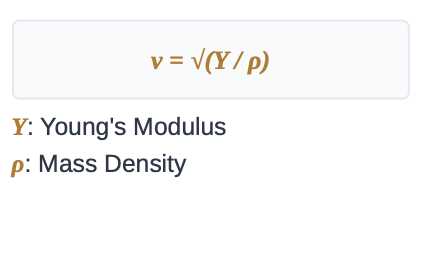
The speed of sound formula shown from the image belongs to _________

Solid Rod Long-Axis
The speed of sound formula shown from the image belongs to _________
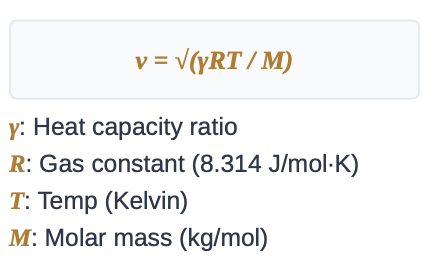
Ideal Gas Medium
The speed of sound formula shown from the image belongs to _________
Wave Intensity
It refers to the average power carried by a wave per unit area perpendicular to flow
False
Intensity is indirectly proportional to the square of displacement amplitude (I ∝ A2), the square of frequency (I ∝ f2), and the square of pressure amplitude (I ∝ pmax2).
True or False
Sphere
According to the Inverse-Square Law for Spherical Expansion, if a source emits sound uniformly in 3D dimensions without boundary absorption, the wavefront area is a _________ (4πr2)
Inverse-Square Law for Spherical Expansion
According to the __________, if a source emits sound uniformly in 3D dimensions without boundary absorption, the wavefront area is a sphere (4πr2)
Decibel Scale
The _________ or also known as Sound Intensity Level, shows that human perception of loudness scales logarithmically with physical intensity rather than linearly.
Wave Interference
_________ is caused by path length differences traveled by sound waves from multiple sources, producing areas of localized constructive reinforcement or destructive cancellation.
Standing Wave
It refers to a non-traveling wave pattern that is generated when two waves of identical frequency and amplitude pass through each other in opposite directions.
Nodes
These are points of permanent destructive interference where no particle movement occur.
Antinodes
These are points of constructive interference where displacement reaches its absolute maximum.