Electric Forces, Capacitance, and Circuit Rules for Physics Students
 Call Kai
 Learn
Learn Practice Test
 Spaced Repetition
 Match
Match Flashcards
 Knowt Play
1/21

There's no tags or description
Looks like no tags are added yet.
Name | Mastery | Learn | Test | Matching | Spaced | Call with Kai |
|---|
No analytics yet
Send a link to your students to track their progress
22 Terms
What is the Electric Force Direction Rule?
Like charges repel; Opposite charges attract.
What is the basic unit of negative/positive charge?
Negative: Electron; Positive: Proton.
What is the difference between a cation and an anion?
Cation: Lost e¯ (Positive); Anion: Gained e¯ (Negative).
In which direction does a positive charge move in an electric field?
Moves in the direction of the electric field.
In which direction does a negative charge move in an electric field?
Moves opposite the electric field.
What happens to work and potential energy when a positive charge moves with the electric field?
Work is positive; U decreases.
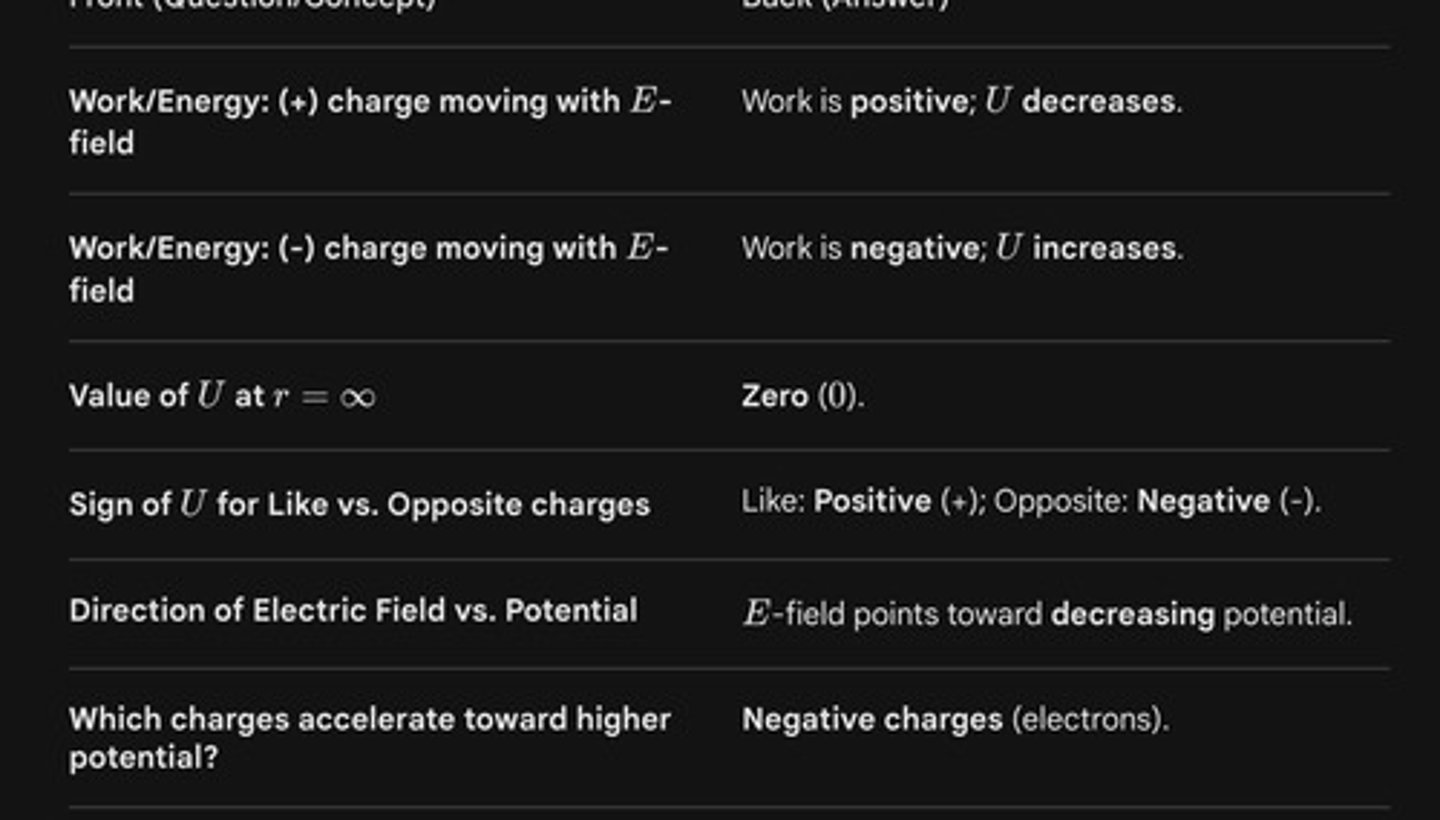
What happens to work and potential energy when a negative charge moves with the electric field?
Work is negative; U increases.
What is the value of potential energy (U) at infinity?
Value of U at infinity = ∞.
What is the sign of potential energy for like vs. opposite charges?
Like: Positive (+); Opposite: Negative (-).
In which direction does the electric field point relative to potential?
E-field points toward decreasing potential.
Which charges accelerate toward higher potential?
Negative charges (electrons).
What is the equivalent capacitance (Ceq) in parallel?
Greater than the largest individual C (Ceq = ΣC).
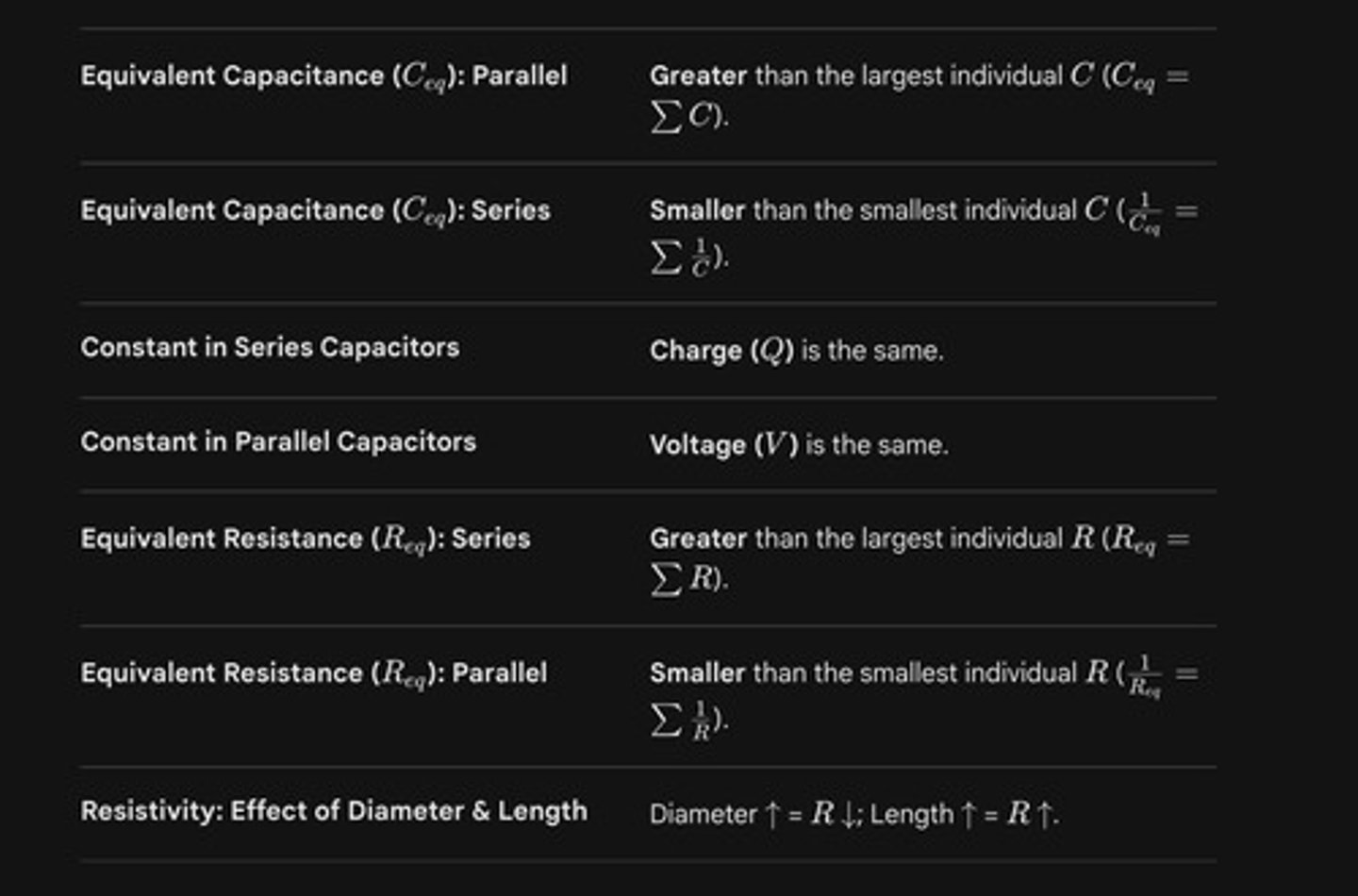
What is the equivalent capacitance (Ceq) in series?
Smaller than the smallest individual C (Ceq = Σ 1/C).
What is constant in series capacitors?
Charge (Q) is the same.
What is constant in parallel capacitors?
Voltage (V) is the same.
What is the equivalent resistance (Req) in series?
Greater than the largest individual R (Req = ΣR).
What is the equivalent resistance (Req) in parallel?
Smaller than the smallest individual R (Req = Σ 1/R).
How does resistivity affect diameter and length?
Diameter R↓; Length ↑ = R ↑.
What is the conventional current direction?
Direction a positive test charge would move.
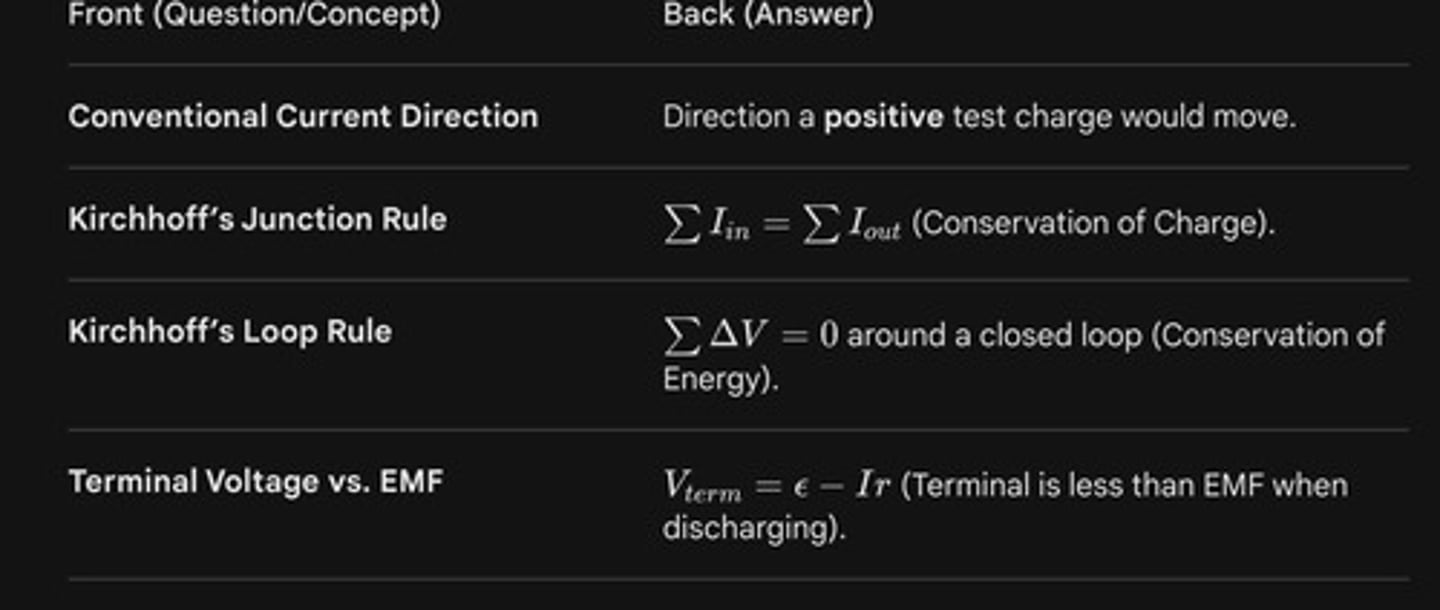
What is Kirchhoff's Junction Rule?
Iin = Iout (Conservation of Charge).
What is Kirchhoff's Loop Rule?
AV = 0 around a closed loop (Conservation of Energy).
What is the relationship between terminal voltage and EMF?
Vterm = EMF - Ir (Terminal is less than EMF when discharging).