CP468 Midterm
 Call Kai
 Learn
Learn Practice Test
 Spaced Repetition
 Match
Match Flashcards
 Knowt Play
1/55

There's no tags or description
Looks like no tags are added yet.
Name | Mastery | Learn | Test | Matching | Spaced | Call with Kai |
|---|
No analytics yet
Send a link to your students to track their progress
56 Terms
Four Ways to Define AI
Acting humanly: Turing Test
Thinking humanly: cognitive science
Thinking rationally: laws of thought
Acting rationally: (AI) rational = doing the right thing
Rule-based systems
Explicit IF-THEN logic
ex: If email contains “lottery” → spam
Learning-based systems
Patterns extracted automatically from data
data → model → prediction
ex: traditional LLM
Pros and Cons of Learning-based vs rules based
Learning-based:
Pro: Flexible and powerful
Cons: Less transparent, hard to explain why it made decision
Rules-based:
Pro: Fast, transparent, predictable
Con: breaks down in reality, no one can write enough rules
3-Types of Learning
Supervised
Unsupervised
Reinforcement
Supervised Learning
Learns from labelled data. Inputs paired with correct outputs. The model maps one to the other.
ex: Search ranking, Spam vs not-spam, fraud detection
Unsupervised Learning
Learns without labels
ex: Clustering
Reinforcement Learning
Takes actions in environment, receive rewards or penalties, improve over time
Discriminative vs Generative
Discriminative: Given this input, which class does it belong to? (ex: Logistic Regression)
Generative: Given this distribution, produce new examples that look like real data (ChatGPT)
AI Problem in 5 Parts SATGC
State: What does the world look like right now? (Position)
Actions: What can’t the agent do? (Move, Buy)
Transition: What happens after an action? (New state + action)
Goal: What are we trying to achieve? (Checkmate)
Cost: What do we want to minimize? (Time, money)
Data is the ___ of AI
fuel
Data ____ matters more than ________
Data quality matters more than model complexity
More data =
Generally improves performance up to a point
Biased Data =
Model learns whatever is in the training set
Learning vs Memorization
Good AI: generalizes, learns patterns
Bad AI: memorizes training data, fails on new examples
Evaluation for AI
Classification, Regression, Reinforcement Learning
Classification(predict category): Accuracy
Regression(predict number): Error
Reinforcement Learning(maximize goal): Reward
Limitations/Risks of AI (BPHO)
Bias: model learns inequities baked into training data
Privacy: Training data can leak into output
Hallucinations: Confidently incorrect outputs
Over-reliance: trusting AI more than it deserves
Agent Definition
An agent perceives it’s environment through sensors and acts on it through actuators
Agents include…
Humans
Robots
Softbots (API calls in, API calls out)
Thermostats (Temp sensor, turn on heater)
Agent Function vs Agent Program
Agent Function(abstract): Maps a percept history to an action
Agent Program(concrete): Code that runs on physical architecture to produce agent behaviour
Percepts
pieces of information an AI agent receives from its environment through sensors
ex: [location, contents] → [A, Dirty] (for vacuum)
Rationality
Rational agent picks option that is expected to maximize it’s performance
Not: Omniscience, clairvoyance, success
Is: Exploration, learning, autonomy
PEAS: how to specify task enviorment
P: performance (how do we score success?)
E: environment (what world does agent live in?)
A: actuators (What can the agent do to/in world?)
S: sensors (What can the agent perceive?)
PEAS for Shopping Agent
Peformance: Price, Quality, Good for User?
Environment: Current and future websites, vendors, the user
Actuators: render results to user, follow URLs, place orders
Sensors: HTML pages, user clicks and queries
Todays LLM agents are a type of…
Softbot
Softbot
An AI genet that mimics human tasks, acts on users behalf, or serves as digital bridge between different computer systems
Automation tools and industrial robotics software
Fully vs Partially Observable (7-Dimensions Environment)
Can the agent’s sensors see the complete state at each step?
Deterministic vs Stochastic (7-Dimensions Environment)
Is the next state fully determined by the current state and action?
Episodic vs Sequential (7-Dimensions Environment)
Do current decisions affect later ones?
Static vs Dynamic (7-Dimensions Environment)
Does the environment change while the agent is deliberating?
Discrete vs Continuous (7-Dimensions Environment)
Are time, percepts, and actions countable or smoothly varying
Single-agent vs multi-agent (7-Dimensions Environment)
Are there other agents whose behaviour matters? Cooperative or adversarial?
Known vs Unknown (7-Dimensions Environment)
Does the agent know the rules of the environment in advance
Environment type drives architecture choice. Use the ______ agent the world allows.
Environment type drives architecture choice. Use the simplest agent the world allows
5 Agent Architectures, in order (SMGUL) (STAR)
Simple Reflex Agent (acts on percept only)
Model-based reflex agent (maintains internal state of the world)
Goal-based agent (reasons about how to reach a goal)
Utility-based agent (Maximizes a continuous utility, not just goals)
Learning Agent (Any of the above + improves from experience)
Simple-Reflex Agent & Pros Cons
Match the current percept against a set of condition-action rules. Whichever rule fires first wins.
Pros: Cheap, fast, predictable
Cons: Has no memory, may loop forever
Model-based reflex agent & Two Ingredients
Keeps an internal model of the world to handle parts the sensors don’t currently see.
Two Ingredients:
How the world evolves (Cars move when I look away)
What my actions do (If I turn wheel left, my heading changes)
Goal-based agent
Considers possible futures “What will happen if I do A?” then chooses the action whose predicted outcome is closest to the goal
Utility-based agent
Maps a state to a real number, “how happy” the agent would be there. Choose the action whose expected utility is highest
Goals-based vs Utility-based agent
Goals → binary (reached or not)
Utility → a continuous degree of preference
Learning Agent and 4 components (PCLP)
Performance element → selects actions
Critic → compares behaviour to a fixed performance standard
Learning element → Updates the performance element from the critics feedback
Problem generator → suggests exploratory actions to discover new things
LLM Agent Anatomy (STAR)
Agent = LLM + Memory + Planning + Tool Use
Short-Term vs Long-Term memory LLM
Short-Term: Context Window
Long-Term: Vector DB, Files, Summaries
Agent =
Agent = percieve → think → act
Problem Solving Agent Implementation:
On holiday in Romania; currently in Arad. Flight leaves
tomorrow from Bucharest
Goal: be in Bucharest
Problem:
- States: various cities
- Actions: drive between cities
Solution: sequence of cities
Problem-solving process
Goal formula
Problem: state and actions
Search: simulate actions until reaches goal (Solution)
Execution
State
description of the world at a particular moment in time
Action
Something the agent can do that causes a transition from one state to another
Transition Model
Agents internal representation of how the world works, how actions change states
(Domain) Model
Complete abstract description of the problem world: states, actions, transitions, goal, coast
Optimal Solution
Lowest path cost among all solutions
Domain Model Abstraction
Ignore irrelevant states. Replacing real-world complexity with simpler representations
ex: Map of cities → cities on graph with distances between them
Vacuum World (States, Actions, Goal Test, Path Cost)
states: integer dirt and robot locations
actions: left, right, suck, NoOp
goal test: no dirt
Path cost: 1 per action
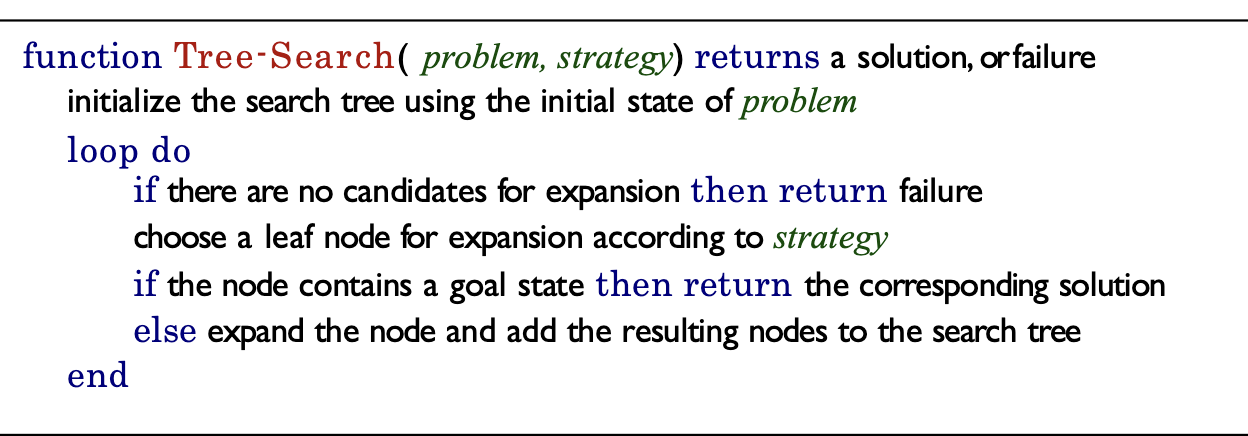
Tree Search Algo
States vs Nodes
State: representation of a physical configuration
Node: data structure constituting part of a search tree (parent, children, depth, path cost g(x))
Strategies are evaluated by the following dimensions (CTSO)
Completeness: Does it always find a solution if one exists
Time complexitity
Space complexity
Optimality