A&0 1 - Final
 Note
Note Call Kai
 Learn
Learn Practice Test
 Spaced Repetition
 Match
Match Flashcards
 Knowt Play
1/244

There's no tags or description
Looks like no tags are added yet.
Name | Mastery | Learn | Test | Matching | Spaced | Call with Kai | Chat |
|---|
No analytics yet
Send a link to your students to track their progress
245 Terms
Climate
The type of weather that exists over a long period in differing areas.
Microclimates
The consistency of an area and the plants that exist there, which contribute to the climate.
Climate zones
Different regions on Earth, such as polar, temperate, and tropical, based on how the sun's radiation hits the Earth's surface.
Weather
Atmospheric conditions in a given location over a short period, typically day to day.
What is the basic difference between weather and the climate?
Weather is short term atmospheric conditions (day to day), while climate is long-term atmospheric conditions (about 30 years)
Climate Change
A change in an area's average temperature, especially the Earth's average temperature, caused by various factors such as changes in solar radiation, chemicals in the atmosphere, the water cycle, and interactions with the land and ocean.
Seasons
The result of Earth's axis tilt, which causes certain hemispheres to receive more solar radiation at certain times during its orbit around the sun.
Does the Earth receive more energy at the poles or the equator?
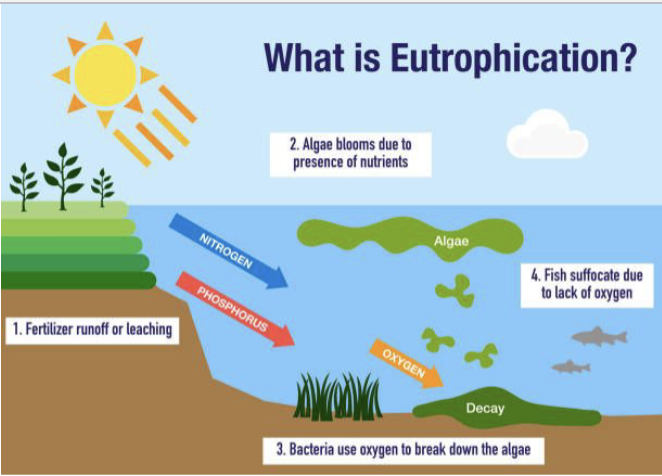
From the sun, more energy is received at the equator due to the angle of the incoming solar radiation
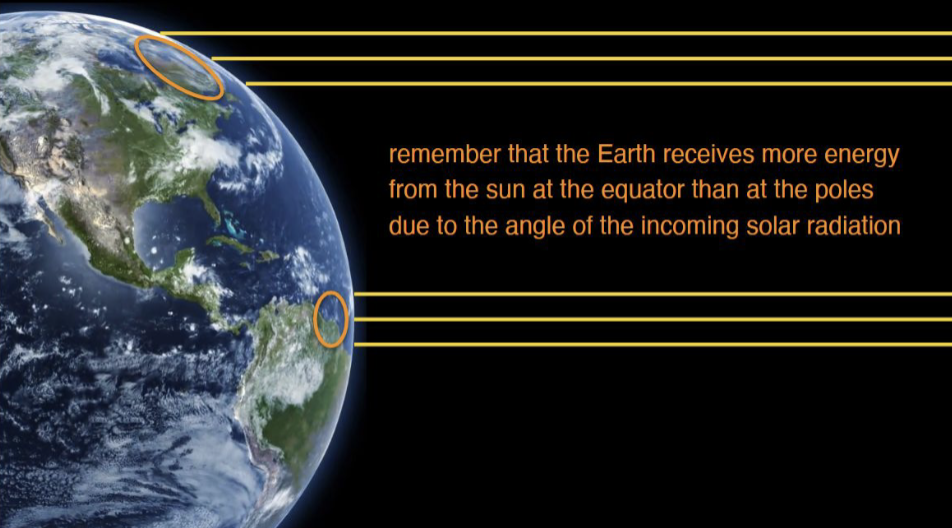
Due to these angles, the lower you are in _____ the more shortwave radiation they receive (hotter)
latitudes
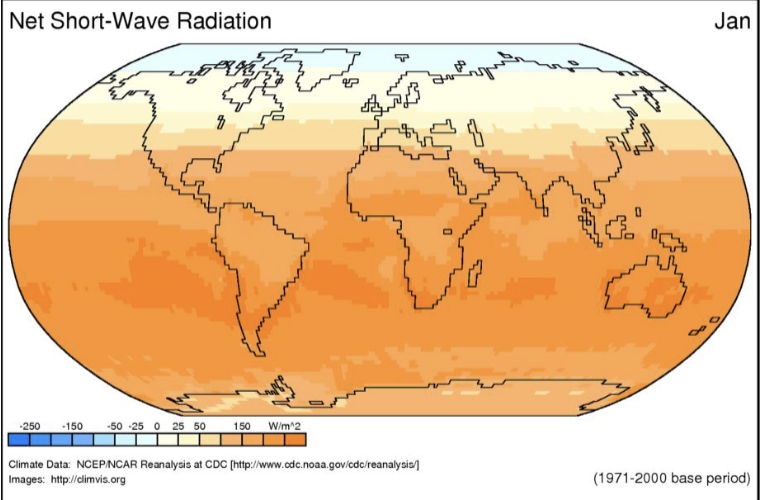
Eutrophication
An increase in organic matter in the ocean due to excessive nutrients, leading to algae blooms and oxygen depletion, which can suffocate marine animals.
Orders of Magnitude
A scale used to represent different powers of ten, such as nano-, micro-, milli-, centi-, deci-, deca-, hecto-, kilo-, mega-, and giga-.
What is the Stefan-Boltzmann constant’s value?
5.67 × 10⁻⁸
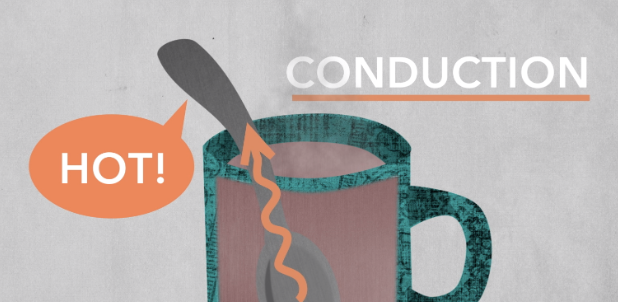
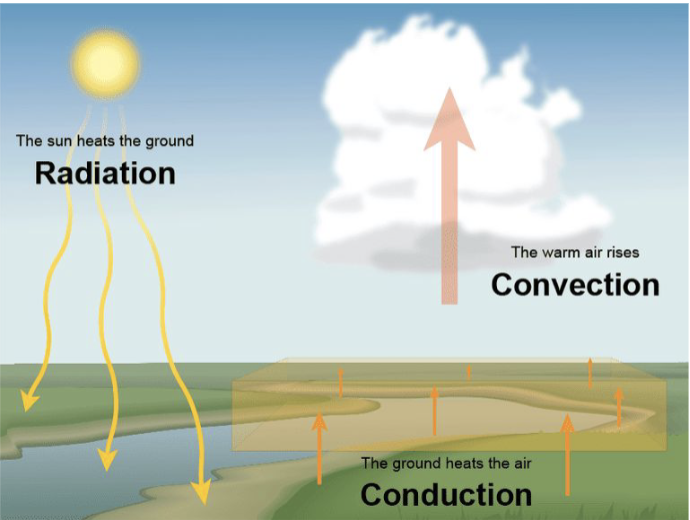
Conduction
Heat transfer that occurs between warm and cold objects (i.e. the metal spoon heats up when it meets the hot liquid)
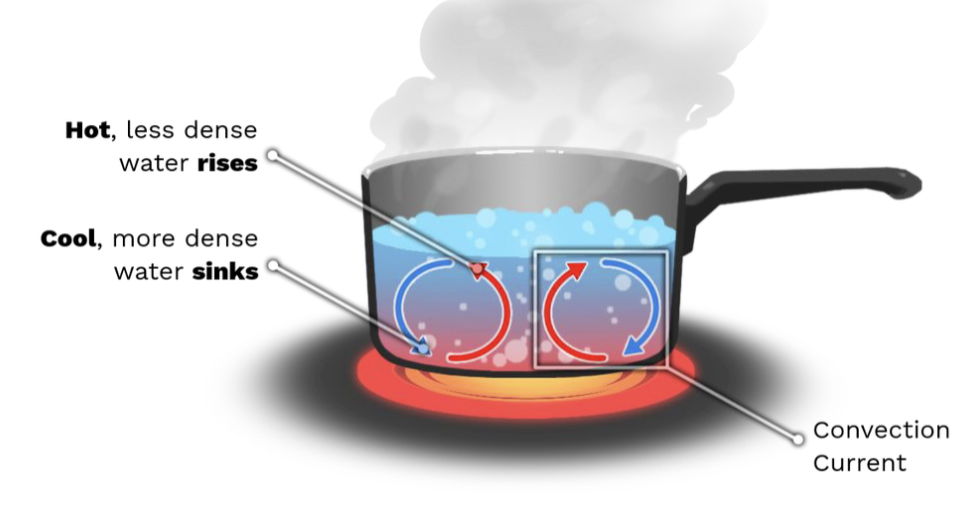
Convection
The transfer of energy through a fluid (such as air) from one part to another, where warmer air rises and colder air sinks.
Phase Changes
Heat transfer due to evaporation (i.e. water evaporates from surface water and travels to the atmosphere)
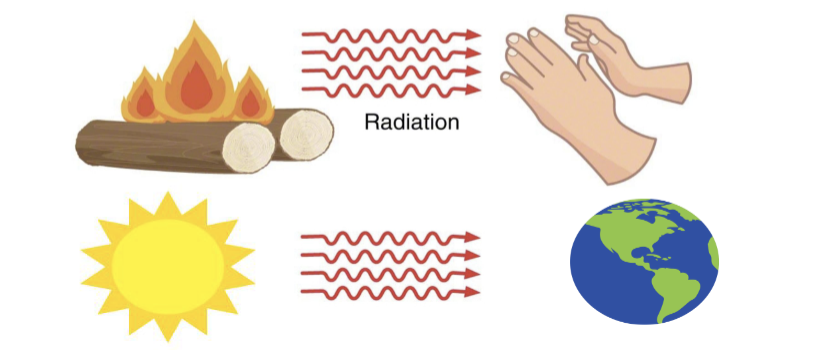
Radiation
transfer of energy due to electromagnetic radiation (i.e. infrared)
Atmospheric circulation is caused by _____
the uneven heating of the Earth’s surface
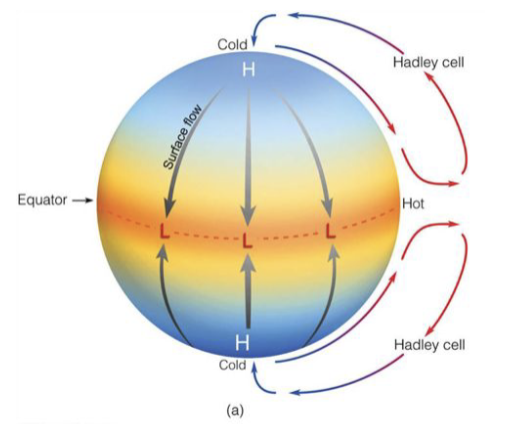
What is atmospheric circulation?
It is where the atmosphere attempts to even out the temperature of the Earth by transporting heat toward the Earth’s poles; this is done due to the continuous convection cells near the equator that push up against the top of the atmosphere and spread out to the poles (Hot air rises, cools, then the new cold air sinks); the image portrayed takes into account if no rotation
Coriolis Effect
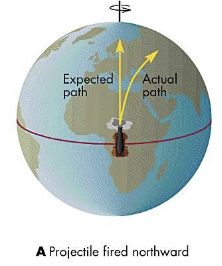
An apparent force due to the rotation of the Earth that causes objects in motion to be deflected, resulting in the deflection of wind patterns and the creation of convection cells.
Due to the Coriolis Effect…
objects that are in motion will be deflected based on which hemisphere they are moving in
Objects in motion moving in the Northern Hemisphere move to the ____
right
Objects in motion moving in the Southern hemisphere move to the ____
left
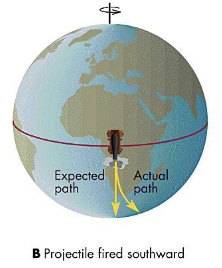
Westerlies defintion
wind blowing from the west to the east
Easterlies defintion
wind blowing from the east to the west
Earth Convection steps
Electromagnetic radiation from the sun is absorbed at the Earth’s surface
Conduction (sensible heat flux)from the surface warms the lowest parts of the atmosphere
Convection, warm air rises as it becomes lighter than the air around it
Electromagnetic Spectrum definition
The range of electromagnetic waves, from gamma-ray to radio, with shorter wavelengths containing more energy and heat.
Electromagnetic spectrum in order (longest to shortest wavelength)
radio, microwave, infrared, visible, UV, X-Ray, Gamma
Shorter wavelengths are ____
higher energy (more heat)
Longer wavelengths are ____
lower energy (less heat)
Wien’s Displacement Law
The object's temperature determines the dominant type of radiation (peak wavelength) emitted from it.
Wien’s Displacement Law Formula
wavelength peak = (2898 µm) / (T)
Stefan-Boltzmann Law
Temperature of the object determines the total amount of radiation emitted from it (E = (5.67 × 10⁻⁸)T^4
Convection Cells
The rising and sinking of warm and cold air that create circular patterns within the Earth's atmosphere, influenced by the Earth's rotation and tilt.
Greenhouse Effect
The process where greenhouse gases in the atmosphere absorb and re-emit longwave infrared radiation, trapping heat and increasing the energy received by the Earth's surface. (by greenhouse gasses and clouds)
So the sun’s radiation can hit the Earth’s surface, it must pass through the earth’s atmosphere by:
Scattering; Absorption; Transmission
Scattering
molecules bounce off the atmosphere and are moved into different directions; this includes UV and some visible light and is much stronger for shorter wavelengths
Scattering is typically done by major gasses like:
Nitrogen, Oxygen, and Argon
Absorption
some shortwave infrared becomes absorbed by water vapor molecules (energy in the photon/wave becomes absorbed by molecules & disappears; molecules that absorb have much higher energy afterwards, more energy, more vibration)
Transmission
70-75% of radiation is transmitted through the atmosphere
Radiation-atmospheric interactions (summarized)
Solar radiation from the sun arrives & has short wavelengths → it isn’t absorbed completely by the atmosphere & heats the Earth → then, Terrestrial radiation from the earth’s surface has longer wavelengths & travels into the atmosphere which is strongly absorbed (by the Greenhouse gasses) and re-emitted into the atmosphere to space.
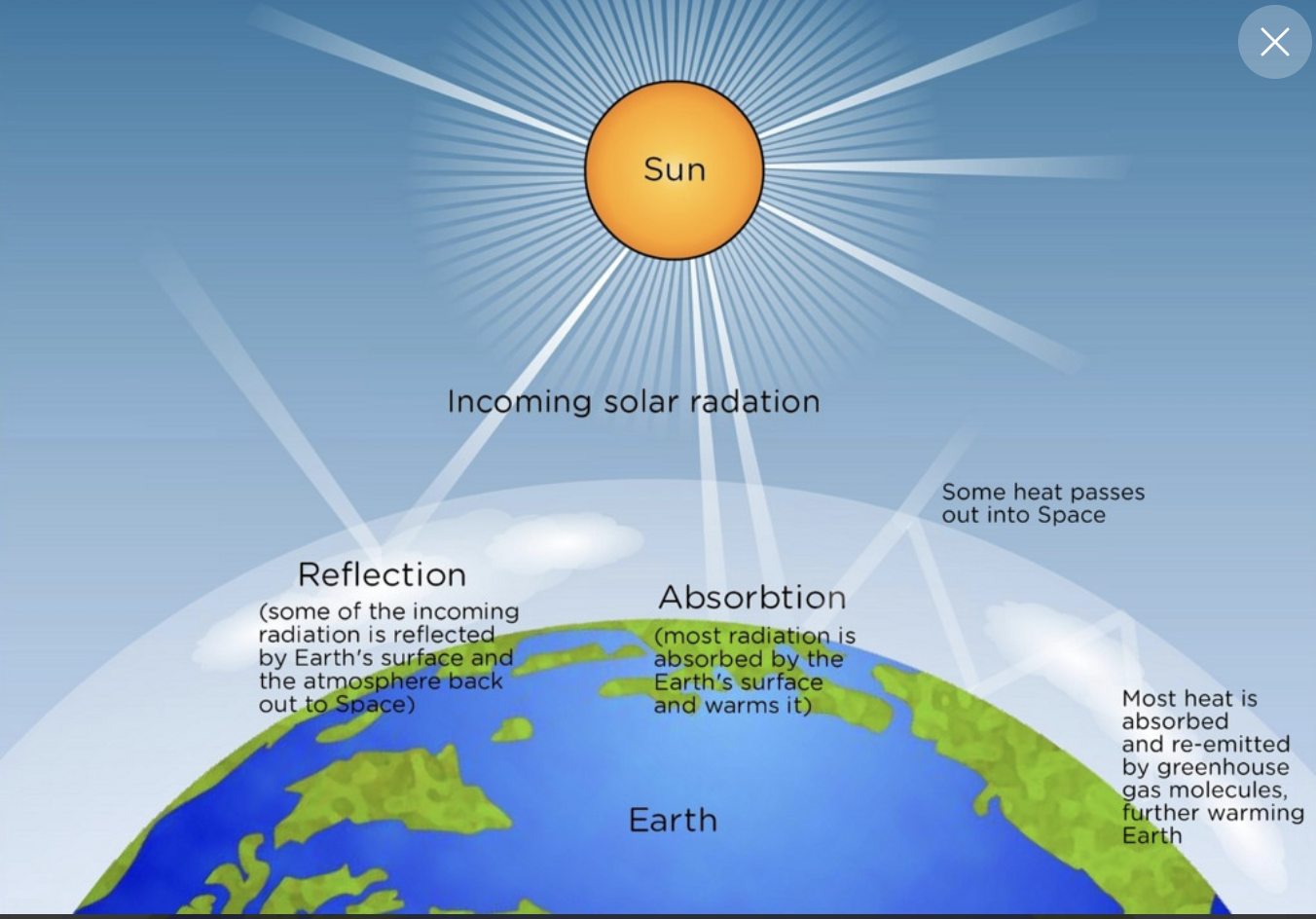
Greenhouse gasses function
Strongly interact with longwave infrared radiation through re-emission and absorption; most infrared radiation is absorped by these gasses rather than the heat leaving Earth
Greenhouse gasses includes:
Water vapor (H20), Methane (CH4), Carbon Dioxide (CO2), Nitrous Oxide (N2O), & Ozone (O2)
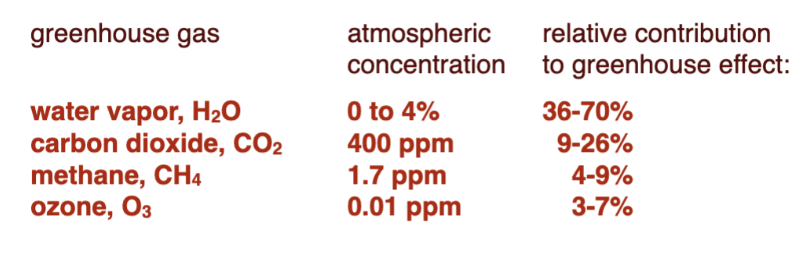
If there is much more water vapor in the atmosphere, then why do we worry about Carbon Dioxide?
We’re worried about Carbon Dioxide because that is one of the gasses we’re making and re-emitting; it is actively closing the window for infrared transmission, keeping more and more heat to the earth
Feedback
The response or reaction to a change in a system, either positive (accelerating the initial change) or negative (counteracting the initial change).
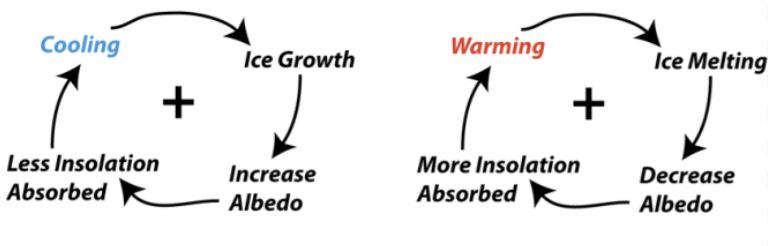
Positive feedback
an act that is done to accelerate initial change, makes it more likely to happen again (i.e. higher population, more births)
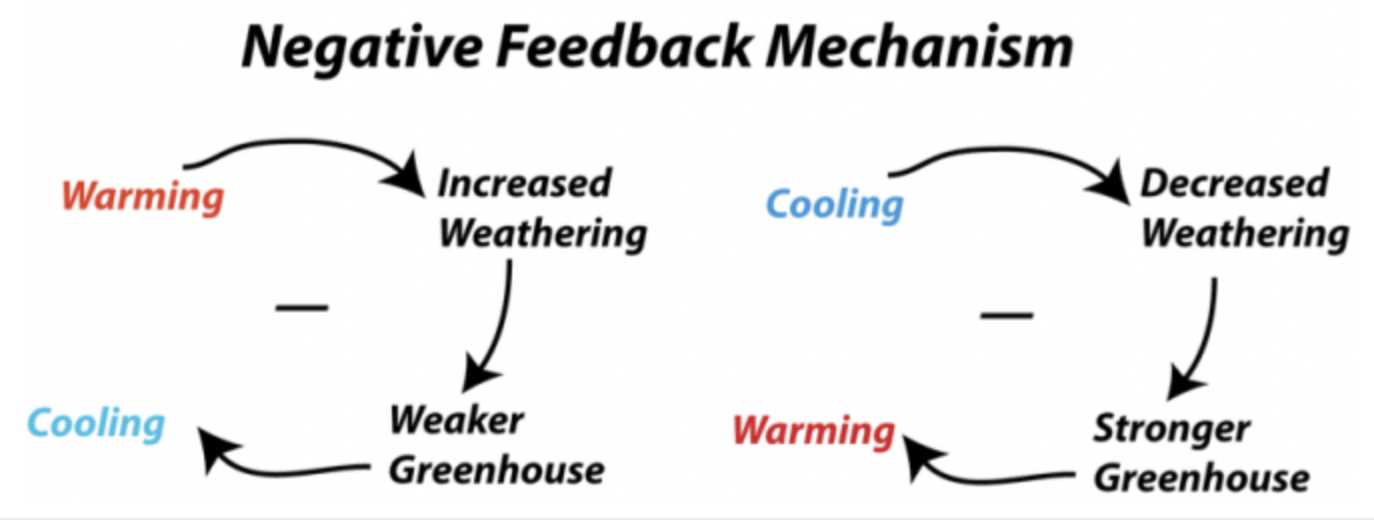
Negative feedback
Counteracts or dampens an initial change, makes it less likely to happen again (i.e. someone gets cold, starts to shiver
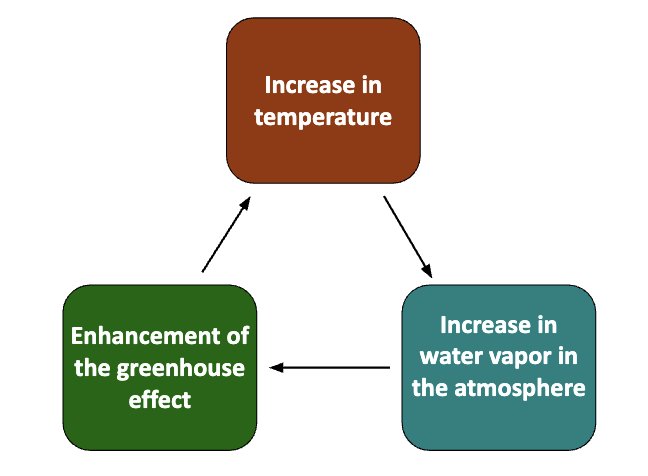
Water Vapor Feedback
Increase in temperature → increase in water vapor in the atmosphere → enhancement of greenhouse effect → increase in temperature
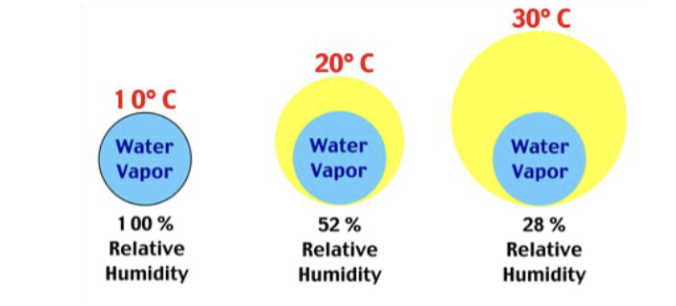
Relative Humidity
Measure of how much water vapor is in the air compared to how much the air can hold in percentage at a given temperature (actual water content / possible water content)
Cloud Feedback (if high clouds decrease)
Decrease in high clouds due to warming → lower absorption of infrared radiation → warming reduced (negative feedback)
Cloud feedback (if low clouds decrease)
Decrease in low clouds due to warming → decrease of high albedo areas → warming is amplified → decrease in low clouds (positive feedback)
Clausius-Clapeyron Relation
The relationship between temperature and relative humidity, stating that as temperature increases, relative humidity decreases.
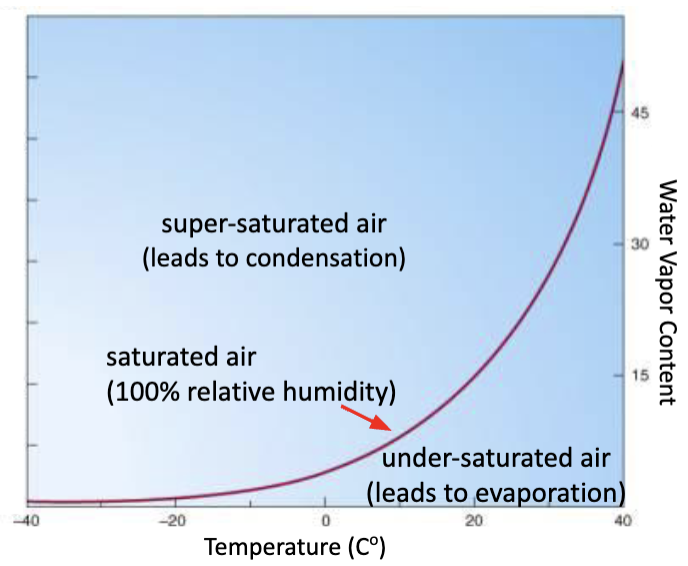
Why is the Clausius-Clapeyron Relation important?
When air rise, like from convection, the temperature continues to cool as you go higher; as this hot air becomes colder it creates clouds
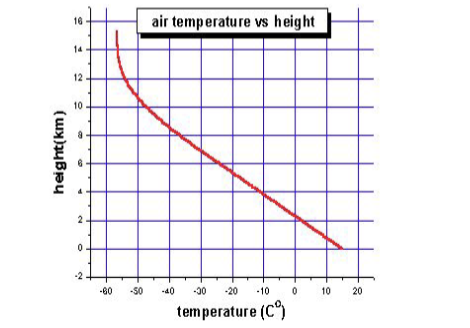
Undersaturated
When the relative humidity is below the curve on a temperature-relative humidity graph.
Supersaturated
When the relative humidity is above the curve on a temperature-relative humidity graph.
condensation
Rising hot air becomes colder the higher up it goes into the atmosphere, this creates clouds
Albedo defintion
The reflectivity of a surface, with high albedo indicating high reflectivity and low albedo indicating low reflectivity.
Low to high albedo (examples)
Water (10%) → Forests (10-20%) → Snow & Ice (85%)
Earth Planetary Albedo is about
30%, with that much solar radiation being reflected back into space (this includes reflection of sunlight from the surface & the clouds)
Arctic greening feedback (positive)
Increase in temperature → trees grown in the artic → increase in incoming sunshine → increase in temperature
Artic greening feedback (negative)
Trees grow in the arctic → more uptake of CO2 → decrease in temperature → fewer trees grow in the Arctic
Surface Albedo Feedback
Increase in temperature → decrease in sea ice and snow cover → increase in incoming sunshine → increase in temperature (positive)
Intertropical Convergence Zone
A low-pressure belt (cloud band) circling the Earth near the equator where trade winds of the Northern and Southern Hemispheres converge; indicates where warm and humid air rises
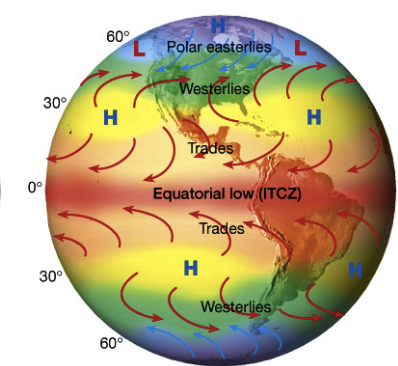
Cloud formation
The process by which water vapor condenses into droplets to form clouds: Sun heats the surface → Atmosphere heats from surface, bottom is warmest → Warm air rises (Hadley cells) → Air cools, reaches saturation → Water vapor condenses into droplets → Clouds form.
Hadley cells
Atmospheric circulation patterns in which warm air rises at the equator and cools as it moves towards the poles.
High altitude clouds
are made out of ice particles and warm the surface; are thin, nearly transparent to sunlight, and are very effective in absorbing infrared radiation
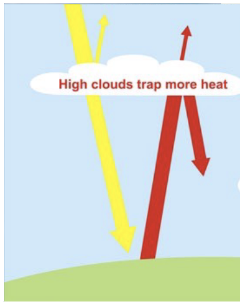
Low altitude clouds
also knows as cumulus clouds; cool the surface, are dense & have a very high albedo; aren’t effective in absorbing infrared radiation
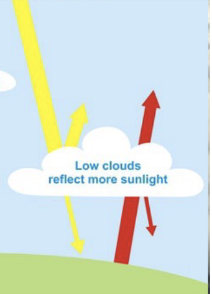
What has the highest albedo?
snow
What type of feedback is this:
Viruses enter the body → Body temeprature rises → ?
Negative
What type of feedback is this:
Get a scrape → Start bleeding → ?
Negative
Study for an exam → Do well on the exam → Self-confidence increase →
Positive
Streets are full of cars/unsafe → Do well on the exam → Parents drive them → ?
Positive
Turning on the shower → Water feels to hot/ too cold → ?
Negative
What drives major patterns of sea surfaces temperature?
shortwave radiation
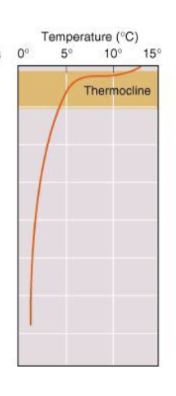
Why is the temperature at the surface much greater than in the deep ocean?
Because the ocean is heated above from the sun
What keeps warm water at the surface?
Warm water is less dense than cold water, so it floats
What drives major sea patterns of sea surface salinity?
precipatation → evaporation
Where is the freshest water located?
Freshest water is located at the surface
What could cause the salinity to increase at the surface?
Evaporation
What causes salinity to decrease?
precipatation
How do you change the volume of water?
Changes the temperature, increase or decrease the temperature
How do you change the mass of water?
Add salt, increase mass
Thermocline
Temperature is changing the quickest
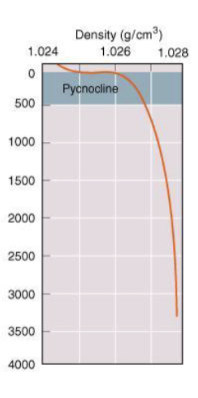
Pycnocline
Density changes the quickest
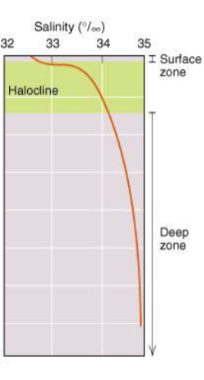
Halocline
Salinity is changing the quickest
Is salt water denser then fresh water?
freshwater is less dense than salt water at sits at the surface
Ocean stratification
since warmer and fresher water is less dense, it sits at the ocean’s surface well deeper water is saltier and colder; this creates verticle layering which makes it very hard to mix surface and deep water
Global ocean salinity
ocean water becomes more salty due to evaporation and less salty from preciptation (rain)
Which ocean has the highest salinity?
the Atlantic Ocean
Deep Convection → in the Atlantic Ocean
Start with warm salty water which eventually cools down & has a higher density which causes it to sink to the bottom
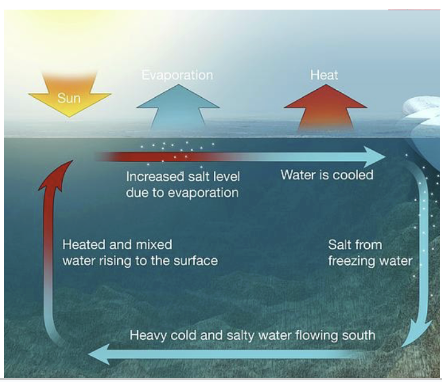
Deep convection happens in what two oceans:
Antarctic & The North Atlantic
Hurricanes spin counterclockwise in ______
the northern hemisphere
Hurricanes spin clockwise in ____
the southern hemisphere
What is our current geological epoch?
Holocene
What is the most recent geological epoch prior to us?
Pleistocene (Ice Age)
Last glacial maximum description
vegetation zones shifted south and lower sea levels created a land bridge fro Asia to the Americas
How do we know about these changes in climates (historically)?
They analyze archives of past climates (i.e. ice cores, tree rings, etc.) as each such archive can be dated
Knowing the age of these changes allows us to know:
Ocean temperatures and amount of ice contained in global ice sheets; composition of atmospheric air contained in bubbles; growth temperatures on land from the width of tree rings and pollen in ocean and lake sediment layers
Approximately how many years are between cold periods (or warm ones)?
100,000 years
Would you expect more dust in the atmosphere during glacial periods?
yes, since the climate is windy and dry
Milankovitch (theory) cycles definition
Changes in Earth’s orbit are responsible for glacial-interglacial climate cycles as Earth’s orbit has changed in both eccentricity and obliquity (angle of the Earth’s tilt)