A&0 1 - Final
Lecture 01/09/24
What is climate? → type of weather that exists over a long period in differing areas
Weather comes out of the climate
Climate → derived from the Greek
How different slopes appear
Microclimates → considered the consistency of the area and the plants that existed there
Earth’s climate zones
I.e., polar, temperate, & tropical
Based on how the sun’s radiation hits the Earth’s surface
The zone around each star where there is a possibility for water, at a right distance → means there is possible life on that planet
Discussion 01/09/24
Weather → atmospheric conditions in a given location over a short period (day to day)
Climate → atmospheric condition of a location over a long period of time
Climate Change → change in an area's average temperature
Especially the Earth’s average temperature
Things that control the climate:
Changes in solar radiation (energy), chemicals in the atmosphere, the water cycle, interactions with the land and ocean
Seasons on Earth
Earth’s axis has a tilt (23.5) → this means that certain hemispheres are getting much more solar radiation at certain times as it orbit around the earth
Eutrophication → too many nutrients lead to an increase of organic matter in the ocean
Fertilizer runs off v algae blooms due to the presence of nutrients → bacteria use oxygen to break down algae that dies → through respirations, produce CO2 → fish and other marine animals suffocate due to a lack of Oxygen
Orders of magnitude
10^-9 → nano-
10^-6 → micro-
10^-3 → milli-
10^-2 → centi-
10^-1 → deci-
10^1 → deca-
10^2 → hecto-
10^3 → kilo-
10^6 → mega-
10^9 → giga-
Stefan-Boltzmann Law → 5.67 x 10^-8
Practice
101.3 kPa (1000 Pa) = 101, 300 Pa
(1 Pa)
Lecture 01/11/23
Increase in temperature is one of very many change sthat can occur within the climate system
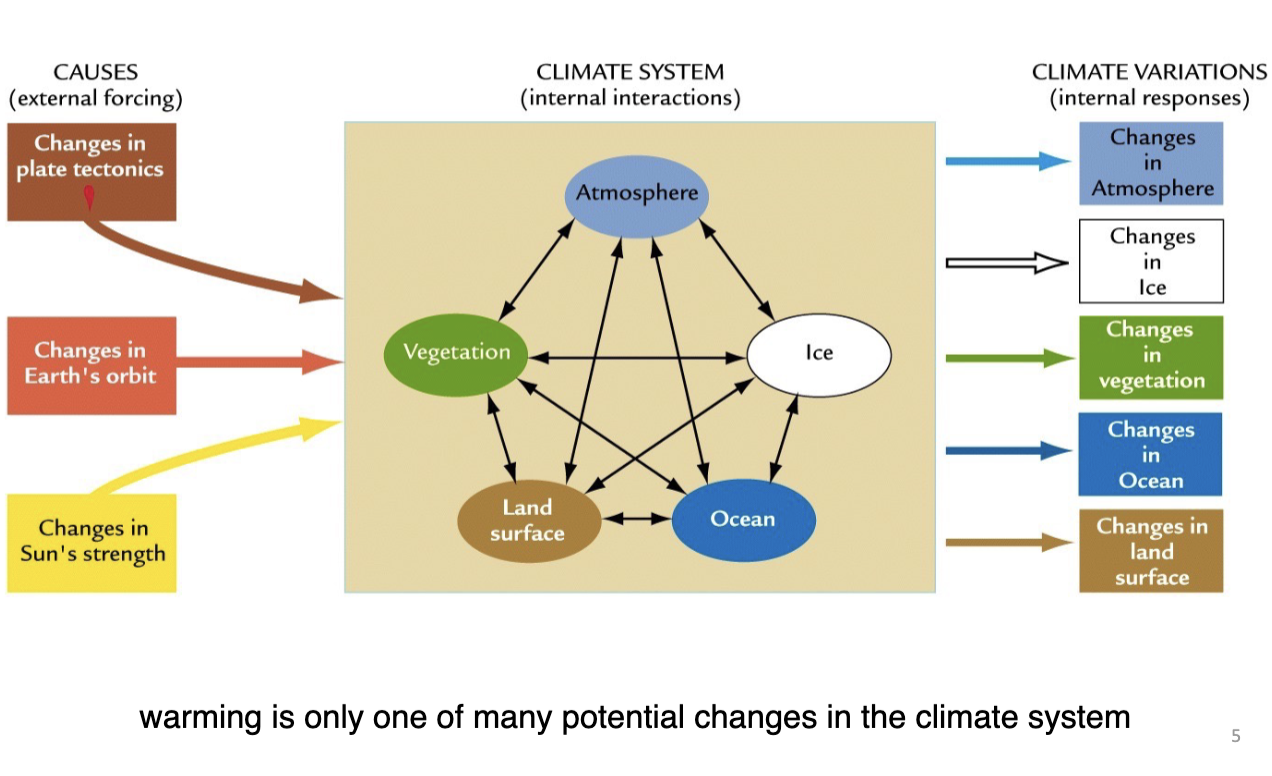
Weather = short term evolution ( a few days)
Climate = longer term statistics of weather (30 yrs)
Stratosphere = ozone layer
Troposphere = what we mean when we discuss the atmosphere
Due to the angle of the incoming solar radiatio = more energy hits the equator than the noth and south poles
Temperature → measure of internal heat energy, measured by observing the speed of movement that molecules make (molecules make up all matter)
More molecule movement, the higher the temperatures
Warm air → much less dense than cold air
Convection → where warmer air (less dense) tends to rise and colder air (more dense) sinks
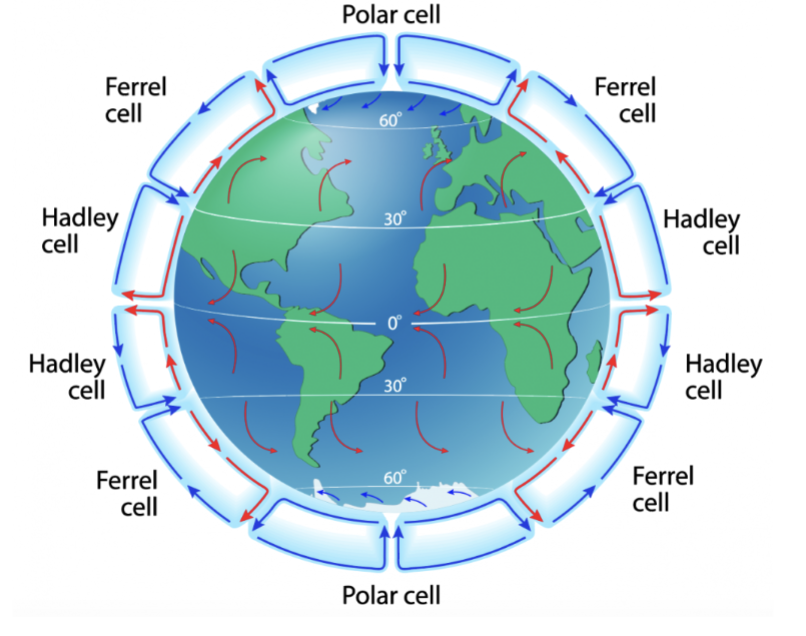
Convection cells → the tising and sinking pf warm and cold air create convection cells within the Earth’s atmosphere (can be imagined without Earth;s tilt)
Since it rotates, however → the south is less stretched out in its convection cells due to the tilt & rotation of the earth
The Coriolois effect → it depends on the atmosphere
Moves faster the closer they are to the equator (Pole = 0 km/hr)
Lecture 01/16/24
Atmospheric circulation is affected by the Coriolis effect
You are moving at a different speed than someone else at a different location on the Earth
To us, it looks as if it’s rotation due to us standing on a rotating sphere (the earth)
The farther you are from the equator, the slower you must go to go around the Earth officially
Because there is less density and pressure, there exists a return to the equator (it becomes reflected to the right)
Since we sit right of the edge of the tropical convection cell
Polar jet steam → happens super high in the atmosphere and the wind never makes it to the pole but to the east
Existence of ‘cold stamps’ isn’t a debunking of global warming, instead it can be evident of it
Electromagnetic spectrum
Gamma-ray > X-Ray > UV > Visible > Infrared > Microwave > Radio
Left to right (shortest to longest wavelength)
Shorter wavelengths → filled with much more energy & heat
Longer wavelengths → filled with much less energy & heat
Sunlight → possesses a wide range of different wavelengths
Discussion 01/17/23
Convection → transfer of energy though a fluid from one part to another
warm air is lighter than cold air (rises) → cold air is heavier than warm air (sinks)
Convection current → hot air rises, cools, then sinks and becomes warmer again, and continues to rise → a continuous cycle
Radiation → energy as a result of absorption and emission of electromagnetic waves (i.e., infrared terrestrial radiation or visible solar radiation)
Ex. → thermal radiation from a campfire emitting heat and being absorbed into our hands, warming them
Atmospheric circulation → result of uneven heating of the Earth’s surface by the sun
Atmosphere ties to event out temperature f the earth by transporting heat toward the poles
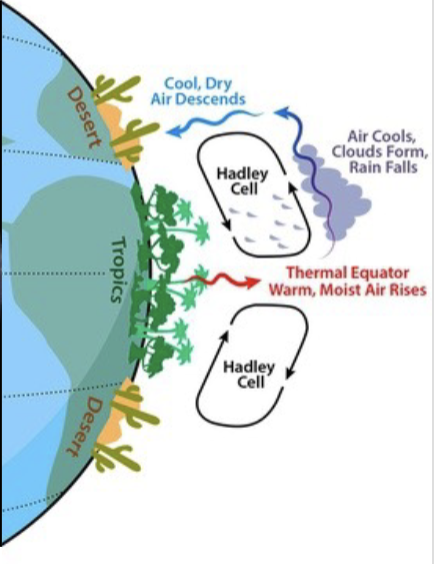
Hot aire rises from the equator, hits the poles where it cools ad then sinks → Hadley cell, due to continuous convection → due to rotation of the earth the convection cells become much more complicated
Convection over 3 steps:
1. Electromagnetic radiation from the sun is absorbed into the
Coriolis “Force” → an apparent force due to the rotation of the earth
Objects in motion will be deflected based on which hemisphere whey are moving in
Northern Hemisphere → Deflection to the right (creates hurricane with counter-clockwise spirals)
Southern Hemisphere → Deflection to the left (creates hurricanes with clockwise spirals
It depends upon our frame of reference
Westerlies→ wind blowing from the west to the east
Easterlies → wind blowing from the east to the west
Electromagnetic waves
Gamma-ray > X-Ray > UV > Visible > Infrared > Microwave > Radio
Length of a wave determines the energy → measurement of peak to peak
Short waveelngths → higher energy
Longer wavelengths → lower energy
Wiens law → temperature of the object determines the dominant type of radiation (peak wavelength) emitted
Lambda → 2898 / T (in kelvin)
Hotter objects → emit the most energy with shirt wavelengths
Colder objects → emit the most energy at long wavelengths
Stefan-Boltzmann law → temperature of the object determines the total amount of radiation emitted from it
E = (Boltzmann constant) T4
Lecture 01/18/24
All objects emit radiation constantly
Temperature determines the range of wavelengths (see specifically in stars)
The hotter an object, the shorter the peak emission (Wien’s law)
The total energy emitted by an object strongly (power of 4) depends on temperature (Stefan-Boltzmann law)
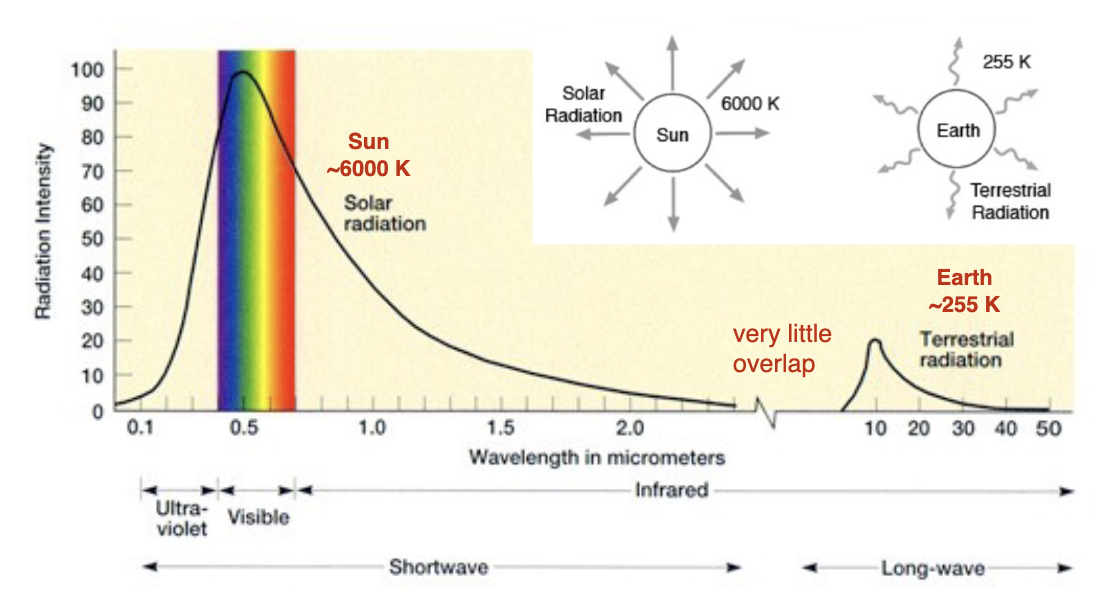
Earth (terrestrial radiation)→ radiation is less intense and less total energy than the sun due to the extreme heat the sun emits
Distribution in wavelength differs as well
The sun’s radiation needs to pass through the earth’s atmosphere on its way to the surface
When its radiation enters in three different ways:
Scattering → UV and some visible light is scattered (molecules bounce off & moves in different directions)
Major gases in our atmosphere (i.e., O2, N2, Ar) only scatters some radiation
Scattering is much stronger for shoirter wavelengths
Is responsible for giving us a blue sky
Absorption → some shortwave infrared becomes absorbed by water vapor molecules (energy in the photon/wave becomes absorbed by molecules & disappears; molecules that absorb have much higher energy afterwards, more energy, more vibration)
Transmission → 70-75% of the radiation is transmitted through the atmosphere
ALSO → the Earth emits radiation from the surface into space
This outgoing infrared radiation is strongly absorbed & re-emitted into the atmosphere
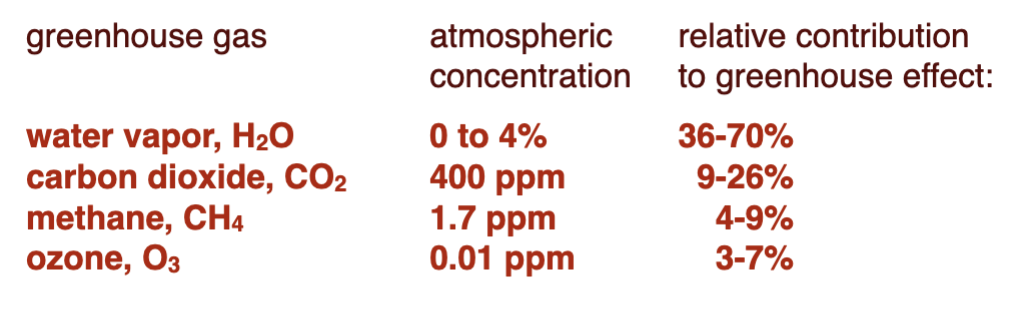
Greenhouse Gasses → strongly interact with this longwave infrared radiation (trhough remisission and absorption)
Includes → Water vapor (H20), Methane (CH4), Carbon Dioxide (CO2), Nitrous Oxide (N2O), & Ozone (O2)
Ozone → absorpbs UV radiation
Most infrared radiation is absorbed by these greenhouse gasses rather then going through the atmosphere (when leaving Earth)
Greenhouse effect (a naturally-occurring phenomenon)→ much of this terrestrial radiation is absorbed by greenhouse gasses & clouds in the atmosphere → it is then re-emitted back to the earth s surface, which increases the energy that the surface receives
Our surface then becomes much warmer than it would be
Due to the increase in the amounts of greenhouse gasses → a growing concern of climate change has occurred as more terrestrial radiation is being reflected onto the earth’s surface
Radiation-atmosphere interactions
Solar radiation arrives from the sun & has shorter wavelengths → this radiation isn’t absorbed strongly & most pass through the atmosphere & heat the earth
Terrestrial radiation comes from the earth’s surface & has longer wavelengths &travels into the atmosphere → it strongly interacts with various gasses in the atmosphere → becomes strongly absorbed, and is re-emitted into the atmosphere
Big player in the greenhouse effects and any small changes affects the surface temperature of a planet → increasing greenhouse gases in the atmosphere creates concern for climate change
Major Gasses → cosnsists of only two atoms
Asymmetry in a molecule → can wobble
Water vapor → most important greenhouse gas, yet why are we worried about CO2
CO2 → we are making it & emitting it → it’s closing the window in the infrared transmission (essentially keeping heat to the earth)
Lecture 01/23/24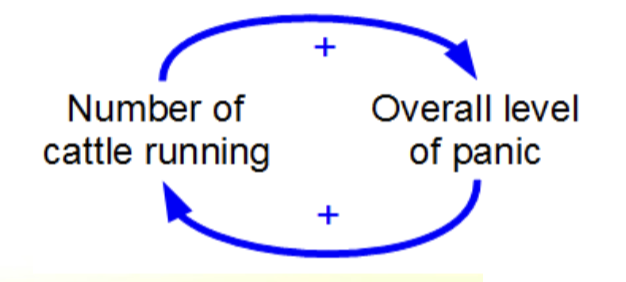
Feedback
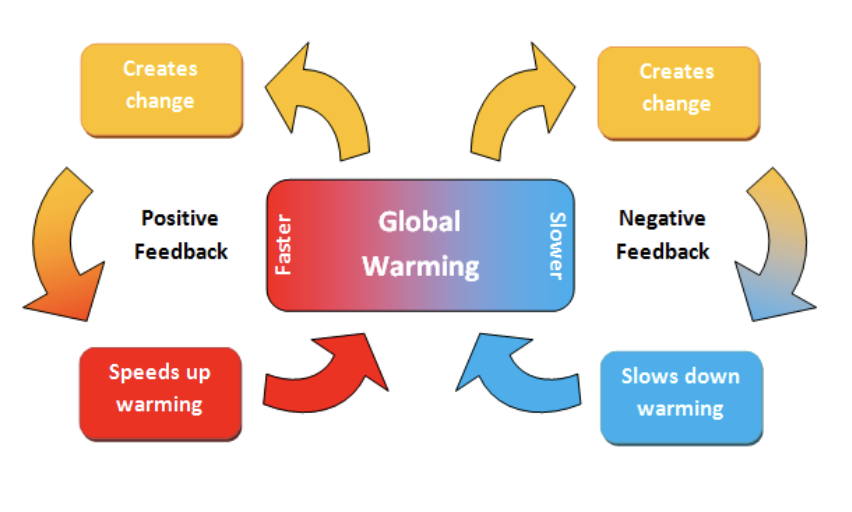
positive feedback → act to accelerate initial change
Created “runaway” situations unless something happens to stop them
Eaxnples of positive feedback:
Anxiet before exams, poor performance
Higher population, more births
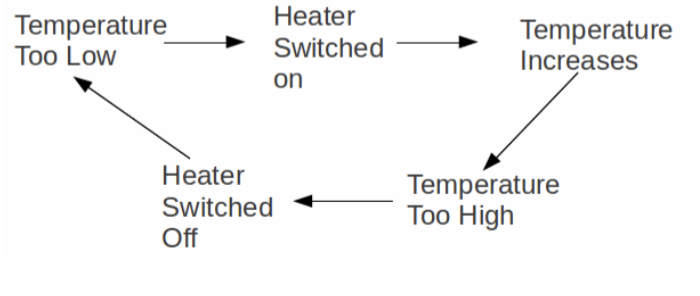
Negative feedback → counteracts (dampen) initial chnage
Can create self-stablizing situations
Examples of negative feedback:
Someone gets cold, starts ot shiver
Someone gets hot, starts to sweat
Climate feedbacks
Water vapor feedbacks
Surface albedo feedback
Cloud feedbacks
Due to temperature difference between objects, condensation is created (i.e. water condenses on a cold window from the hot steam of a shower)
Water condenses on cold surfaces
Water vapor → where does it come from?
The ocean; earth’s surface
More water vapor exists over oceans & the equator → amount of it is extremely variable
Condensation → makes water visible in the air
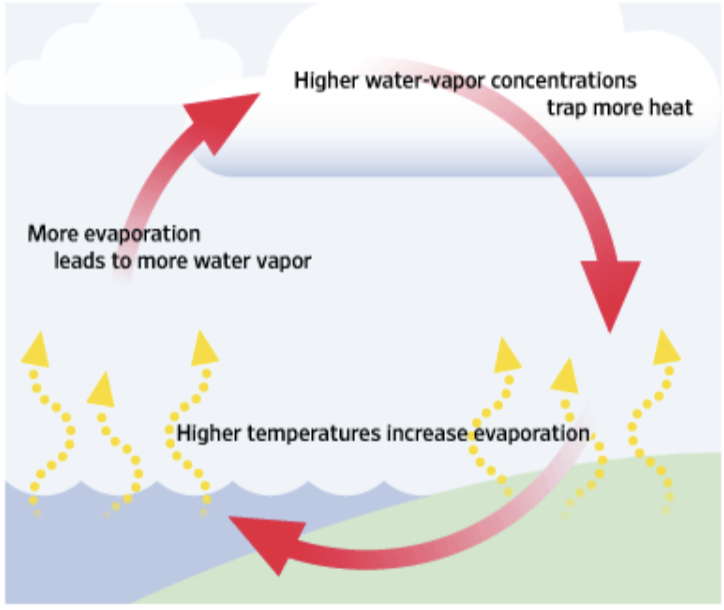
Warmer air → capable of holding more water vapor
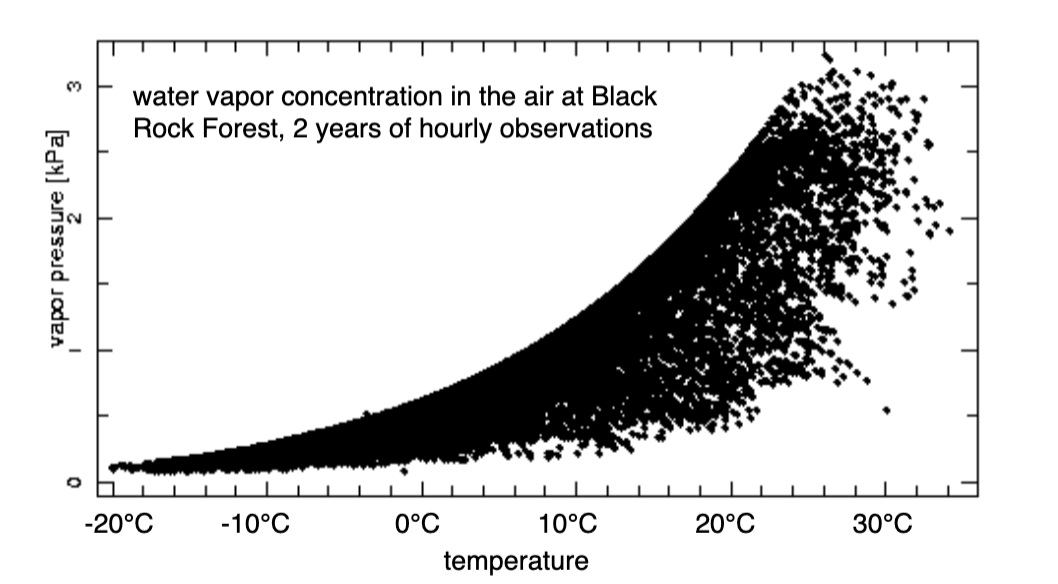
The increase on the graph → displays water vapor saturation
Also knows as the Clausiaus-Clapeyron curve → shows how much water vapor the air is capaoble of holding when saturated, dpeending on air temperature (about 7% per ˚C)
Relative humidity → actual water content / possible water content (in %)
Water vapor → most important greenhouse gas, accounts for about ½ of the Earth’s natural greenhouse gass effect
Discussion 01/24/24
Radiation review
1. Atmosphere allows most of thus kind of graduation to pass through it → shortwave radiation
2. Radiation has less energy than the other → longwave radiation
Greenhouse Effect → result of longwave radiation being trapped
Earth absorbs this kind of radiation → both longwave & shortwave radiation
This kind of radiation is not visible ti the naked eye, but can be felt as heat → longwave radiation
Terrestial and solar radiation & atmospheric absorption
Solar radiation must go through the many different greenhouse gasses before hitting the earth’s surface, much of the uv and other harmful rays are absorbed (does also emit some longwave)
Terrestial radiation → most solar (shortwave) radiation can make it all the way through the atmosphere, but very little terrestrial (longave, infrared) radiation can
Water vapor → most important greenhouse gas, absorpbs most longwave radiation
Major gasses won’t absorb longwave or shortwave radiation
Two of the same element & two atoms will not interact with radiation
Practice Q’s
1. Transmission, Scattering, Re-emitting
2. Transmission
3. Longwave pass right through N2 & O2; other gasses absorbed it
Ozone → will absorb UV rays and then split apart
Scattering → bounces off
Absorption → wobbles
Greenhouse effect
Solar radiation hits earth → earth’s surface absorbed this shortwave radiation → earth’s surface re-emits this energy as longwave radiation → Greenhouse gasses in the atmosphere absorb this infrared radiation → GHG re-emits the infrared radiation
We can control CO2 (unlike Water vapor) and it closes the window in which thermal radiation can leave the earth
Climate feedback →
Positive → someting happens, result of that makes it occur again
I..e → get sick, produce viruses, get someone else sick, they produce virus, etc.
Exponential increase
Negative → something happens, result of that doesn’t make something happen again
I..e → wolf eats an elk, one less elkto eat, less wolves to eventually eat the elk, controls the population
Watervapor feedback loop
Positive → increase the temperature, increase the water vapor on earth, more water vapor increases the greenhouse effect, continues to get warmer, etc.
Relative humidity (RH) → measure of how much watr vapor is in the air compared to how much the air ca hold in percentage
Increase the temperature → relative humidity goes down
Air has greater capacity to hold water at higher temperature
Also known as the Clausis-Capeyrobn Relation
Below curve → undersaturated
Above curve → supersaturated
Relative humidity → what we have v. was we can hold
Why is the Clausius-Clapeyron Relation important? → when air rises (convection), the temperature cools as you go higher up
Rising hot air becomes colder higher up in the atmosphere (condensation), this creates clouds
Practice
Temeprarure of the parcel → 30˚ C
The temperature the parcel would reach saturation → 20˚ C
Lecture 01/25/24
Albedo → reflectivity of a surface
Snow & ice → high albedo (85%)
Water → low albedo (10%)
Forests → low albedo (10-20%)
Albedo can vary throughout the earth’s surface
It can also vary seasonally
Earth’s planetary albed → about 30%
30% of solar radiation is reflected back into spave (this includes reflection of sunlight from the surface & the clouds)
Decline in Artic sea ice
Sea ice → much higher labedo than ocean water
Less sea ice → more solar energy is absorbed by the surface (ocean water)
Does the decline in Artic sea ice due to warming create feedback → yes, positive feedback
Artic greening → trees expanding into an area previously covered by low shrubs
Does the expansion of tree covered area due to warming creates a positive feedback → the expansion of trees makes it warmer, this allows for more trees to grown expansive
These trees → changes the albedo’s of the surface (lessens the albedo effect)
How are clouds formed?
Solar radiation passes through the atmosphere and directly heats the surface → because the atmosphere is heated from the surface, it is warmest at the bottom → warm air rises in the atmosphere (Hadley cells), and as the warm air rises in the atmosphere it cools down → as it cools it reaches saturation & water vapor starts to condense into droplets → clouds from
Condensation in the tropics → visible from space
Cloud band in the tropics → (Intertropical Convergence Zone) indicates where warm, humid air rises
Do clouds warm or cool the surface?
If warmer → less clouds
Clouds have two opposing effects → reflect sunshine back to space (albedo) & absorb infrared radiation (greenhosue effect)
Many areas will have less clouds, yet more clouds in the tropics as there will be more water vapor
Cloud height
High altitude (made of ice particle) →
Warms the surface
Thin, nearly transparent to sunlight
Very effective in absorbing infrared radiation
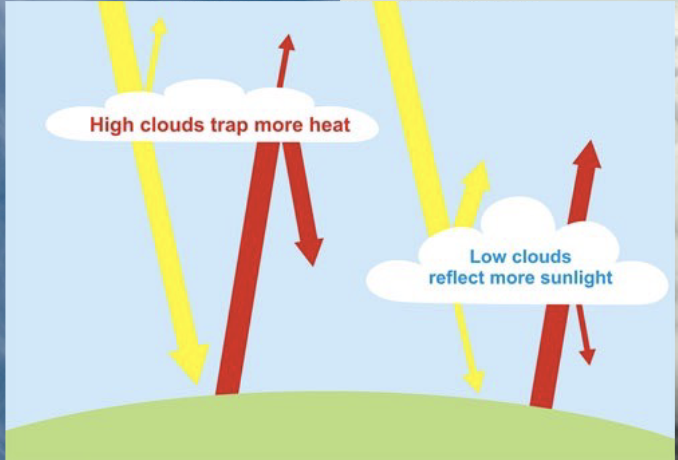
Low altitude (cummulus clouds) →
Cool the surface
Dense, very high albedo
Not effective in absorbing infrared radiation
Best guess → positive low cloud feedback is slightly stronger but cloud feedback have large uncertainties