Theories and Perspectives; Laws and Effects (AP Psychology)
 Call Kai
 Learn
Learn Practice Test
 Spaced Repetition
 Match
Match Flashcards
 Knowt Play
1/110

There's no tags or description
Looks like no tags are added yet.
Name | Mastery | Learn | Test | Matching | Spaced | Call with Kai |
|---|
No analytics yet
Send a link to your students to track their progress
111 Terms
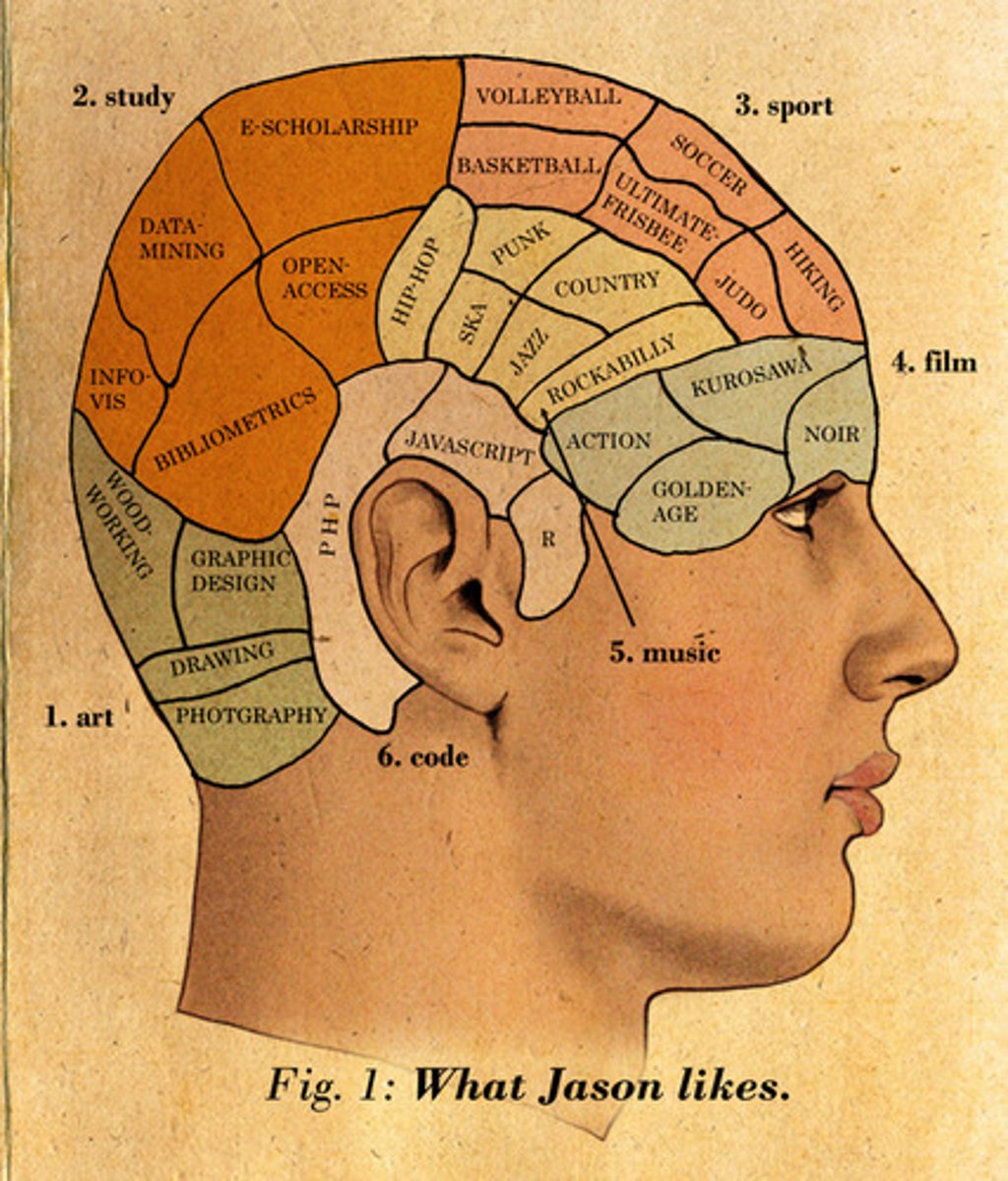
Phrenology
Associated with FRANZ GALL, the belief that bumps and other external physical characteristics on the skull indicated personality traits.
Neuroscience Perspective
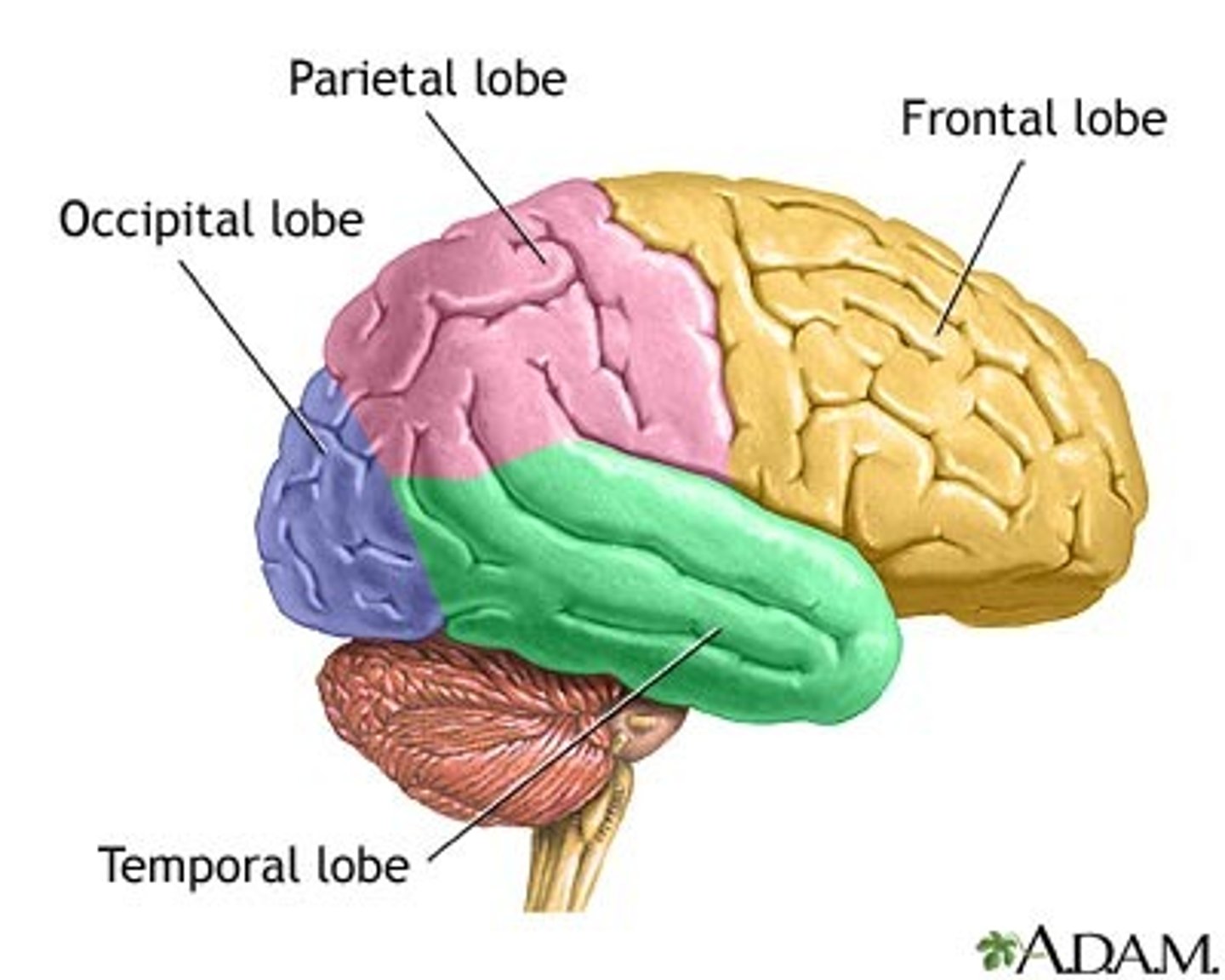
(also called biological perspective)
Explores the body's role in behavior and mental processes.
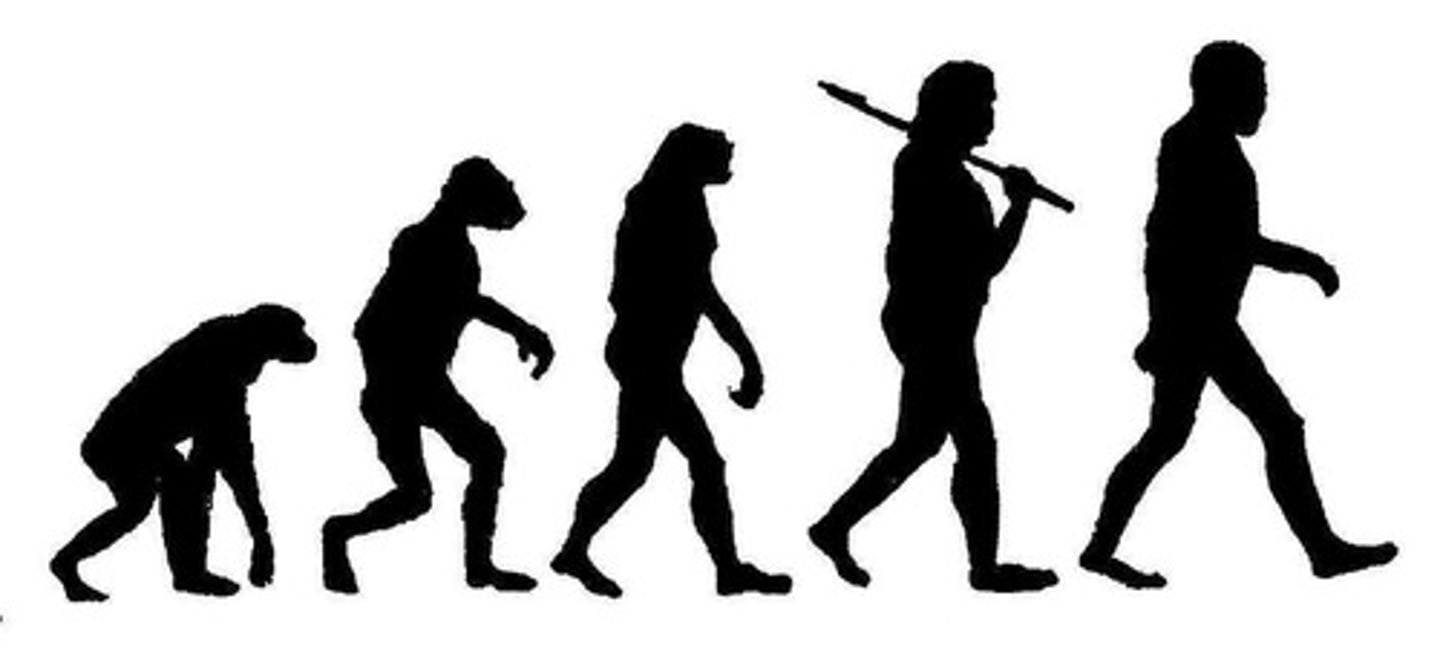
Evolutionary Perspective
Explores how the natural selection of traits and behavior promotes the perpetuation of one's genes. Behavior is explained in terms of how it increases the occurrence of an individual's GENES IN FUTURE GENERATIONS.
Behavioral Genetics Perspective
Explores how our genes INTERACT with environment.
Psychodynamic Perspective
Explores how behavior arises from UNCONSCIOUS forces, drives and, conflicts.
Behavioral perspective
Explores how the behavior is controlled by our environment.
(especially, rewards and punishments)
Cognitive perspective
Explores how the cognition (i.e., encoding, processing, storing, retrieving, thinking) affects our behavior
Sociocultural perspective
Explores how behavior and thinking vary across situations and cultures
Humanistic perspective
Explores how best to express our individual natures and to promote our psychological growth; assumes humans are fundamentally good.
experimental method
MANIPULATES variables under controlled conditions to observe effects on a behavior. Seeks to find, understand, control causes of behavior.
**The ONLY type of research that allows us to conclude that a causal connection exists.
descriptive method
Attempts to describe variables/connections of interest. CAN'T PROVE CAUSE AND EFFECT. Uses surveys, observations, case studies, naturalistic observation, correlation, etc.
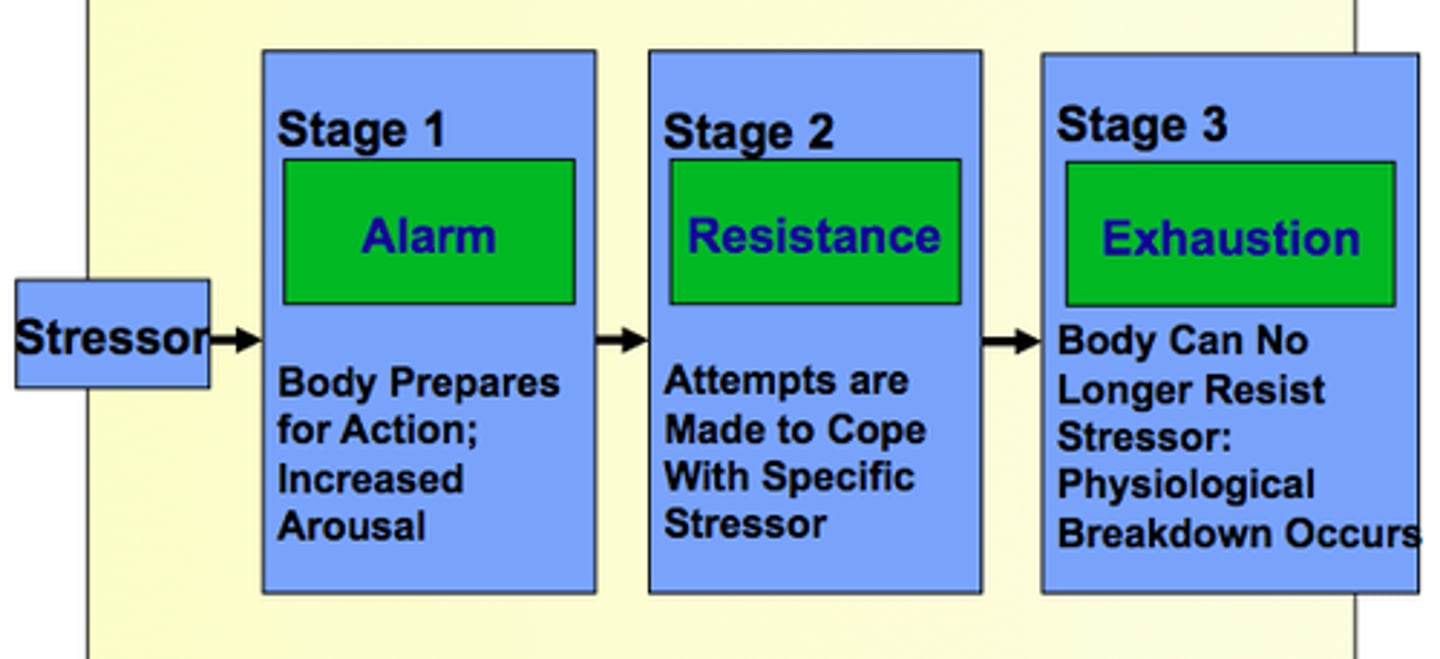
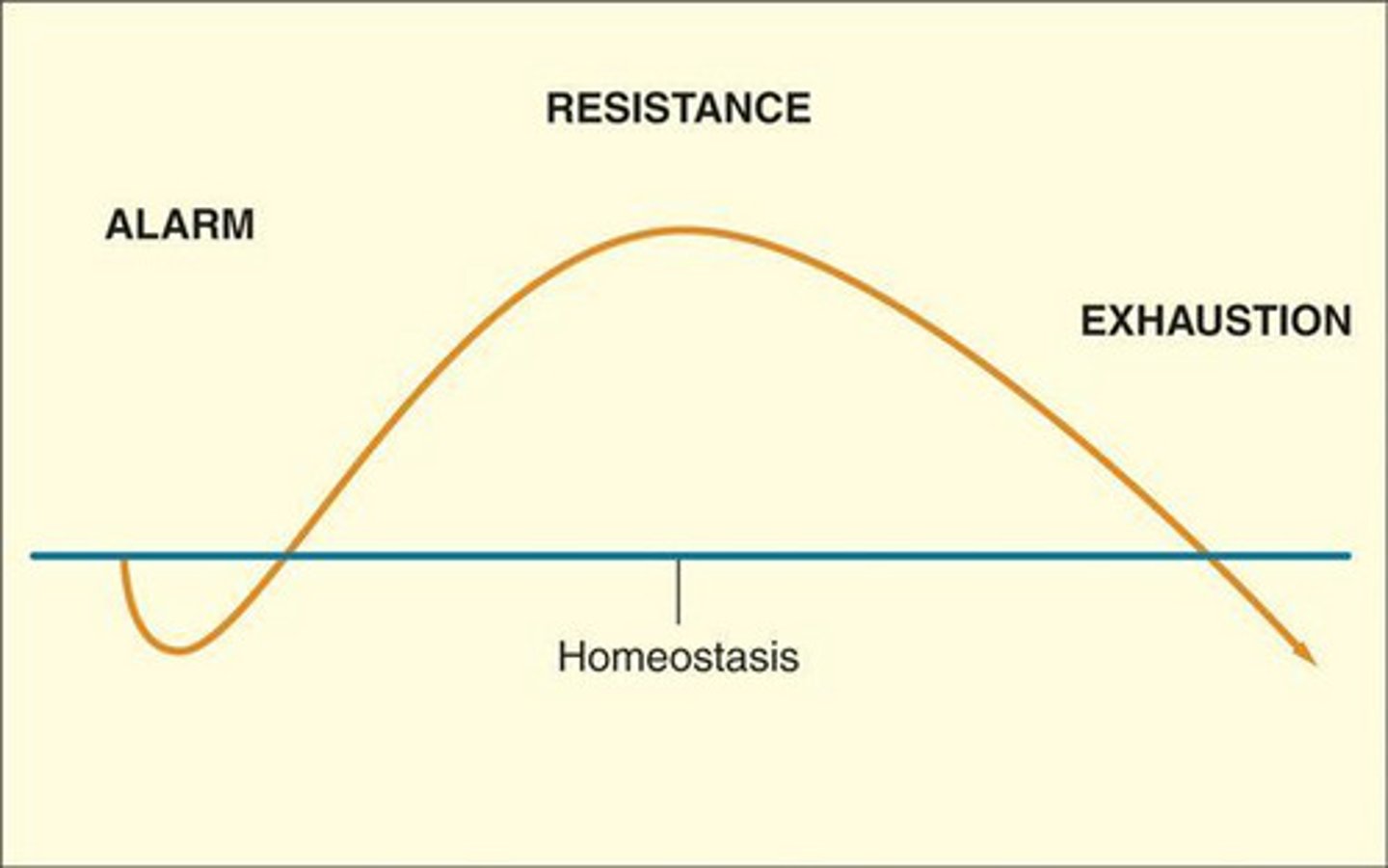
General Adaptation Syndrome (GAS)
Seyle's concept that the body responds to stress with alarm, resistance and exhaustion
restoration theory of sleep (aka recuperation theory)
Believes that NREM sleep relaxes the body; REM sleep relaxes the brain. Believes that the purpose of sleep is to restore the body and brain so that they can recuperate.
evolutionary/adaptive sleep theory
Believes that unique sleep patterns of animals evolved over time to help promote survival; sleep keeps us away from predators.
Freud's theory of dreams
Dreams are "the royal road to the unconscious." They symbolically reflect our unconscious wishes. They provide a release of unacceptable emotions (catharsis)
(Their MANIFEST CONTENT is on the surface and obvious; their LATENT CONTENT is latent hidden and needs to be analyzed to be understood.)
activation synthesis model of dreaming
Sleep activates the brain--perhaps consolidating memories--and dreams are the brain's way of making sense of the essentially random activity.
Neodissociation
Hilgard's theory that the mind splits during hypnosis: part is in tune with the hypnotist, part is in tune with reality--i.e., there's a HIDDEN OBSERVER, a part of our awareness is "keeping an eye" on things.
Social Cognitive theory of hypnosis
Believes that hypnotized persons are essentially role playing. They are simply complying with the what the hypnotist wants.
Weber's law
size of the just noticeable difference will vary depending on the size of the original stimulus (proportions)
opponent-process theory of vision
There are three paired types cones: red-green, blue-yellow, black-white. If one color is stimulated, the other is inhibited. Used to explain afterimages.
Trichromatic theory
Helmhotlz and Young: there are three varieties of cones: red, blue, and green. Combinations of these cones can be stimulated to create other colors using the additive method of mixing colors
place theory
Helmholtz's theory that the perception of pitch corresponds to the vibrations of different places on the basilar membrane
frequency theory
believes that the perception of pitch corresponds to the rate or frequency at which the basilar membrane vibrates
gate control theory
Neurological gates in the spinal cord open and close. So, in some instances, you can feel pain but in others, you can't. Small nerve fibers open them, large nerve fibers close them.
**Often used to explain why rubbing a painful injury may relieve the pain to a degree
McGurk effect
Our perception of sound can be affected by our visual perception.
monocular cues
cues used to judge distance of an object using only one eye (relative size, overlap, aerial perspective, texture gradient, linear perspective, motion parallax, relative height)
binocular cues
depth perception that require information from both eyes (retinal disparity, convergence)
stroboscopic movement
flashing different slightly varying images in sequence is perceived as continuous movement (animation)
phi phenomenon
when two adjacent, stationary lights blink in quick succession and are perceived as a moving light
https://upload.wikimedia.org/wikipedia/commons/8/8b/Phi_Phenomenon.gif.
stroop effect
Deals with automatic perception--e.g., when told to only pay attention to color of text, you can't help but read the word "blue" even when written in red letters. Remember class demonstration.
Mere Exposure effect
The more exposure to a stimulus, the more positively a person will feel about it.
Harlow's attachment theory
studied baby monkeys and which mother they prefer, a hard wire one that provides biological needs (food) or a soft, cloth one that provides feeling of safety. attachment to mothers is more nurture than nature
Ainsworth's attachment theory
three types of attachment
1. secure: child plays comfortably with mom, cries when she leaves, then is calmed when she returns
2. anxious/ambivalent: anxious with mom, protests when she leaves, not comforted when she returns
3. avoidant: little contact with mom, not distressed when she leaves
Erikson's theory psychosocial development
We progress through 8 stages of conflicts over the course of our lives.
1. trust v mistrust
2. autonomy v shame and doubt
3. initiative v guilt
4. industry v inferiority
5. identity v role confusion
6. intimacy v isolation
7. generativity v stagnation/self absorption
8. integrity v despair
Piaget's theory of cognitive development
kids go through four stages
(Terms: schemas/assimilation/accommodation)
1. sensorimotor stage: kids respond to reflexes, use senses to explore the world, gain OBJECT PERMANENCE
2. pre-operational stage: kids use symbols, names, numbers, are able to focus on one feature of a problem but neglect other aspects, are EGOCENTRIC. Difficulty with reversibility (3+2=5 is the same as 2+3=5)
3. concrete operational stage: CONSERVATION is understood, beginning to use logic
4. formal operational stage: use critical thinking and ABSTRACT CONCEPTS to answer questions
Kohlberg's theory of moral development
Believes that we make moral judgement based on three distinct ways of evaluating situations.
1. pre-conventional: morals reside in a person's own needs (will I be punished?)
2. conventional: values reside in performing well and keeping order; follow the laws set down by others.
3. post conventional: moral values reside in principles that are assessed by the individual. Follow own laws.
Gilligan's theory of moral development
Believes males base morality on individual rights and justice while women base morality on care of and responsibility for others.
CRITICIZED Kohlberg for favoring a male approach to morality
Baumrind's theory of parenting
parenting styles
1. authoritarian: imposes rules and expects complete obedience
2. permissive: submits to children's desires, makes few demands, little punishment
3. authoritative: demanding but responsive, set and enforce rules, but explain them, democratic
Kubler-Ross's stages of coping with death
Stages of Grief and Dying
1. denial
2. anger
3. bargaining
4. depression
5. acceptance
For more information: https://www.psycom.net/depression.central.grief.html
Pavlov's classical conditioning
UCS provokes an UCR. When a neutral object is presented with the UCS and still provokes the same UCR, the neutral becomes a CS that provokes the new CR
Seligman's learned helplessness
When we're exposed to repeated, inescapable and uncontrollable events, passive behavior develops--i.e., we stop trying
Thorndike's law of effect
responses followed by satisfying effects become strengthened and are more likely to occur again; behavior is controlled by its consequences
Premack principle
preferred behaviors can be used to reinforce non-preferred behaviors
(e.g., You can go outside if you finish your dinner.)
Tolman's latent learning
Some learning is not immediately reflected in a behavior change, rewards are not needed for learning, but they enhance performance
Kohler's insight theory
learning occurs rapidly as a sudden result of the coming together of the ingredients to a problem
*Challenges behavioral theories
*Instead of trial and error (i.e., getting closer and closer to correct solutions, subjects will sometimes become inactive (during which Kohler postulates that the problem ingredients are "incubating"--i.e., developing as a whole.) After a period of INCUBATION, the subject experiences an ""AHA!" feeling and the problem is solved quickly.
Bandura's observational learning (aka Modeling)
children learn by observing others and repeating the behaviors they witness (Bobo doll experiment)
Atkinson and Shiffrin's stage model of memory
(aka Information Processing Model of Memory)
how information is encoded and kept in memory
1. sensory memory
2. short term memory (also Working Memory)
3. long term memory
interference
retroactive/proactive, either old information gets in the way of learning new information(retroactive) or new information inhibits the remembrance of old information (proactive)
Loftus' misinformation effect
participants recall of an event that they witnessed may be altered by misleading information they have reconstructed
Skinner's theory of language
We imitate our parents' use of words; reinforcement encourages linguistic growth; there is an association between sight and sound
Chomsky's theory of language
We are prewired for language (we have a Language Acquisition Device--LAD), but it must be turned on by nurture during a CRITICAL PERIOD.
We all have an underlying sense of universal grammar.
(This concept is seen in Genie; her speech was never stimulated during a critical period, so it didn't develop.)
Freud's theory of personality
basic principles include the unconscious mind, early childhood experiences, and influence of sexual drives, includes id/ego/superego and psychosexual stages
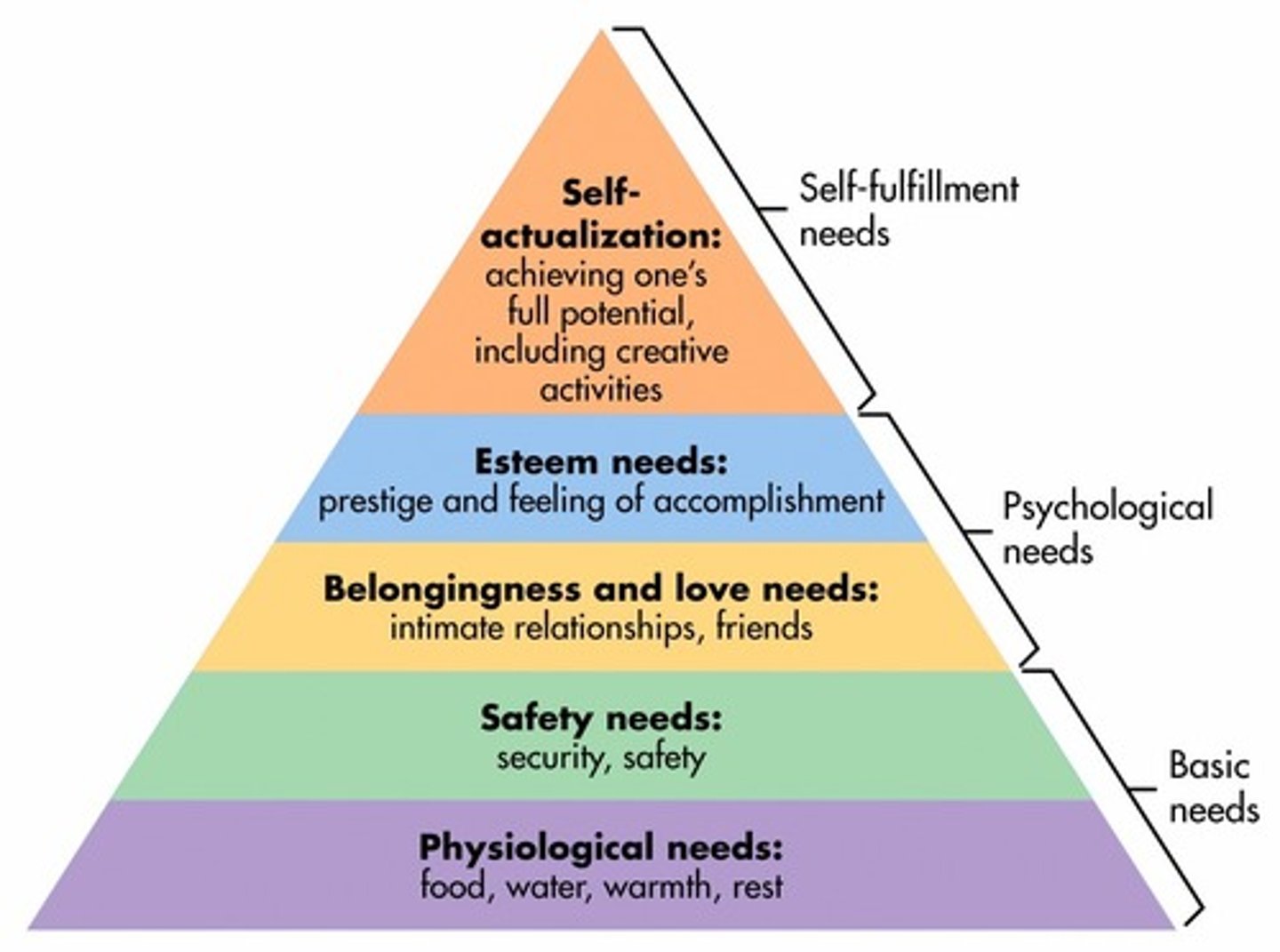
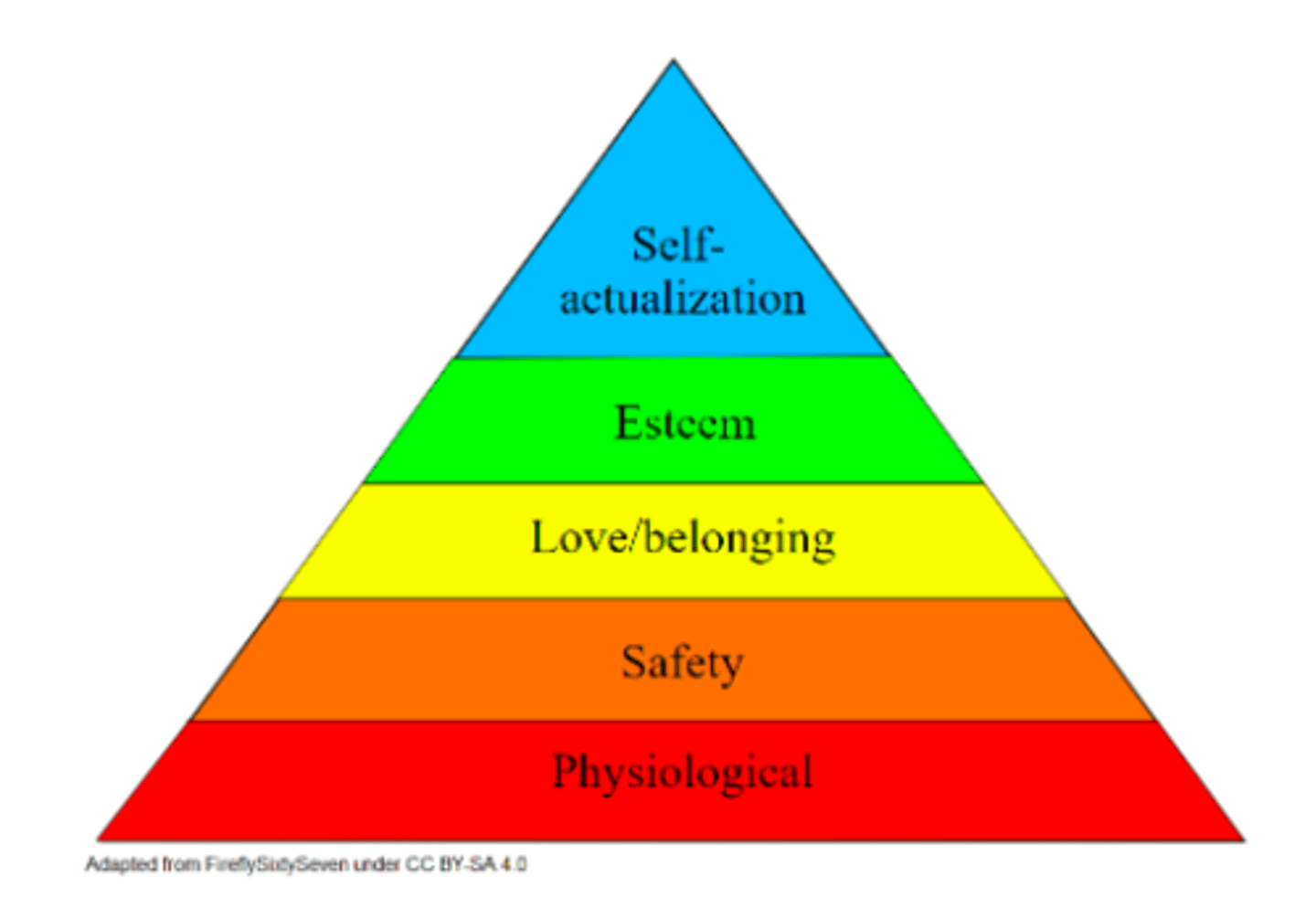
Maslow's theory of self-actualization
physiological needs must be met before higher level needs are achieved and ultimately until an individual reaches complete and full function
Cattell's theory of personality
Used factor analysis to identify 16 source traits of personality
5-factor model of personality (Big Five Theory)
There are 5 core personality traits that each of us exhibits in individual degrees:
TWO DIFFERENT MNEMONIC DEVICES
*conscientiousness, agreeableness, neuroticism, openness, and extroversion (CANOE)
*Openness, conscientiousness, extroversion, agreeableness, neuroticism (OCEAN)
Spearman's theory of intelligence
g factor, single measure of general mental capacity can be measured by a single IQ test
Gardner's theory of intelligence
multiple intelligences are independent of each other (kinesthetic, spatial, musical, interpersonal, etc.)
Sternberg's theory of intelligence
triarchic theory of successful intelligence (analytical, creative, and practical)
normal curve of intelligence
Bell-shaped curve: 100 is the mean; 15 is the standard deviation
Flynn effect
The observation that average IQ scores worldwide are increasing over time.
Flynn's explanation: intelligence test measure abstract problem solving, and because of the demands of the modern world, abstract problem-solving skills are increasing. If Flynn is right, this challenges the idea that intelligence is an innate trait that is unaffected by environment.
psychoanalysis
Freud's theory of personality that attributes thoughts and actions to unconscious motives and conflicts; the techniques used in treating psychological disorders by seeking to expose and interpret unconscious tensions
Client-centered therapy
(sometimes person-centered therapy)
(sometimes non-directive therapy)
humanistic therapy based on Carl Roger's beliefs that an individual has an unlimited capacity for psychological growth and will continue to grow unless barriers are placed in the way
positive psychology
the scientific study of optimal human functioning; aims to discover and promote strengths and virtues that enable individuals and communities to thrive
cognitive behavioral therapy (CBT)
a popular integrated therapy that combines cognitive therapy (changing self-defeating thinking) with behavior therapy (changing behavior)
Aaron Beck for depression
exposure therapy
a form of behavior therapy in which a survivor confronts feelings or phobias or anxieties about a traumatic event and relives it in the therapy situation all at once (flooding)
systematic desensitization
a type of counterconditioning that associates a pleasant relaxed state with gradually increasing anxiety-triggering stimuli
rational emotive therapy
Albert Ellis: form of psychotherapy based on identifying and correcting irrational beliefs that are believed to underlie emotional and behavioral difficulties
cognitive therapy
teaches people new, more adaptive ways of thinking and acting; based on the assumption that thoughts intervene between events and our emotional reactions
instinct theory of motivation
a view that explains human behavior as motivated by automatic, involuntary, and unlearned responses
drive reduction theory of motivation
biological needs create internal states of tension or arousal- called drives- that organisms are motivated to reduce
incentive theory of motivation
theories of motivation in which behavior is explained as a response to the external stimulus and its rewarding properties
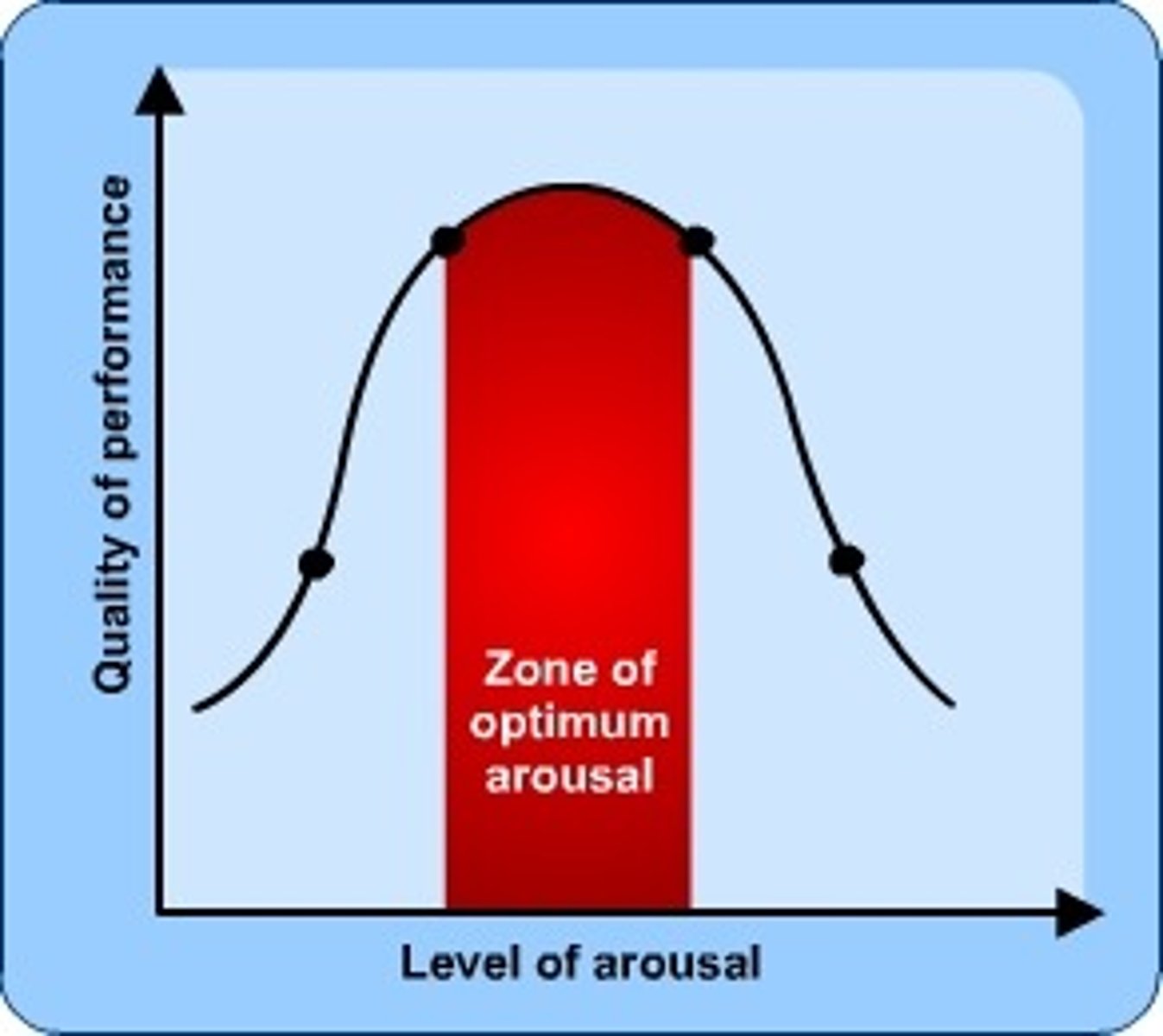
arousal theory of motivation
theory of motivation in which people are said to have an optimal (best or ideal) level of tension that they seek to maintain by increasing or decreasing motivation
affiliation theory of motivation
need for social bonds and belongingness push us to interact with others
achievement theory of motivation
the desire to direct your behavior toward excelling, succeeding, or outperforming others at some task
intrinsic/extrinsic theory of motivation
desire to perform effectively for ones own sake or to perform it to receive external rewards
opponent process theory of emotion
positive (primary) emotion is often followed by a negative (secondary) emotion
James-Lange theory of emotion
physiological responses come first, then emotion is experienced
Cannon-Bard theory of emotion
physiological responses and emotion are experienced simultaneously
two-factor theory of emotion
Sometimes called the Schacter-Singer Model: 1)physiological responses and 2) cognitive label together cause emotions
adaptation level phenomenon
we judge stimuli relative to those previously experienced, lose satisfaction over time
Example: We think a new car will make us happy, but after we get it, we adapt to having it, and it becomes normal to us and we no longer experience added happiness.
relative deprivation
We think we are worse off than others we compare ourselves to
Interaction
Occurs in a factorial experimental design (more than 1 independent variable) when the effect of one independent variable is different at different levels of another independent variable.
*Noted on a graph by lines that are NOT parallel.
Tip of the Tongue Phenomenon
the memory phenomenon that occurs when we feel like we nearly have the answer but can't quite spit it out.
(NOTE: supports the concept of spreading activation in associative network theory of memory)
Spotlight Effect
when in social settings, individuals tend to overestimate how much others notice them.
Next-in-Line Effect
When we're expected to perform some task (say, introduce ourselves to a group), we have poor recall for information presented just before we presented. Probably the result of diminished attention as we mentally prepare what we're going to say or do.
McGurk Effect
A specific type of sensory interaction: Seeing a mouth say "ga", hearing "ba', and perceiving "da."
Overjustification Effect
The decreased motivation that results from being rewarded for doing something that was intrinsically rewarding.
Cocktail Party Effect
Filtering out then refocusing on what was background information when it is personally relevant.
False Consensus Effect
the tendency to overestimate the extent to which others share our beliefs and behaviors
Hawthorne Effect
A change in a subject's behavior caused simply by the awareness of being studied
*subjects tend to comply with what they believe researchers want them to do.
Halo Effect
tendency to allow a single positive characteristic (e.g., attractiveness) to alter our overall perception of a person.
Mere Exposure Effect
The finding that the more exposure we have to a stimulus, the more apt we are to like it
Placebo Effect
Results caused by expectations alone.
Example: Giving people a fake sugar pill that they believe to be a "memory drug" will improve their memory performance.
Stroop Effect
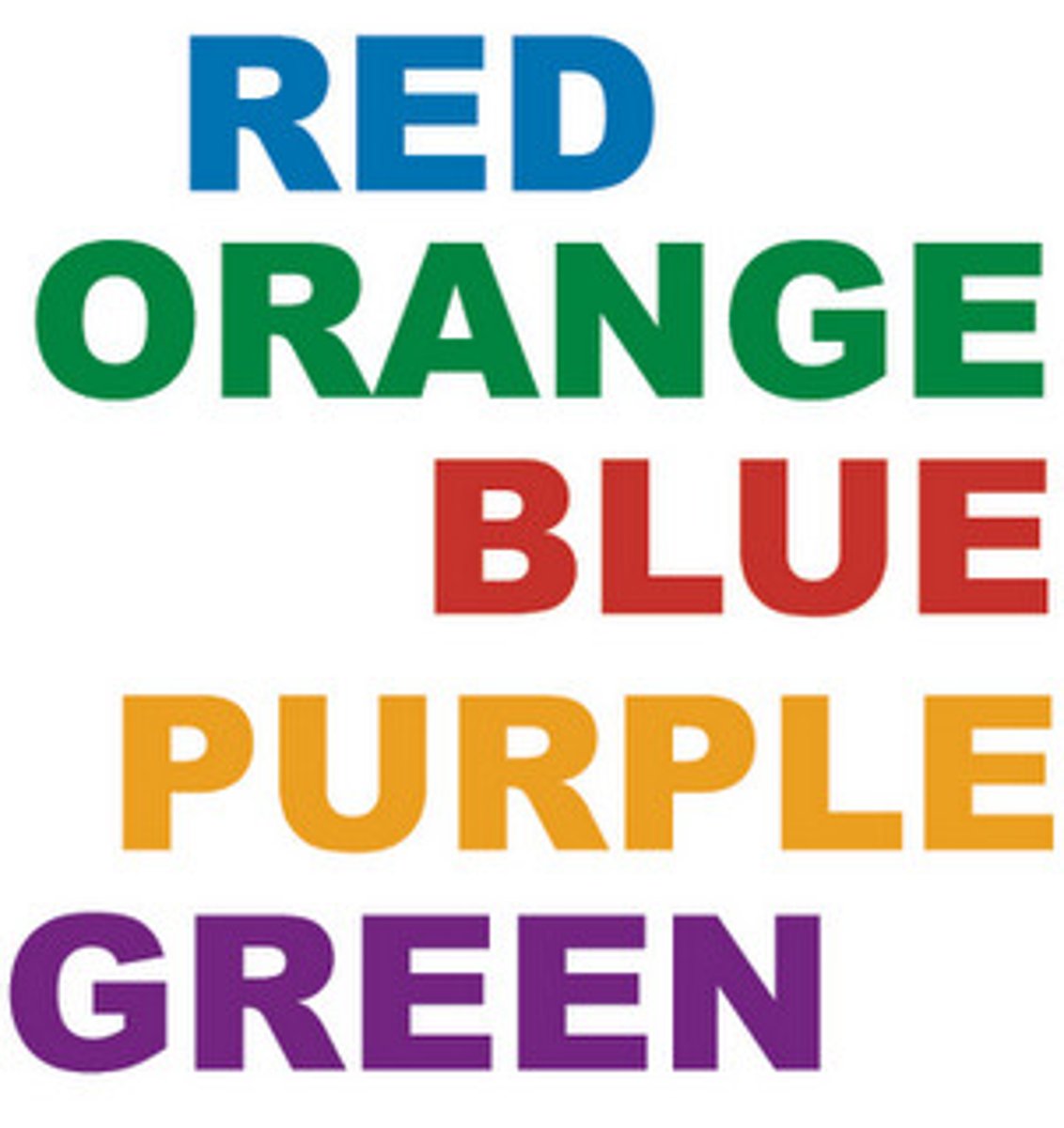
A demonstration of the potential interference in reaction time due to overlearned or automatic tasks.
*If we're asked to say the colors of the image to the right, we are slowed down by our automatic reading of the words.
Levels-of-processing Effect
the differential effect of surface processing of information (e.g., whether or not it has a letter "i" in the word) and deeper levels of processing (e.g., semantic processing) on memory.
*surface processing leads to weaker memory of material
Adaptation level phenomenon
Satisfaction and dissatisfaction is relative to recent experience--i.e., we adapt (get used to) what we have at present. Objects that used to make us happy come to be expected and then become the new normal, no longer giving us additional happiness.
Reciprocal Determinism
Albert Bandura's theory stating that a person's behavior both influences and is influenced by personal factors and the social environment. Bandura accepts the possibility that an individual's behavior may be conditioned through the use of consequences
General Adaptation Syndrome (GAS)
Selye's concept of the body's adaptive response to stress in three phases—alarm, resistance, exhaustion.
Optimal Level of Arousal
Theory that performance varies relative to task complexity and arousal
Barnum effect
The tendency to consider a personal description accurate if it is stated in very general terms.