B.5 Current and circuits
 Call Kai
 Learn
Learn Practice Test
 Spaced Repetition
 Match
Match Flashcards
 Knowt Play
1/20

There's no tags or description
Looks like no tags are added yet.
Name | Mastery | Learn | Test | Matching | Spaced | Call with Kai |
|---|
No analytics yet
Send a link to your students to track their progress
21 Terms
Elementary charge
The magnitude of charge of a proton/electron.
1e = 1.6 × 10⁻¹⁹ C
Number of electrons = Total charge / elementary charge
Potential difference
Potential difference (ΔV) is the work done per unit charge in moving a positive charge between two points.
ΔV = W/q
Electromotive force (ε - emf)
Emf is the work done by a cell per unit charge
ΔV = W/q
Electron volt
The energy gained when an electron is accelerated by a potential difference of 1 volt. 1ev = 1.6 × 10⁻¹⁹ J
Convectional current
Convectional current (I) is defined as the amount of positive charge flowing past a point per second. Flowing from high potential (+) to low potential (-).
I = Δq / Δt
Electron current
From low potential (-) to high potential (+).
Resistance
The ratio of the potential difference across a component to the current through it. R = V/I
Ohm’s Law
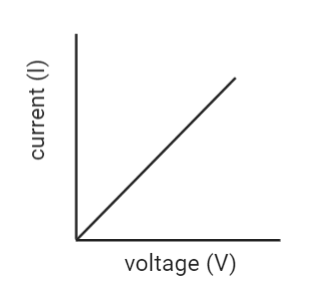
The potential difference across a metallic conductor is proportional to the current flowing through it, provided the temperature does not change.
Materials that obey Ohm’s law (Ohmic conductors) will have a constant resistance at a constant temperature.
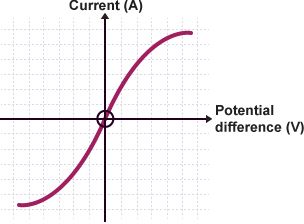
Explain the Non Ohmic conductors graph - Filament Lamp
As pd across the filament lamp is increased, the electrons collide more frequently with the vibrating fixed ions, transferring energy.
The ions vibrate with greater amplitude and the temperature of the metal filament increases.
This makes it more difficult for electrons to flow (resistance increases).
Power
The rate of energy transfer (amount of work done per second)
P = W / t
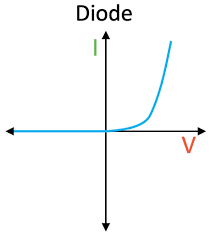
Explain the Non Ohmic conductors graph - Diode
Diodes only allow current to flow in one direction.
For a negative V values there is no current
There is no significant current in the forward direction until a certain pd (threshold voltage) is exceeded. High resistance in the backward direction and high then low resistance in the forward direction.
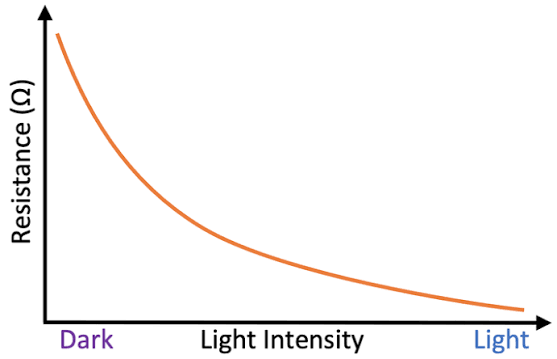
Explain the Non Ohmic conductors graph - LDR
Resistance is inversely proportional to light intensity.
Bright - low resistance
Dark - high resistance
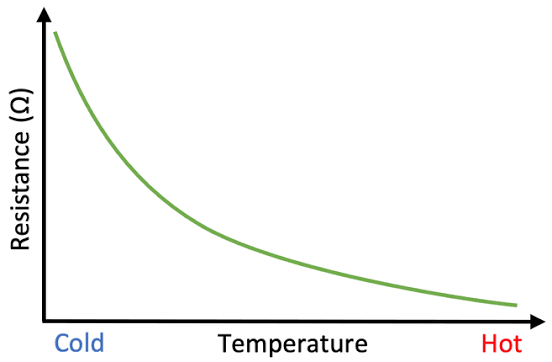
Explain the Non Ohmic conductors graph - Thermistor
Resistance is inversely proportional to temperature
Hot - low resistance
Cold - high resistance
What physical properties of a wire change its resistance?
Length (L)
Cross sectional area (A) - πr2
Resistivity (ρ) - a property of material equal to the resistance of a sample of the material with a length of 1m and a cross sectional are of 1m2.
Resistivity formula
ρ = AR / L
Potential dividers
A circuit made of two (or more) series resistors that allow us to put any voltage we want that is less than the battery voltage.
Input voltage is the emf of the battery.
Output voltage is the voltage drop across a component.
What is a potentiometer?
A is a single wire with sliding contact that can be used to build potential divider circuit.
Battery vs Cell
A battery consists of two or more cells that are joined together
The cell consists of conductive components and a store of chemical energy.
Primary vs Secondary vs Solar
A primary cell cannot be recharged, the chemicals in the cell get used in a non reversible reaction.
A secondary cell can be recharged by applying an external reversed voltage, reversing the chemical reaction.
In solar cells the electrons in semiconductors can absorb energy from sunlight, energy is converted from solar to electrical energy.
All cells produce a direct current.
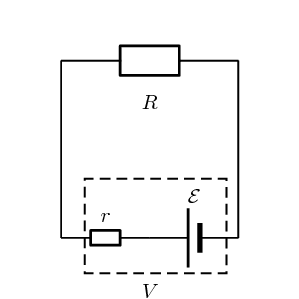
Internal resistance and cell emf formula
The conductive components of a cell have resistance - internal resistance of a cell / battery.
ε = V + v, V - terminal pd, v - lost volts
ε = IR + Ir, IR - external resistance, Ir - internal resistance.
Power formula
P = IV = I2R = V2/R
PT = I2R + I2r, I2R - power transferred to external resistance I2r - power overcoming internal resistance.