S&P exam 3 - ch 8
 View linked note
 Call Kai
 Learn
Learn Practice Test
 Spaced Repetition
 Match
Match Flashcards
 Knowt Play
1/40

There's no tags or description
Looks like no tags are added yet.
Name | Mastery | Learn | Test | Matching | Spaced | Call with Kai | Chat |
|---|
No analytics yet
Send a link to your students to track their progress
41 Terms
Motion Perception
The brain’s ability to perceive movement based on visual stimuli.
Motion Silencing
A phenomenon where the ability to perceive motion is impaired, often associated with brain damage.
Akinetopsia
A condition where motion is either very difficult or impossible to perceive.
People who have damage to parts of the brain responsible for perceiving and understanding movement. (from disease or trauma)
also known as motion blindness.
example: Without the ability to perceive motion following a stroke, L.M. was unable to successfully complete activities as simple as pouring a cup of tea. As she put it, “the fluid appeared to be frozen, like a glacier,” and without the ability to perceive the tea rising in the cup, she had trouble knowing when to stop pouring.
Apparent Movement
Perception of motion when there is no actual movement between stimuli.
Example: lights on a sign- when two stimuli in slightly different locations are alternated with the correct timing, an observer perceives one stimulus moving back and forth smoothly between the two locations.

Induced Motion
Occurs when the motion of one object (usually a large one) causes a nearby stationary object (usually smaller) to appear to move.
Example: the moon usually appears stationary in the sky. However, if clouds are moving past the moon on a windy night, the moon may appear to be racing through the clouds. In this case, movement of the larger object (clouds covering a large area) makes the smaller, but actually stationary, moon appear to be moving.
Motion Aftereffects
Perceiving motion in the opposite direction after adapting to one direction of motion.
occurs when viewing a moving stimulus causes a stationary stimulus to appear to move.
Type of illusory movement
Example: the waterfall illusion. If you look at a waterfall for 30 to 60 seconds and then look off to the side at part of the scene that is stationary, you will see everything you are looking at—rocks, trees, grass—appears to move upward for a few seconds.

Selective Adaptation
A phenomenon where prolonged exposure to a specific stimulus affects perception of subsequent stimuli.

Real Motion
object moving back and forth
Actual displacement of an object in visual space, leading to a clear perception of motion.
We perceive motion when something moves across our field of view
example: Perceiving a car driving by, people walking, or a bug scurrying across a tabletop, object moving back and forth on a screen
Illusory Motion
The perception of movement of stimuli that isn’t actually moving.
example: flashing lights
Control condition
Similar visual stimuli without perceived motion
example: simultaneous flashing
Area MT (Middle Temporal Area)
A brain region associated with motion perception
= Direction and speed of object motion
Control Condition: No significant brain response observed.
Real Motion Condition: Strong response detected in area MT.
Apparent Motion Condition: Reasonably strong response, no significant difference from real motion response.
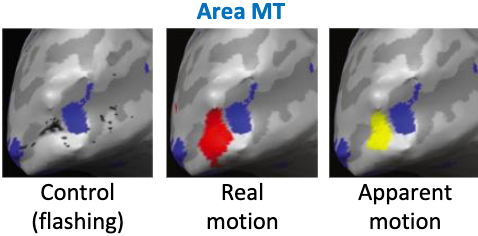
Brain imaging and analysis
Imaging techniques used to visualize brain activity:
Enhanced images are smoothed to illustrate brain areas more clearly.
The takeaway: Apparent movement activates the same brain area as real movement.
Optic Array
The structure formed by surfaces, textures, and contours in the environment that helps in motion perception.
Local Disturbance in the Optic Array
Changes in the visual field as an object moves, helping to perceive that object's motion.
Reichardt Detector
A model that explains motion perception through;
Two receptor fields connected to a single neuron in the brain, designed to signal motion.
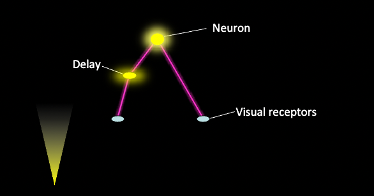
Direction detection
Respond to specific motion directions and speeds.
Reichardt detectors are directionally tuned:
If light flashes farther than moves smoothly, it can create the perception of movement (apparent movement).
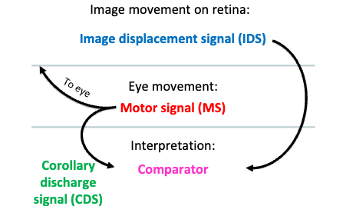
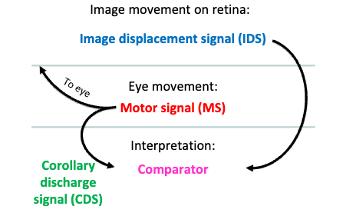
Corollary Discharge Theory
The brain’s mechanism to account for eye movement when interpreting external motion.
Explains why we don’t see the scene blur when we move our eyes from place to place when scanning a scene.
the neural signals that travel from the eye to the brain.
Interpretations are based on a combination of retinal information and eye movement information
Understanding Movement Interpretation
A combination of retinal information and eye movement is essential for accurate motion perception.
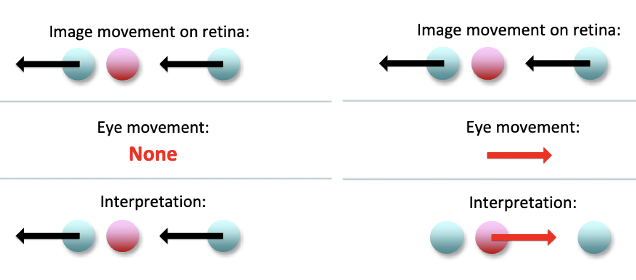
What are the Corollary Discharge theory’s three signals?
Image Displacement Signal (IDS)
Motor signal (MS)
Corollary Discharge Signal
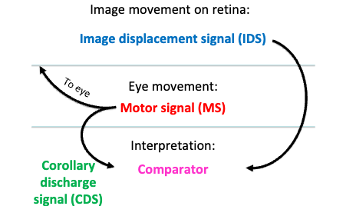
Image Displacement Signal (IDS)
Information from the retina regarding where light is on the visual field.
occurs when an image moves across the retina
Motor Signal (MS)
Signals sent to muscles to guide eye movement.
Corollary Discharge Signal
A copy of the motor signal sent to assist in motion interpretation.
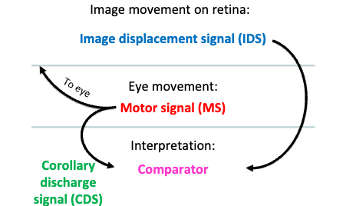
Comparator Function
Brain mechanism that integrates the IDS and Corollary Discharge to determine if an object is truly moving.
• According to corollary discharge theory; movement will be perceived if this brain structure (comparator) receives just one signal
MST Area
(Medial Superior Temporal Area) (A brain area involved in the perception of motion)
= Processing optic flow; locating moving objects; reaching for moving objects
involved in eye movements, so it’s important for localizing a moving object in space.
Example: ability to reach for a moving object is affected when there is impairment to the MST cortex
STS Area
(Superior Temporal Sulcus) (A brain region involved in perception of motion)
= Responds strongly when seeing points that look like a person or animal walking/ moving
but doesn’t respond when shown the same dots but scrambled.
more active when viewing biological motion than viewing scrambled motion.
Coherence in Motion Perception
The proportion of dots moving in the same direction, affecting motion perception performance.
When the dots are all moving in random directions, coherence is 0 percent.
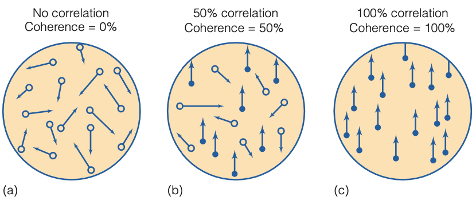
What happens if you increase the coherence?
Leads to better performance
Increases activation in individual MT cells
Damage to MT cells
More coherence required to detect direction
Transcranial magnetic stimulation (TMS)
temporarily disrupts the normal functioning of neurons.
Example: When researchers applied TMS to the MT cortex, participants had difficulty determining the direction in which a random pattern of dots was moving.
Although the effect was temporary, these participants experienced a form of akinetopsia much like patient L.M.
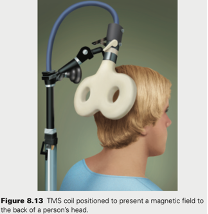
Stimulating MT cells
Changed interpretation of direction
Stimulating the MT neurons shifted the monkey’s perception of the direction of movement; instead of perceiving the correct rightward motion, the monkey responded as if the dots were moving downward and to the right.
Aperture Problem
Situation where only a small portion of a moving scene is visible, which can mislead motion perception.

Implied Motion
The brain response when looking at still images that suggest movement.
example: It is not hard to imagine the person moving to a different location immediately after this picture was taken.
A situation such as this, in which a still picture depicts an action involving motion

Results to Motion perception in still images experiment
Strongest response to something that looks like it’s moving / expect it to move
Still get a little bit of a response when looking at people even if they aren’t in motion but could move
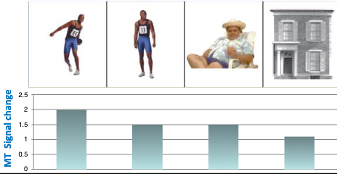
Representational Momentum
When you see something moving, your mind is anticipating where it stopped which is farther than it actually stopped
Falsely recognized an image of the object a little ahead of what they’d actually seen
Activity in areas MT and MST
is an example of experience influencing perception because it depends on our knowledge of the way situations involving motion typically unfold.

Solution to the aperture problem
a neuron could use information about the end of a moving object (such as the tip of the pencil) to determine its direction of motion.
neurons that could signal this information, because they respond to the ends of moving objects, have been found in the striate cortex.
To pool, or combine, responses from across many neurons.
Apparently, MT neurons receive signals from a number of neurons in the striate cortex and then combine these signals to determine the actual direction of motion.
Point Light Walkers
An experimental condition where biological motion is represented by dots moving in a way that suggests a human or animal's movement.
When scrambled version, can compare both and see what is different in activity in the brain
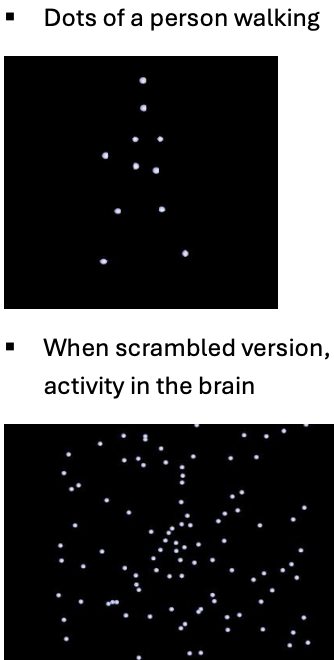
Biological Motion
Perceiving the movement of living creatures; not just perceiving that something in the world is moving
crucial for survival.
Part of brain designated to detecting living animals
Optic Flow
The perception that objects moving towards the observer appear to move faster.
What happens when using - Transcranial Magnetic Stimulation (TMS)?
It is used to temporarily disrupt neuronal function to study brain areas involved in motion perception.
When researchers affected the STS: Disrupted ability to detect biological motion
When researchers affected the Area MT: no effect on detection of biological motion
Retinal Processing
Understanding how motion is detected via the retina when an image moves across.
Striate Cortex (V1)
(A brain region involved in the perception of motion)
= Direction of motion across small receptive fields