COGS 14A Midterm 2
 Call Kai
 Learn
Learn Practice Test
 Spaced Repetition
 Match
Match Flashcards
 Knowt Play
1/67

There's no tags or description
Looks like no tags are added yet.
Name | Mastery | Learn | Test | Matching | Spaced | Call with Kai |
|---|
No analytics yet
Send a link to your students to track their progress
68 Terms
non-experimental methods
are used when you can’t (or shouldn’t) manipulate something in your unit of analysis.
e.g. concerned with ecological validity or the phenomenon can’t be duplicated in a lab
examples of non-experimental methods
field studies
surveys and interviews
longitudinal studies
case studies; ‘natural experiments’
field studies
allow observations of people or animals in their natural state
surveys and interviews
can be used to gather qualitative and quantitative data
longitudinal studies
track changes in an individual or groups of people over time
case studies or ‘natural experiments’
are used to examine and characterize abilities or deficits of individuals with rare conditions or disease states; this is idiographic research
non-experimental research methods: advantages
high ecological validity
lack of control allows for completely unexpected observations
non-experimental research methods: disadvantages
lack of control can allow many confounds
open to observer bias
with no manipulation of an independent variable, you don’t have a basis for making causal inferences
may have ethical concerns
may not replicate
experimental research methods: main feature
they’re typically used in situations where the independent variable has been directly manipulated by the experimenter
reaction times (RTs)
often attempt to quantify the onset of duration of some cognitive operation. sometimes called mental chronometry.
the most widely used method in cognitive psychology
can test sensory systems (psychophysics), motor, memory, cognitive load, attention, etc.
reaction times (RTs): theoretical assumption
RT = sensory processing time + object recognition + decision + motor response
reaction times (RTs): advantages
cheap + non-invasive
accepted in a variety of disciplines
has good objectivity, reliability, and sensitivity *if used correctly
reaction times (RTs): disadvantages
very simple. the measure may not be limited in internal validity as it may not measure the process you intend.
doesn’t specifically indicate brain responses by itself
eye tracking *not likely on test
infrared cameras can detect eye fixations + microsaccades (tiny movements). provides measure of where the eye is focused + for how long
electroencephalography (EEG)
records electrical activity at the scalp occurring as a result of ionic currents within similarly oriented neurons in the brain.
electroencephalography (EEG): theoretical assumptions
post-synaptic potentials (EPSPs and IPSPs) are appropriate measures of internal cognitive states
event-related potentials (ERPs)
take the raw EEG data and average it over many trials. this filters out “noise” and allows for better analysis of specific components
EEG and ERP: advantages
fantastic temporal resolution (milliseconds)
rich data sets; lots of information
non-invasive + safe
EEG and ERP: disadvantages
very poor spatial resolution of activity inside the head
inverse problem: infinite number of ways to model activity recorded at the scalp
must be tightly controlled (no movement)
hard to do outside the lab, limiting ecological validity
magnetoencephalography (MEG)
detects magnetic fields produced by the synchronized activity of neurons in the brain
magnetoencephalography (MEG): advantages *not likely on test
excellent temporal resolution + better spatial resolution than EEG
non-invasive + safe
magnetoencephalography (MEG): disadvantages *not likely on test
very limited in tasks (mainly sensory + decision studies)
all studies done in a shielded chamber; poor ecological validity
computed tomography (CT) *not likely on test
mostly used as a diagnostic tool (descriptive); uses many different X-ray images to reconstruct a 3D image of a living brain
- not used much for research; mildly invasive
- mainly highlight structural damage in brain
positron emission tomography (PET) *not likely on test
provides a 3D image of a functional brain process
functional Magnetic Resonance Imaging (fMRI)
tracks the flow of blood within the brain with the blood oxygenation level dependent (BOLD) signal.
any neural activity triggers increased blood flow to replace glucose + oxygen used
functional Magnetic Resonance Imaging (fMRI): how it works
large magnet aligns protons within brain
brief radio pulses change orientation of protons
protons within different tissue types return to their original orientation at different rates
deoxygenated hemoglobin (used up) is more magnetic than oxygenated hemoglobin (going to active region)
functional Magnetic Resonance Imaging (fMRI): theoretical assumption
blood flow is a good proxy of cognitive activity
functional Magnetic Resonance Imaging (fMRI): advantages *not likely on test
excellent spatial resolution
considered safe, non-invasive
functional Magnetic Resonance Imaging (fMRI): disadvantages *not likely on test
poor temporal resolution
noisy + confined; poor ecological validity
very expensive
magnetic resonance imaging (MRI)
can be used to track the diffusion of water in brain tissue; can provide images of white matter; called Diffusion Tensor Imaging
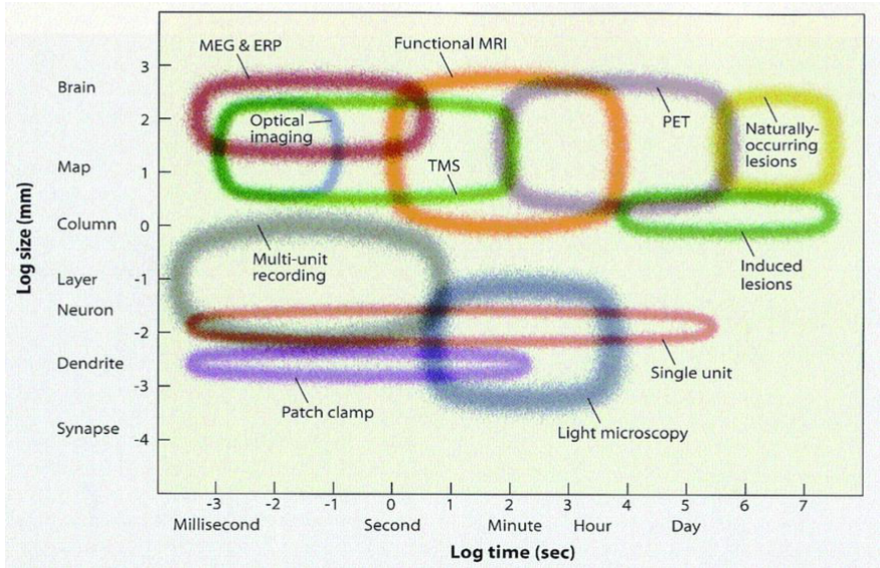
cognitive neuroscience methods chart A
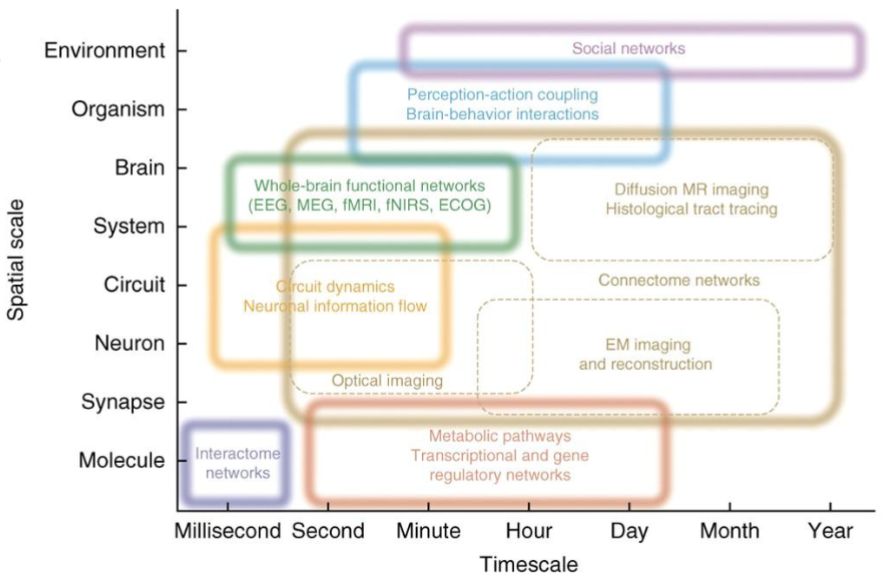
cognitive neuroscience methods chart B
transcranial magnetic stimulation (TMS) *not likely on test
can be used to induce an electric current in the neurons of the cortex
can stimulate activity in a particular region or cause temporary inactivity
used to determine if a brain area is causally necessary for a particular behavioral function
considered non-invasive; however, risk of seizures may be present depending on protocol
considered an independent variable
National Commission for the Protection of Human Subjects of Biomedical
and Behavioral Research (United States)
created by the National Research Act of 1974
Belmont Report
generated by the National Commission for the Protection of Human Subjects of Biomedical and Behavioral Research
provided ethical principles and guidelines for research involving humans
principles outlined by the Belmont Report
respect for persons
beneficence
justice
respect for persons
informed, voluntary consent + protection for those needing protection
free consent
informed consent
individual rights: privacy + confidentiality, maintained. violations made clear to participants
participants who can’t decide for themselves must be protected by a responsible party
a participant can stop the experiment at any time
deception to be avoided; never used to cause participant to act in ways they otherwise would’ve avoided
if used, must be justified by nature of experiment and explained clearly during debriefing
beneficence
humans should not be harmed; aim is to maximize benefit and limit any potential harm
risks to be kept at a minimum; if any risk is present, the benefit to society must greatly outweigh the risk
minimal risk
appropriate care and steps must be taken to mitigate risks as much as possible
can be subjective + open to interpretation
who must benefit + how much?
justice
participant selection should be fair + benefits should accrue to everyone
participants should be recruited fairly + equally to any study
risks + benefits should apply equally to all participants or potential participants
can’t experiment on one group for the benefit of a different group
mainly applies to the selection of participants
free consent
All participation in human studies must be voluntary and free from coercion
informed consent
Adequate information must be provided so that the participant can provide _____
minimal risk
the risk or discomfort must be comparable to what would be experienced in ordinary life
Institutional Review Boards
independent committee; its general goal is to protect human participants from physical or psychological harm
all facilities receiving federal funding must have an IRB or equivalent
all IRBs must have at least 5 members
mixed gender
at least 1 scientist
one non-scientist
one community member
review all proposed research protocols at the institution and approve, approve with changes, or reject each submission
at UCSD, the IRB operates under the Human Research Protections Program (HRPP), which ensures it follows federal, state, University policies
the Belmont report provided the ethical principles that ___ should adhere to
federally funded research
the Common Rule
the federal regulations which are used by the United States Department of Health and Human Service to provide oversight to Institutional Review Boards are codified under Title 45 of the Code of Federal Regulations, Part 46 (recently revised)
the regulations encapsulate previous ethical guidelines, including those defined by the Declaration of Helsinki
Ethical Principles of Psychologists and Code of Conduct
issued by the APA to help identify ethical concerns in research
Institutional Animal Care and Use Committee (IACUC)
oversees all proposed research protocols for animal research on campus
animal welfare is an important concern in research: the goal is to minimize animal pain and distress, or propose alternative methods when possible [replacement, reduction, and refinement]
ensures compliance with federally mandated regulations through reviews of procedures and on-site inspections
because the Belmont principles (consent, beneficence, justice) can’t be applied, this remains controversial
scientific misconduct
a violation of the regulatory or scholarly codes of ethical behavior in scientific research. may involve:
falsifying data
reporting/manipulating data to inaccurately reflect the results of an experiment
excluding or suppressing data that do not support the research hypothesis
plagiarizing another person’s work without giving appropriate credit
including (or excluding) authors on a paper in a way inconsistent with their contribution to the work
Andrew Wakefield
a British physician who published a paper in 1998 in the Lancet purporting to find a link between the measles, mumps, and rubella (MMR) vaccine and onset of autism and bowel disease.
a medical tribunal found that he falsified data
had an undeclared conflict of interest: funded by a lawyer suing MMR manufacturers
1998 paper was retracted + lost his medical license
measles outbreaks have continued to occur in the US
searches: if new to a topic…
see what the autocomplete gives you; this might help redirect you to specific keywords
searches: when doing a search for a paper…
use the campus internet or a VPN to use institutional subscriptions for journals
to limit Google Scholar search results…
use a boolean search, author, or time range with keywords
boolean search
“AND” narrows (filters) the search space
“OR” expands the search space
NOT excludes and narrows the search space
citations
are critical in reporting results as they indicate ties to other research and also guard against charges of plagiarism.
done in-line with the text and in the references
statistical test
we perform ___s on our measurements to arrive at a decision regarding our statistical null hypothesis
the ____ is often determined by the scale of the data (nominal, ordinal, interval, ratio)
parameter
a value that reflects something in the entire population of interest
statistic
a value that reflects something from a sample. it can be said to estimate the population parameter.
sampling error
a difference between the population parameter and the sample statistic due to random chance.
this is not an error as in mistake, it is due to random variability.
unless dealing with extremely small and very uniform population, the sample statistic will (almost) always be different from the population parameter
due to random selection of individuals from the population and inherent variability that exists in the population
sample statistics from different samples will also be different from each other for the same reason
between-groups design
usually, the two samples have been treated with different levels of an independent variable to see how this will affect a dependent variable (when comparing two different samples from a population)
nominal measures
labels or categories that classify qualitative data. these are often names that express a difference in kind.
ordinal measures
a set of qualitative categories that are organized in an ordered (ranked) sequence
differences of magnitude or degree of the category differentiate values. however, the differences between all values may not be directly comparable
interval measures *not likely on test
a set of ordered categories where the categories form intervals of equal size
zero value is arbitrary
quantitative
ratio measures
set of ordered categories where the categories form intervals of equal size
there is a true zero
quantitative
statistical analyses
used to (1) compare different conditions or samples and (2) generalize from sample data back to the larger population of interest
we use the central tendency to tell us what most of the data in a sample are like
we use the dispersion (variability) to tell us how the data in the sample vary
can be used to compare different samples/groups
descriptive statistics
before comparing groups, compute sample statistics (estimates of population parameters) that describe our data. ways of doing this:
measures of central tendency
measures of dispersion
measures of relationships
mean
the sum of all score values divided by the number of scores.
commonly known as the arithmetic average
uses all scores to calculate the central tendency + is the most sensitive measure of central tendency
used in most (parametric) statistical analyses
appropriate for interval and ratio scale data.
not valid for nominal or ordinal scale data
affected by outliers; extreme values “pull” the mean in one direction
median
the middle value when observations are ordered from least to greatest
divides the distribution such that 50% of observations are at or below that value
appropriate for quantitative data that is ordinal, interval, or ratio scale data
not valid for nominal data
not affected by outliers