Market Segmentation
 Call Kai
 Learn
Learn Practice Test
 Spaced Repetition
 Match
Match Flashcards
 Knowt Play
1/51

There's no tags or description
Looks like no tags are added yet.
Name | Mastery | Learn | Test | Matching | Spaced | Call with Kai |
|---|
No analytics yet
Send a link to your students to track their progress
52 Terms
Successful Segmentation (Lancaster, 1966)
Suggested that goods / services should be viewed as consisting of a ‘bundle’ of characteristics:
Each characteristic can satisfy different consumer preferences.
Benefits of market segmentation
Increased revenue
Reduces space for competitors
Enhance brand reputation
Monopoly power
Earn positive economic profits
Non-uniform pricing
Consumers are charged different prices for the same good.
Can be quantity-based
Conditions for price discrimination
Must have a degree of market power
Customers have varying willingness to pay
Know valuation of good
Separate markets
Arbitage
The practice of a customer in a low-price market to sell on to customers in a high-priced market.
Mechanisms to avoid arbitage
Void warranty agreements for resold goods
High transaction costs
Binding mechanisms
Poisoning of goods
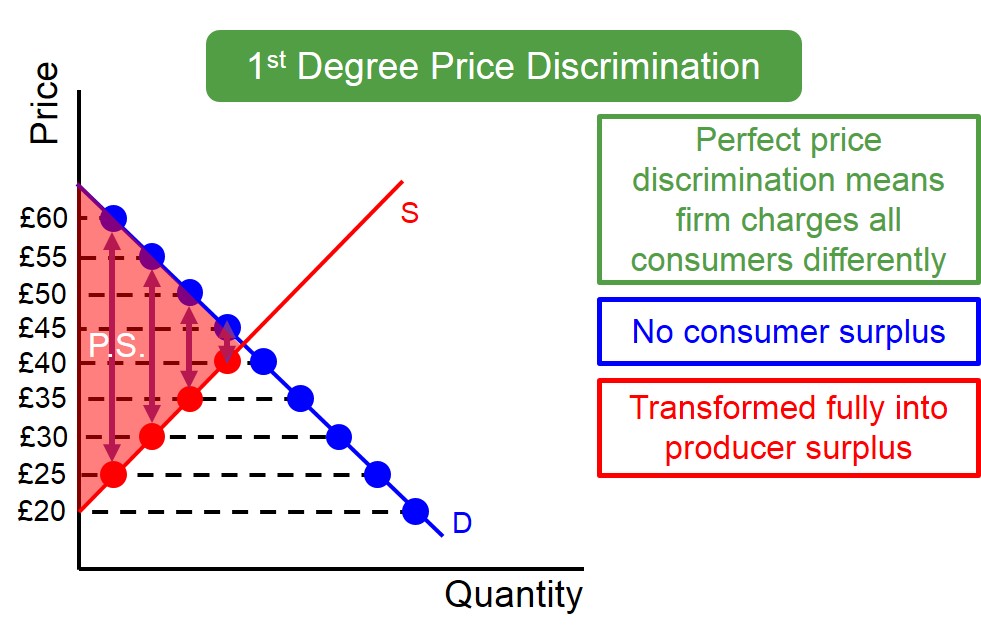
First degree / ‘Perfect’ price discrimination
Involves selling at a different price to each customer.
In this case the firm can successfully extract all consumer surplus.
Demand = marginal revenue
Second degree price discrimination
Involves the firm selling at different prices depending on how much of the good the customer buys or the version chosen.
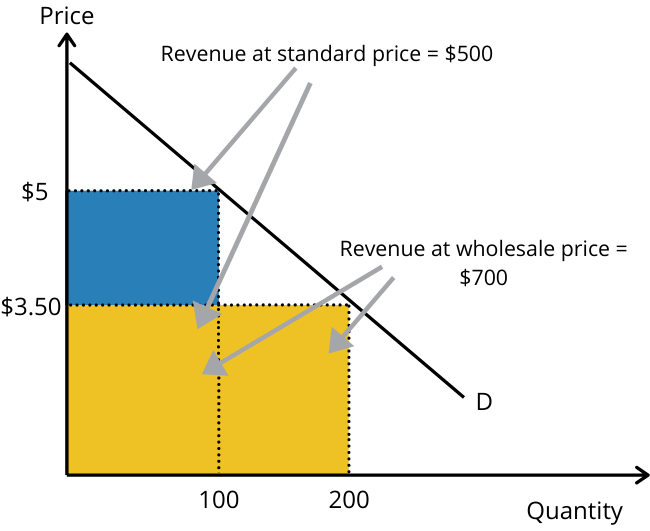
Quantity discount
Occurs when small levels of consumption are charged at relatively higher rates and increasingly high levels are charged at lower rates.
Third degree price discrimination
Involves the firm identifying groups of customers with different sensitivities to the variations in the price of a good.
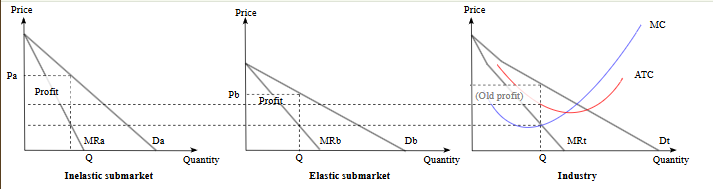
Whole market in third degree price discrimination
Arbitrage may cause a kinked demand curve
Arbitrage may cause a discontinuous MR curve
Price 1 > Price* > Price 2
The firm has higher profits by charging 2 prices
Total welfare & price discrimination
Total welfare is higher with price discrimination than with monopoly pricing.
Firm welfare & price discrimination
Firm welfare is higher as firms generate greater economic profit.
Consumer welfare & price discrimination
Consumer welfare is lower as firms extract all consumer surplus as profit.
Equity issues
More customers are served
Product Differentiation Strategy / Versioning
When firms sell different versions of the good/service to consumers who can self-select the product they desire.
Purpose of Versioning
Set themself apart from competitors
Offer different versions of goods/services
Horizontal product differentiation
Products differ but their physical attributes are quite similar.
Vertical product differentiation
Products’ real physical attributes differ in quality.
Advertising & Competition
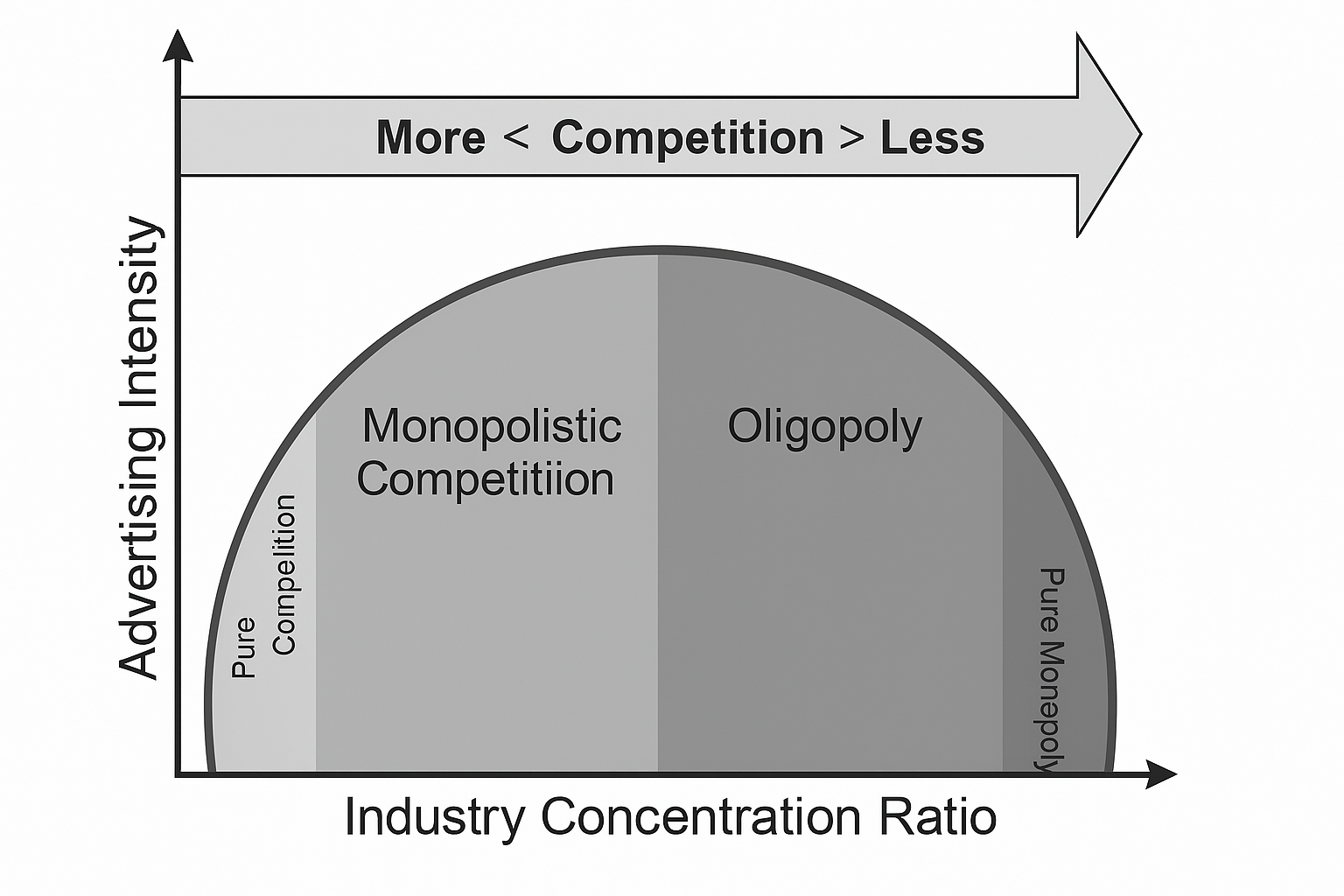
The intensity of advertising depends upon the degree of competition in the market (market concentration).
Durability
Low advertising:
Consumers tend not to rely on advertising for significant purchases, which are often durable goods.
Brand proliferation
High advertising:
Brands that value loyalty will need to entice customers from rivals and maintain brand awareness.
Brand loyalty causes a relatively inelastic demand curve
Successful advertising
Increases sales and causes the demand curve to shift to the right.
Deadweight welfare loss & advertising
Advertising does not increase the quality of number of goods in the economy.
Irrational consumers
"If the firm can afford to spend a lot on advertising it must be good. Therefore, they trust the good to offer a minimum standard of service."
Benefits of advertising
Increases information
Builds consumer trust
Creates jobs
Vital source of revenue
Mutually beneficial during sponsorships
Improves retail efficiency & productivity
Drawbacks of advertising
Invasive to consumers
Adverts for demerit goods
Cost of advertising does not improve product
Exploitative advertising
Barriers to entry
Requires regulation
Opportunity cost of R&D
Advertising and low prices
In some areas prices tend to fall when advertising is used, because there is better information and greater competition.
Advertising and high prices
In some areas prices tend to rise when advertising is used because of persuasion and lack of information.
Information View and advertising
Informing customers about products and prices.
Elastic demand curve
Signal of Quality (Milgrom & Roberts, 1986)
If consumers cannot distinguish between high quality (Gh) and low quality (Ql) all firms receive the same market price.
Signal of Quality: Burning money
Firms selling high quality (Gh) goods will spend more on advertising to secure a higher price and repurchases.
Benefits of information advertising
Welfare improving
Widens consumer choice
Lower barriers to entry
Lower prices
Lower search
Persuasive View and advertising
Switches market demand from one product to another.
Less elastic demand curve
Creates deadweight welfare loss
Entry Deterrent (Sutton, 1992)
Persuasive advertising creates high barriers to entry via brand loyalty and the sunk cost nature of advertising.
Complementary View and advertising
The advertisement adds additional value to the product and the world of wider media.
Search good
When a consumer can establish a product’s quality by inspection before purchase.
Experience good
When the consumer must consume the product to determine its quality.
Credence good
When a consumer cannot determine the quality even after consumption.
Traditional Theory of Information
Consumers have complete (perfect) information
Price reflects quality
Asymmetrical Information
One or more agent hold better information sets (bargaining advantages) over the other agents in the market.
Adverse selection
When one party has better information than the other before a transaction.
Moral hazard
One party takes more risk because it does not bear the full consequences of that risk.
Opportunism
Occurs when one agent takes actions that the principle cannot observe.
Cost of quaulity
If information about quality is costly to obtain, then it is no longer possible that buyers and sellers have the same information.
Gresham’s Law (1558)
Circulating currency consisting of both ‘good’ and ‘bad’ money, where both forms are required to be accepted at equal value under legal tender law quickly becomes dominated by the ‘bad’ money.
The Market for ‘lemons’ (Akerlof, 1970)
When buyers have incomplete information about the quality of a product, sellers have an incentive to pass off lower quality goods.
Measures to solve the Lemon Problem
Guarantees
Warranties
Brand names
Licensing
Credit scores
Evidence of no-claims bonus
Signalling Theory (Spence, 1973)
Evaluates a situation between two parties where one actor holds more information than the other.
Role of education
Improving human capital
Signal higher productivity
Education and wages
Firms cannot observe productivity levels of workers before hiring them, but they can observe educational attainment.
High level education = high wages
Low level education = low wages
Pooling equilibrium and education
Nobody will undertake education because the cost is too high relative to the rewards.
Everybody will undertake education if the cost is too low relative to the rewards
Separating Equilibrium and education
Highly productive individuals might find it cheaper to undertake education compared to low productive individuals.
High productive individuals = high wages
Low productive individuals = low wages