Business Judgement
 Call Kai
 Learn
Learn Practice Test
 Spaced Repetition
 Match
Match Flashcards
 Knowt Play
1/40

There's no tags or description
Looks like no tags are added yet.
Name | Mastery | Learn | Test | Matching | Spaced | Call with Kai |
|---|
No analytics yet
Send a link to your students to track their progress
41 Terms
Expertise Trap
Seasoned professionals rely on rigid, outdated mental models and analysis paralysis
System 1 thinking
Fast thinking, low effort, jumping to conclusions
System 2 thinking
Slow, effortful, high effort, logical
Flawed Problem definition
Confusing symptoms with causes, e.g. the music industry defining the MP3 as a piracy problem rather than a distribution shift
Solution Confirmation
Starting with a favourite answer and working backwards from it, e.g. Increasing yogurt production in third world countries despite refrigeration constraints
Wrong Framework
Applying an inapproporiate mental model, analytical tool or theoretical structure to a situation, e.g. Using personality tests to fix turnover when the cause is low pay
Narrow Framing
Relying on superficial analogies, e.g. JC Penney assuming Apples retail strategy would translate to department stores
Miscommunication
Solving the right problem but failing to persuade the stake holders
4S method, what are they?
State: Sharp, actionable question (TOSCA)
Structure: Logical architecture, i.e. Hypothesis Pyramid, Issue Tree and Design Thinking
Solve: Analysis or experimentation needed to find a solution
Sell: Convincing stakeholders to take action (Pyramid Principle)
4S Method, what is it?
A 4 stage framework used to solve complex business and strategic problems
Deductive Reasoning
Logical proces where you start with a general premise or established truth and apply it to reach a specific, certain conclusion - Hypothesis and Issue Driven
Abductive Reasoning
A logical process of making an educated guess to find the simplest and most likely explanation for an incomplete set of observations - Design Thinking
TOSCA
Trouble: Symptoms, e.g. sales down 10%
Owner: Who is accountable, e.g. CEO
Success Criteria: Quantifiable goals and timeline, e.g. 5% growth in year 2
Constraints: Resource limits, e.g. $500k budget
Actors: Stakeholders affected
MECE
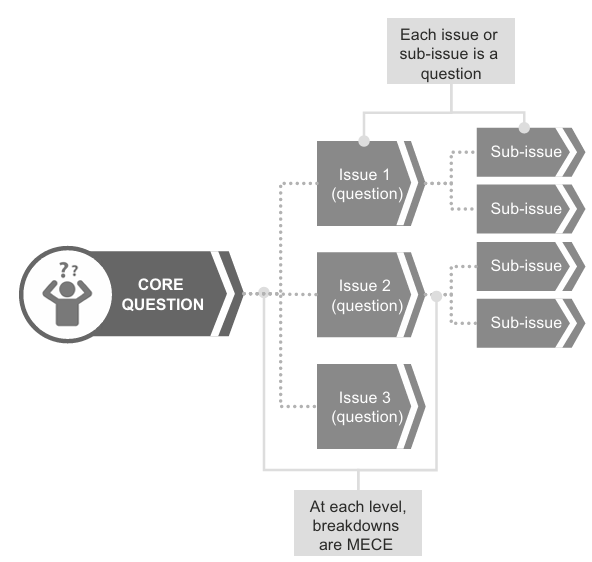
Mutually Exclusive Collectively Exhaustive: No overlaps or gaps
Hypothesis Pyramid
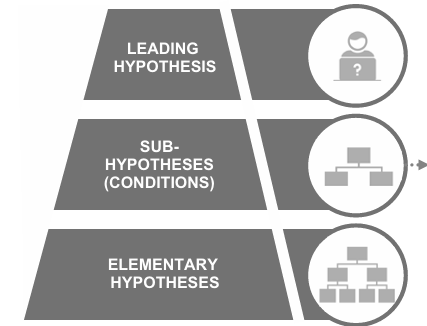
A top-down structure used when you have high confidence. You start with a leading hypothesis / problem to solve, then break down into sub-hypotheses / conditions that must be true for the leading hypothesis to hold. Then the elementary hypotheses are statements that are concrete enough to be proven or disproven through facts / data
Issue Tree
Exploration of how and why questions
Confirmation Bias
The tendency to seek only information that supports our existing beliefs
Porter’s 5 Forces
Strategic framework used to analyse an industry’s competitiveness and profitability
4P’s
Foundational elements businesses use to create a winning marketing strategy
Design Thinking
Use design thinking for complex, ill-understood, human-centered problems
5 Phases of Design Thinking
EDIPT - Edith Dislikes Indian People like Taj
Empathise: Understanding the users for who you are designing. A strategic tool to uncover what users actually do vs what they say
Define: A POV statement that idenfies the user, their needs, and unexpected insights gained
Ideate: Divergent mindset that prioritises volume and variety of ideas over immediate quality
Prototype: Experiemented to test specific hypotheses about a solution’s attributes
Test: Let users interact with the prototypes in their natural setting to generate feedback
5 Pitfalls
Flawed Problem Defintion
Solution Confirmation
Wrong Framework
Narrow Problem Framing
Miscommunication
Groupthink
A psychological phenomenon where the desire for harmony or conformity in a group results in irrational or dysfunctional decision-making
Problem statement
A sharp, core question formulated from the perspective of the problem owner
Seven steps to strategy making (what is it?)
Applying creativity to scientific processes to generate new strategies and pinpoint the most likely to succeeed
Seven steps to strategy making (what are they?)
Chris Practices Cricket Before Tennis Trials in Castlemaine
Frame a choice - Force problem into two mutually exclusive choices
Generate Probabilities (i.e. paths to follow)
Specify conditions for success
Identify Barriers
Design Tests
Conduct the tests
Make your choice
Self-Interested Bias
Does the team benefit personally
Affect Heuristic
Mental shortcut where people rely on their immediate emotional response rather than making logical decisions
Anchoring Bias
Cogntitive bias that forces us to rely heavily on the first piece of information we learn about a topic, e.g. I want to buy a laptop and see one for $1000 that I want. It’s too expensive but then I see a T-shirt for $100 and buy that, because my mind thinks it’s alot cheaper than the laptop
Sunk Cost Fallacy
Is the team emotionally tied to past investments
Competitor Neglect
Ignoring competitors decisions, or acting as though they don’t exist
Overconfidence bias
A cognitive error where an individual’s subjective confidence in their own abilities, knowledge, or judgments is greater than objective reality
Loss Aversion
Is the team being overly cautious, because they don’t want to fail
Action-oriented bias
Drive us to take an action less thoughtfully than we should - Excessive optimism, overconfidence, competitor neglect
Interest bias
Presence of conflicting incentives (i.e. Monetary or emotional) - Misaligned individual incentives, inappropriate attachments, misaligned perception of corporate goals
Pattern Recognition Bias
Recognising patterns even where there are none - Confimration bias, chmapion bias
Stability Bias
Tendency to reject change in the presence of uncertainty - Loss aversion, status quo bias, sunk cost fallacy
Social Biases
Preference for harmony over conflict - Groupthink, sunflower management (align with views of leaders)
When to use Issue Tree vs Hypothesis Pyramid
Hypothesis Pyramid: When you candidate solution and have expertise, or a simple problem
Issue Tree: When it is a complex issue, and you do not have a good candidate solution
Pyramid Principle
Core Message (Convey the recommendation), Key Line (How and Why), Support (Data)
8 Types of Analysis
Eric Eats at Noodle-Noodle Fridays, As Isaac Eats Junk-food
Exisiting data - Statements accepted without any second thought
Easy-to-find numbers - Quantitative data
Non-Numerical facts - Qualitative data
Fact based analyses - Logical processing of factual data
Assumption based analysis - Educated guesses when perfect data isn’t available
Internal plans and forecasts - Assumptions based on management projections
Expert input - Assumptions requiring expertise, e.g. legal opinion
Judgement calls - Educated judgement