Chapter 11: Anxiety and Obsessive-Compulsive Disorders in Children
 Call Kai
 Learn
Learn Practice Test
 Spaced Repetition
 Match
Match Flashcards
 Knowt Play
1/76

There's no tags or description
Looks like no tags are added yet.
Name | Mastery | Learn | Test | Matching | Spaced | Call with Kai |
|---|
No analytics yet
Send a link to your students to track their progress
77 Terms
What is anxiety characterized by?
Strong negative emotion and bodily symptoms of tension in anticipation of future danger or misfortune.
What are anxiety disorders?
Conditions involving excessive and debilitating anxieties that can occur in many forms.
What is the fight/flight response?
An immediate reaction to perceived danger or threat aimed at escaping potential harm.
What are the three interrelated anxiety response systems?
Physical system, cognitive system, and behavioral system.
How does the cognitive system respond to anxiety?
It leads to feelings of apprehension, nervousness, difficulty concentrating, and panic.
What distinguishes anxiety from fear?
Anxiety is future-oriented and may occur without realistic danger, while fear is present-oriented and occurs in response to current danger.
What is panic?
A group of physical symptoms of the fight/flight response that occurs unexpectedly in the absence of obvious danger.
What role do moderate fears and anxieties play in development?
They are adaptive and can help children gain control and prepare for the future.
What is separation anxiety disorder (SAD)?
A condition characterized by age-inappropriate, excessive anxiety about being apart from parents or home.
What is the prevalence of separation anxiety disorder in children?
Occurs in 4% to 10% of children and is more prevalent in girls.
What are common characteristics of specific phobias?
Persistent, irrational fear that leads to avoidance of the feared object or event, lasting at least six months.
What types of specific phobias exist?
Animal, natural environment, blood-injection-injury, situational, and other.
What is social anxiety disorder?
A marked, persistent fear of social or performance situations that expose the child to scrutiny.
What is the lifetime prevalence of social anxiety disorder in children?
6% to 12%, with a higher prevalence in girls.
What is selective mutism?
Failure to talk in specific social situations despite speaking freely in other settings.
What is panic disorder?
A condition characterized by recurrent unexpected panic attacks and persistent concern about having more attacks.
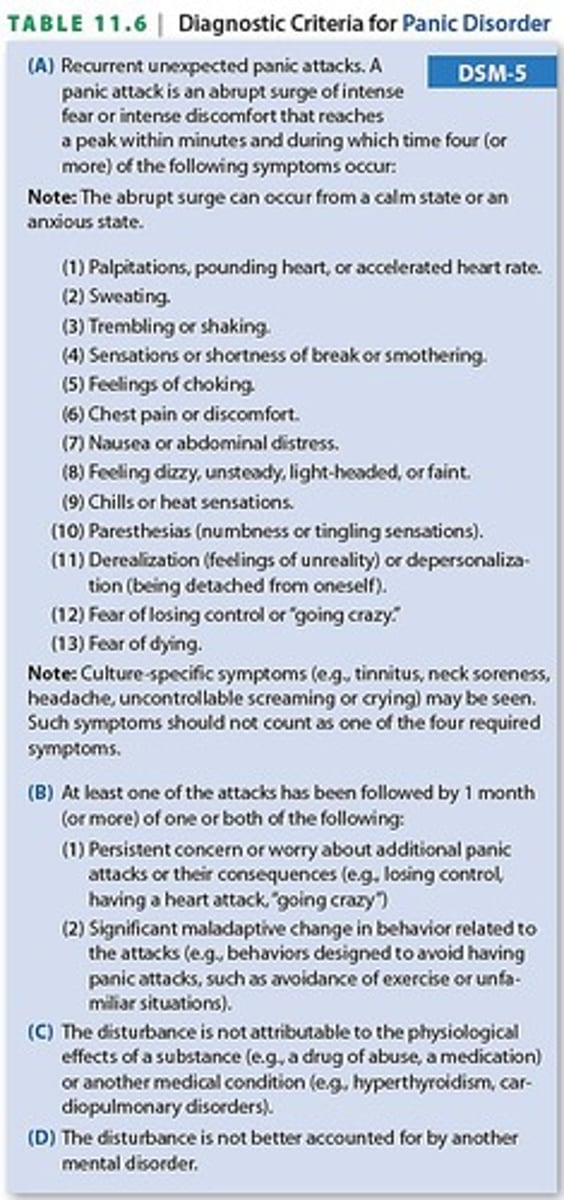
What is agoraphobia?
Marked fear or anxiety in certain places or situations, often related to panic attacks.
What is the typical age of onset for panic disorder?
15 to 19 years, with 95% of adolescents being post-pubertal.
What are common comorbid conditions with panic disorder?
Another anxiety disorder or depression.
What is the significance of normal rituals and repetitive behaviors in children?
They help children gain control and mastery of their environment.
What is the relationship between anxiety disorders and functional impairment?
Anxiety disorders can lead to significant functional impairment in social and personal life.
What is the impact of untreated school refusal behavior?
Serious long-term consequences for the child's education and social development.
What is the DSM-5-TR classification for anxiety disorders?
Includes Anxiety Disorders, Obsessive-Compulsive and Related Disorders, and Trauma- and Stressor-Related Disorders.
What is the average age of onset for selective mutism?
3 to 4 years.
What is the typical course of separation anxiety disorder?
It can progress from mild to severe and may persist into adulthood.
What are the implications of high anticipatory anxiety in panic disorder?
It may lead to agoraphobia due to fear of having a panic attack in difficult-to-escape situations.
What is the common age range for school refusal behavior?
Most often occurs in children aged 5 to 11.
What is the relationship between anxiety and gender in children?
Girls display more anxiety than boys, although symptoms are similar.
What is Generalized Anxiety Disorder (GAD)?
A mental health condition characterized by excessive, uncontrollable anxiety and worry about everyday occurrences.
What are common symptoms of GAD?
Symptoms include excessive worrying, somatic symptoms like headaches, stomach aches, muscle tension, and trembling.
How long must symptoms persist before diagnosing GAD?
Symptoms must last for at least 6 months.
What is the lifetime prevalence rate of GAD according to national surveys?
The lifetime prevalence rate is 2.2%.
Is GAD equally common in boys and girls?
Yes, GAD is equally common in both genders.
What is the average age of onset for GAD?
The average age of onset is early adolescence.
What disorders are commonly comorbid with GAD?
GAD is often accompanied by other anxiety disorders and depression.
What are the characteristics of Obsessive-Compulsive Disorder (OCD)?
OCD is characterized by recurrent, time-consuming obsessions and compulsions that are resistant to reason.
What are obsessions in the context of OCD?
Obsessions are persistent and intrusive thoughts, urges, or images.
What are compulsions in OCD?
Compulsions are repetitive behaviors or mental acts performed to relieve anxiety.
What is the lifetime prevalence of OCD in children and adolescents?
The lifetime prevalence is between 1% to 2.5%.
Which gender is more commonly affected by OCD according to clinic-based studies?
OCD is found to be twice as common in boys.
What are common comorbidities associated with OCD?
Common comorbidities include anxiety disorders, ADHD, ODD, and tics.
What is the average age of onset for OCD?
The average age of onset is between 9 to 12 years.
What is Body Dysmorphic Disorder (BDD)?
BDD involves a preoccupation with perceived defects or flaws in physical appearance, often leading to repetitive behaviors.
What is the prevalence of Body Dysmorphic Disorder?
The prevalence of BDD is 2.4%, with slightly more females affected than males.
At what age does Body Dysmorphic Disorder commonly begin?
The mean age of onset is 16-17 years, but it often starts between ages 12-13.
What are some behaviors associated with Body Dysmorphic Disorder?
Behaviors include mirror checking, excessive grooming, and skin picking.
How does OCD affect the normal activities of children?
OCD can severely disrupt health, social and family relations, and school functioning.
What is the long-term outcome for children diagnosed with OCD?
As many as two-thirds of children continue to have OCD 2 to 14 years after initial diagnosis.
What is a characteristic of obsessions in younger children with OCD?
Young children typically have more vague obsessions compared to older children.
What is Hoarding Disorder characterized by?
Difficulty discarding items, perceived need to save items, and distress with discarding them.
What is the prevalence of Hoarding Disorder?
2-6%.
At what age do symptoms of Hoarding Disorder typically first emerge?
Ages 11-15.
When does functional impairment from Hoarding Disorder usually occur?
In the mid-20s.
What is Trichotillomania?
A disorder characterized by pulling out hair, resulting in hair loss, with repeated attempts to stop.
What is the prevalence of Trichotillomania?
1-2%.
Which gender is more likely to develop Trichotillomania?
Females, who are 10 times more likely than males.
What is Excoriation Disorder?
A disorder involving recurrent skin picking resulting in skin lesions and repeated attempts to stop.
What is the prevalence of Excoriation Disorder?
1.4%.
In which population is Excoriation Disorder more common?
Persons with OCD.
What are cognitive disturbances associated with Anxiety Disorders?
Disturbances in information perception, deficits in cognitive functioning, and cognitive errors and biases.
What physical symptoms are common in children with anxiety disorders?
Somatic complaints, sleep-related problems, and increased long-term health risks.
What social and emotional deficits do children with anxiety disorders exhibit?
Low social performance, high social anxiety, low self-esteem, and difficulty maintaining friendships.
How does anxiety relate to depression in children?
Depression is more common in children with multiple anxiety disorders, and negative affectivity is linked to both.
What gender differences exist in the prevalence of anxiety disorders?
By age 6, twice as many girls as boys experience symptoms of anxiety.
What ethnic differences are observed in anxiety disorder prevalence?
Higher prevalence in underrepresented ethnic groups, with Black American children reporting more symptoms than White American children.
How does culture affect the expression of anxiety symptoms?
Culture may influence the developmental course and interpretation of anxiety symptoms.
What are early theories regarding anxiety disorders?
Classical psychoanalytic theory, behavioral and learning theories, and Bowlby's attachment theory.
What role does temperament play in anxiety disorders?
Inherited differences in neurochemistry can lead to variations in behavioral reactions to novelty.
What family and genetic risks are associated with anxiety disorders?
Parents of anxious children often have anxiety disorders, and children of such parents are five times more likely to have anxiety disorders.
What neurobiological factors are implicated in anxiety disorders?
Overactive behavioral inhibition system and irregularities in neurotransmitter systems like GABA and serotonin.
What is the HPA axis's role in anxiety?
It is part of the anxiety response system controlled by interrelated brain systems.
What are the main treatment approaches for anxiety disorders?
Exposure to anxiety-producing situations, modifying distorted information processing, and addressing physiological reactions.
What is the main technique used in behavior therapy for anxiety?
Exposure to feared stimuli while providing coping strategies.
What is Cognitive-Behavioral Therapy (CBT) known for in treating anxiety disorders?
Combining cognitive restructuring with behavioral exposure.
What medications are commonly used for anxiety disorders?
Selective serotonin reuptake inhibitors (SSRIs) like fluoxetine and sertraline.
What is the focus of prevention programs for anxiety disorders?
Identifying at-risk children and providing interventions to reduce the incidence of anxiety disorders.
What were the results of a prevention study for anxiety disorders?
Children who received intervention showed fewer anxiety disorders and lower symptom severity compared to a control group.