Biology Genetics/hormones etc. DP1
 Call Kai
 Learn
Learn Practice Test
 Spaced Repetition
 Match
Match Flashcards
 Knowt Play
1/44

Earn XP
Description and Tags
Menstrual cycle & hormones, genetic expression ...
Name | Mastery | Learn | Test | Matching | Spaced | Call with Kai |
|---|
No analytics yet
Send a link to your students to track their progress
45 Terms
Phenotype
An observable trait determined by genotype and environmental factors
Genotype
The combination of alleles inherited by offspring
Discrete variation
Defined by categories, not in a scale. Controlled by a single gene, the environment has no effect (yes/no to having the phenotype)
Continuous variation
Controlled by multiple genes - polygenic. There is an environmental influence and a very broad range, no distinct categories
What occurs in the follicular phase
Days 1-14
The hypothalamus releases GnRH.
GnRH stimulates the pituitary gland to release FSH and LH.
FSH stimulates a follicle containing an egg to develop in the ovary.
As the follicle develops, it secretes estrogen
Estrogen stimulates repair and slight thickening of the endometrium.
Increasing levels of oestradiol inhibit FSH.
This causes FSH levels to decrease, ensuring that only one dominant follicle continues to develop.
When estrogen reaches very high levels, it switches to positive feedback on the hypothalamus and pituitary gland
This causes a surge in LH (and a smaller surge in FSH).
The LH surge causes ovulation; the mature follicle ruptures and releases the egg into the fallopian tube.
The remaining follicle stays in the ovary and develops into the corpus luteum.
What occurs at ovulation
The surge of LH causes the egg to rupture from the follicle and leave the ovary to the fallopian tubes
What does the follicle secrete as it develops
Estrogen
Positive feedback loop hormones
LH and estrogen in ovulation
Role of estrogen in the menstrual cycle
Thickens endometrium lining and triggers LH
Role of FSH in the menstrual cycle
To grow the follicle (the ring of cells) around the egg, the egg can mature into an oocyte
What occurs in the luteal phase
The remaining follicular cells w/ no egg are now corpus luteum
Corpus luteum secretes estrogen & progesterone
Progesterone levels rise as days go by and thicken the endometrium
Progesterone inhibits FSH and LH (as no new egg needs to be released then fertilized)
If pregnancy does not follow, corpus luteum breaks down
This causes a drop in progesterone & estrogen since nothing is secreting it, so nothing can keep up the uterine lining and it is shed as menstruation
Since little progesterone is there, nothing is inhibiting LH and FSH, so the cycle starts again
Role of progesterone in the menstrual cycle
Thickens the endometrium, which is required for embryo implantation as it will provide embryo nutrients etc. for growth and inhibits FSH and LH.
Negative feedback loop in menstrual cycle
Progesterone inhibiting FSH & LH
Estrogen inhibiting FSH for most of the time (follicular phase)
Steps of IVF
Injections given to stop FSH & LH (doctors need to control cycle)
High levels of FSH injected to start superovulation, where many follicles are developed and many eggs are released
The eggs are harvested from the follicles
Fertilization occurs outside of body (eg. in petri dish)
Fertilized eggs implanted back into uterus along with progesterone injections to keep the endometrium lining sufficient for embryo
Autosomal disease
An inherited disease occurring on non-sex chromosomes (any other of the 22 pairs).
PKU
Recessive autosomal disease: must have 2 recessive alleles to show, one to carry
A mutation in the PAH gene that codes for phenylalanine hydroxylase needed to convert phenylalanine to tyrosine. This leads to a build up of phenylalanine, which can impair brain development, and a lack of tyrosine which is also bad for neurological development
Cystic Fibrosis
Recessive autosomal disease: must have 2 recessive alleles to show, one to carry
A mutated CFTR protein is unable to regulate movement of salt in & out of cells, leading to a sticky, thick mucus that clogs the lungs and makes it hard to breathe
Sickle cell disease
Recessive autosomal disease: must have 2 recessive alleles to show, one to carry
Single point mutation in the HBB gene on chromosome II, leading to haemoglobin S being mutated, red blood cells are cresent shaped, rigid, and sticky = they can clump together and restrict blood flow
How does a pregnancy test work
The test detects hCG, which the embryo secretes when implanted into the uterus. When you pee on the stick, the monoclonal antibodies from the stick bind to hCG, triggering a reaction and activating a dye.
Homologous chromosome
Same genes in the same locations
Not always the same alleles
Independent assortment
Occurs in metaphase: the chances of the mother chromosome facing a pole and the father chromosome facing another are completely random and independent of each other, so when they get pulled away, the probability of a certain chromosome being located on a certain side is random.
Nondisjunction
Failure for homologous paired chromosomes or chromatids to separate in either anaphase 1 or anaphase 2 respectfully. Results are gametes with either too many or too few chromosomes.
What occurs during crossing over
This occurs in prophase 1. The homologous chromosomes come together (synapsis) and form a bivalent (tetrad) (two homologous chromosomes attached). The point(s) at which they cross over are called the chiasma(s). Then, non sister chromatids exchange alleles. The number of chiasma and the amount of alleles exchanged is random.
Fertilization in humans
The sperm swims up to the fallopian tubes and meets the egg (attracted by chemicals that the egg releases)
The sperm cell contains an acrosome (a vesicle with enzymes) and digests the zona pellucida (eats through it to get to egg cell membrane)
The sperm binds to specific receptors on the egg membrane (ensures it’s only human sperm)
The sperm cell membrane fuses with the egg cell membrane.
The successful fusion of the sperm membrane to the cell membrane initiates a chemical cascade of the egg. This triggers a large amount of calcium throughout the cytoplasm, which triggers the cortical granules to harden the zona pellucida - preventing polyspermy from occurring (no other sperm can enter). Also, it will alter the glycoproteins that sperm use to fuse to cell membrane so no other sperm already in zona pellucida can enter.
Upon entering the cell, the sperm tail and mitochondria are being broken down
The sperm and egg nuclei are now both in the egg cell, and nuclear envelopes form around both sets of nuclei. This is a pronucleus, with purpose of protection for DNA replication (interphase of mitosis)
The pronuclei break down and both combine (from egg & sperm), and then mitosis occurs giving rise to a diploid zygote.
How does puberty start in males & females
Both experience hypothalamus producing GnRH, which triggers the pituitary gland to produce LH and FSH. For females, this triggers the ovaries to produce estradiol (estrogen) which leads to uterus enlargement, breast growth, pubic hair, etc.
For men, this triggers the testes to produce testosterone which leads to sperm production, penis enlargement, pubic hair, etc.
What is the role of the placenta
The placenta acts as a barrier from mother to fetus, ensuring no blood gets mixed. It is also a way for materials to diffuse from mother to fetus & vise versa without blood needing to mix. It allows the fetus to develop longer providing it with more nutrients.
What does the mother exchange to the fetus via the placenta?
Oxygen is exchanged via diffusion
Glucose via facilitated diffusion
Water via osmosis
Antibodies via endocytosis
Alcohol, drugs, etc.
Fetus to mother exchange via placenta
CO2 via diffusion
Urea via exo/endocytosis (waste product like urine)
Water via osmosis
Epigenesis
Differentiation - all cells in the body have the same genome but can express/not express certain ones (turn them off = silenced and on = activation).
Epigenetic tags
Chemical modifications that cause some genes to be activated and others to be silenced. It does not alter the genome itself. Examples are methylation or adding an acetyl group.
What is methylation
A methyl group can be added to base sequences of a gene. If added to the promoter region, it will inhibit transcription (it can be added to the cytosine base). A methyl group can be added to the histone protein too, which changes how available DNA is to be transcribed. It squishes the histones together and hide some of the DNA. Demethylation is possible, too
Phenotype plasticity
The ability of an organism changing its phenotype in response to environmental factors (tanning, building muscle, etc.) without changing its genotype
Air pollution and methylation
Air pollution decreases methylation in DNA.
This leads to less genes having the “off expression” button, so more genes are expressed.
This affects mainly immune/inflammatory genes - more of those proteins are produced since methylation isn’t there to say “no don’t produce”
This can lead to asthma (where this occurs in the lungs making it hard to breathe) or heart, etc.
Genomic imprinting
When epigenetic tags remain on DNA (this barely happens/practically all epigenetic tags are removed) during gamete formation and are then passed on to offspring
Lions for patterns in genomic imprinting
Patterns in genomic imprinting are for the offspring to have a better chance of being conceived, born, and then surviving later in life. Female lions have an epigenetic tag for large litters (she can have be pregnant with cubs from different lions at the same time). Having a lot of cubs = more likely one of them will survive to reproductive age. Also, conserves her energy.
Male lions have an genomic imprinting favoring bigger cubs since they are more likely to grow up strong and compete for resources & survive compared with other cubs.
Usually, this evens out so litters are medium sized with medium sized offspring.
Tigers & Lions for genomic imprinting
Tigers & lions can produce offspring together.
Female tigers aren’t able to get pregnant with multiple tigers at the same time, so males do not have the epigenetic tag for their offspring to be bigger since there’s no competition within the litter.
Male tiger + female lion = small Tigon (tiny)
Male lion + female tiger = very big Liger (large)
Lactose as gene expression
Lactase is an enzyme that isn’t coded for/produced when unnecessary. This is achieved via a repressor protein on the silencer region of the gene binding. When lactose levels rise, though, the repressor protein is removed, so lactase can be produced and break down lactose into galactose and glucose.
Highly conserved genes
DNA sequences that are almost/completely identical over a wide range of species and long periods of time. For example, haemoglobin A gene has almost all the same base sequences for a variety of different species (humans, gorillas, mice, chicken, etc.).
Hypotheses for highly conserved genes?
1) It’s highly essential for life, and if a mutation occurs the person will die without being able to reproduce & pass the mutation down to offspring, so the gene stays very similar. This is purifying selection
2) The gene can mutate like all genes, but the proteins and enzymes that are able to fix & correct it work better & better see if a mutation will occur because it’s so important, so there are slower mutation rates.
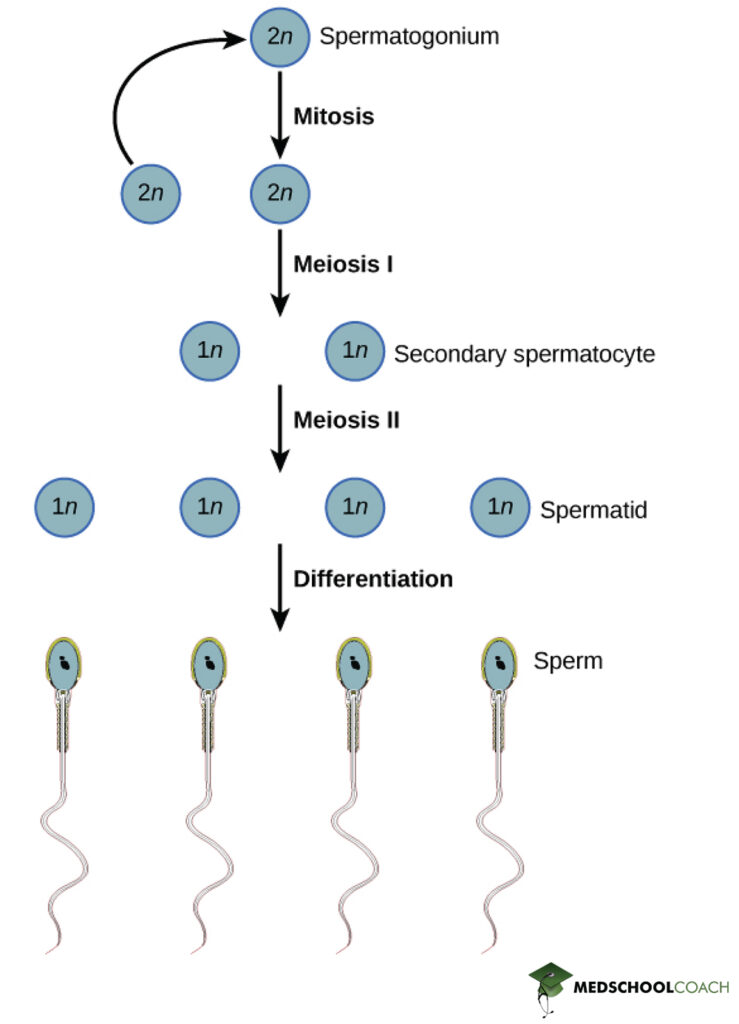
Spermatogenesis
Before puberty, all cells in the testes are spermatogonium. They are dividing very slowly or are completely inactive. Then, in response to testosterone, the spermatogonium begin to divide more actively and produce sperm cells. This happens occurs in the seminiferous tubules in the testes:
1) Spermatogonium has 2n chromosomes (46 chromosomes and 46 chromatids)
This then undergoes mitosis and produces..
2) Primary spermatocytes have 2n chromosomes (46 chromosomes and 92 chromatids, they double their genetic info because they need to go into meiosis)
They then undergo meiosis 1 and produce…
3) Secondary spermatocytes have n chromosomes (23 chromosomes and 46 chromatids, first splitting of homologous chromosomes in meiosis).
They then undergo meiosis 2 and produce…
4) Spermatids have n chromosomes (23 chromosomes and 23 chromatids, final splitting of sister chromatids in meiosis) They are haploid.
The spermatids then attach to sertoli cells and get nutrients to differentiate fully into their structure of a sperm cell (very little cytoplasm, flagellum, acrosome, etc.). They then travel to the epididymis and mature further & are stored there
Oogenesis
This starts as a fetus. When the fetus’ reproductive system is developed, many oogonium will be in the ovaries and will go through a lot of mitosis to produce many copies of oogonium.
1) Oogonium in the ovaries (46 chromosomes, 46 chromatids)
The oogonium then can either divide & produce more of itself OR can decide to do something else and go through different mitosis to produce…
2) Primary oocyte in the ovaries (46 chromosomes, 92 chromatids bc they have to double their genetic material to go thru meiosis)
The primary oocyte then goes through meiosis prophase 1, but is ARRESTED in prophase 1 until puberty occurs and can continue with meiosis 1 to produce…
3) Secondary oocyte in the ovaries (23 chromosomes, 46 chromatids).
The secondary oocyte then does meiosis 2 but is ARRESTED in metaphase 2 when it ruptures from the follicle (during ovulation) and ends up in the fallopian tubes. It will be in the fallopian tubes, and IF fertilization DOES occur (sperm meets egg) the secondary oocyte will finish meiosis 2 to produce..
4) An ovum (23 chromosomes, 23 chromatids)
IF fertilization does NOT occur, the secondary oocyte will not finish meiosis 2 and will break down.
Codominance
Both dominant alleles are expressed in the phenotype (eg. type AB blood has both A and B antigens on red blood cells)
Incomplete dominance
Individual that is heterozygous for two dominant alleles will express an intermediate phenotype (like two pure white (WW) and red (RR) flowers having a pink flower baby)
Conserved genes
Base sequences that are almost/completely identical over a species/group of species
Positive feedback loop during childbirth
The fetus's head will press on the cervix, which stimulates the hypothalamus to signal to the posterior pituitary gland to release oxytocin into the bloodstream. The surge in oxytocin causes the uterus to contract more and more frequently, pushing the baby's head against the cervix more, thus producing more oxytocin. This is a feedback loop to push out the fetus during childbirth.