Endocrine - L1 part 2 - Hypothalamus + Pituitary
 Call Kai
 Learn
Learn Practice Test
 Spaced Repetition
 Match
Match Flashcards
 Knowt Play
1/41

There's no tags or description
Looks like no tags are added yet.
Name | Mastery | Learn | Test | Matching | Spaced | Call with Kai |
|---|
No analytics yet
Send a link to your students to track their progress
42 Terms
what does the hypothalamic-pituitary unit regulate? (a lot of things)
growth
kidneys
body fluid homeostasis
thyroid glands
adrenal glands
gonads/ reproduction
mammary glands/ lactation
* T/F: the hypothalamus has one main nuclei
false, the hypothalamus has several nuclei*
= work to stimulate or inhibit the functions of the anterior pituitary
what is the anterior pituitary, or the front lobe of the gland, also called?
Adenohypophysis --> has 2 parts
what are the 2 parts of the anterior pituitary?
pars tuberalis (dorsal)
pars distalis (ventral)
what does the pars distalis (in the anterior pituitary) contain?
cells that secrete the classical pituitary hormones
ex. FSH, LH, prolactin, TSH, ACTH, etc.
what structure does the pars tuberalis (in the anterior pituitary) SURROUND?
the infundibular or hypophysial (pituitary) stalk
--> connects hypothalamus + pituitary together
where is the site of hormone release from the hypothalamus and where they are accumulating?
neurohypophysis
accumulating in the capillary plexuses before being released in blood stream
what is the posterior pituitary also called?
Neurohypophysis, or Pars nervosa
what connects signals from hypothalamus to the anterior pituitary?
infundibular stalk
* what is a third part of the pituitary, seen in some species, called?
the intermediate lobe, or pars intermedia
**important in horses**
what is the 'median eminence'?
site of storage and secretion of releasing or inhibiting hormones, from the hypothalamus
the median eminence has vascular connections with the ______________. This connection is called what?
the anterior pituitary
= called the 'hypothalamo-pituitary portal circulation'
(transports hormones to pituitary)
the pars distalis is regulated by what 2 things?
1. hypothalamus
2. direct feedback from target organs via their hormonal products
what are some factors that regulate hormone secretion by the hypothalamus?
light, stress, changes in blood volume, metabolic agents, hormones
what cells in the hypothalamus secrete both releasing + inhibiting factors into the portal blood vessels --> get transported to anterior pituitary
**these factors are specific for individual anterior pituitary hormones**
neurosecretory cells
there are at least 3 types of neurosecretory cells in the hypothalamus, including:
1. large magnocellular neurons
2. small parvocellular neurons
3. projection neurons
in the hypothalamus, what do large magnocellular neurons produce?
produce hormones that are STORED in the posterior pituitary
(ex. ADH, oxytocin)
in the hypothalamus, what do small parvocellular neurons produce?
produce releasing + inhibiting hormones which...
regulate the functions of the anterior pituitary
in the hypothalamus, what is the function of 'projection neurons'?
they project into different parts of the CNS, towards 'neuronal targets'
= regulate processes such as appetite, bondings, etc.
what are main examples of hypothalamic 'releasing' hormones?
1. CRH = corticotropin-releasing hormone
2. GnRH = Gonadotropin-releasing hormone
3. GHRH = growth hormone-releasing hormone
4. TRH = thyrotropin-releasing hormone
what are the 2 main examples of hypothalamic 'inhibiting' factors?
1. somatostatin
2. dopamine
* hormones secreted by neurons are called __________, and peptides from neurons are called _______________
neurohormones,
neuropeptides
quick review = what neurosecretory cells secrete ADH + oxytocin, that will be stored in posterior pituitary?
large magnocellular neurons
when ADH + oxytocin are transported to the posterior pituitary for storage, what happens next?
they are secreted from the posterior pituitary into the bloodstream by nerve impulses
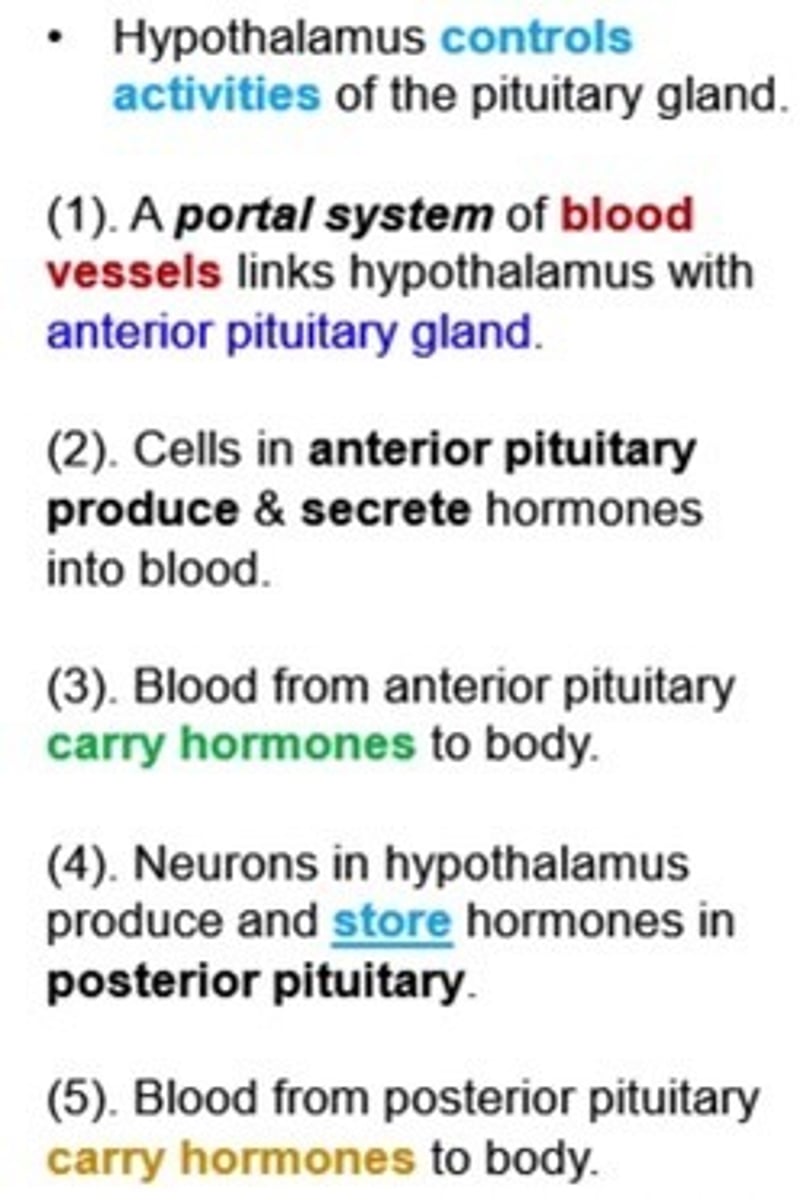
flip to see summary image of 'hypothalamus-pituitary unit'
as a releasing hormone from the hypothalamus --> GHRH (GH-releasing hormone) stimulates what?
synthesis/ secretion of growth hormone from anterior pituitary
as a releasing hormone from the hypothalamus --> TRH (thyrotropin-releasing hormone) stimulates what?
synthesis/ secretion of thyroid-stimulating hormone (TSH) from anterior pituitary
(also known as thyrotropin)
as a releasing hormone from the hypothalamus --> CRH (corticotropin-releasing hormone) stimulates what?
synthesis/ secretion of adrenocorticotropic hormone (ACTH)
as a releasing hormone from the hypothalamus --> GnRH (gonadotropin-releasing hormone) regulates what?
regulates synthesis/ secretion of both LH + FSH
- these are secreted in a 'pulsatile' fashion (beating/rhythmic)
the stimulation or inhibition of LH + FSH secretion is determined by the frequency/ amplitude of what?
GnRH pulse (the beat/rhythm)
lower GnRH pulse frequency favors _________, higher GnRH pulse frequency favors __________ secretion
lower = FSH
higher = LH
somatostatin is an 'inhibiting hormone' produced in the hypothalamus + other parts of the CNS, and is known as what 2 other names?
GHIH = growth hormone inhibiting hormone
SRIF = somatotropin release-inhibiting factor
somatostatin is widely distributed outside the nervous system, including:
1. delta (D) cells of pancreatic islets
2. gastric + duodenal mucosa
3. in circulation
somatostatin inhibits secretion of many substances from both endocrine + exocrine glands in different organs - give some examples:
1. from pituitary = GH, TSH, prolactin
2. from pancreas = insulin, glucagon
3. from GI tract = gastrin, gastric acid, secretin, CCK, VIP, digestive enzymes
4. body fluids = reduces saliva production
5. kidneys, liver, gastric mucosa = reduces blood flow
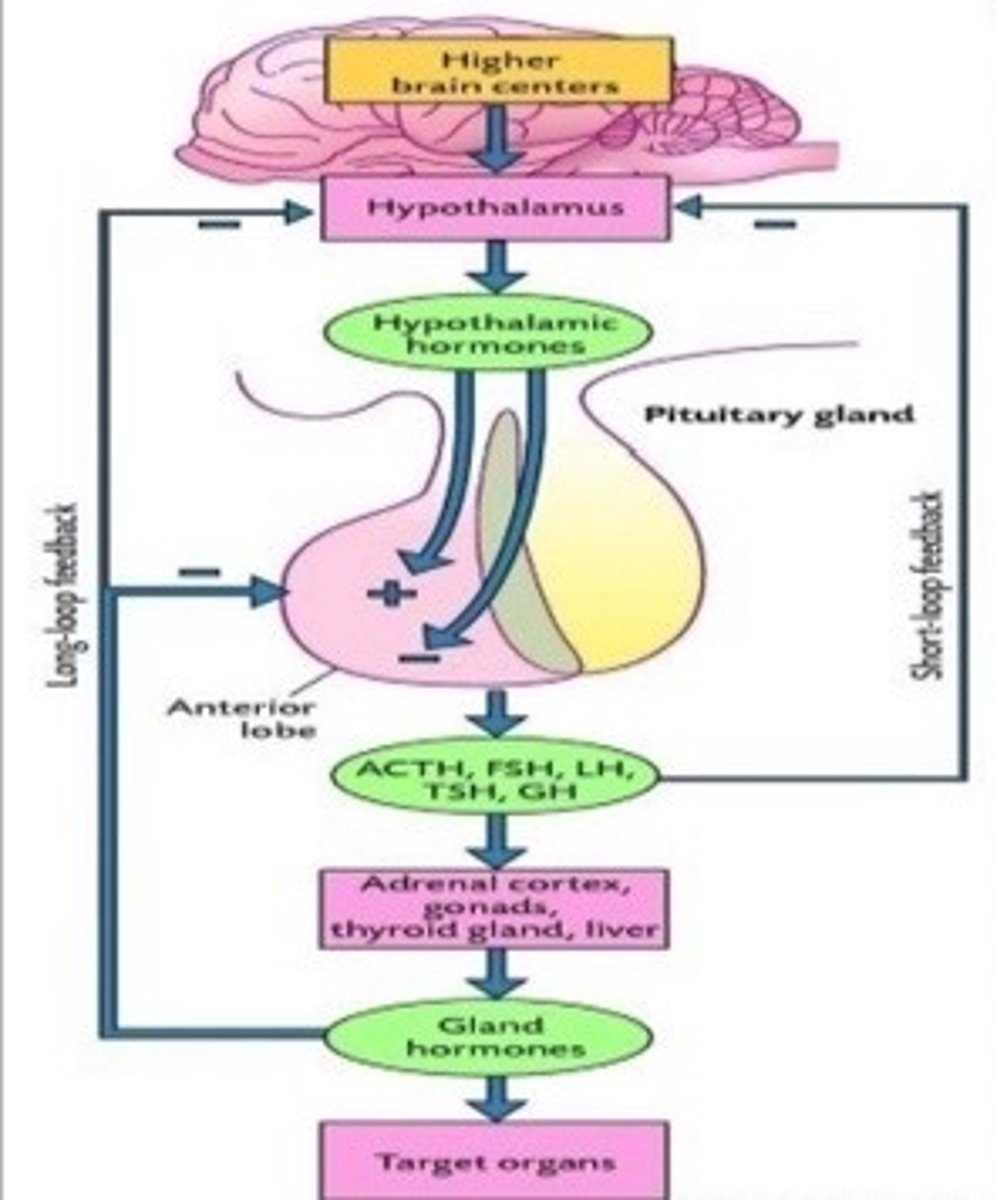
* explain the negative feedback loop between --> hypothalamus-pituitary unit + target organs
1. releasing hormones from hypothalamus stimulate hormone secretion by anterior pituitary gland
2. hormones from anterior pituitary stimulate target glands to synthesize hormones
3. hormones from the target glands exert a (-) feedback on BOTH the hypothalamus + anterior pituitary
= called 'Long-Loop'
4. after this, hormones from anterior pituitary ALSO exert a (-) feedback on the hypothalamus
= called 'Short-Loop'
5. these negative feedbacks together work to reduce CNS hormone secretion from hypothalamus
**like a double attack on hypothalamus**
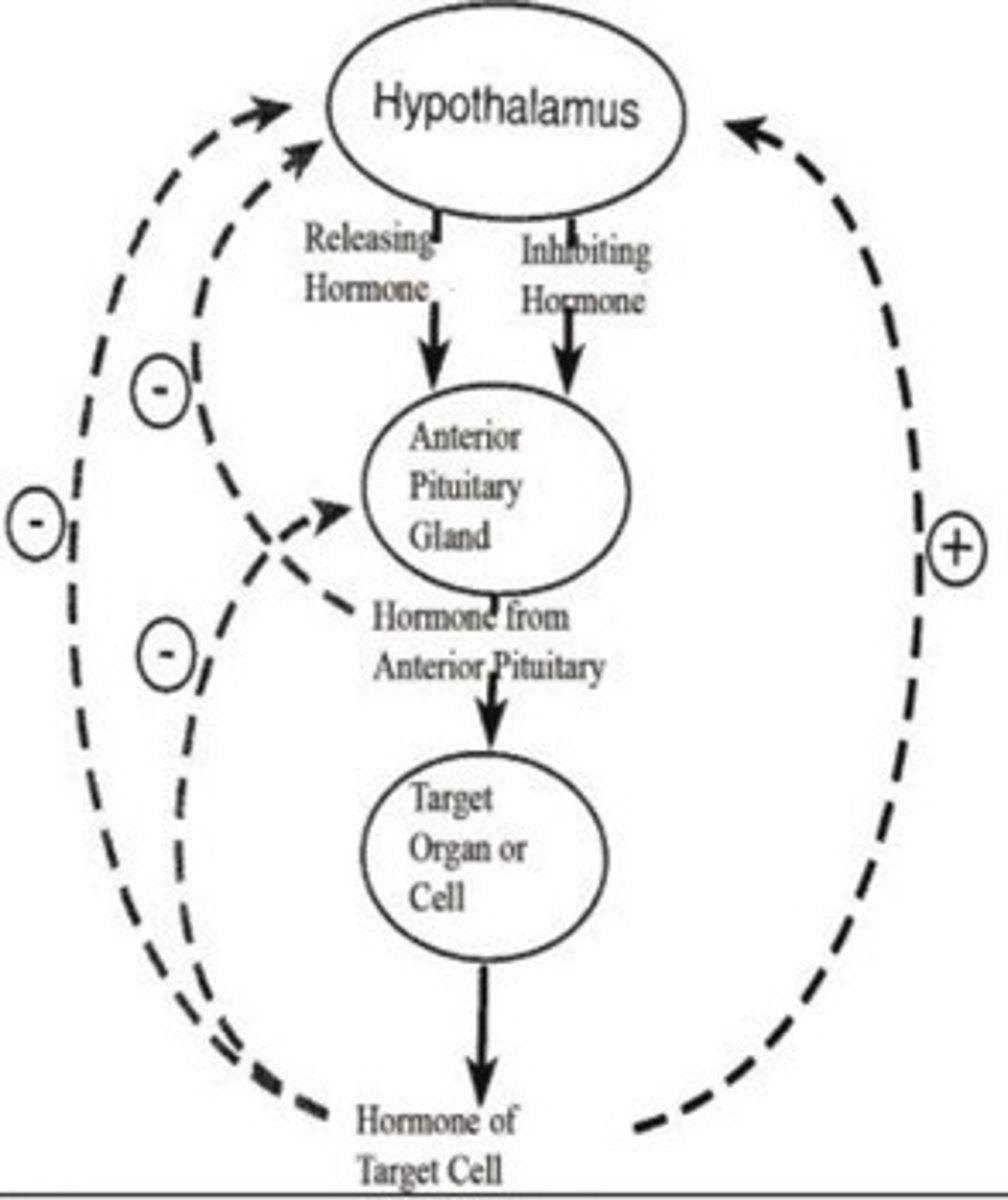
* T/F: positive feedback loops are RARE and relatively short-lived
true !
* what is an example of a positive feedback loop?
between:
- estradiol from the ovary
- LH secretion by anterior pituitary
*(+) feedback shown on right side as general mechanism*
the hypothalamus is PROTECTED by the _________
blood-brain barrier (BBB)
* some blood-borne hormones, peptides, macromolecules, etc. can get access to the hypothalamus via 2 ways:
1. facilitated transport
2. unique anatomical modifications of capillaries in adjacent regions*
* explain how blood-borne chemicals can get into the hypothalamus via facilitated transport
the capillaries in the hypothalamus have specific carriers for these chemicals
* what are examples of regions that have 'unique anatomical modifications of capillaries' that are used by blood-borne chemicals to get into the hypothalamus?
what are they collectively called?
median eminence
subfornical organ (SFO)
organum vasculosum of lamina terminalis (OVLT)
= collectively called circumventricular organs *
* how do circumventricular organs allow passage of blood-borne chemicals into hypothalamus?
have pores (fenestrations) that are large enough to permit passage of blood-borne chemicals