Forensic Fingerprint
 Call Kai
 Learn
Learn Practice Test
 Spaced Repetition
 Match
Match Flashcards
 Knowt Play
1/25

There's no tags or description
Looks like no tags are added yet.
Name | Mastery | Learn | Test | Matching | Spaced | Call with Kai |
|---|
No analytics yet
Send a link to your students to track their progress
26 Terms
William Herschel
Required fingerprints on contacts in India, and also as a means of identifying prisoners
Alphonse Bertillion
Proposed body measurements as a mean of identification; termed anthropometry
Francis Galton
Developed primary classification scheme based on loops, arches, and whorls
Edward Henry
In collaboration with Galton instituted a numerical classification system
Juan Vucetich
developed a fingerprint classification based on Galton’s that used Spanish speaking countries
What are fingerprints composed of
patterns and ridges friction ridges on your finger
Anthropometry
proposed body measurements as a mean of identification
Dactyloscopy
the study of fingerprint identification
Ridgeology
the study of uniqueness of friction ridge structures and their use
Minutiae
specific characteristics of ridge patterns, including ridge endings, holes, and bifurcations
What is the FBI’s database of fingerprints called
IAFIS
Describe how you would know if the loop print is radial or ulnar
ulnar loop- points inside the arm to the left
radial loop- points to the radial bone going right
What are the 3 main principles of using fingerprint identification
fingerprint is an individual characteristic, two people don’t have the same fingerprint
fingerprints remained unchanged for individuals life
general ridge patterns allow for systmatic identification
What are the three fundamental fingerprint patterns, and how do they differ from one another
loops- radial & ulnar
whorls- plain, central pocket loop, accidental
arches- plain and tented
What is the percentages of each of the three above in general population
60% loops, 35% whorls, 5% arches
What is a core? What is a delta?
Core is the center of whorl or loop
Deltas are triangular regions near a loop
What are latent fingerprints and why are they important in forensic
invisible residues of sweat, oils, and body secretions left on surfaces, requiring specialized techniques like dusting powders, chemical reagents, or alternate light sources for detection
What are patent fingerprints and what are they important in forensic
2D impressions that are visible, such as a print created by dirt or makeup on a flat surface
What are plastic fingerprints and why are they important in forensic investigations
3D impressions created in a softer material, such as wax clay and puddy
How are latent fingerprints typically developed or enhanced at a crime scene, 4 techniques
Fluorescent powder
UV light
Black powder, then lift with clear tape
cynocrylate fuming method (super glue method)
Define “minutiae in the context of fingerprint analysis. Why are they critical in identifying fingerprints
unique characteristics found within the friction ridge patterns of a finger
help distinguish more points of similarity in fingerprints
How much of a fingerprint is needed to make a positive comparison (how many minutiae points)
No standard number
Criminal courts generally accept 8-12 points of similarity
Provide examples of each type of minutiae
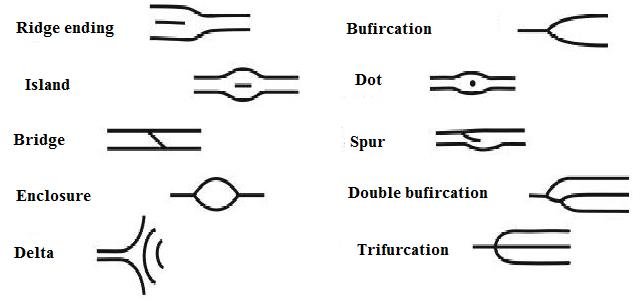
How can automated fingerprint identification system (AFIS) assist forensic experts in identifying fingerprints, what are their advantages and limitations
help ready classify and match fingerprints
advantages- reduced search time , increases accuracy, improves collaboration
disadvantages- fails positive potential high maintenance costs
Name all the parts of the body where ridges prints can be found
foot
palm of hands
lips
teeth
ears
voice
shoe
Discuss the challenges and limitations of using fingerprints evidence in court. What factors can affect the accuracy of fingerprints identification
Prints can become smudged or partial, great chance human error, low quality prints or enough obtained to make a valid match