Dev Econ ch 7 and 13
 Call Kai
 Learn
Learn Practice Test
 Spaced Repetition
 Match
Match Flashcards
 Knowt Play
1/9

There's no tags or description
Looks like no tags are added yet.
Name | Mastery | Learn | Test | Matching | Spaced | Call with Kai |
|---|
No analytics yet
Send a link to your students to track their progress
10 Terms
List and describe the advantages and disadvantages of Urbanization. (Urbanization definition: Cluster of population in cities due to better job opportunities and rural poverty)
Advantages
Agglomeration economy and Economies of scale
Supply of trained/skilled workers
Infrastructure built specifically for the industry
Good and cheap transport links
Better education and health facilities
Disadvantages
Overloading of social services
Lack of water and sanitation
Unemployment and increased crime rate
Pollution and congestion
Growth of huge slums and shantytowns
What is the role of cities in fostering economic development?
Cities are formed because they provide cost advantage to producers and consumers through agglomeration economies
Agglomeration economies is the cost advantage and benefit that occurs when people locate near one another in cities and industrial clusters
List and describe agglomeration effects associated with the general growth of a concentrated geographic region? (Urbanization Economy: Agglomeration effects associated with the general growth of a concentrated geographic region)
You have shared infrastructure and services
Large and diverse labor market
Knowledge spillovers
Sharing of firms that provide business services
What is Agglomeration economies and what are the two types?
The cost benefit that occurs when firms and people are located near one another in cities and industrial sectors.
Localization economies are benefits captured by particular sectors of the economy as they grow within an area (like the automobile industry in Detroit)
Have access to same group of skilled workers, knowledge spillover, firms supplying intermediate inputs or raw materials
Urbanization economies are the agglomeration effects associated with the general growth of a concentrated geographic region
Shared infrastructure, knowledge spillover, large and diverse labor markets
What is Urban Giantism, what are some causes and effects of it?
Urban giantism occurs when one or a few cities within a country grow disproportionately large compared to other urban areas, resulting in a dominant city that absorbs a significant share of the nation’s population and economic activity.
One cause of this is the hub-and-spoke system of transportation, in which a single city acts as the central hub connecting many smaller towns. As a result, the largest city receives a disproportionate amount of investment.
This pattern is further reinforced by factors such as the concentration of political power in the largest city, trade barriers, and the higher costs and risks associated with doing business in other regions of the country.
What are 3 arguments for and 2 arguments against supporting the urban informal sector?
Arguments in favor of promoting the informal sector are that it
generates income and employment for the urban labor force,
there is minimal financial capital requirement,
and it absorbs unskilled labor.
Arguments not in support of supporting the urban informal sector are that it
aggravates the urban unemployment problem and
many informal sector activities can cause pollution, congestion, and inconvenience to pedestrians.
There are four basic components of a typical IMF stabilization program. Identify and briefly describe the four fundamental components that typically make up an International Monetary Fund (IMF) stabilization program.
The 4 basic components of a typical IMF stabilization program are:
Liberalization of foreign exchange and imports control: Removing or relaxing government restrictions on currency exchange/imports. Allow market forces to determine exchange rates and import levels
Devaluation of official exchange rate: By devaluing currency, exports become more competitively priced, and imports become more expensive meaning the countries balance of payments can improve.
Stringent domestic anti-inflation program: Try to reduce inflation by reducing government spending, limiting money supply, etc. Goal is to bring inflation under control
Opening up of the economy to international commerce: Reduce tariffs and quotas in order to integrate the country into the global economy.
Several initiatives were introduced during the 1980s debt crisis to alleviate or restructure the debt burdens of highly indebted nations. Identify and explain each of these major debt relief programs.
Brady Plan (commercial banks): involves converting existing commercial bank loans into new securities known as brady bonds, with better terms and some level of debt relief
Paris Club (Public Debts): a group of official creditors that provide coordinated debt restructuring solutions to countries facing payment difficulties
Debt for Nature swap: A country’s debt is reduced in exchange for its commitment to invest in environmental conservation
Debt for Equity swap: It involves the sale (at a discount) of developing countries debt to private investors
These investors then trade the debt for a local state-owned asset such as steel mill or telephone company
During the 1980s, many developing countries experienced declines in both their current and capital accounts, shifting from net capital inflows to outflows. Identify and explain three major factors contributing to the decline in the current account and three factors contributing to the decline in the capital account.
Reasons for Current Account decline:
A dramatic fall in commodity prices including oil
Global recessions in 1981-1982 and 1991-1993 which caused a general retraction of world trade
Overvalued exchange rates in several developing countries (decrease in exports, increase in imports)
Reasons for Capital Account decline:
Rising developing country debt service obligations
Sharp declines in lending by international banks
Massive capital flight
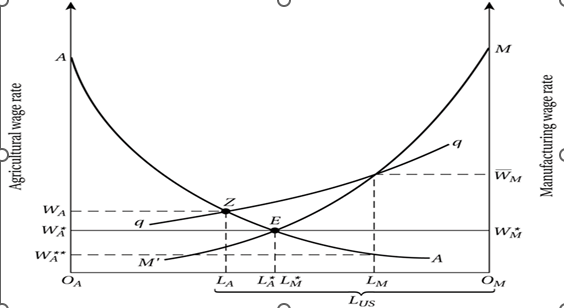
Be able to use the Todaro Migration model calculate and decide whether migrants needs to migrate or not (from chapter 7)
Horizontal Axis
L(a): Labor in agriculture (rural)
L(a)*: rural labor after migration
L(m): Labor in manufacturing (urban)
L(m)*: equilibrium urban labor
L(us): Total labor supply
Wage Variables
W(a): Actual rural wage
W(a)*,**: alternative rural wage levels at different labor allocations
W(m): Actual urban manufacturing wage
W(m)*: equilibrium urban wage
Wm (with line): fixed or minimum wage in urban center (often set above equilibrium causing unemployment)
Curves
A (downward sloping): agricultural wage amount (as more workers stay in agriculture, wages fall)
M (upward sloping): Manufacturing wage amount (shows how wages relate to employment in urban sector)
Q (upward sloping): Expected urban wage line