7.1 Mutual Fund Industry
 Call Kai
 Learn
Learn Practice Test
 Spaced Repetition
 Match
Match Flashcards
 Knowt Play
1/32

There's no tags or description
Looks like no tags are added yet.
Name | Mastery | Learn | Test | Matching | Spaced | Call with Kai |
|---|
No analytics yet
Send a link to your students to track their progress
33 Terms
What are mutual funds?
pool the resources of many investors by selling them shared using the proceeds to buy securities
How did mutual funds grow?
At the beginning of 2013, 57% of retirement assets were held by mutual funds.
28% of the US stock market and almost 44% of all U.S. households hold stock via mutual funds
Assets held by mutual funds have grown by about 17% per year for the last 25 years → reaching >$14 trillion
The first mujtual fund similar to the funds of today was introduced in Boston in 1824
Stock market crash of 1929 set the mutual fund industry back because small investors avoid stocks and distrusted mutual funds
Investment Company Act of 1940
What was the Investment Company Act of 1940>
requiring disclosure of fees etc → reinvigorated the indusrty
What ar ethe 5 principal benefits of mutual funds?
Liquidity intermediation: investors can quickly conver investments into cash
Denomination intermediation: investors can participate in equity and debt offerings that individually require more capital than they possess
Diversification: investors immediately realise the benefits of diversification even for small investments.
Cost Advantages: mutual fund can negotiate lower transaction fees than would be available for the individual investor
Managerial expertise: many investors prefer to rely on professional money managers to select their investments
How has ownership in mutual funds change over the last 20 years
changed drastically:
1980 - only 5.7% of households held mutual fund shares
2013 - 75% held
Mutual funds account for $5.3 trillion of the retirement market - est. at $19.5
What doe sthe total industry net assets vs net mutual funds look like
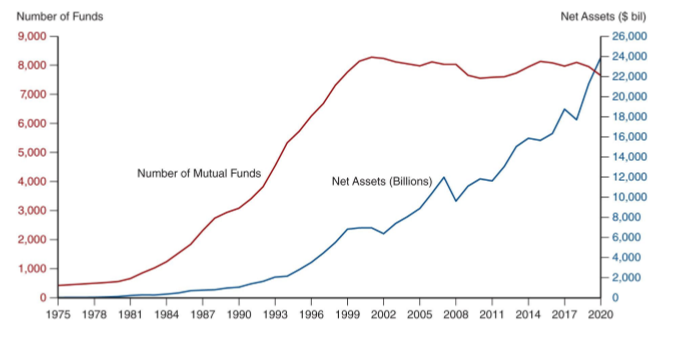
What is the mutual fund structure?
offer a number of different types of mutual funds
can move investments btw/ funds w/o penalty
Complexes often issue consolidated statements
What are the different fee structures in mutual funds?
Closed-End Fund
a fixed number of nonredeemable shares are sold through initial offering and are then traded in the OTC market - price for the shares is determined by supply and demand forces
Open-End Fund:
investors may buy or redeem shares at any point, where price is determined by the net asset value of the fund
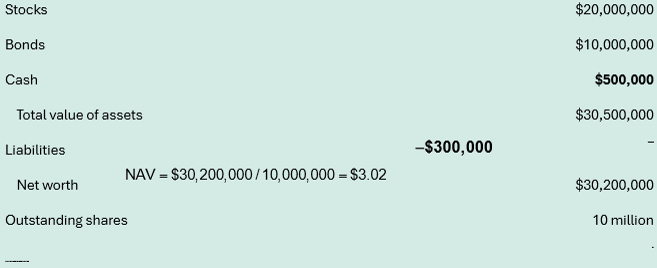
What is Net asset Value (NAV)?
Total value of the mutual fund’s stocks, bonds, cash and other assets minus any liabilities such as accrued fees, divided by the number of shares outstanding
Whats an example of calculating a mutual funds NAV
What does the organisational structure of a mutual fund look like
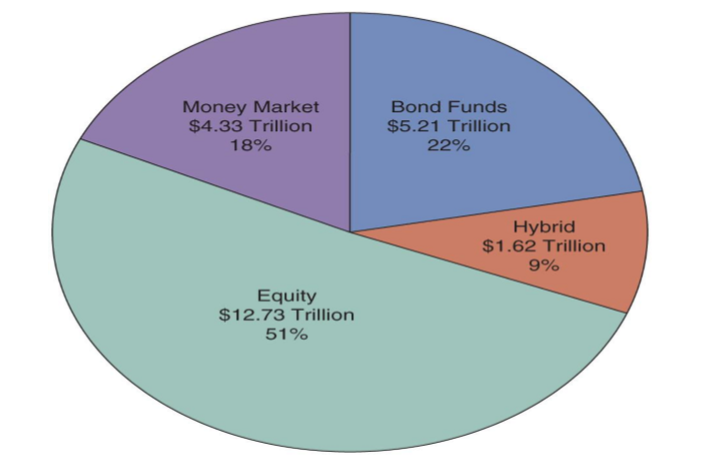
What are the 4 primary classes of mutual funds available to investors?
Stock (equity) funds
Bond funds
Hybrid funds
Money market funds
What does the distribution of Assets among types of mutual funds look like?
What are the investment objective classes?
Stock funds
bond funds
hybrid funds
Money Market Mutual Funds
Index Funds
What are stock funds?
other than investing in common equity the stated objective of any particular fund can vary dramatically
Capital appreciation funds seek rapid increase in share price, not being concerned about dividends
Total Return Funds seek a balance of current income and capital appreciation
World Equity Funds invest primarily in foreign firms
Other types in Value, growth, a particular industry
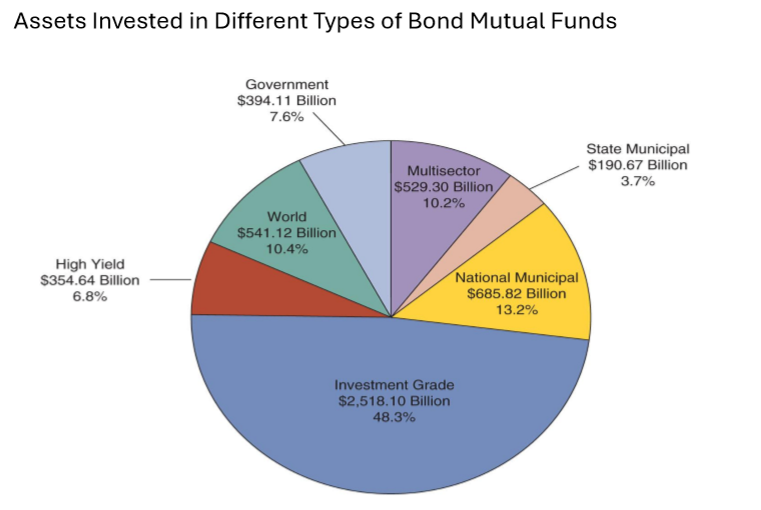
What are bond funds?
strategic Income Funds invest primarily in the U.S. corporate bonds, seeking a high level of current income
Gov bond Funds invest in U.S. Treasury, as well as state and local gov bonds
Others inc World Bond Funds etc
What does the distribution of assets among the bond fund classification look like?
What are hybrid funds?
combine stocks and bonds into a single fund
Account for about 5% of all mutual fund accounts
Gives flexibility of stocks and bonds
What are Money Market Mutual Funds?
open- end funds that invest only in money market securities
Offer check-writing priveleges
Net assets have grown dramatically
Although money market mutual funds offer higher returns than bank deposits the funds are not federally insured
relatively safe
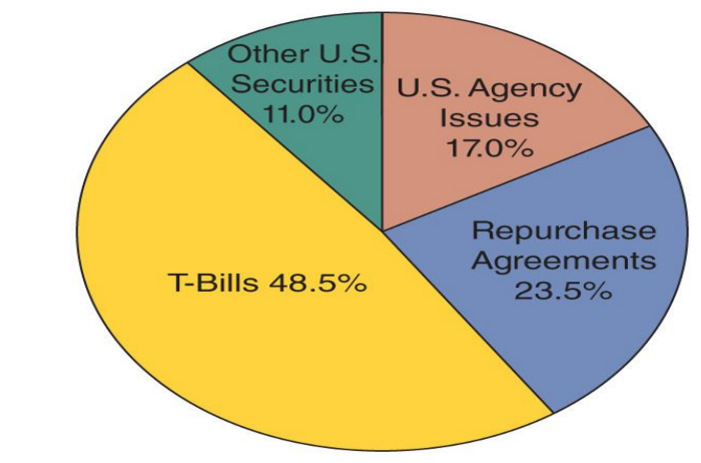
What does the distribution of Assets invest in MMMF look like
What are Index Funds?
a special class of mutual funds that do fit into any of the previous categories
the fund contains the stock of the index it is mimicking - S&P 500 index fund would hold the equities compromising of the S&p 500
Offers benefits of traditional mutual funds without the fees of the professional money manager
What are different fee structures of Investment funds?
Load funds (Class A)
Deferred load (Class B)
contingent deferred sales charge (Class B)
redemption fee (class B)
exchange fee (Class C)
Account maintenance fee (class C)
What are loan funds?
Class A shares
Charge an upfront fee for buying the shares.
No-load funds do not charge this fee
What is deffered load
Class B shares
funds charge a fee when the shares are redeemed
What are contingent deferred sales charge?
Class C
a back end fee that may disappear altogether after a specific period
What is a redemption fee?
Class B
another name for a back end load
What is an exchange fee?
Class C
A fee for transferring money btw funds in the same family
usually low
What is an account maintenance fee?
charges if the account balance is too low
What is a 12b-1 fee
Class C
fee to pay marketing, advertising and commissions
What are the 4 primary laws that regulate Mutual funds?
Securities Act of 1933: specifies disclosure requirements
Securities Exchange Act of 1934: details antifraud rules
Investment Company Act of 1940: requires registration and minimal operating standards
Investment Advisors Act of 1940: regulates fund advisors
In US, what is the law for Mutual Funds and independent directors?
In US mutual funds are the only companies that are required by law to have an independent directors as follow:
they must consititute a majority of the board
they select and nominate other independent directors
legal counsel to them must also be independent
How are Hedge Funds different from mutual funds?
high min investment, averaging around $1 mil
LR commitment of funds is required
High fees: typically 1% of assets pls 20% of profits
Highly leveraged
Little current regulation
What do hedge Funds do?
trying to take advantge of unusual spreads btw security prices