ANAT 35 Lecture 14-16 The Heart + Blood Vessels + Blood
 Call Kai
 Learn
Learn Practice Test
 Spaced Repetition
 Match
Match Flashcards
 Knowt Play
1/58

There's no tags or description
Looks like no tags are added yet.
Name | Mastery | Learn | Test | Matching | Spaced | Call with Kai |
|---|
No analytics yet
Send a link to your students to track their progress
59 Terms
What are the primary functions of the atria?
Receiving chambers that receive blood into the heart from veins
thin walled, derived from veins
Where does the right atrium receive blood?
vena cava
coronary sinus
Where does the left atrium receive blood?
pulmonary veins
What is the function of the L/R auricles?
they help to increase volume into the atria to accommodate blood returning to the heart while the AV valves are closed during ventricular contraction
What is the pectinate muscle?
the muscle of the wall of atria, looks like a honeycomb
What is the general function of the ventricles?
pumping chambers, receive blood from the atria
thick walled, derived from arteries
Where does the right ventricle pump blood to?
to the lungs
blood is pumped at a lower pressure
Where does the left ventricle pump blood to?
to the aorta, then to tissues of the body
blood is pumped at a higher pressure
Which ventricle has thicker walls?
the left ventricle
What is the trabeculae carnae?
the muscle of the walls of the ventricles
What are the AV valves?
tricuspid valve
mitral valve
What are the SL Valves?
pulmonary valve
aortic valve
When the ventricles relax, what happens to the AV and SL valves?
AV valves are open
SL valves are closed
When the ventricles contract, what happens to the AV and SL valves?
AV valves are closed
SL valved are open
What are the stimulating tissue of the heart called, and what is their composition?
SA Node
AV Node
modified myocardium
What is the function of conducting tissue and what is it made of?
transmit impulses to produce coordinated contractions
modified myocardium
What are the types of blood vessels?
Arteries
Veins
Capillaries
What do arteries do and their characteristics?
carry blood away from heart
resistance vessels
under high pressure
What do veins do and their characteristics?
carry blood to the heart
capacitance vessels
under low pressure
What are the function of capillaries?
exchange vessels
perfusion
Do arteries and veins have similar anatomy to other tubes in the body?
Yes
How do arteries and veins different anatomically?
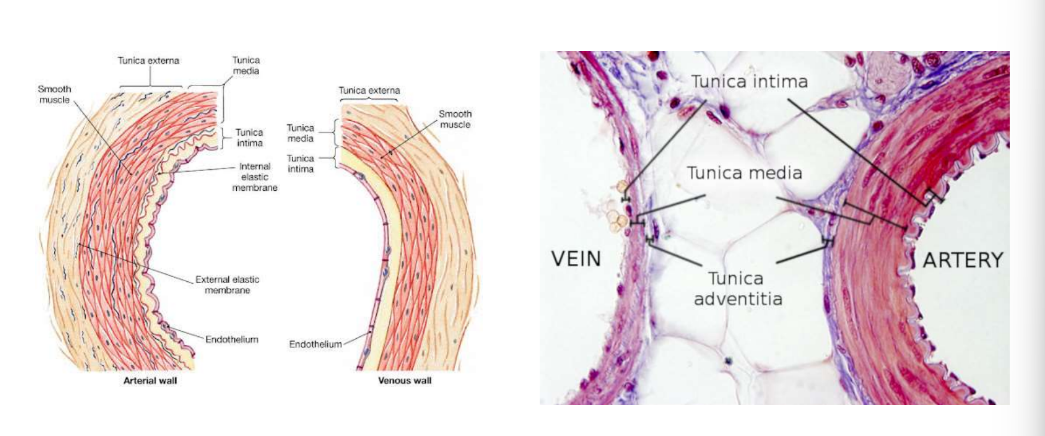
proportion of muscle to connective tissue is different:
arteries = thickest layer is smooth muscle
veins = thicket layer is connective tissue
What are capillaries made of?
endothelum and basement membrane
What are the layers of arteries and veins?
tunica adventitia/externa
tunica media
tunica intima
What are the three types of arteries?
elastic
muscular
arterioles
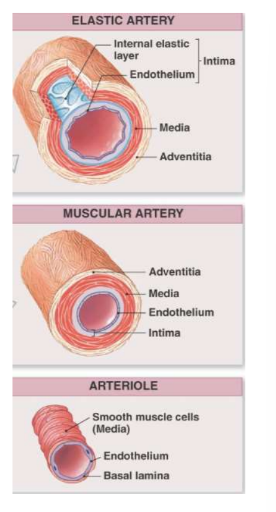
What do elastic arteries do?
transport large volumes of blood away from the heart
What do muscular arteries do?
transport blood to skeletal muscle and internal organs
What do arterioles do?
deliver/regulate blood flow to capillaries
What are the 3 types of capillaries?
continuous
fenestrated
sinusoidal
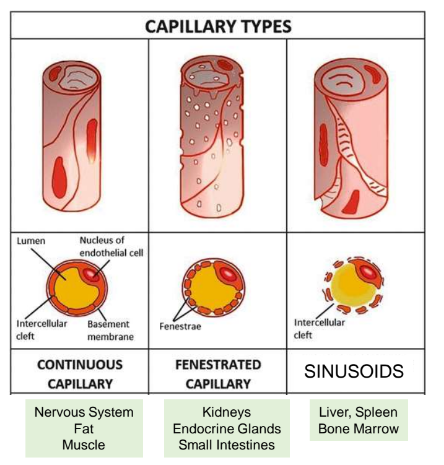
Characteristics of continuous capillaries
Smallest blood vessel in body
most common
no perfusion, tight junctions
Characteristics of fenestrated capillaries
intracellular perforations
allow movement through fenestrations
Characteristics of sinusoidal capillaries
open spaces between endothelial cells
very permeable
permit bulk flow
Location of continuous capillaries
nervous system
fat
muscle
Location of fenestrated capillaries
kidneys
endocrine glands
small intestine
Location of sinusoidal capillaries
liver
spleen
bone marrow
What is the difference between normal circuits and portal circuits of blood flow?
normal: one capillary bed in circuit
portal: two capillary beds in series
Where are the 3 portal circuits in the body?
hepatic
renal
hypothalamo-pitutary
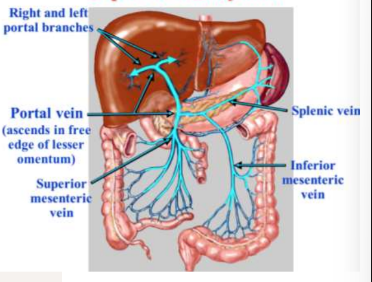
What does the hepatic portal system connect?
connects the capillaries of the digestive tube to the capillaries of the liver
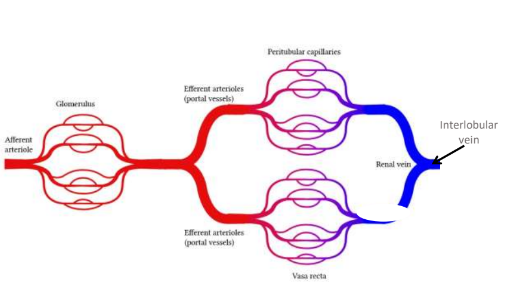
What does the renal portal system connect?
connects the capillaries of the glomerulus to the capillaries of the cortex or medulla of kidney
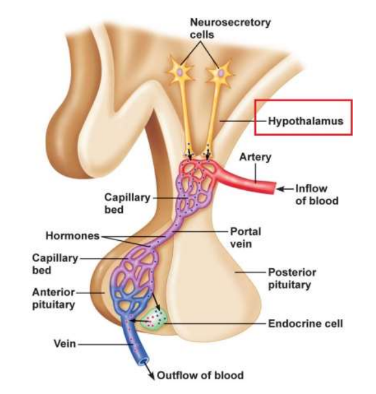
What does the hypothalamohypophyseal portal system connect?
connects the capillaries of the infundibulum to the capillaries of the anterior pituitary
What are the three types of veins?
Large
Medium
Venules
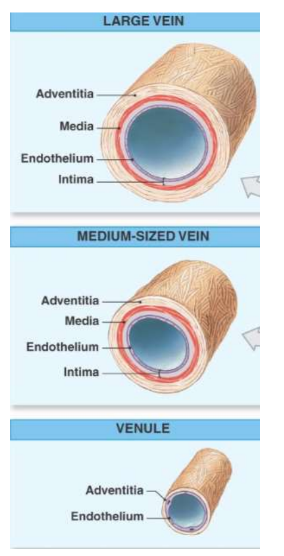
What are the characteristics and function of veins?
relatively large diameter
thin tunica media
thick tunica externa
large veins have valves
return blood to the heart
What is the function of the lymphatic system?
maintain fluid balance in tissues
immune function
lipid transport
What are the lymphatic organs?
primary:
bone marrow
thymus
secondary:
lymph nodes
spleen
tonsils
lymphatic nodules
What are the components of plasma?
primarily water
other:
glucose
lipids
dissolved gases
ions
bicarbonate
amino acids
What are plasma proteins and where are they made in?
predominantly made in liver
albumins
lipoproteins
fibrinogen
globulins
What are the formed elements in blood?
red blood cells - erythrocytes
white blood cells - leukocytes
platelets - thrombocytes
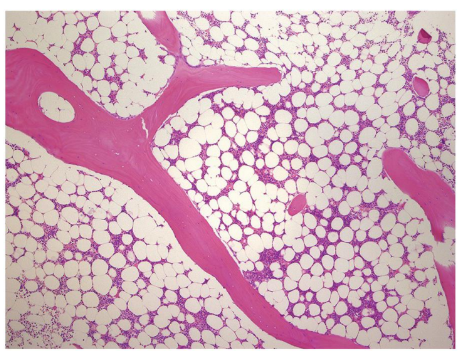
Characteristics of bone marrow
all blood cells are produced in bone marrow
fills space in spongy bone tissue
2 types: red and yellow
more red bone marrow in child vs adults
What is red bone marrow?
myeloid tissue
hematopoietic - gives rise to all blood cell types
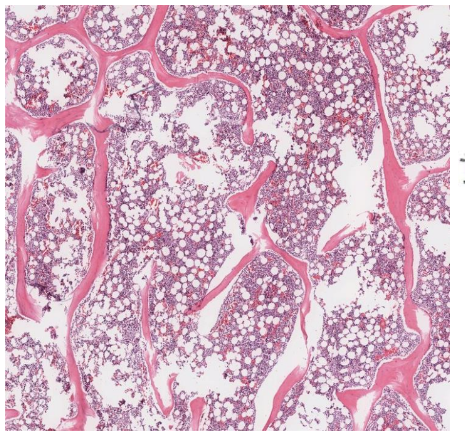
What is yellow bone marrow?
fatty marrow stores adipose
replaces most red bone marrow in adults
not hematopoietic, but can revert back to red bone marrow
Characteristics of erythrocytes
red blood cells
mature cells lack mitochondria
function is oxygen transport and delivery to tissues
Hemoglobin characteristics
quaternary protein produced by red blood cells
each subunit contains a heme group containing iron
What are leukocytes and the 5 types?
white blood cells
granular:
neutrophils
eosinophils
basophils
agranular:
monocytes
lymphocytes
Characteristics of neutrophils
polymorphic nuclei
most numerous WBC
first WBC at infection site
microphage
Characteristics of basophils
least numerous WBC in plasma
not phagocytic; degranulate to release heparin and histamine
responsible for inflammatory response (allergies)
Characteristics of monocytes
can differentiate to macrophage or dendritic cells
will move out of blood to tissues
phagocytize microbes and clear cellular debris
antigen presenting cell (APC)
Characteristics of lymphocytes
2nd most numerous WBC in plasma
primary cells of lymphatic system
responsible for immunity (T, B, NK cells)
Characteristics of platelets
formed by fragmentation of megakaryocytes in bone marrow
released in plasma
required for blood clotting repsonse
Characteristics of spleen
secondary lymph organ
2 types of tissue: red and white pulp
red pulp filters blood to remove from circulation
white pulp stores naive, mature, monocytes and b cells