Culture Keywords
 Call Kai
 Learn
Learn Practice Test
 Spaced Repetition
 Match
Match Flashcards
 Knowt Play
1/109

There's no tags or description
Looks like no tags are added yet.
Name | Mastery | Learn | Test | Matching | Spaced | Call with Kai |
|---|
No analytics yet
Send a link to your students to track their progress
110 Terms
Francis Fukuyama
end of the Cold War marked potential endpoint of mankind’s ideological evolution
liberal democracy + market economy = the final form of human govt
MNCs
multi-national corporations, companies that operate in more than one country and earn revenue in outside their home country
Meyer
1990s, globalization’s sets of meanings, world polity theory
exchange (hard): interdependency, fast rates of transaction
cultural and institutional (soft): cultural consciousness, embeddedness
Ritzer
McDonaldization thesis, hyper-globalist
Barber
Jihad vs McWorld, skeptical
Huntington
The Clash of Civilizations, skeptical
Robertson
acknowledge homogenization but stresses glocalization, transformationalist, world culture theory
globalization is not in tension with localization
contemporary conceptions of locality are produced in global terms, but this does not mean they are homogenized
globalization involves the linking of localities and the intervention/imagination of locality
Local culture is a modern product manufactured by globalization.
culture is not institutionalized, not a collection of readymade scripts but a contentious and open-ended process of cultural formation
Lechner and Boli
emergence of world culture but different levels of attachment, transformationalist
Papastergiadis
cultural turbulence, rise of hybridity, deterritorialized belonging, transformationalist
globalization
a period of radical transformations where multidimensional and interlinked changes occur simultaenously
deterritorialization
people feel a sense of belonging without sharing the same territory
→ culture doesn’t need a concrete territory to be practiced
→ this is not a theory, but a framework
dispora communities
the dispersion or spread of any people from their original homeland (unidirectional, suddenly losing ties with community in homeland)
transnational communities
groups that are established within different national societies, acting on the basis of shared interests and references (territorial, linguistic, religious)
cultural assimilation
1. The process whereby a minority group gradually adopts the customs and attitudes of the prevailing culture.
2. The merging of cultural traits from distinct cultural groups.
acculturation
1. The modification of the culture of a group or individual as a result of contact with a different culture.
2. The process by which the culture of a particular society is instilled in a human from infancy onward.
transnational social spaces
(virtual) places where transnational individuals cultivate, support, and nurture their transnational activities and identities
deterritorialized discourse
Communication as if participants were at the same time and spacing having a synchronous conversation.
chronotope
(Virtual) shared reality where people from far away act as they were in the same space & time.
mediatization of culture
Hepp, the gathering and diffusion of different forms of talking, and sharing through media communication (e.g. hiphop appropriated in Japan)
culture (4 elements)
the complex whole which includes knowledge, belief, art, law, morals, custom, and any other capabilities and habits acquired by all humans as members of society
symbols: something that represents something else by association, resemblance, or convention
language: communication of thoughts and feelings through a system of arbitrary signals, such as voice, gestures, or written symbols
values: culturally defined standards for what is good and desirable
norms: culturally defined expectations of behavior
Culture
high culture such as theater, painting, music
cultures (two kinds)
when you contrast each
national/ethnic culture: the site of a child’s primary socialization (state-based nation-building, a recent invention, played a key role) (shared language, traditions, beliefs)
secondary/subgroup culture: organizational, professional, religious, etc. (happens in complex international societies)
Clifford
traveling cultures. connection between culture and movement, fluid
Appadurai
traveling cultures. five scapes of how cultures diffuse.
ethnoscapes (migration, travel)
technoscapes (technology)
financescapes (flows of capital)
ideoscapes (flows of ideas)
mediascapes (mass media)
indigenization
indigenization
global culture not only takes over, but is transformed by the area it diffuses in
cultural globalization (the broader one, two theses)
the diffusion of ideas, values, and ways of life, as well as the creation of a global conscience, through technology, media, transportation
homogenization thesis (cultural assimilation)
heterogenization thesis (acculturation)
Geertz
examined the symbolic dimension of culture in Java
Lila Abu-Lughod
“Writing against culture” criticized the ignorance of connections between societies, sociocultural change, contradictions in everyday life
Hannerz
engaged with the idea of cultural diversity. focus on complexity, creolization, innovation or creativity as ongoing tendencies.
cultural studies
an interdisciplinary field in which perspectives from different disciplines can be selectively drawn on to examine the relations of culture and power
McDonaldization thesis
Ritzer, the process where the principles guiding McDonald’s rise to global supremacy dominate not only American society, but also the rest of the world
efficiency (maximizing profit)
calculability (the bigger the better)
predictability (uniform worldwide)
control (automation of employees)
irrationality of rationality (shifts labor to consumer, dehumanizing, homogenization, hidden health costs)
※but moving away from mass consumption, cultural complexity exists within homogenizing trends
Wilk
GSCCD Global Structures of Common Cultural Difference
globalization forces us to express our unique cultural differences using the exact same formats, channels, and rules. a form of standardization
standardization, convergence, homogenization, hybridity
If you imagine global culture as a giant kitchen trying to feed the world:
Standardization is the health code and the exact metrics of the measuring cups that every kitchen must use.
Convergence is the fact that kitchens all over the world are slowly switching from wood-burning stoves to modern electric induction ovens because it just makes sense.
Homogenization is a mega-chain corporation buying up every local restaurant in the world and forcing them to sell the exact same corporate hamburger.
Hybridization is a local chef taking that corporate hamburger concept, but stuffing it with local spices, traditional meats, and regional sauces to create a brand-new fusion dish that belongs completely to that community.
cultural hybridity/hybridization
the mixing of cultures and the emergence of translocal cultural forms that cannot be designated as either local or global
Burke
media key role in globalization, hybridity more visible with cultural goods
accelerated hybridization: media encourages imitation and adaptation through standardizing certain cultural forms
Bhabha
studied colonizer/colonized relations in India
hybridity: (e.g. jazz (African traditions, European instruments), Mexican corridos, yoga (from anti-market movement to commodification in the west))
mimicry: a form of colonial discourse where the colonized subject is encouraged to imitate the colonizer, resulting in “almost the same, but not quite”
ambivalence: the complex, unstable and simultaneous mix of attraction and repulsion that characterizes colonizer-colonized relationships
glocalization
late 80s, Robertson, 土着化
the adaptation of globally distributed goods, services, or publications in order to make them suitable for local needs (changing the products themselves, top-down)
the modification of imported cultural practices and ideas to conform with local norms (changing the social meaning of practices, bottom-up)
cultural brokers
a person who facilitates communication, understanding and interaction between individuals or groups of different cultural backgrounds.
Herbert Schiller
cultural imperialism (CI)
Stuart Hall
cultural globalization
active audience reception theory
Nye
soft power theory
Anholt
nation-branding
active audience reception theory, how they affect different classes
media encode messages and audiences decode based on personal background
3 readings:
dominant (accepts intended meaning)
negotiated (partly accepts, but modifies meaning)
oppositional (rejects intended meaning)
non-elite middle-class:
accept only those meanings which can be layered (violence, patriarchy)
elite middle class:
changes in beliefs and values through English
cultural globalization (CG)
the power of people, both on individual and collective levels, to read, appropriate, and use cultural products in creative and often counter-hegemonic fashion
transculturation
cultural forms move through time and space, interact with other cultural forms and settings, influence each other, produce new forms, change cultural settings and produce cultural hybrids
Rantanen
globalization causes worldwide econ/pol/cul/social relations become mediated across time and space
multi-sited ethnography: ethnographic fieldwork in more than one geographic location
global mediagraphy: researching different generations of a family about media, identity, education
Kraidy
AGAINST ci and cg
hybridity as an active exchange that leads to mutual transformation of both sides
hegemony isn’t over yet, rather dominance
culture is synthetic (local and global codependent)
critical transculturalism: economic/political power rules culture
cultural reproduction reproduces dominance
world culture
the emergence of values shared by all world societies
Weber
modernization theory
Parsons
modernization theory
Lipset
modernization theory
Wallerstein
world-systems theory/dependence theory
Stanford school
world polity theory
world polity
political structures, associations and culture in the intl. sphere
scripts
products of professional activity in intl. organizations
W6 international cooperation, UN security council and ICC
social movement
any group that gets together with the goal of social transformation, horizontal networks
global injustice symbols
what protests have in common.
commonly perceived transgressions, universalized meanings
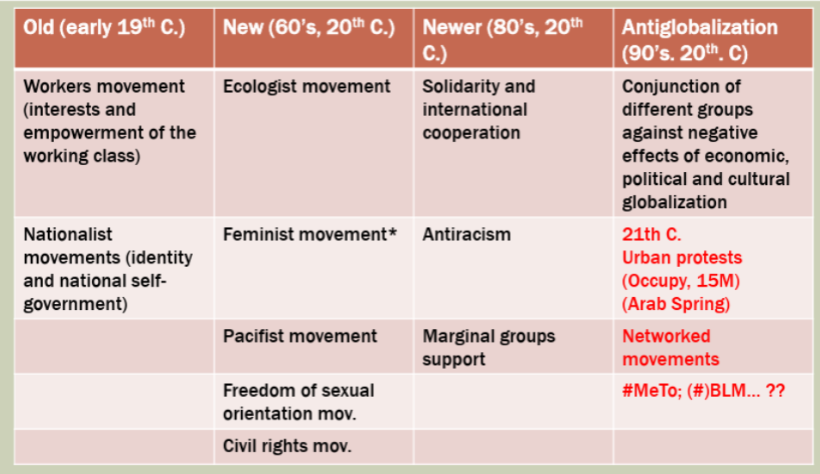
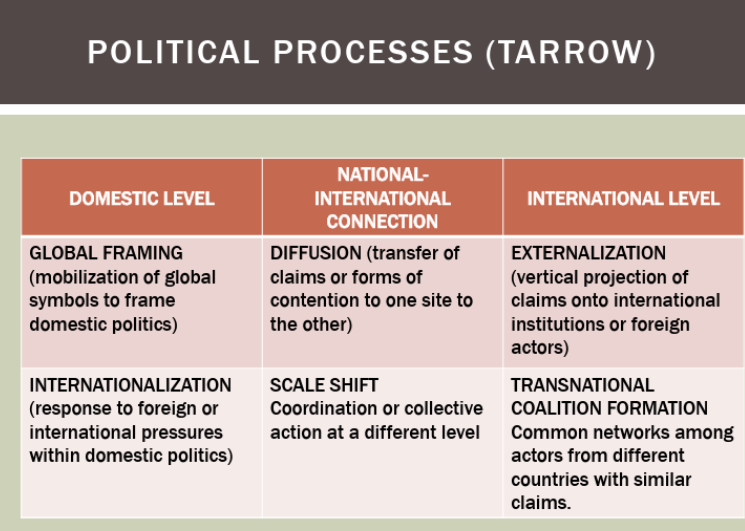
transnational activism
groups that mobilize domestic and international resources to
advance claims on behalf of/in favor of/against external groups
insiders: local activists exposed to international processes, forging transnational ties
outsiders: local activists who directly target global instit, forging transnational groups
(e.g. labor activists from the South, ecologists, advocacy networks, immigrants)
Tarrow
Gellner
soft constructivism
nationalism: “a principle that the political and national unit should be congruent”
Hobsbawm
soft constructivism
Traditions are recent inventions for certain ideological objectives
(e.g. King Pelayo defeated Arabs in the Covadonga Battle, Spain
Tomb of the Unknown Soldier in the US)
nationalism: what creates nations
Anderson
soft constructivism
nations are “Imagined political communities”.
Every successful revolution becomes national.
nations not as a political category
nationalism: at its base more similar to religion that to the rationalist institutions
of democracy and bureaucracy which legitimize it
Smith
ethnosymbolism
nation
a group of people who share a common identity
(e.g. language, religion, ethnicity, history)
state
a human community that claims the monopoly of the legitimate use of physical
force within a given territory - Weber
nation-state
a state in which a single nation predominates and the legal, social,
demographic and geographic boundaries are connected in important
ways to that nation
creole states
formed by people who share the same language and common descent
the first to develop conceptions of nation-ness, well before Europe
Why? → tax pressures from metropolis (shift to provinces’ capitals)
official nationalism
naturalization of Europe’s dynasties with retention of dynastic power
colonial nationalism
mimics the exact territorial shape and administrative structure of the empire that preceded it
unintentionally planted the seeds of its own destruction
local intelligentsia (westernized, bilingual literacy, creating a shared we-image regardless of original differences)
spread of modern-style education
ethnicity
aspects of relationships between groups which consider themselves, and are
regarded by others, as being culturally distinctive, majorities as well
race
the process whereby social groups categorize other groups as different or inferior on
the basis of phenotypical characteristics, cultural markers or national origin
Chicago School
a structural safety net you used to get on your feet before eventually assimilating into the mainstream
Manchester School
urbanization didn't make people "less ethnic." Instead, it made them invent new urban subsystems to perform and exaggerate their ethnic identity as a way to navigate a world full of strangers
Park
Chicago school
cities are a kind of ecological system with its own internal
dynamic, creating diverse opportunities and constraints for
different individuals and groups
ethnic identity change
Eidhem, Samis and Norwegians
subject of discrimination, not a single community
only recognized as “indigenous people” in 1990
Eidhem found no cultural traits (locals always showing off “Norwegianness”)
no engagement in ethnicity in public by Samis
Mountain Sami: ethnic incorporation, organizing themselves politically on
ethnic basis
Coastal Sami: moved towards assimilation, gradually losing their markers of
distinctiveness and merging into the majority population, becoming full Norwegians
a real, practical possibility of removing the stigma imposed by dominant pop.
because not physically very different from the Norwegians
Eidhem
ethnic identity change, Samis and Norwegians
we-hood vs us-hood
We-hood (We-Identity): Emphasizes collectivism, internal bonding, and a shared sense of "we" against outside influences. It is often linked to localized community cohesion.
Us-hood (Us-Identity): Similar to we-hood, it is used to describe the formation of in-group solidarity, though it may sometimes be used to differentiate from a broader "them," frequently in studies focusing on regional, national, or organizational belonging.
traditional migration
family- and community-based strategies of economic survival
non-traditional migration:
results from individual-based strategies and may
reflect all kinds of motivations.
migrant
: someone who does not live in the country in which he/she was born
(2nd gens not included)
integration
a simultaneous attachment to the heritage culture and the adoption of the host culture, preferred and practiced strategy by immigrants
connotation of assimilation, but can refer to any combination of adaptation and cultural maintenance
acculturation (two dimensions, caveats)
cultural change of any kind. the dual process of cultural and psychological change that takes place as a result of contact between two or more cultural groups and their individual members
cultural dimension: group, changes in social structures, institutions, cultural norms
psychological dimension: individual, changes in people’s behavioral repertoires
1. Acculturation may happen without ‘continuous first-hand’ contact (culture may be
deterritorialized through media and others)
2. It takes places over the long term (lifetime of an individual or in few generations)
3. Acculturation is increasingly complex (increasing cultural diversity of national
societies, no longer one single dominant group, more frequent and varied
intercultural contacts)
these two dimensions should be kept separate because:
individual human behavior interacts with the cultural context
individuals’ approaches vary
integration hypothesis
when individuals are multiply engaged, they will be more successful in their lives
multiculturalism hypothesis: when people feel secure in their own cultures, more willing to accept differences
contact hypothesis: intercultural contact will promote mutual acceptance under certain conditions, especially when the groups are considered as equal
racism
the belief that individual characteristics are linked with hereditary ones, which differ systematically between races
new racism
talks of cultural difference instead of inherited characteristics but uses it for the same purposes
Balibar
1870-1914: nationalism inventing nations that created racism as a political tool
discourse of race first applied to the working classes who were perceived as a threat
British new racism based on cultural differences. New Right
French Nouvelle Droite, racism of the era of decolonization and the reversal of populations between the old colonies and the old metropolises
Modood
multi-racist approaches (being racist but incorporating their cultures)
the rise of cultural racism
color-racism became negligible, but was possible to operate in conjunction with cultural racism
EU integration/migration has recently and only partially blurred this distinction
Modood argues that racialized groups (phenotypical racism) which have a distinctive cultural identity or a community life defined as ‘alien’ will suffer an additional dimension of discrimination and prejudice
multiculturalism
can refer to
demographic features (plural and poly-ethnic composition of a society)
psychological aspects (individuals’ acceptance and support for a plural composition of society as well as appreciation of diversity)
policy issues (shared citizenship and community bonds in ethnically diverse societies)
education/counseling
Kymlicka
other list
liberal pluralism
absence, even prohibition, of any minority group having separate standing before the law or govt
corporate pluralism
recognition of minority groups as legally constituted entities, on the basis of which, (depending on their size and influence) distinctions exist on a non-discrimination and corporatist or group rights model
check interculturalism, slides
tourism
the act of traveling for leisure, recreation, or business, and the commercial industry of providing services like transportation, lodging, and entertainment to travelers
emerged alongside industrialization, the separation of work and leisure
a way to accumulate symbolic capital
both reflects and reinforces globalization processes
the tourist gaze
the way of looking at the world through particular ideas etc. framed by social class, gender, nationality, age, education, historical period, constructed through signs (semiotic meaning)
global flows often dominated, structured by wealthy Western tourists
resembles cultural domination (tourists as observers, locals as spectacles)
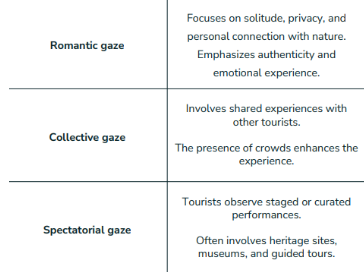
staged authenticity
MacCanell and Urry
even seemingly genuine cultural experiences may be constructed performances, but (Urry) the distinction between real and fake is irrelevant to enjoyment
MacCanell/Urry
staged authenticity
Crick
study of host-guest interactions, socio-cultural impacts, representation
Nash
tourism as acculturation/development, personal transition, social superstructure