Overview of Muscles and Muscle Tissue
 Call Kai
 Learn
Learn Practice Test
 Spaced Repetition
 Match
Match Flashcards
 Knowt Play
1/126

There's no tags or description
Looks like no tags are added yet.
Name | Mastery | Learn | Test | Matching | Spaced | Call with Kai |
|---|
No analytics yet
Send a link to your students to track their progress
127 Terms
What is the primary function of muscles?
To convert chemical energy to mechanical energy and exert force.
What are the three types of muscle tissue?
Skeletal, Smooth, and Cardiac Muscle.
What characterizes skeletal muscle fibers?
They are long, striated, and voluntary.
Where is cardiac muscle located, and how is it controlled?
Located only in the heart, it is involuntary and controlled by the heart's pacemaker.
What is the function of smooth muscle?
To move fluids and other substances through internal body channels.
What are the four important functions of muscle tissue?
Produce movement, maintain posture and body position, stabilize joints, and generate heat.
What is the role of excitability in muscle tissue?
It allows muscle cells to receive and respond to stimuli. respond to external stimuli by changing their resting membrane potential
What is contractility in muscle tissue?
The ability of muscle tissue to shorten when stimulated.
What does extensibility refer to in muscle tissue?
The ability of muscle tissue to extend or stretch.
What is elasticity in muscle tissue?
The ability of muscle tissue to resume its resting length after being stretched.
What supplies skeletal muscle with nerves and blood?
Each muscle is served by 1 nerve, 1 artery, and 1 or more veins.
What are the two types of muscle attachments to bones?
Insertion (moveable bone attachment) and Origin (non-moveable bone attachment).
What is the difference between direct and indirect muscle attachment?
Direct attachment involves the epimysium attaching to the periosteum or perichondrium, while indirect attachment involves connective tissue forming tendons or aponeuroses.
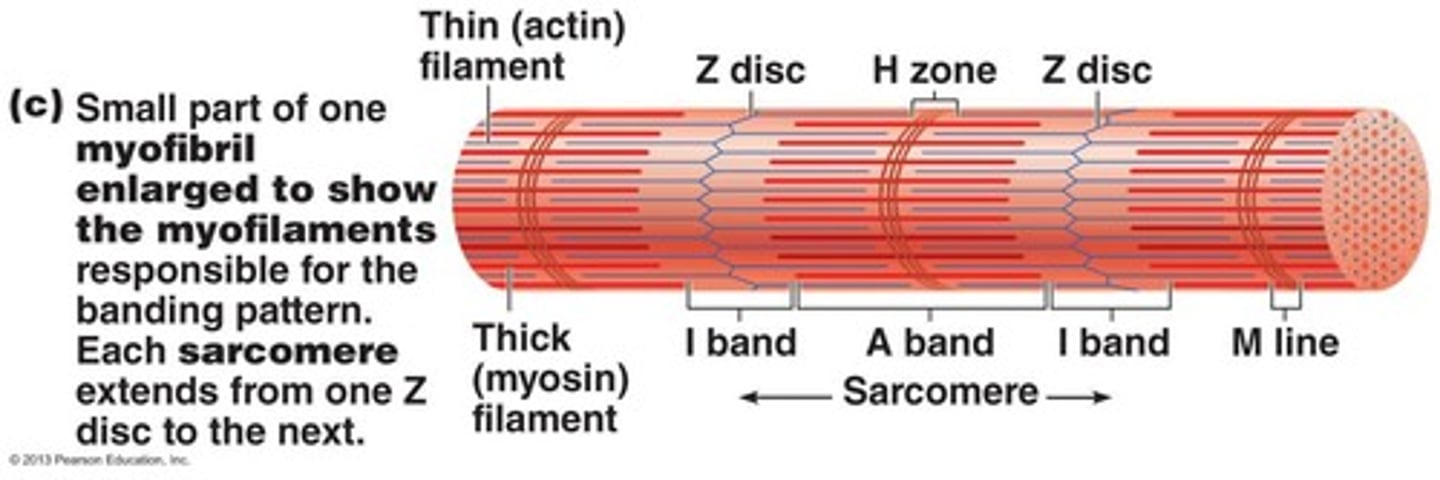
What are myofibrils?
Contractile units within muscle fibers that contain sarcomeres.
What are the two types of myofilaments?
Thick filaments (myosin) and thin filaments (actin).
What is the sarcomere?
The contractile unit of muscle fibers, consisting of repeating dark (A band) and light (I band) bands.
What is the role of the sarcoplasmic reticulum (SR)?
To regulate Ca2+ levels by storing and releasing calcium ions during contraction.
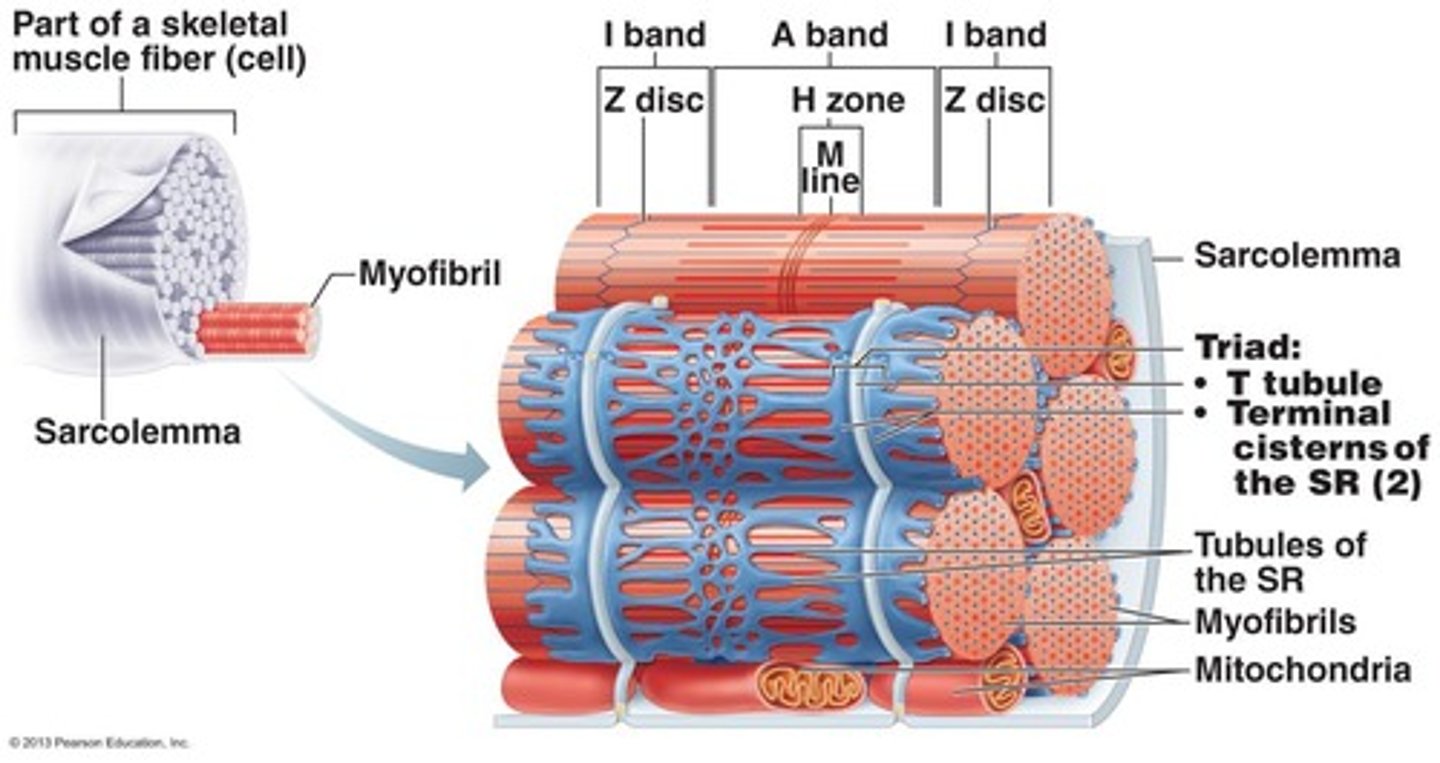
What are T tubules and their purpose?
T tubules are indentations of the sarcolemma that transmit electrical impulses deep into the muscle.
What is a triad in muscle anatomy?
A grouping of terminal cistern-T tubule-terminal cistern that aids in efficient contraction signaling.
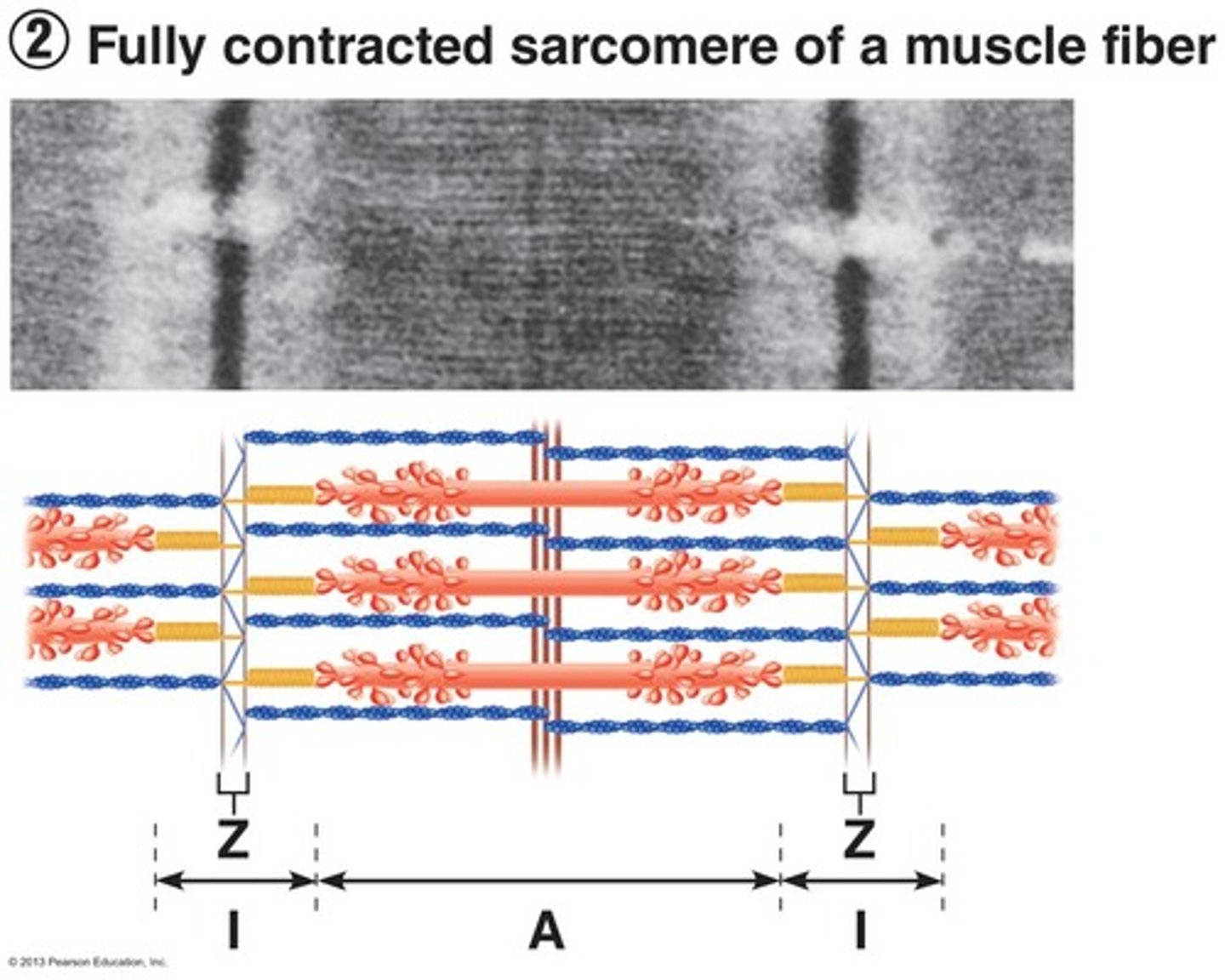
What happens during the sliding filament model of contraction?
Thin filaments slide past thick filaments, increasing the overlap between actin and myosin.
What is the significance of muscle fibers being multinucleated?
It allows for greater control and coordination of muscle contraction.
What is the function of myomesin in muscle tissue?
It is a structural protein that helps maintain the organization of the sarcomere.
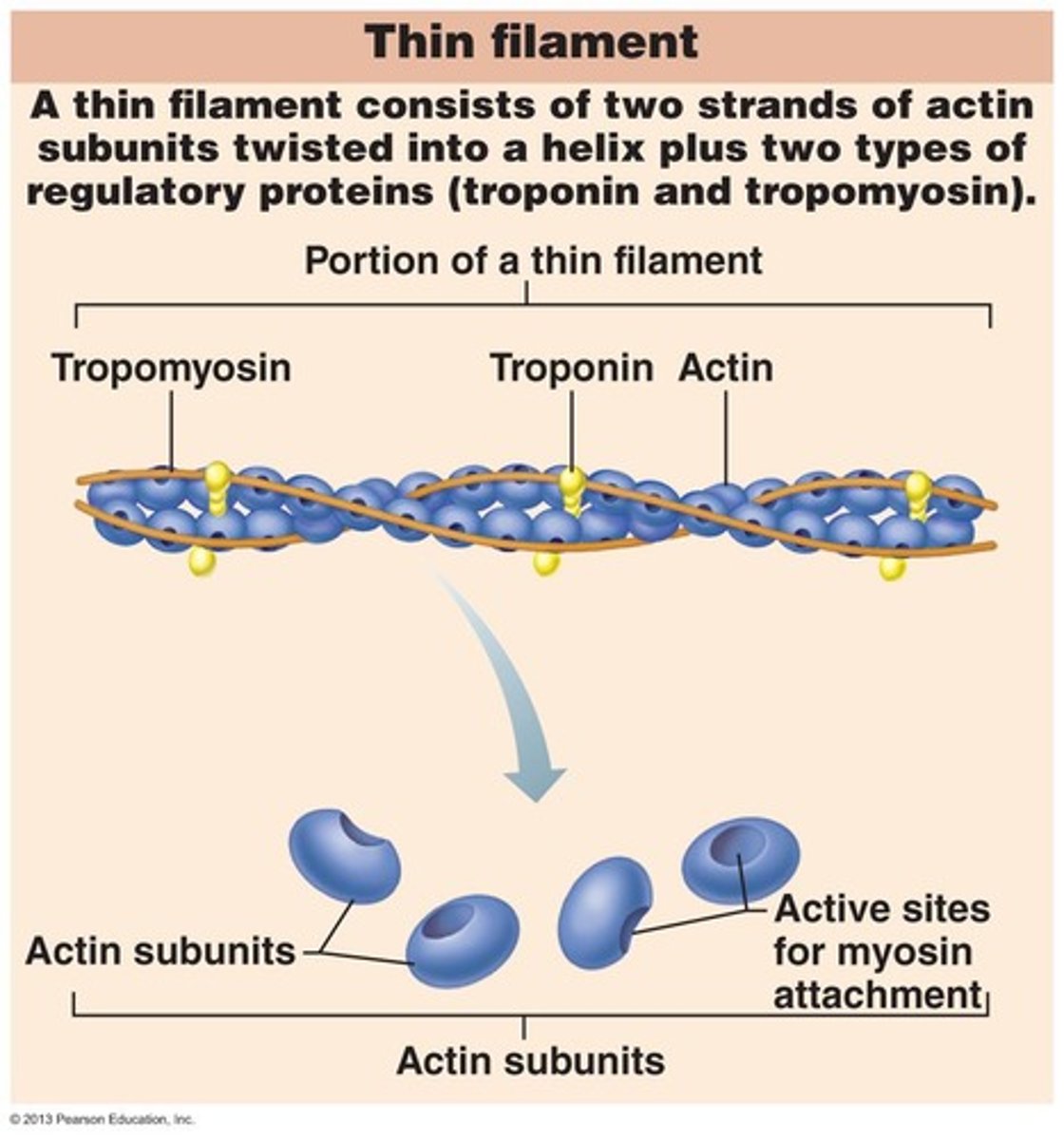
What are the components of the actin molecular composition?
F-actin, TnI (inhibitory), TnT (tropomyosin), TnC (calcium).
What is the primary function of skeletal muscle?
Body mobility.
What type of muscle is striated and under voluntary control?
Skeletal Muscle.
Where is cardiac muscle located?
Only in the heart (walls).
What is the control mechanism for cardiac muscle contractions?
The heart's pacemaker controls the heart's steady heart rate.
What type of muscle is found in the walls of hollow visceral organs?
Smooth Muscle.
What is a key characteristic of smooth muscle contractions?
Contractions are slow and sustained, and it is involuntary.
What is excitability in muscle tissue?
The ability to receive and respond to a stimulus.
What does contractility refer to in muscle tissue?
The ability to shorten when stimulated.
What is the purpose of the sarcoplasmic reticulum (SR) in muscle fibers?
Regulates Ca2+ levels by storing and releasing calcium ions as needed during contraction.
What are the two types of muscle attachments?
Insertion (moveable bone attachment) and Origin (non-moveable bone attachment).
What is a tendon?
Dense regular connective tissue that connects muscle to bone.
What is the structure of skeletal muscle fibers?
Long rod-like cells that are multinucleated.
What is the functional contractile unit of a muscle fiber?
The sarcomere.
What is the sliding filament model of contraction?
During contraction, thin filaments slide past thick filaments, increasing the overlap of actin and myosin.
What are myofibrils?
Structures within muscle fibers that contain the contractile units called sarcomeres.
What is the role of T tubules in muscle contraction?
To transmit electrical impulses deep into the muscle.
What are the components of the triad in muscle fibers?
Terminal cistern-T tubule-terminal cistern groupings.
What is myoglobin's role in muscle fibers?
It stores oxygen for use during muscle contraction.
What are the two types of connective tissue sheaths in skeletal muscle?
Dense irregular connective tissue and areolar connective tissue.
What is the significance of striations in skeletal muscle?
They represent the repeated series of dark (A band) and light (I band) bands.
What is the composition of myosin in muscle fibers?
It is a protein that forms thick filaments and interacts with actin during contraction.
What is the role of calcium ions in muscle contraction?
Calcium ions are released from the sarcoplasmic reticulum to initiate contraction.
What must happen for skeletal muscle contraction to occur?
Muscle fiber must be activated.
What generates an action potential in muscle fibers?
Activation of the muscle fiber.
How is the action potential propagated in muscle fibers?
It is propagated along the muscle fiber.
What change occurs in the muscle fiber during contraction?
Intracellular Ca2+ concentration changes.
What stimulates muscle fibers?
Somatic motor neurons.
What is the neuromuscular junction?
The motor end plate where a branched axon system connects to a single muscle fiber.
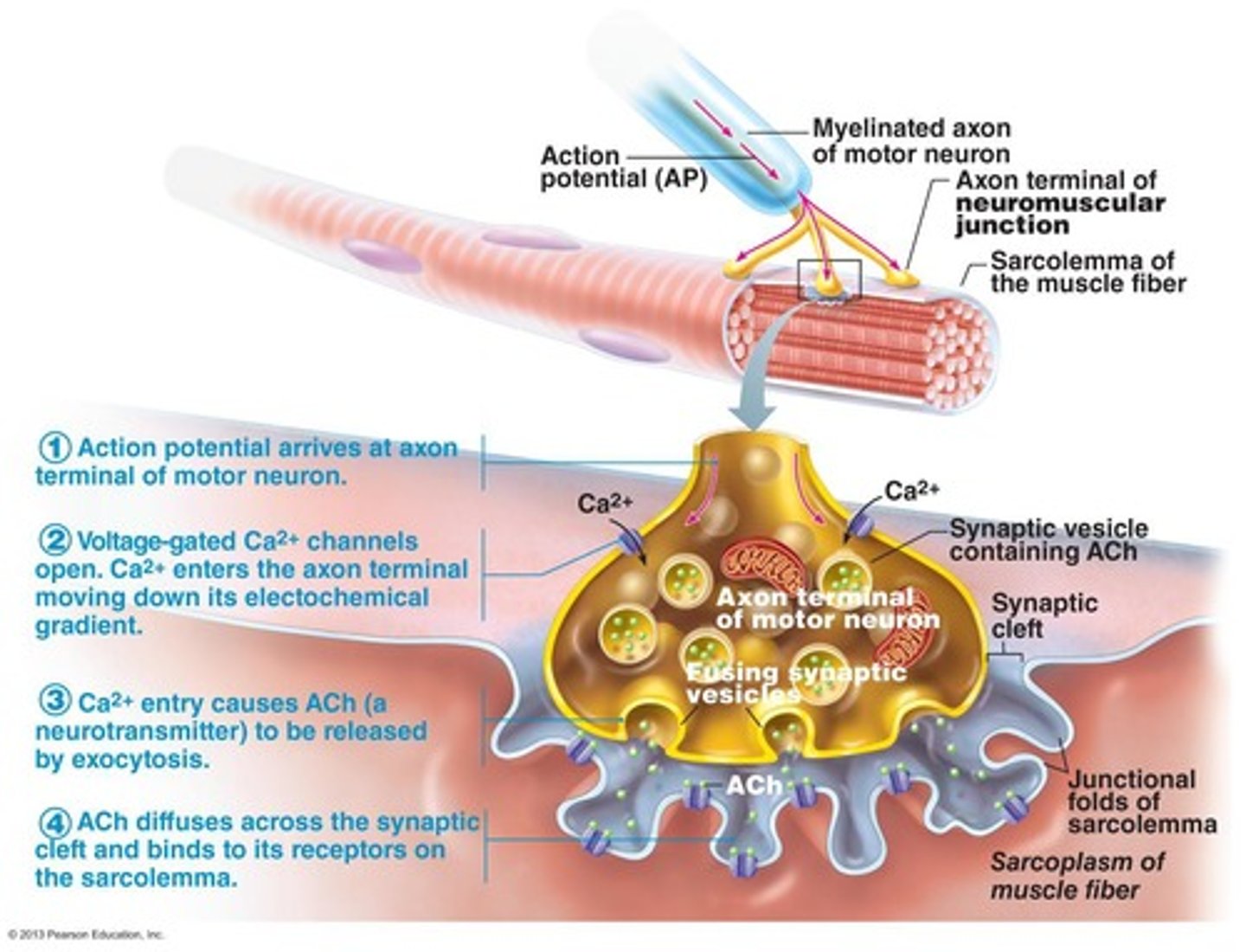
What is the synaptic cleft?
The space between the axon terminal and the muscle fiber.
What do synaptic vesicles contain?
The neurotransmitter Acetylcholine (ACh).
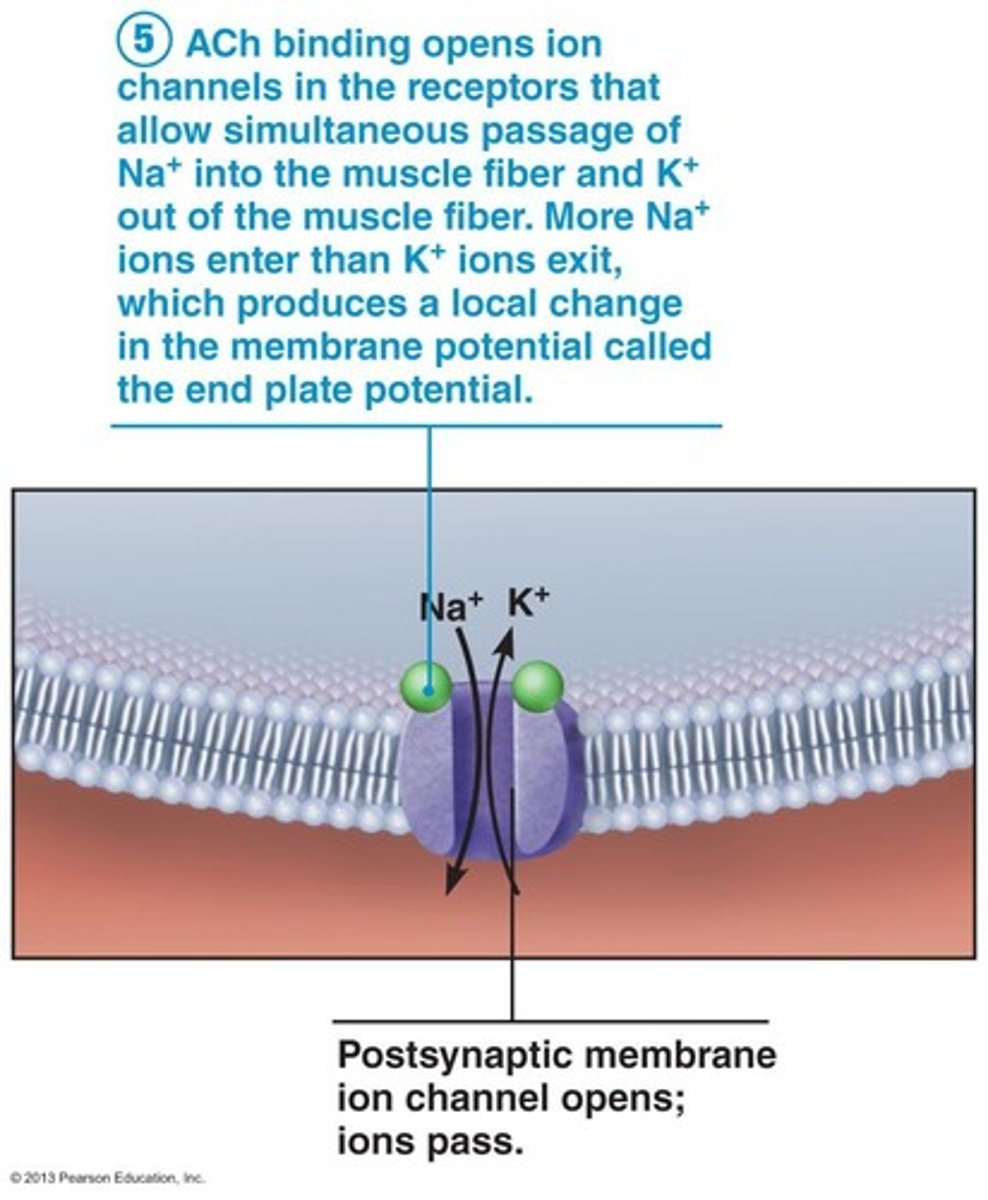
Where are ACh receptors located?
In the junctional folds of the muscle fiber.
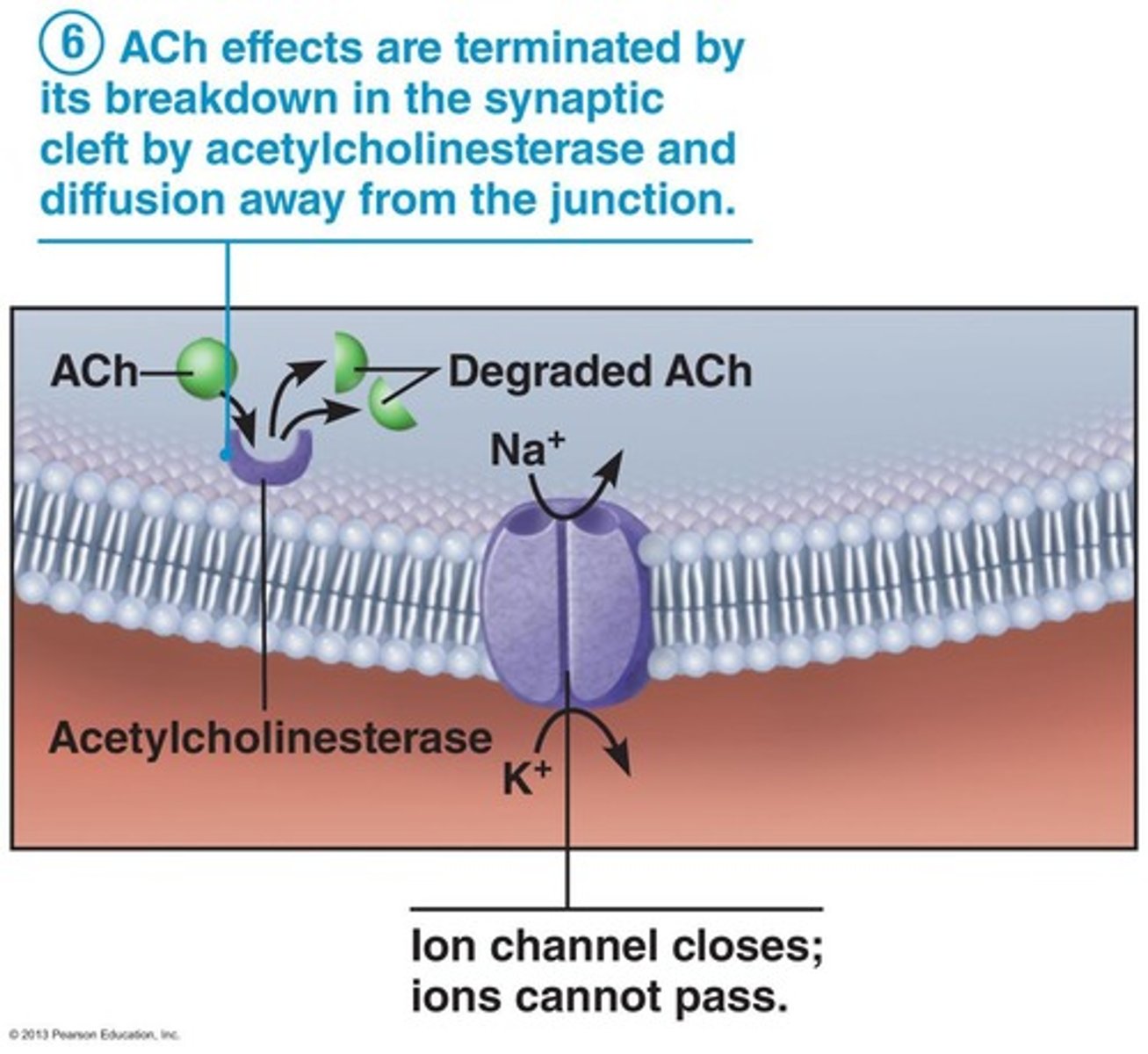
What is the role of acetylcholinesterase?
It breaks down Acetylcholine (ACh) in the synaptic cleft.
What restores ionic conditions to the resting state in muscle fibers?
The ATP dependent Na+-K+ pump.
What is the refractory period in muscle contraction?
The time during which the muscle fiber cannot be stimulated again immediately after an action potential.
What is excitation-contraction coupling?
The transmission of action potential resulting in myofilament sliding.
What happens to Ca2+ during excitation-contraction coupling?
Ca2+ is released and then recycled back to the terminal cistern.
What blocks the myosin head binding site when Ca2+ is not present?
Tropomyosin.
What is muscle tension?
The force exerted by a contracting muscle on an object.
What is the difference between isometric and isotonic contractions?
Isometric contraction does not change muscle length, while isotonic contraction does.
How does the frequency and intensity of stimuli affect muscle contraction?
They vary and influence the strength and duration of muscle contractions.
What is a motor unit?
A motor unit consists of one motor neuron and all the muscle fibers it innervates.
What distinguishes small motor units from large motor units?
Small motor units control small muscles and allow for fine muscle control, while large motor units are associated with larger, weight-bearing muscles and do not require fine control.
What is a muscle twitch?
A muscle twitch is the motor neuron response to a single action potential, characterized by three distinct phases: latent period, period of contraction, and period of relaxation.
What occurs during the latent period of a muscle twitch?
The latent period is the time just before the muscle responds to a stimulus, during which excitation-contraction coupling is occurring and muscle tension is not measurable.
Describe the period of contraction in a muscle twitch.
During the period of contraction, muscle tension overcomes resistance and the muscle begins to shorten, lasting 10-100 ms.
What happens during the period of relaxation in a muscle twitch?
During the period of relaxation, Ca2+ reenters the sarcoplasmic reticulum (SR), and the muscle returns to its resting length, also lasting 10-100 ms.
What is a graded muscle response?
A graded muscle response refers to variations in muscle contraction that are required for proper control of skeletal movements.
How can the frequency of stimulation affect muscle contraction?
Increasing the frequency of stimulation can lead to wave (temporal) summation, resulting in greater muscular force as subsequent contractions occur before the previous one is completed.
What is the difference between unfused and fused tetanus?
Unfused (incomplete) tetanus occurs when muscle contractions are not fully fused, while fused (complete) tetanus occurs when contractions are smooth and sustained.
What is multiple motor unit summation?
Multiple motor unit summation, or recruitment, is the process where increasing stimulus strength recruits more motor units into play during muscle contraction.
What is the size principle in muscle recruitment?
The size principle states that smaller motor units are recruited first, followed by larger motor units as the strength of the stimulus increases.
What are isotonic contractions?
Isotonic contractions involve a change in muscle length to move a load, including concentric contractions (shortening) and eccentric contractions (lengthening).
Give an example of a concentric contraction.
Picking up a book is an example of a concentric contraction.
What is an isometric contraction?
An isometric contraction occurs when muscle length does not change despite increased muscle tension due to load.
What is muscle tone?
Muscle tone refers to the slight contraction of relaxed muscles, which keeps them firm, healthy, and ready to respond to stimuli.
What is the primary energy source for muscle activities?
ATP is the primary energy source for muscle activities.
What happens to ATP during muscle metabolism?
ATP is converted to ADP and inorganic phosphate (Pi) during muscle metabolism, and ATP reserves are limited to about 4-6 seconds worth.
What role does the Ca2+ pump in the sarcoplasmic reticulum (SR) play?
The Ca2+ pump in the SR helps to reabsorb calcium ions during muscle relaxation.
What is the function of the ATP-dependent Na+/K+ pump?
The ATP-dependent Na+/K+ pump maintains the electrochemical gradient across the muscle cell membrane.
How is ATP regenerated in muscle cells?
ATP must be regenerated as fast as it is used to sustain muscle activity.
What triggers muscle tone?
Activated stretch receptors in the muscle trigger spinal reflexes that activate groups of motor units sequentially.
What is creatine phosphate's role in muscle contraction?
Creatine phosphate is stored in muscles and helps produce ATP almost instantly with the help of creatine kinase.
How long can ATP be produced via direct phosphorylation during muscle contraction?
For 15 seconds.
What process does the body rely on for ATP production in the absence of oxygen?
Glycolysis (sugar splitting).
How long can ATP be produced through anaerobic glycolysis during strenuous activity?
For 30 to 40 seconds.
What is a consequence of the lack of oxygen during anaerobic glycolysis?
The production of lactic acid.
What is aerobic endurance?
The time muscles can use the aerobic pathway for ATP synthesis.
What is the anaerobic threshold?
The time when the body switches to anaerobic glycolysis.
What is muscle fatigue?
When muscles are physiologically unable to contract despite stimuli.
What does EPOC stand for and what does it entail?
Excess Postexercise Oxygen Consumption; it involves replenishing oxygen in myoglobin, converting lactic acid to pyruvic acid, replenishing glycogen stores, and resynthesizing ATP and creatine phosphate.
What factors determine the force of muscle contraction?
The number of myosin cross bridges attached, which depends on the number of muscle fibers recruited, the size of muscle fibers, frequency of stimulation, and the degree of muscle stretch.
What is the relationship between muscle fiber recruitment and contraction speed?
More motor units recruited leads to faster and longer contractions.
What are the two functional characteristics of muscle fiber types?
Speed of contraction and major pathways for ATP formation.
What are the three types of muscle fibers?
Slow oxidative fibers, fast oxidative fibers, and fast glycolytic fibers.
How does load affect muscle contraction?
More motor units recruited for contraction results in faster and longer contractions.
What adaptations occur in muscles with regular aerobic exercise?
Increased vascularity, number of mitochondria, and myoglobin synthesis, leading to more efficient muscle metabolism.
What is the effect of resistance exercise on muscle fibers?
It promotes muscle hypertrophy, increasing the size of muscle fibers without increasing the number of fibers.