chapter 11: personality
 Call Kai
 Learn
Learn Practice Test
 Spaced Repetition
 Match
Match Flashcards
 Knowt Play
1/99

There's no tags or description
Looks like no tags are added yet.
Name | Mastery | Learn | Test | Matching | Spaced | Call with Kai |
|---|
No analytics yet
Send a link to your students to track their progress
100 Terms
Anal stage
Psychosexual stage in which children experience pleasure in their bowel and bladder movements
Analytical psychology
Jung’s theory focusing on the balance of opposing forces within one’s personality and the significance of the collective unconscious
Archetype
Pattern that exists in our collective unconscious across cultures and societies
Collective unconscious
Common psychological tendencies that have been passed down from one generation to the next
Congruence
State of being in which our thoughts about our real and ideal selves are very similar
Conscious
Mental activity (thoughts, feelings, and memories) that we can access at any time
Contemporized-Themes concerning Blacks Test (C-TCB)
Projective test designed to be culturally relevant to African Americans, issuing images that relate to African-American culture
Culture
All of the beliefs, customs, art, and traditions of a particular society
Defense mechanism
Unconscious protective behaviors designed to reduce ego anxiety
Displacement
Ego defense mechanism in which a person transfers inappropriate urges or behaviors toward a more acceptable or less threatening target
Ego
Aspect of personality that represents the self, or the part of ones personality that is visible to others
Five factor model
Theory that personality is composed of five factors, including openness, conscientiousness, extroversion, agreeableness, and neuroticism
Genital stage
Psychosexual stage in which the focus is on mature sexual interests
Heritability
Proportion of difference among people that is attributed to genetics
Id
Aspect of personality that consists of our most primitive drives or urges, including impulses for hunger, thirst, and sex
Ideal self
Person we would like to be
Incongruence
State of being in which there is a great discrepancy between our real and ideal selves
Individual psychology
School of psychology proposed by Adler that focuses on our drive to compensate for feelings of inferiority
Inferiority complex
Refers to a person’s feelings that they lack worth and don’t measure up to others’ or to society’s standards
Latency period
Psychosexual stage in which sexual feelings are dormant
Locus of control
Beliefs about the power we have over our lives; an external locus of control is the belief that our outcomes are outside of our control; an internal locus of control is the belief that we control our outcomes
Minnesota Multiphasic Personality Inventory (MMPI)
Personality test composed of a series of true/false questions in order to establish a clinical profile of an individual
Neurosis
Tendency to experience negative emotions
Oral stage
Psychosexual stage in which an infants pleasure is focused on the mouth
Personality
Long-standing traits and patterns that prowl individuals to consistently think, feel, and behave in specific ways
Phalic stage
Psychosexual stage in which the focus is on the genitals
Projection
Ego defense mechanism in which a person confronted with anxiety disguises their unacceptable urges of behaviors by attributing them to other people
Projective test
Personality assessment in which a person responds to ambiguous stimuli, revealing hidden feelings, impulses, and desires
Psychosexual stages of development
Stages of child development in which a child’s pleasure-seeking urges are focused on specific areas of the body called erogenous zones
Rationalization
Ego defense mechanism in which a person confronted with anxiety makes excuses to justify behavior
Reaction formation
Ego defense mechanism in which a person confronted with anxiety makes excuses to justify behavior
Real self
Person who we actually are
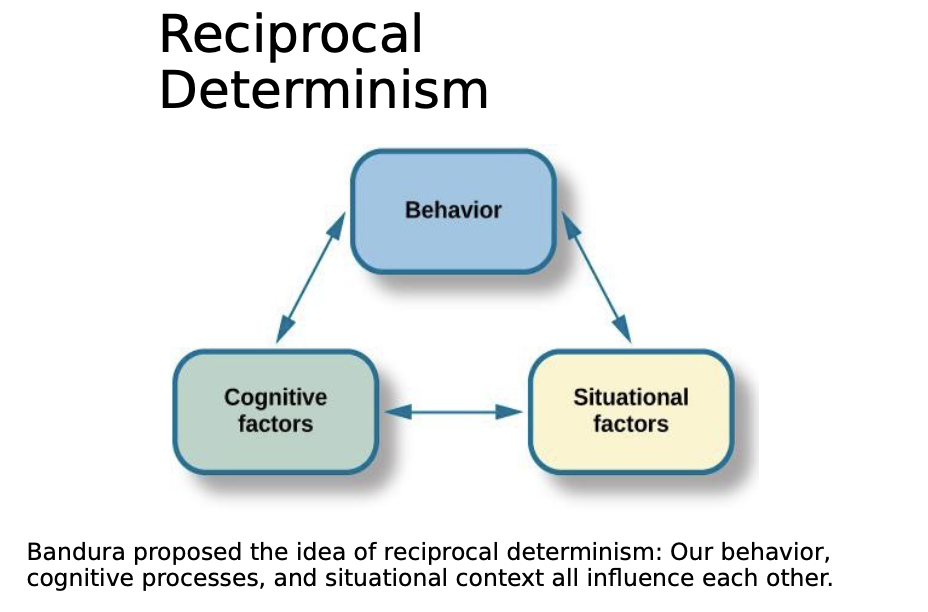
Reciprocal determinism
Belief that one’s environment can determine behavior, but at the same time, period can influence the environment with both their thoughts and behaviors
Regression
Ego defense mechanism in which a person confronted with anxiety returns to a more immature behavioral state
Repression
Ego defense mechanism in which anxiety-related thoughts and memories are kept in the unconscious
Rorschach Inkblot test
Projective test that employs a series of symmetrical inkblot cards that are presented to a client by a psychologist in an effort to reveal the persons unconscious desires, fears, and struggles
Rotter Incomplete Sentence Blank (RISB)
Projective test that is similar to a word association test in which a person completes sentences in order to reveal their unconscious desires, fears, and struggles
Selective migration
Concept that people choose to move to places that are compatible with their personalities and needs
Self-concept
Our thoughts and feelings about ourselves
Self-efficacy
Someone’s level of confidence in their own abilities
Social-cognitive theory
Bandura’s theory of personality that emphasizes both cognition and learning as source of individual differences in personality
Sublimation
Ego defense mechanism in which unacceptable urges are channeled into more appropriate activities
Superego
Aspects of the personality that serves as one’s moral compass, or conscience
TEMAS Multicultural Thematic Apperception Test
Projective test designed to be a culturally relevant to minority groups, especially Hispanic youths, using images and storytelling that relate to minority culture
Temperament
How a person reacts to the world, including their activity level, starting when they are very young
Thematic Apperception Test (TAT)
Projective test in which people are presented with ambiguous images, and they then make up stories to go with the images in an effort to uncover their unconscious desires, fears, and struggles
Traits
Characteristic ways of behaving
Unconscious
Mental activity of which we are unaware and unable to access
where does the word personality come from?
Comes from the Latin word persona (a mask worn by an actor).
In ancient times, theatrical masks were used to represent/project
a specific personality trait
what did Hippocrates (460-370B.C.) believe in personality?
Developed the theory that the body consists of Four humors—blood, phlegm, black bile, and yellow bile—which must be balanced for physical health.
what were the 4 humors seen from Hippocrates
Choleric – yellow bile from the liver.
Melancholic – black bile from the kidneys.
Sanguine – red blood from the heart.
Phlegmatic – white phlegm from the lungs
what did Galen (A.D. 129 - c. 216) believe in personality?
Believed both diseases and personality differences could be explained by imbalances in the humors and that each person exhibits one of four temperaments.
Prevalent view for over 1000 years and through the Middle Ages
how did Galen’s look at the four humors?
Choleric – passionate, ambitious, and bold.
Melancholic – reserved, anxious, and unhappy.
Sanguine – joyful, eager, and optimistic.
Phlegmatic – calm, reliable, and thoughtful.
what did Wilhelm Wundt (19th century) suggest about personality?
that personality could be described using two major axes
emotional/non-emotional
changeable/unchangeable
what is emotional/non-emotional?
separated strong emotions (melancholic, choleric) from the weak emotions (phlegmatic, sanguine)
what is changeable/unchangeable ?
divided the changeable temperaments (choleric, sanguine from the unchangeable ones (melancholic, phlegmatic).
what did Franz Gall (1780) propose (phrenology)
Proposed that the distances between bumps on the skull reveal a person’s personality traits,
character, and mental abilities.
Discredited for lack of empirical support.
what is does freud say about the unconscious
According to Freud:
We are only aware of a (about one-tenth) of our mind’s activities. Most remains hidden.
Unacceptable urges and desires are kept in our unconscious through repression.
The information in our unconscious affects
our behavior, although we are unaware of it.
freudian slip
Freud suggested that slips of the tongue are sexual/aggressive urges
accidently slipping out of our unconscious.
what does freud say about personality?
Freud posited that personality results from efforts to balance two
competing forces.
1. Biological aggressive and pleasure-seeking drives.
2. Internal (socialized) control over these pleasure-seeking drives.
Freud described this process as an interaction between three
systems.
according to freud what does the EGO (self) do?
• Contains primitive urges (for hunger, thirst, and sex).
• Impulsive, instinctual.
• Operates on the ”pleasure principle” – seeks immediate
gratification.
according to freud what does the SUPEREGO do?
• Develops through interactions with others, learning social rules for
right and wrong.
• Moral compass that tells us how we should behave based on rules..
• Strives for perfection.
• Judges behavior - leads to feelings of pride or guilt.
according to freud what does the ID do?
• Attempts to balance the id with the superego.
• Rational
• Operates on the “reality principle” – helps the id satisfy desires in a
realistic way.
• The part of the personality seen by others.
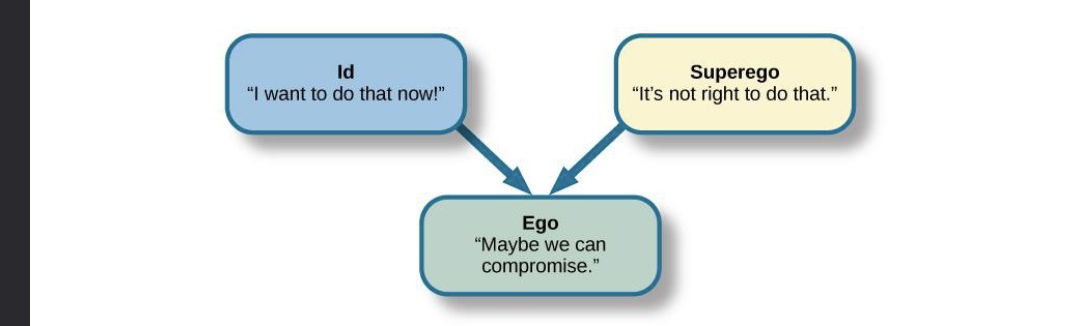
what are the effects on personality from the ID, EGO, and SUPEREGO
Balanced id and superego → healthy personality.
Imbalanced id and superego → neurosis (tendency to experience
negative emotions), anxiety disorders, or unhealthy behaviors.
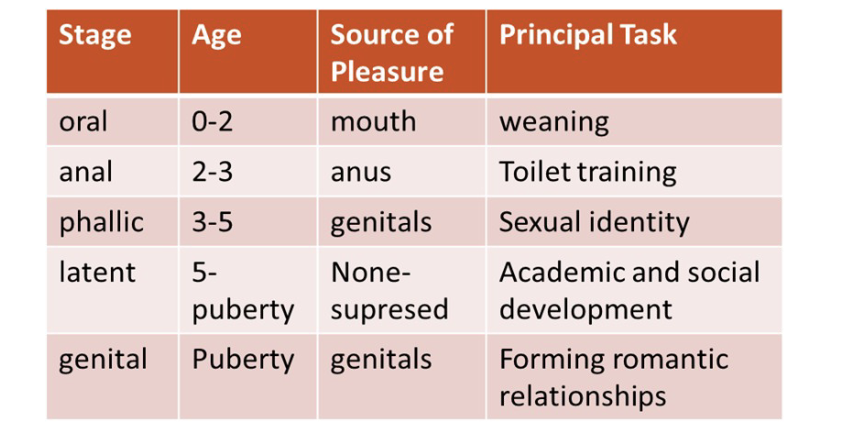
what are the stages of Freuds theory of personality development?
oral
anal
phasic
latent
genital
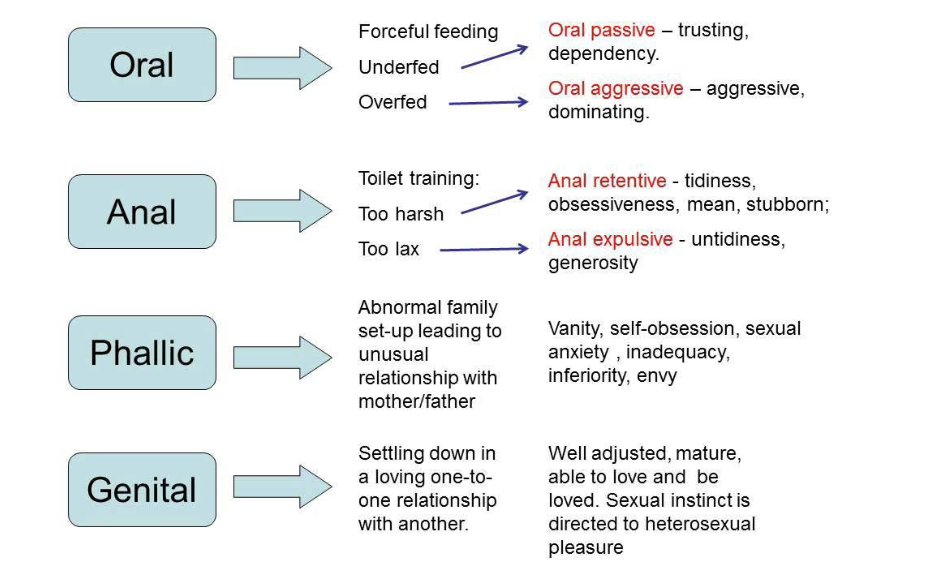
what is individual psychology?
focuses on our drive to compensate for feelings of inferiority
social motives thought to be the force behind thoughts, emotions, and behaviors
placed focus on social connections during childhood development
what did Alfred Adler believe when it came to personality?
• Believed happiness can be found in working together
for the betterment of all.
• Viewed main goal of psychology to be “to recognize
the equal rights and equality of others”.
• Saw conscious processes as more important.
• Theorized that birth order shapes our personality.
alder identified the three fundamental social tasks all individuals must experience the three are…?
occupational tasks - careers
societal tasks - friendship
love tasks - finding an intake partner
persona
a mask that we consciously adopt
derived from conscious experiences and our collective unconscious
a compromise between our true self and the self that society expects us to be (hiding parts of the self that do not align with society's expectations)
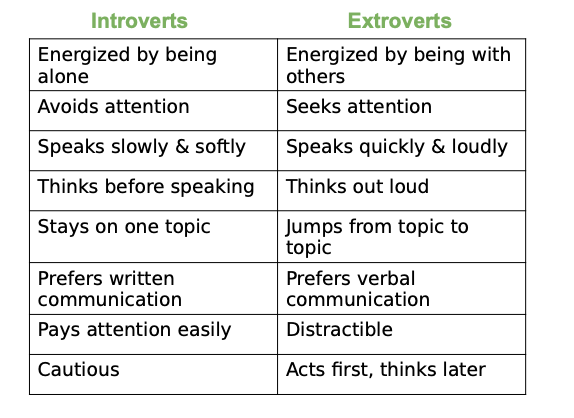
What was carl Jungs most important contribution to personality psychology?
intoversion v. extroversion
what did Karen Horney agree on with Jung?
Agreed with Jung that individuals have the potential for self-realization and believed the goal of psychoanalysis should be moving toward a healthy self.
what were hornets theories focused on on?
unconscious anxiety
normal growth can be blocked by basic anxiety stemming from needs not being met
what are the 3 styles of coping used by children to relieve anxiety according to Horney?
Moving toward people – affiliation and dependence.
As adults – likely to have an intense need for love and acceptance.
Moving against people – aggression and assertiveness.
As adults – likely to lash out and exploit others.
Moving away from people – detachment and isolation.
As adults – likely to avoid love/friendship and avoid interaction with others.
What did skinner (a behaviorist) believe we learn personality?
We learn to behave in particular ways.
Personality is shaped by reinforcements and consequences in the environment.
Personality develops over our entire life.
Personality can vary as we experience new situations.
according to bandura (a social-cognitive theorist) how did they believe personality was developed?
Agreed that personality develops through learning but disagreed with the behaviorist approach because thinking and reasoning are important parts of learning.
what is observational learning?
learning by observing someone else’s behavior and its consequences
teaches us which behaviors are acceptable and rewarded in our culture
teaches us which behaviors are social unacceptable

way did Julian rotter purpose?
locus of control - proposed as a cognitive facto that affects learning and personality development

internal locus of control?
tend to believe that most of our outcomes are the direct result of our efforts.
Perform better academically, achieve more in careers, more independent, healthier, less depressed

external locus of control?
tend to believe that our outcomes are outside of our control.
Believe lives are controlled by other people, luck, or chance.
what did Walter Mitchel find on behavior + personality (person-situation debate)?
Mischel’s Findings:
• Behavior was inconsistent across different situations but more consistent within situations.
• Behavior is consistent in equivalent situations across time.
• This data did not support the theory that a person’s personality traits are consistent across situations - triggered the person-situation debate among psychologists.
what was mishels marshmallow study?
• Study on self-regulation (aka will power) – ability to delay gratification.
• Revealed that children differ in levels of self-control.
• Children that had more self-control (waited for two marshmallows) in preschool were more successful in high school.
• Children that had poorer self-control (took the one marshmallow) in preschool were more likely to have academic and behavioral problems.
Mischel’s approach to personality – People use cognitive processes to assess the situation in their own way and behave in accordance with that interpretation.
what was maslows (a humanistic) approach personality?
Studied people he considered healthy, creative, and productive (Albert Einstein, Eleanor Roosevelt, Thomas Jefferson, Abraham Lincoln).
Found that they shared similar characteristics – open, creative, loving, spontaneous,
compassionate, concerned for others, accepting of themselves
what was carl Roger ( a humanistic) approach to personality
• Linked personality to self-concept (thoughts and feelings about ourselves).
• Divided the self into the idea self and the real self.
• Ideal self – the person you would like to be.
• Real self – the person you actually are.
• Believed we needed to find congruence between the ideal and real self – thoughts about ideal self and real self are similar.
• High congruence → greater sense of self-worth and a health, productive life.
• Incongruence → maladjustment.
what are the two dimensions of temperament important to adult personality?
reactivity - how we respond to new or challenging environmental stimuli
self-regulation - ability to control responses
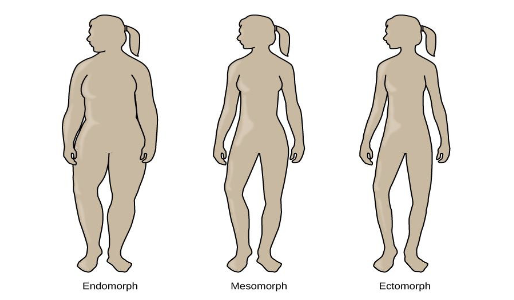
what was William H. Sheldon belief on body types and how they are linked to personality?
Endomorphs – relaxed, comfortable, good-humored, even-tempered,
sociable, and tolerant.Mesomorphs – adventurous, assertive, competitive, and fearless.
Ectomorphs – Anxious, self-conscious, artistic, thoughtful, quiet, and
private
what did gordon allport (a trait theorist) find?
Found 4,500 words in the English language to describe people and
organized them into three categories.
1.Cardinal traits – dominates entire personality (rare).
2.Central traits – make up our personality.
3.Secondary traits – less obvious or consistent, present under certain
circumstances (e.g., preferences, attitudes)
what does Raymond cattell (a trait theorist) do to all ports original words?
Narrowed Allport’s list to about 171 traits.
Identified 16 dimensions of personality – instead of a present being
present or absent, people are scored on a continuum.
what did Hans and sybil Eysenck focus on?
temperament and believed that our personality
traits are influenced by our genetic inheritance.
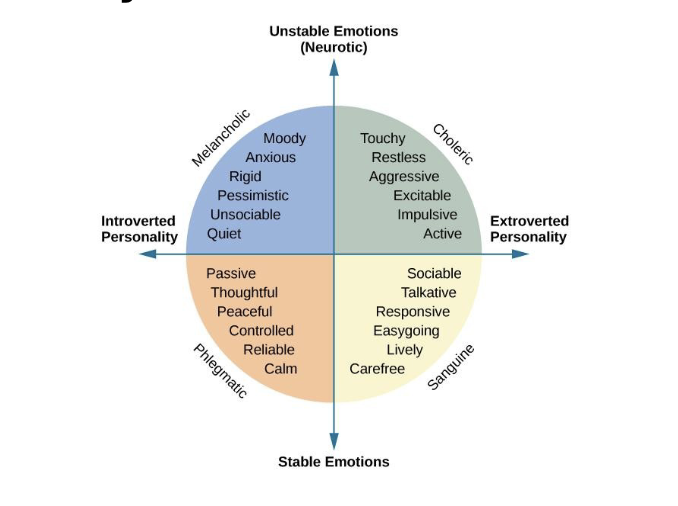
what did the eysencks find?
2 specific personality dimensions:
1. Extroversion/Introversion.
High in extroversion – sociable, outgoing.
High in introversion – high need to be alone, engage in solitary behaviors.
2. Neuroticism/Stability.
High in neuroticism – anxious, overactive
sympathetic nervous system.High in stability – more emotionally stable
what is the HEXACO model/traits
(H) Honesty - EXAMPLE: humility Sincerity, modesty, faithfulness
(E) Emotionality - EXAMPLE: Sentimentality, anxiety, sensitivity
(X) Extraversion - EXAMPLE: Sociability, talkativeness, boldness
(A) Agreeableness - EXAMPLE: Patience, tolerance, gentleness
(C) Conscientiousness - EXAMPLE: Organization, thoroughness, precision
(O) Openness - EXAMPLE: Creativity, inquisitiveness, innovativeness
What is one important environmental factor that influences personality?
culture
what are asian cultures personalities?
more collectivist, tend to be less extroverted
what are central and South American cultures personality?
tend to score higher on openness to experience.
what are europeans culture on personality?
tend to score higher on neuroticism.
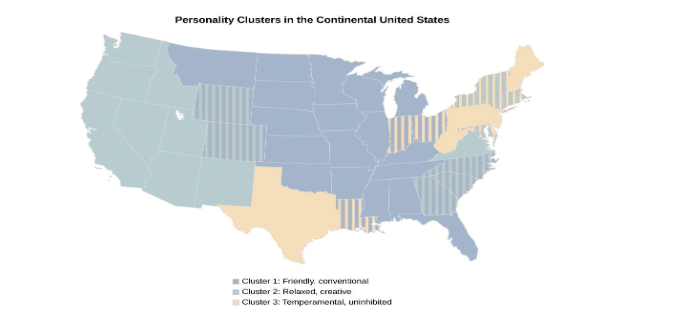
are there regional differences in personality?
Researchers found three distinct regional personality clusters in the United States.People tend to be friendly and conventional in the Upper Midwest and Deep South; relaxed, emotionally stable, and creative in the West; and stressed, irritable, and depressed in the Northeast.
One explanation for this is selective migration - people choose to move to places that are compatible with their personalities and needs.
what are individualist cultures?
• Value independence, competition, and personal achievement.
• Mainly Western nations such as the U.S. England, and Australia.
• People display more personally oriented personality traits.
what are collectivist cultures?
• Value social harmony, respectfulness, and group needs over
individual needs.
• Asia, Africa, and South America.
• People display more socially oriented personality traits.
why are personality testing used for?
• To screen applicants for employment and job training.
• In criminal cases and custody battles.
• To assess psychological disorders.
what are self-report inventories
An objective test to assess personality
Often use multiple-choice items or numbered scales (Likert Scales)
what are projective tests?
Projective testing relies on projection (defense mechanism) to assess
unconscious processes.
• Ambiguous cards are shown to individual who is asked to tell a story,
interpret an image, or complete a sentence.
• Individual will project feelings, impulses, and desires onto the cards