Perception & Cognition 1
 Call Kai
 Learn
Learn Practice Test
 Spaced Repetition
 Match
Match Flashcards
 Knowt Play
1/75

There's no tags or description
Looks like no tags are added yet.
Name | Mastery | Learn | Test | Matching | Spaced | Call with Kai |
|---|
No analytics yet
Send a link to your students to track their progress
76 Terms
Cognition
All aspects of knowing (e.g., sensation, learning, remembering, perception, reasoning, decision making)
Nativism/Genetic Predisposition
Alternative to empiricist/blank slate
we're somehow set up for acquiring this knowledge
American Behaviourist Tradition
William James
gain knowledge from experience / Founder of Empiricist Tradition
newborn's mind is a BLANK slate
Associationism
Learning on the basic of contiguity and frequency
Contiguity
Learning on the basic of ________
Space and time (Shaking cat tin means cat treats)
Frequency
Learning on the basic of _______
How often things occur together
Behaviourism
Focuses on things you can someone observe, Not the mind
Edward Thorndike
Came up with the Law of Effect
A Behaviourist
Law of Effect
Animals learn responses to things which are rewarded and drop responses to things that are punished
Classical Conditioning
A learning process where a biologically potent stimulus is paired with a previously neutral stimulus to create an automatic, unconscious response.
Operant Conditioning
A learning process where behaviors are modified by their consequences.
The "effect" of making a response is crucial to learning — the animal must do something
Strengthening and weakening of S-R bonds
J.B. Watson
Another hardcore Behaviourist
Psychology should limit itself to discussion of stimuli, responses, and physiological data
Law of Exercise
The more often a given situation is followed by a particular response, the stronger will be the associative bond between them
Example of ROTE learning
Laws of association includes these two things
Contiguity and frequency
Laws of learning
Effect/reinforcement and exercise
B.F. Skinner
Stated that all explanations of behaviour are descriptions of environmental histories
Operant conditioning: shaping behaviour
Ideas from Behaviourism
we are nothing more than deterministic systems or machines
Ideas from constructivism
People construct their own understanding and knowledge of the world through their experiences and their reflections on those experiences
Edward Tolman
The emergence of animal cognition
He focused on behaviour that was "goal-directed"
Emphasis on molar (overall) achievements rather than molecular (steps to get there) movements
Cognitive map experiments
Noam Chomsky
Poverty of the stimulus argument
We are not exposed to complete and perfect language yet we make novel sentences.
Universal grammar
Universal grammar
We are predisposed to acquire any natural language
Generative grammar
These abstract rules are a part of our genetic code
Emergence of Cognitive Psychology
Miller, Newell and Simon, Broadbent, Neisser, FLOW DIAGRAMS
Miller
Magical number 7 +/-2
Newell and Simon
Computer simulation of mental processes (GPS)
Broadbent
Information processing theory
Neisser
first textbook on cognitive psych AND naive realism
Iconic memory
Short visual memory
high capacity, fast passive decay, mask able
Visual code (fast)
iconic memory —> Low capacity, flexible decay, not mask able, visual info
Name code (slow)
Iconic memory —> Moderate capacity, neglible decay, not maskable, auditory info
Stage models of cognition
Independent modules (modular)
These models assume that human cognition is based on modular sub-systems
Differences in intellectual abilities have been interpreted as differences in arrows and/or boxes to in arrows-and-boxes flow diagrams
Renes Descartes
All we can assume is that we're thinking
Naive realism
Alternative view to Descartes
Neisser (1967)
Neisser and naive realism
Visual experiences mirror the external stimulus (what about hallucinations?)
Visual experience starts and ends with the onset and offset of the external stimulus (visual persistence and memory?)
Visual experiences are based on passive copies of the outside world, which could be described using verbal reports
bottom up processing
Information going in one direction
Visual letter recognition in the pandemonium model
Grouping
Disproves #3 of Neisser's naive realism
(Gestalt ideas! We are automatically interpreting bottom up)
This is contradicted by evidence from the Gestalt principles - the sensory information is organised according to certain coding principles that operate to facilitate object recognition.
The principles carve up the input into things that might be objects.
These laws apply from the bottom up — without knowledge of what the possible objects in the scene are. (Happens with babies too — perceptual organization is innate) by proximity, similarity, common fate, symmetry, common region
Bottom up
Gestalt
analysis that begins with the sensory receptors and works up to the brain's integration of sensory information
Stimulus driven and passive
Top down
This processing is perceiving the world around us by drawing from what we already know to interpret new information (Gregory, 1970).
These theories are hypotheses-driven and stress the importance of higher mental processes such as expectations, beliefs, values, and social influences.
Throughout our lifetime, we construct schemas, which consist of past experiences, prior knowledge, emotions, and expectations, and then use these schemas to form hypotheses upon the arrival of new information.
Bruner and others "New Look" information processing guided by higher-level mental processes, as when we construct perceptions drawing on our experience and expectations
Knowledge driven and active
Congruent
Matches knowledge of the world (heart cards being red)
Interpretation
We make interpretations on completely novel and ambiguous things
Role of expectancy
Based on our knowledge of the world, we actively generate expectations about what will occur next
Bruner's Perceptual Readiness Theory
Need and value determine our perceptions of the world
Our perceptions of the world reflect how we construe the world
Simplicity (minimum principle) and likelihood
Have also been discussed to drive perception
Squares vs L shaped — likeihood says it's just another square!
Crude-fine / global-local processing
Larger stimuli made of smaller stimuli
People are quicker at finding larger stimuli
When people are asked what the global stimuli is, the local stimuli doesn't seem to matter
People take longer to say that the smaller letter is H when the large letter is S versus when the smaller letter is S and large letter is S as well (inconsistent vs consistent local stimuli means faster)
Two processes of hypothesis making
Modularity of mind
Interactive hypothesis generation and testing
Posner
Reaction time experiments with letters
are they physically identical? (AA vs Aa)
Do they share the same name? (Aa vs AB)
Are they both vowels or both consonants? (Ae vs AB)
Posner experiment results
took longer to say they're NOT physically identical
took longer to say they're NOT the same name
took longer to say they're CONSONANTS rather than both vowels (different was in the middle)
Temporal hierarchy
It takes time to recover different forms of information from visual input
We could posit either:
Mental pictures, images, analogical representations (X)
Some other form of non-pictorial form of representation (e.g., "a left diagonal bisects a right diagonal line") - structural coding
Testing mental imagery and analogical representations
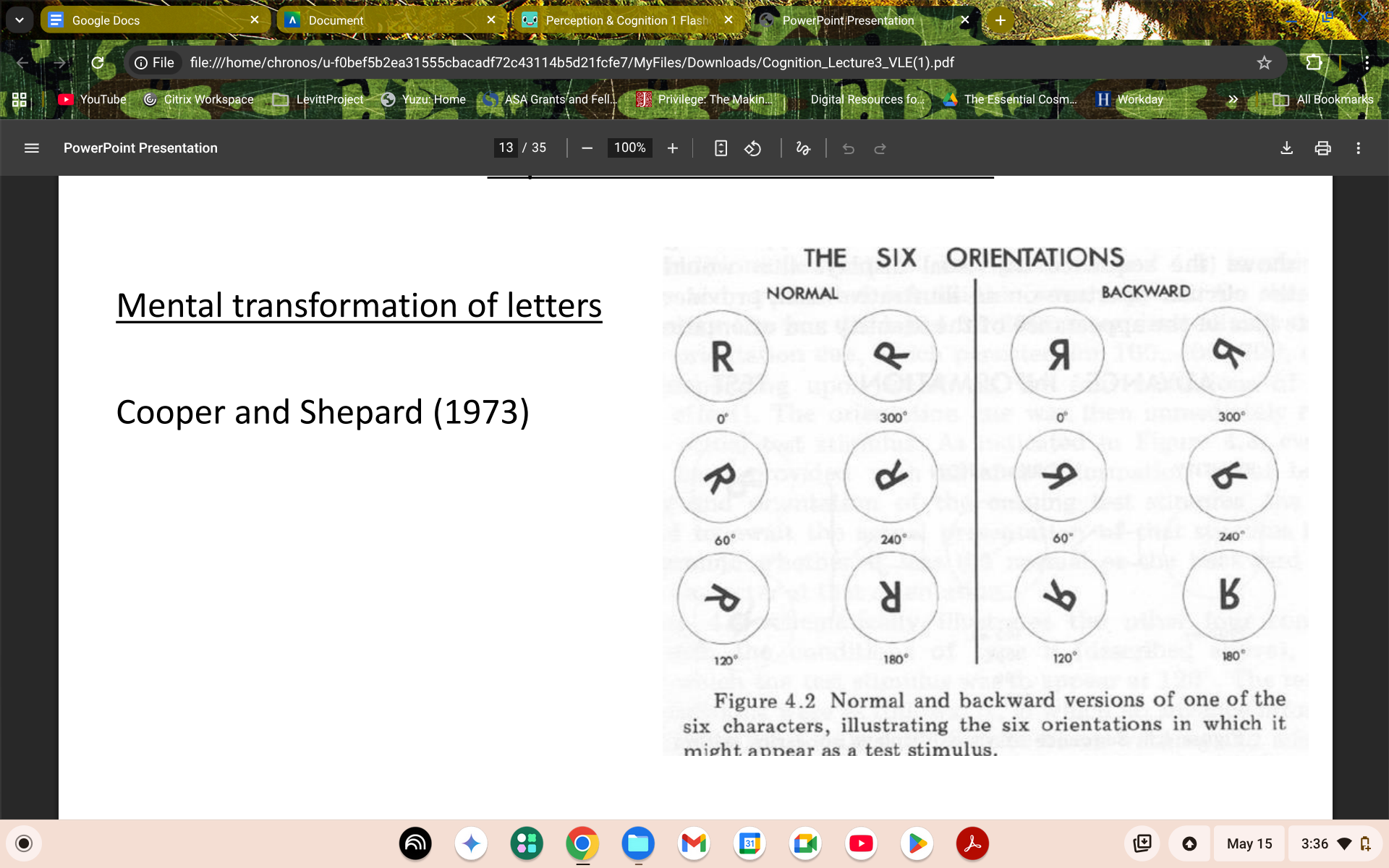
We can test people on the mental transformation of letters - whether it is backward or forward facing after being turned (normal distribution) also: mental origami
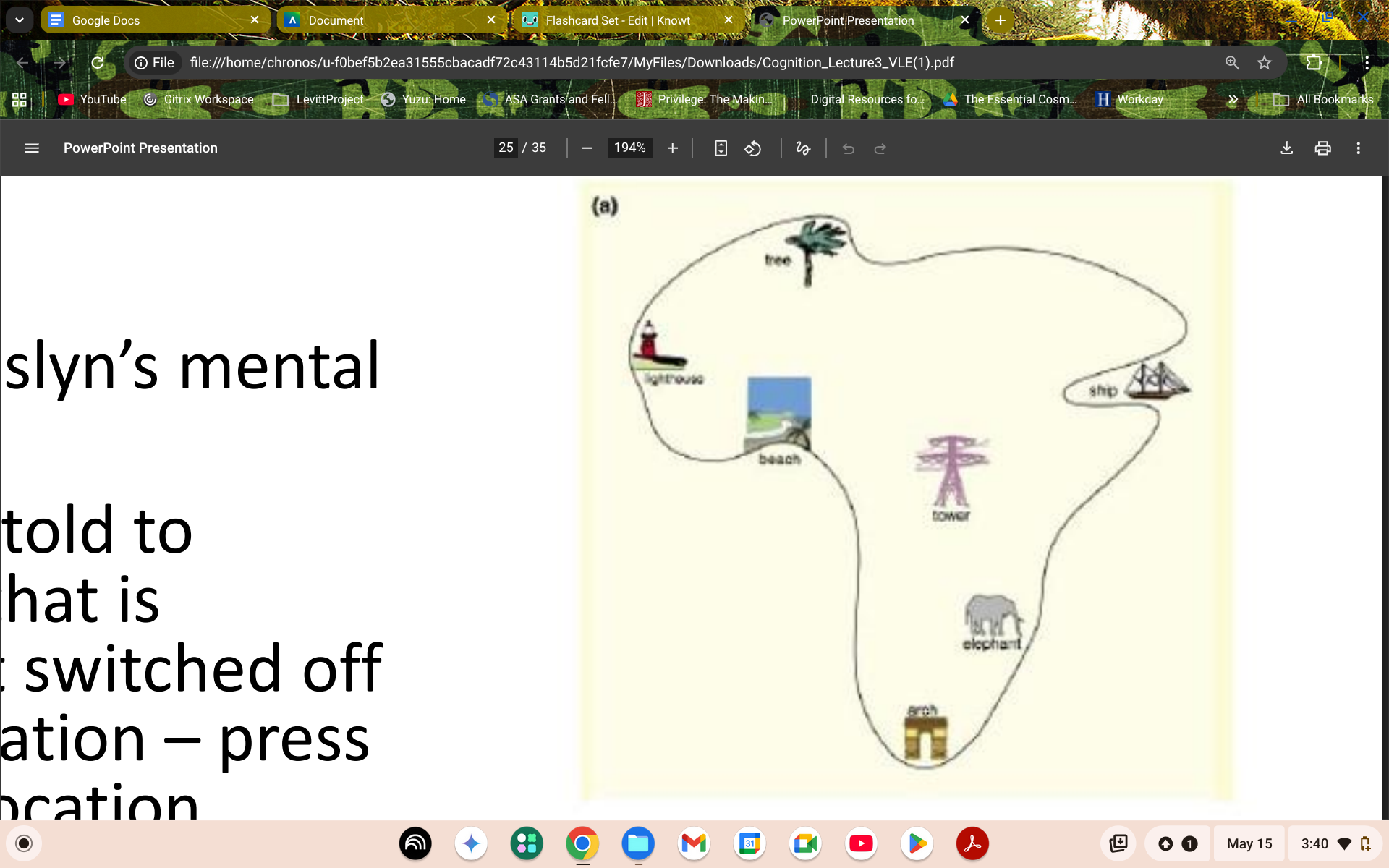
Pylyshyn: Mental imagery of island experiment
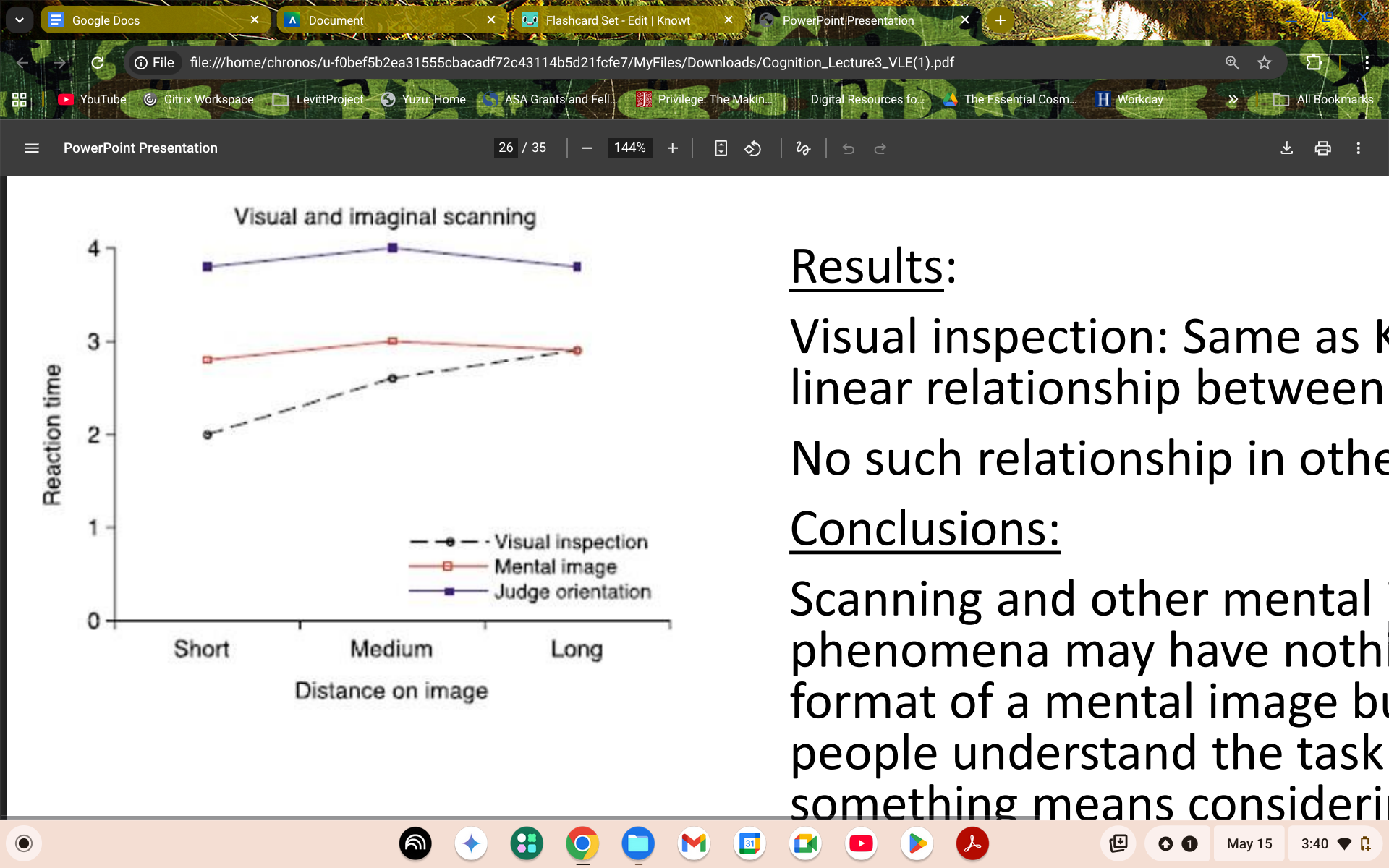
Scanning and other mental imagery phenomena have nothing to do with the format of a mental image but rather how people understand the task: imagining something means considering what it would look like if you saw it
Pylyshyn island results
Visual inspection: linear relationship between RT and distance
no such relationship in other two conditions
Mental imagery? Doubtful
Are there really pictures inside the head? A better conclusion is that the evidence suggests that when reasoning visually humans naturally adopt a strategy of mental stimulation which in turn reflects how perception and problem solving are closely linked
Mental synthesis
Quicker at synthesizing parts with high goodness than low goodness
Bower (1970) paired associative learning and interactive imagery
interactive imagery: imagine each word's referent interacting with one another in a vivid way in an integrative scene
separation imagery: imagine each word's referent next to each other side by side
rote repetition: overt repetition of word pair whilst the pair is presented
Item recognition
Identifying previously encountered items.
PA recall test
What was with this other word?
Bower (1970) results
No effect of condition on recognition rates but very large effect of condition of PA recall rates
the lack of an effect on recognition shows that the S words were equally well encoded during the study phase
the effect on PA recall strongly suggests that the study instructions influenced PA memory
Bower (1970) interpretations
Very bad news for the law of exercise (repetition has very poor PA recall) and mental imagery (separation imagery) is no better interactive imagery!! (Relational coding!!)
Mandler and Pearlstone (1966)
Two groups of subjects:
Free sorting
Constrained sorting Yoked sampling for #2
Constrained sorting
The experimenter took the set of responses from a Free sorting subject and sat opposite the Constrained sorting subject. At the outset subject told how many piles to use. Given feedback after every care. The subject does this until their responses match the Free sorting subject's Obviously, they took more trials than the free sorting subjects. Free sorters and constrained sorters recalled the SAME number of words SO repetition did NOT produce a memory benefit.
Craik and Tulving (1975)
"Is the word an animal name?"
Next word is presented and the subject must make a speeded Yes/No response once they're done, there is an unannounced memory old/new recognition test
Structural
Level of processing 1
Is the word in capital letters?
Phonemic
Level of processing 2
Does the word rhyme with WEIGHT?
Category
Level of processing 3
Is the word a type of fish?
Craik and Tulving (1975) Results
Meaningful orienting tasks (CATEGORY) produce better retention than do ones that focus subjects attention on phonemic or visual features.
Deep encoding is better than shallow encoding
Interim conclusions for lecture 4
Relational encoding seems important that is, recovering a meaningful relationship that links the to-be-remembered concepts aids memory.
Also maybe recovering distinctive relations is also key - using the same next-to relations seems not to be effective. Using unique and distinctive relations is key.
These tie in with both the organisational view and the deeper processing view.
Effective remembering reflects properties of the human mind that are not solely explained in terms of simple S-R theory.
The War of the Ghosts passage
The general form of a subject's first reproduction is preserved throughout the repeated reproductions
There is a strong tendency to rationalize unconnected or disturbing elements for example make the young man sleep through an unexplained interval or changing the "something black" to "foamed at the mouth"
Certain dominant details serve as anchor points for organizing recall and these may become embellished
Various preconceptions are worked into the reproduction
The reproductions became shorter and more coherent — "No trace of an odd or supernatural element is left, we have a perfectly straightforward story of a fight and a death"
Schema
An organized structure that captures knowledge and expectations about events in the world
Kay (1955) another passage
Whatever organization they put on the first reproduction stuck with them throughout the experiment FOFL- failure of further learning
Spitzer (1939) - critical importance of testing for learning
Sixth graders
The longer the first test is delayed the worst performance on the test is
Having a test improved performance on subsequent tests
The sooner the initial test the better later performance
Roediger et al. (2006)
S-one presentation of a list of 40 words every 3 seconds
T-The same as S but followed by a free recall test
Conditions:
STST (Best)
SSST (Worst)
STTT
Importance of repeated testing, not repeated studying
Roediger and Karpicke (2008)
Stimuli: 40 Swahili-English word pairs
Study Period 1:
study phase: all conditions study all 40 word pairs
test phase: all conditions tested on all 40 pairs
Subsequent study period:
once you correctly recall a word during a test phase, what happens depends on what condition you're in
Four conditions each [Study then Test] x 4.
1) ST – standard learning. Study 1 – test 1 (mashua - ?) repeat for times and do this for the whole list.
2) SNT – Once a word is correctly recalled, drop it from study but include it at test.
3) STN – Once a word is correct drop it from the test but continue to include it during study.
4) SN TN – Once a word is correctly recalled, drop it from both study and test.
Conclusion:
repeated studying -> almost no effect on recall
repeated testing -> large effect on recall
Butler and Roediger (2008)
12 prose passages
Each subject studied the passages and then different groups of subjects were allocated to different conditions.
Some took the MCQs and some did not.
All groups were tested one week later on a final cued recall test.
Butler and Roediger (2008) RESULTS
Taking an initial test (even without feedback) tripled final recall relative to study only group. Immediate feedback increased it by 10% and delayed feedback (shown at end of test) had the highest performance.
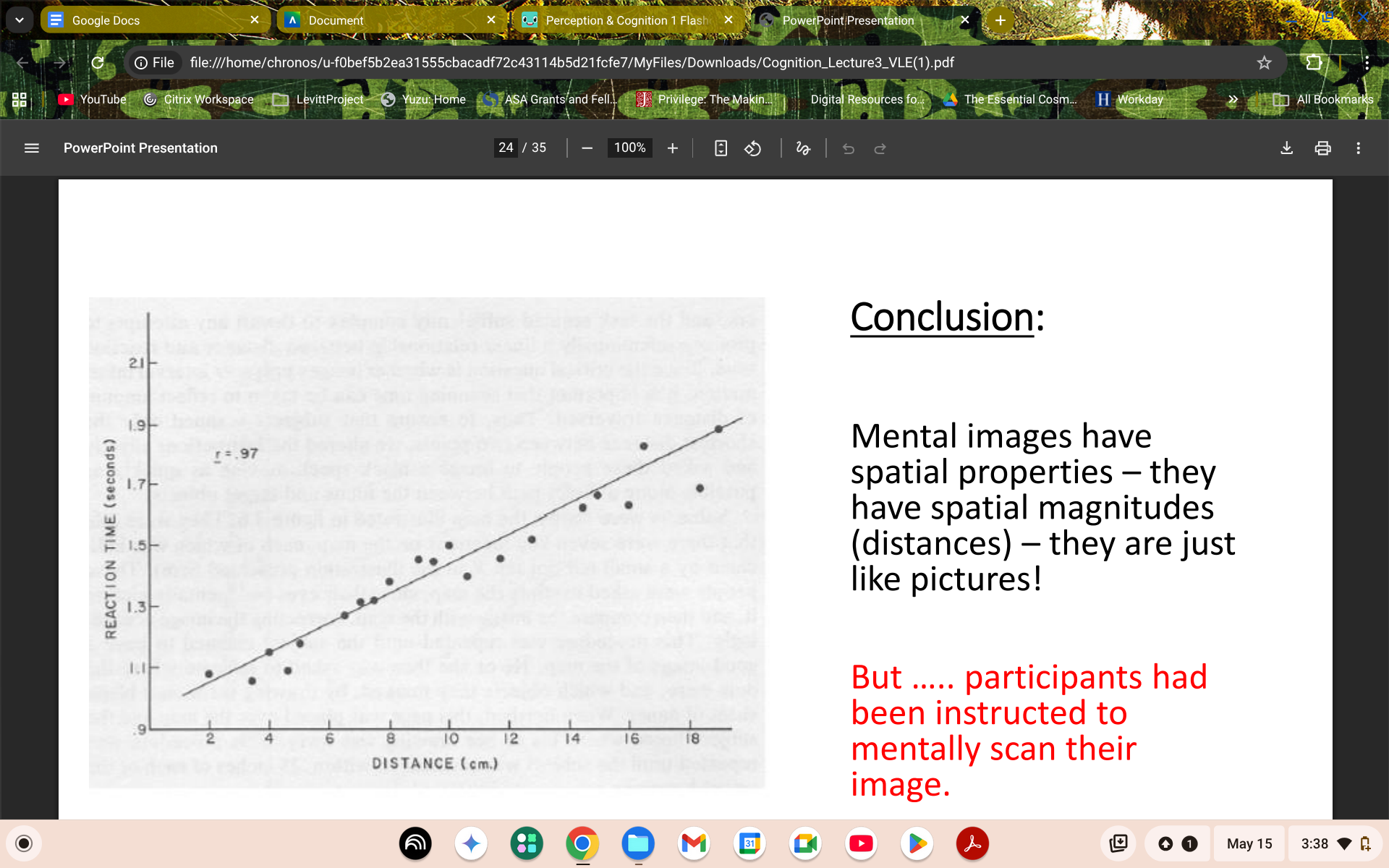
Evidence for analogical representations – Mental imagery? Kosslyn, Ball and Reiser (1978)
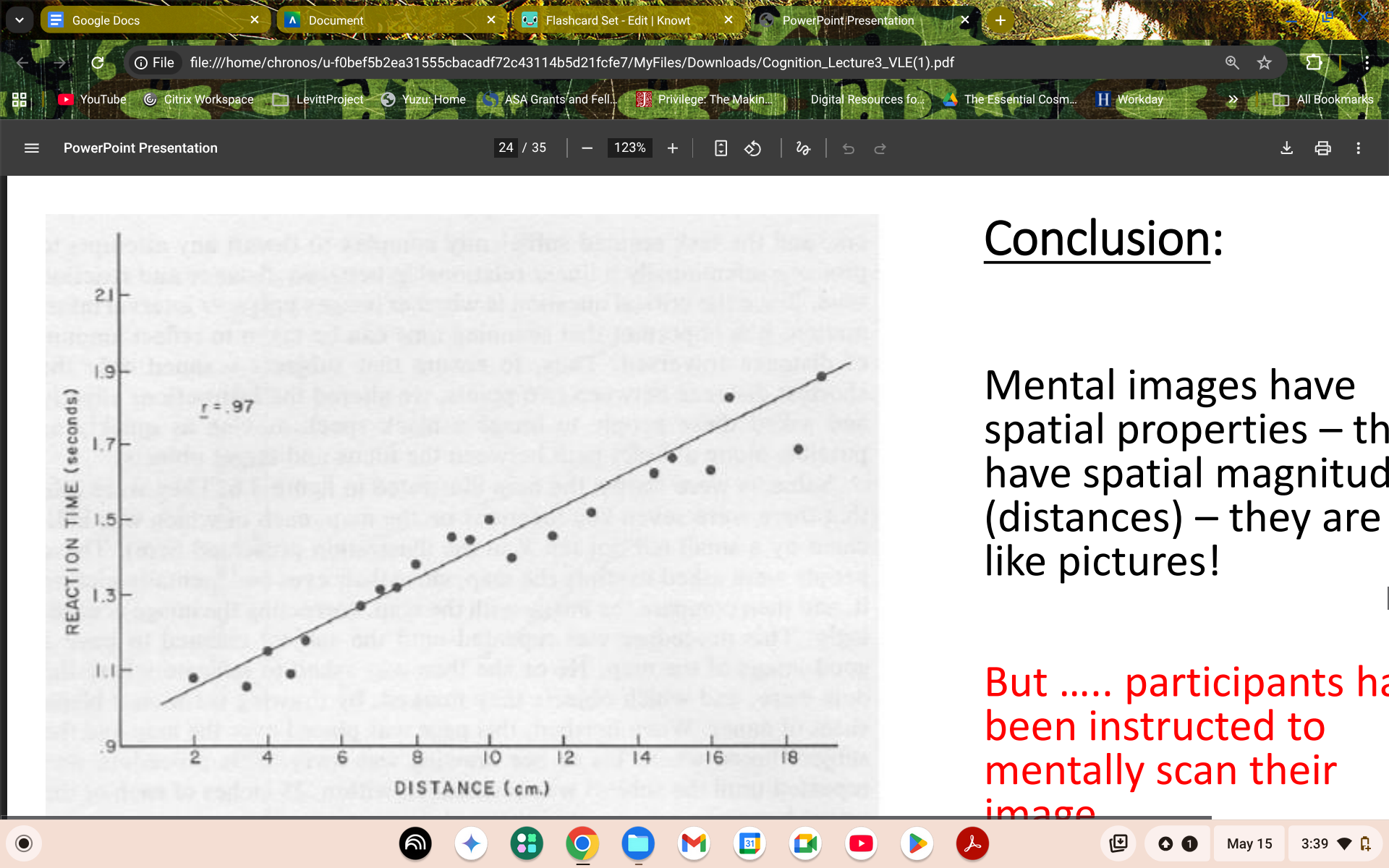
Learn map. Draw from memory. Now timed task. Form mental image. Focus on named location (e.g. sandy cove), now say whether another named location was on the map. Importantly, participants were instructed to mentally scan their image. Scanning time was directly proportional to the distance between landmarks on the actual map
Conclusion from Kosslyn, Ball and Reiser (1978)
Mental images have spatial properties – they have spatial magnitudes (distances) – they are just like pictures! But ….. participants had been instructed to mentally scan their image.