Cosmic origins final
 Call Kai
 Learn
Learn Practice Test
 Spaced Repetition
 Match
Match Flashcards
 Knowt Play
1/219

There's no tags or description
Looks like no tags are added yet.
Name | Mastery | Learn | Test | Matching | Spaced | Call with Kai |
|---|
No analytics yet
Send a link to your students to track their progress
220 Terms
Is the sun on fire?
No because fire is a chemical reaction and that would mean the sun would only last about 3,000 years
1853 JJ Waterston
Said that the sun was powered by meteoric infall
Meteoric infall
Converting kinetic energy to thermal energy
Problems with meteoric infall
1.) The sun would need a lot of meteors a day
2.) More meteors would hit the earth if that was the case
1862 Lord Kelvin and Herman von Helmoltz
Thought the sun was powered by gravitational contraction and meteoric infall and that the sun would be shrinking every day (would last 30mil years)
Sedimentation
Layered deposits can be used to determine age of the earth and geologist said that earth was 100mil years old
1911 Arthur Holmes
Calculated 370mil years old with radiometric dating
Radioactivity
Spontaneous emission of radiation (emits alpha particles and decays)
Marie, Piere, and Henry
Figured out the radiation that we use for half-life
Half-life
Time it takes for a radioactive sample to reduce its mass by half and emits radon in the process
Radio carbondating
Cosmic rays will be detected by water tanks when it hits nitrogen but Holmes used argon to calculate this number
Why was Arther Holmes so off?
We hadn’t discovered the neutron because he didn’t know there can be different isotopes, he did revise his number to 4.5 billion years
Makeup of an element
x=element symbol
z= atomic number (proton number) defines element
A= mass number (number of protons and neutrons)
What is the sun made up of?
74% hydrogen
24% helium
2% metals
What state of matter is the sun in?
Plasma (electrons jump up and separate because of heat)
What powers the sun?
Nuclear fusion
Nuclear fusion
Taking 2 small nuclei to make 1 large nuclei
Mass defect
Difference in the mass of the nucleons and the atom
Nuclear fission
Is a large atom that splits (ex: uranium 235)
E=mc²
E= energy
m= mass defect
c= speed of light
1916 Arthur Eddington
Observed variable stars (stars that get bigger/smaller) and disproves Kelvin/Helmholtz
1920 Eddington’s correct theory
Thinks the sun was powered by nuclear fusion
1939 Hans Bethe
Came up with the process called the proton-proton chain (and CNO cycle)
Proton-proton chain
Takes 4 protons to make helium
CNO Cycle
Not used as much, except for in stars that are greater than 1.3xs the mass of the sun (Ms)
Burning
Fusion
Nebula theory
Stars were thought to have been formed by a collapsing nebula (usually stellar, but ours was a solar nebula)
Nebulas
Are clouds in space that are mostly hydrogen and can form a star if they are triggered to collapse
What can cause a nebula to collapse?
Shockwave from supernova
Dwarf galexy passing by
Rogue passing star
Black hole passing by
Nebula collapse
Forms a protostar (collection of gas that cosplays a star)
Protostar vs Star
A star is an object large enough to sustain fusion
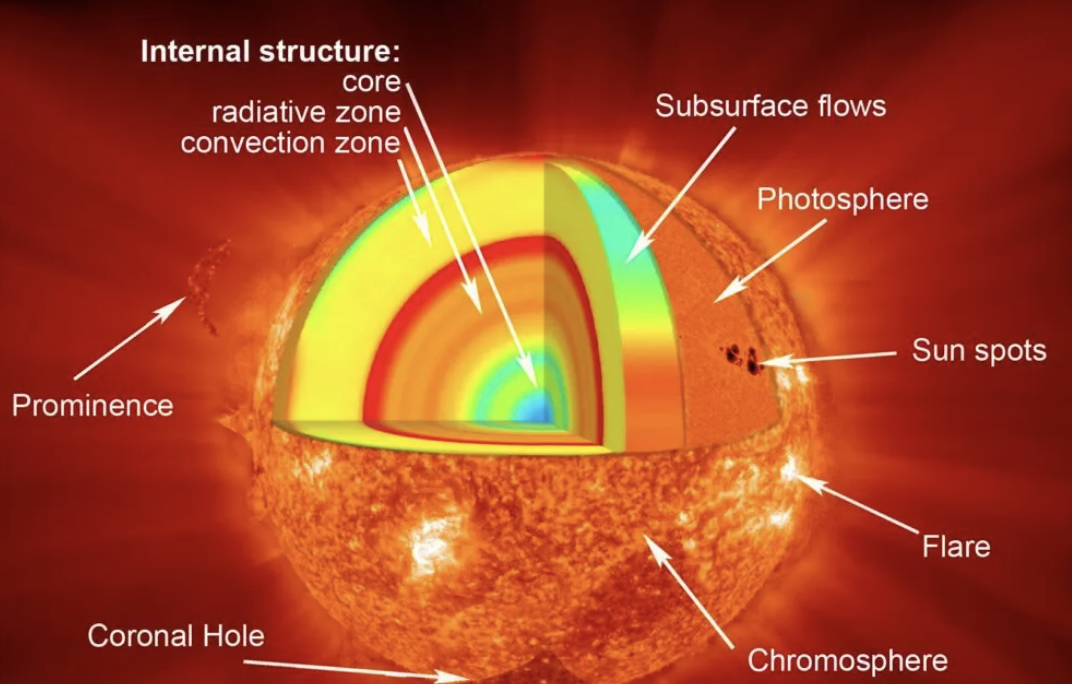
Structure of the sun
Core (fusion)
Radiative zone
Convection zone (photosphere=surface)-
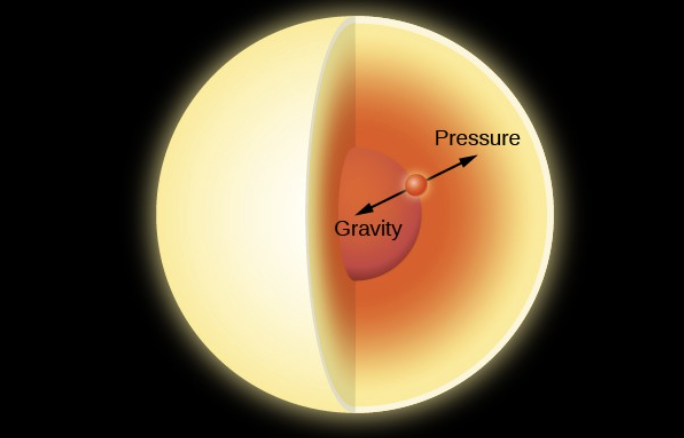
Hydrostatic equilibrium
Stars are ballenced between thermal pressure (fusion) and gravity
Astronomical Units
The average distance from the earth to the sun
Lightyear
Distance light travels in one year
Paralax
Change in the position based on different view points
Stellar paralax
Apparent change in a star’s position against distant stars due to Earth’s movement around the sun
Distance and paralax
The farther the star, the less the paralax (limit = 100 parasecs = 326 light years)
Luminosity
Total power output of a star measure in watts (needs to account for dimness)
Brightness
Power per area in watts per square meter (is actually apparent brightness because light dims with distance)
Apparent magnitude
Same thing as apparent brightness in different units
Original magnitude scale
A scale created 129 BC by Hipparchus that goes from 1-6 (1=brightest) and was expanded to 25 with the telescope
Absolute Brightness/magnitude
How bright an object is at 10 parsec (doesn’t depend on distance)
Light
Electromagnetic wave on a spectrum (eye detects small visible spectrum)
Energy of light
Depends on frequency and is inversely proportional to the wave length (distance between trough/crest)
Max Planck
Discovered quantum mechanics
Atoms
Electrons have different energy level (orbitals)
Energy levels
Lowest= ground state
First excited state= n is 2
Second excited state= n is 3
How does an atom move up energy levels
Absorb light and then jumps back down to emit light (certain colors are different energy levels)
Spectral lines
See everything except what the atom absorbs (opposite for the emissions)
Henry Draper
Pioneer in astrophotography; has the oldest pic of the sun and took one of Vega too because he wanted to figure out why lines were missing (wife donated to Harvard)
Edwards Pickering
Director of Harvard Observatory who used the money to classify stars with the Harvard Computers
Harvard Computers
Women from Radcliffe College that were interested in astronomy
What was used to classify stars
Glass plates were used to classify stars
Antonia Maury
Pioneer in spectroscopic binary stars (published her own catologue)
Williamina Fleming
Pickering’s maid that was the first person in charge of classifying stars
Annie Jump Cannon
Was the fastest at classifying and came up with the spectral classes that we use today (OBFGKM)
Cecilia Payne
Used quantum mechanics to figure out the composition of the universe (rejected first) and figured out that Annie Jump Cannon ordered them by temperature (O=hotest)
1925
Cecilia Payne’s Disertation was on the composition of sun (mostly hydrogen and helium) and was the best one
Star’s color
Proportional to the surface temperature
What color is the sun?
Green (appears as white)
Blackbody
Idealized body that absorbs all radiation that falls on it and perfectly emits radiation
Wein’s Law
Alpha times the peak wavelength is equal to the constant b, over the temperature
Small wavelengths
The smaller the wavelength the hotter a star
Spectral Sequence
O→M were subdivided from 0-9 (hot to cool)
What spectral class is the sun?
G2V
Most common star
76% of stars are red dwarf stars (LTY on the spectrums)
Least common star
O stars are the least common because they burn through their fuel really fast (only last a few million years)
Brown Dwarfs
They can’t sustain fusion and are usually 13-18 MJ
What is lowest mass a star could be a brown dwarf
The lowest would is 80 MJ or 0.08 Ms
Stefan-Boltzmann Law
How we determine a star’s luminosity:
1.) Temperature (dominates)
2.) Radius
Hertsprung-Russle Diagram (H-R)
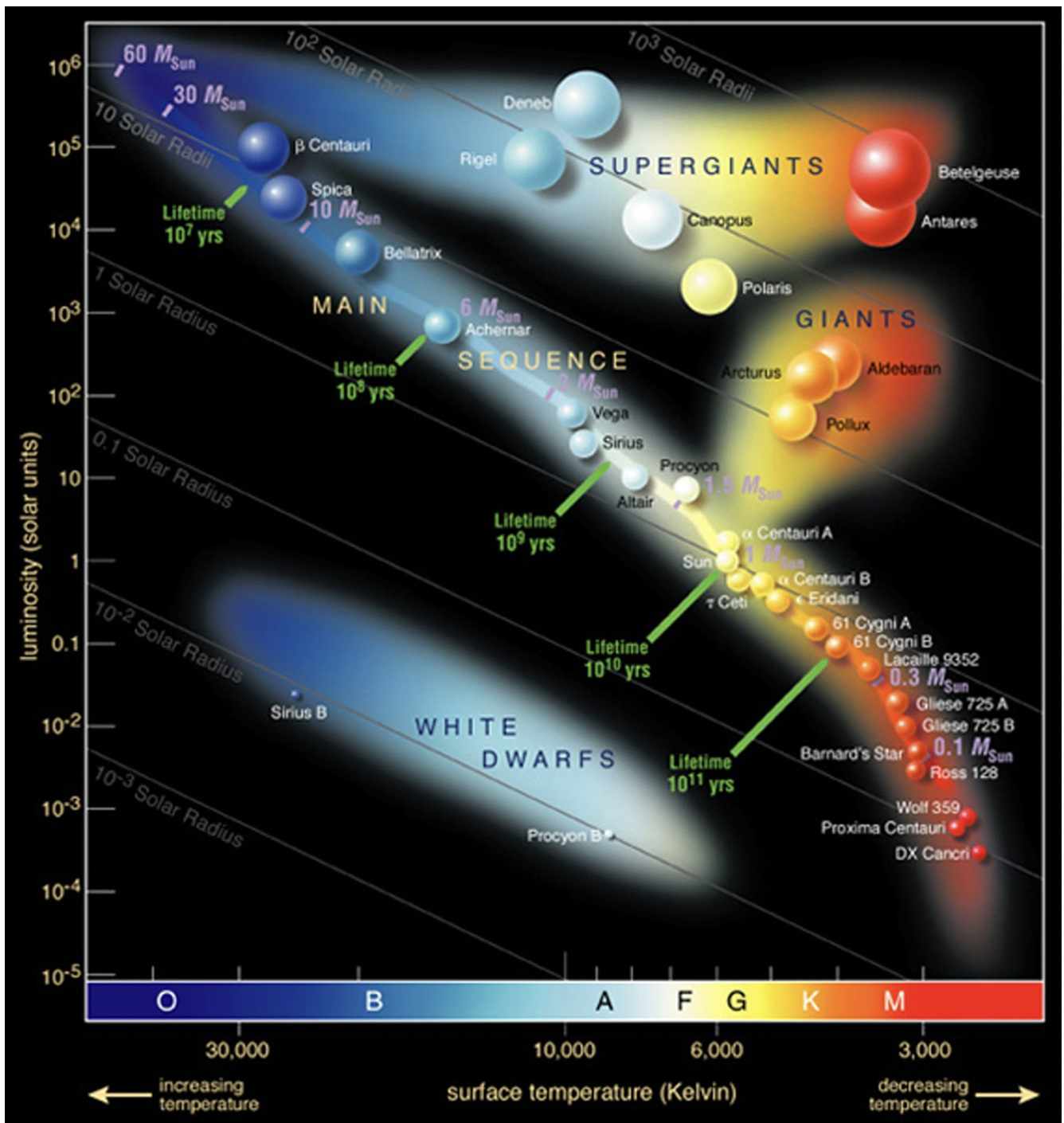
Main Sequence
A star that that is burning hydrogen in the core
Life of a star
Born→main sequence→death (runs out of hydrogen)
Mass
Tells you luminosity, lifespan, and temperature
Luminosity class
I.) Supergiant
II.) Bright giant
III.) Giant
IV.) Sub-giant
V.) Main sequence star (sun is a G2V)
Variable stars
Apparent magnitude of the star changes over time
Light Curve
Is a plot of the apparent magnitude over time
Extrensic Variable Stars
Exoplanet (exoplanet passes in front of the stars)
Eclipsing binary stars
Rotating variable stars (there are star spots)
Eruptive variable stars (large ejections of matter into space)
Intrensic Variable Stars
Star physically changes (pulsating variable star)
Instability Strip
Where most variable stars are
Henrietta Swan Leavitt
Investigated Variable Stars (cepheids)
Period
Time it takes a star to go from maxima to maxima (brightest back to brightest)
Period luminosity relationship
The brighter the star, the longer its period
Leavitts Law
Can use brightness of a cephid to measure the distance of stars
Limit of Leavitts Law
30million parsecs
Cepheids
Are important because they are bright and can be used to find the distance to other galaxies
Type 1 Cepheid
Are more luminous, massive, and have higher metallicity (is younger)
Type 2 Cepheid
Is the opposite of a type 1
Star’s mass at birth
Less than 2 Ms= low
2-8Ms= intermediate
8Ms+= high
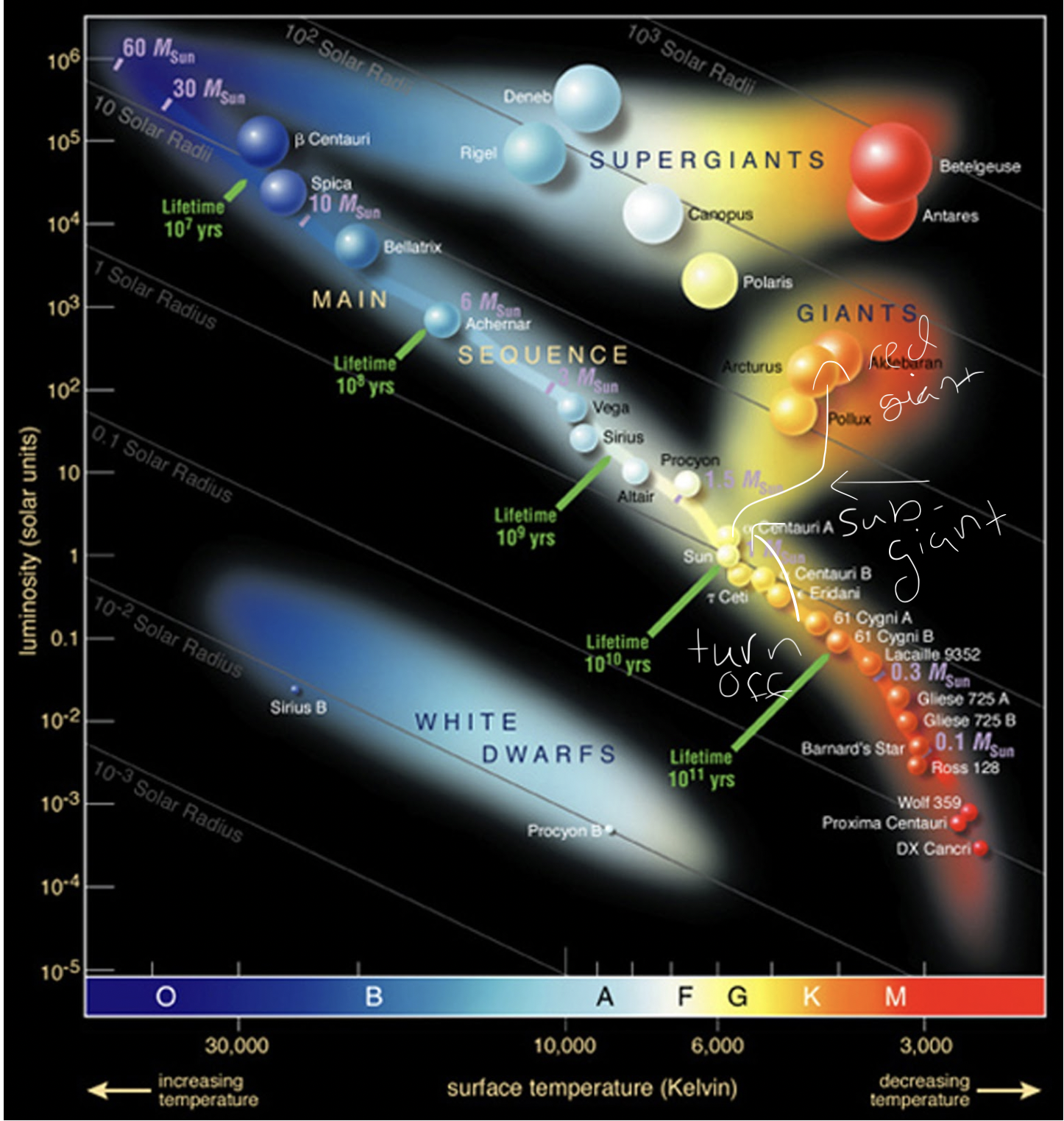
Death process
1.) Inert helium core causes fusion to stop
2.) Initiates main sequence turn off (vertical)
3.) Outer layer eventually cools (moves right horizontally to the sub-giant branch)
4.) Hydrogen shell around the helim core causes burning and pushes outward (moves to red giant branch
Inert helium core
When hydrogen is exhausted
Main sequence turn off
Leaves the main sequence
Hydrogen shell
Surrounds the helium core and by proximity it ignites, causing an increase in luminosity and pushes outward to the red giant branch
What will happen to the sun when it is about to die?
It will eventually become 100x bigger and 1kxs more luminous (will only get up to luminosity class 3)
Dredge-up
During hydrogen shell burning CNO is brought to the surface and convection layer expands down to the hydrogen shell burning
Temperature to fuse helium
100 million kelvin
Tripple Alpha Process
3 Helium → 1 Carbon
Helium Flash
Runaway helium fusion event at the tip of the Red Giant Branch
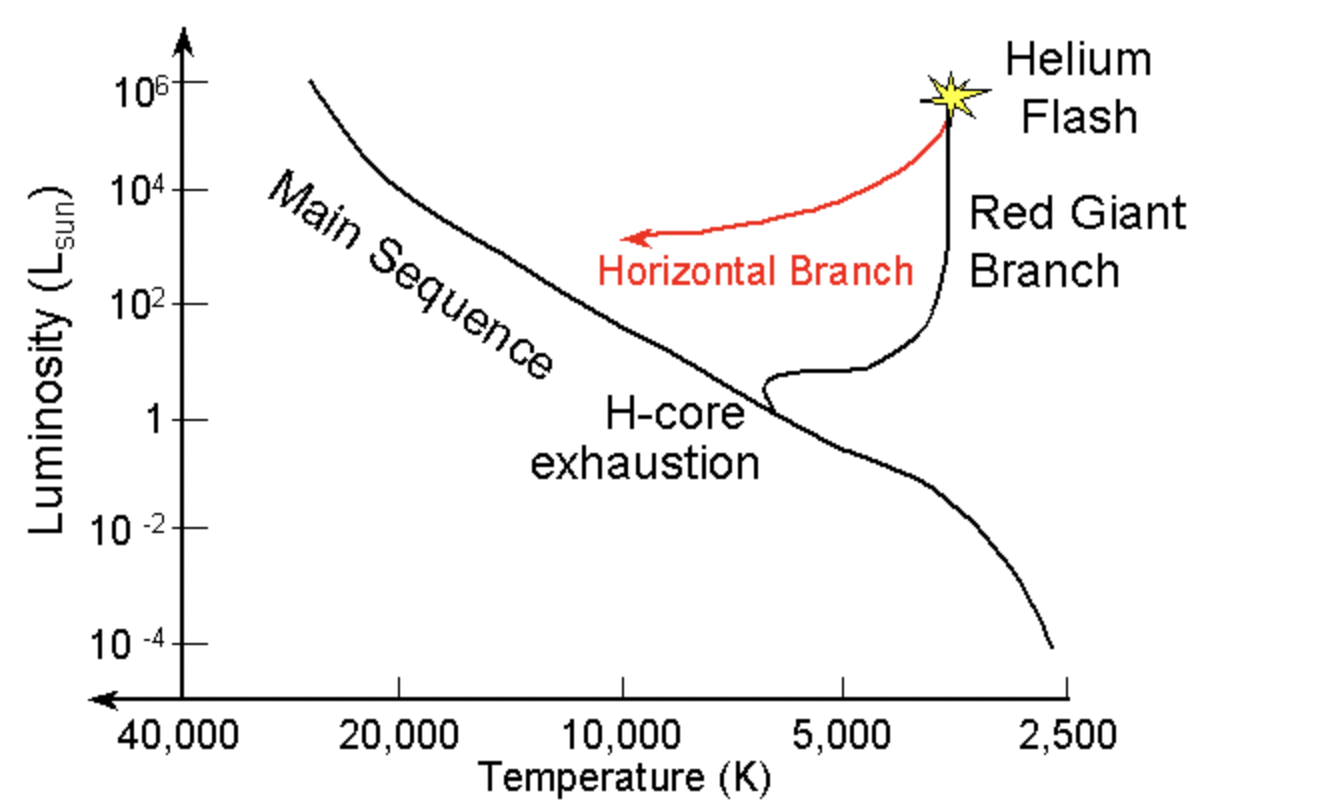
Horizontal Branch
The distance it goes on this branch depends on how much mass is lost from burning (little mass lost= big dip) and has helium core burning (only one)