factors affecting evolution. Hardy-Weinberg principle
 Call Kai
 Learn
Learn Practice Test
 Spaced Repetition
 Match
Match Flashcards
 Knowt Play
1/20

There's no tags or description
Looks like no tags are added yet.
Name | Mastery | Learn | Test | Matching | Spaced | Call with Kai |
|---|
No analytics yet
Send a link to your students to track their progress
21 Terms
types of natural selection
stabilising selection
directional selection
stabilising selection
→occurs when.. [mention effect on allele frequency]
→when does it occur [in terms of environment]
→effects to population
-individuals with alleles for an average phenotype are more likely to survive
→Increases allele frequency for the average phenotype
-Occurs when the environment does not change (stable)
-selects against extreme phenotypes
→Individuals with extreme phenotypes are less likely to survive or reproduce
→Reduces variation in the population
[e.g. Human baby weight
Very small babies → less likely to survive
Very big babies → difficult birth
Average weight babies are more likely to survive, reproduce and pass on their alleles to offspring]
directional selection
→occurs when.. [mention effect on allele frequency]
→when does it occur [in terms of environment]
-individuals with alleles for an extreme phenotype are more likely to survive
→Increases allele frequency for an extreme phenotype
-occurs when the environment changes
the data of stabilising and directional selection is shown in what graph. draw graph for each selection.
bell-shaped curve
[look at the axes]
![<p>bell-shaped curve</p><p>[look at the axes]</p>](https://assets.knowt.com/user-attachments/e6270ec5-1e51-4843-a84a-bbbbeac034bf.png)
effect of stabilising and directional selection on bell-shaped curve
stabilising selection
-mean remains the same
-curve becomes narrower
→standard deviation decreases
→variation decreases as individuals with extreme phenotypes decrease
[peak of curve is slightly higher than original peak, not too high tho→ when drawing keep this in mind]
directional selection
-Curve shifts toward the favoured extreme
-Mean of population shifts toward the favoured extreme
-curve remains roughly the same
![<p><strong>stabilising selection</strong></p><p>-mean remains the same</p><p>-curve becomes <u>narrower</u></p><p>→standard deviation <u>decreases</u></p><p>→variation decreases as individuals with extreme phenotypes decrease</p><p>[peak of curve is <u>slightly</u> higher than original peak, not too high tho→ when drawing keep this in mind]</p><p><strong>directional selection</strong></p><p>-Curve <u>shifts toward the favoured extreme</u></p><p>-Mean of population shifts toward the favoured extreme</p><p>-curve remains roughly the same</p>](https://assets.knowt.com/user-attachments/ec2bd68d-3cf2-463a-87a9-d3fa3aad86da.png)
allele frequency
how common an allele is in a population.
e.g. 70% of alleles are A [frequency of A = 0.7]
30% are a [frequency of a = 0.3]
[not the number of people, it’s the proportion of a specific allele]
gene pool
the complete range of alleles in a population
gene flow
the transfer of alleles between populations
genetic drift
random changes in allele frequencies in a population due to chance events
[does not occur as a result of natural selection]
![<p>random changes in allele frequencies in a population due to chance events </p><p>[d<span><span>oes not occur as a result of natural selection]</span></span></p>](https://assets.knowt.com/user-attachments/2e7d89f2-b256-46d4-908b-5eeb5f98e01e.png)
Which populations will genetic drift have a larger effect in? why?
small population
-each allele has a proportionally larger effect in a small population.
-alleles are more likely to be lost from population
-population becomes more vulnerable due to environmental change
what does genetic drift cause
reduces the genetic diversity of a population because alleles are lost from the gene pool
types of genetic drift
genetic bottleneck
founder effect
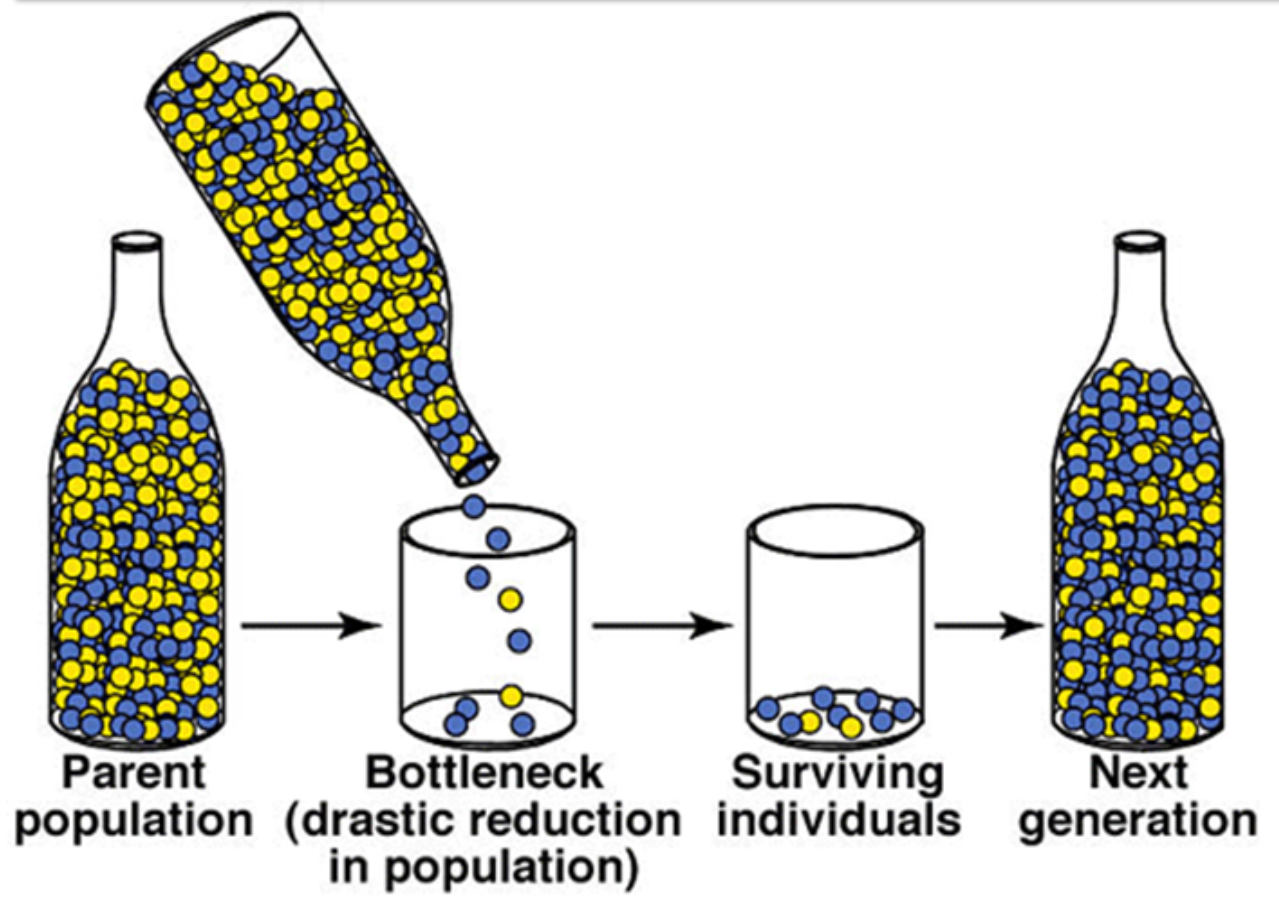
genetic bottleneck [include effects]
it’s a large decrease in population size due to an event such as natural disasters and disease
→ leads to a reduced gene pool and decreased genetic diversity
→alleles are lost from original population
→new population is descended from few survivors
→population may struggle to adapt to future changes in their environment
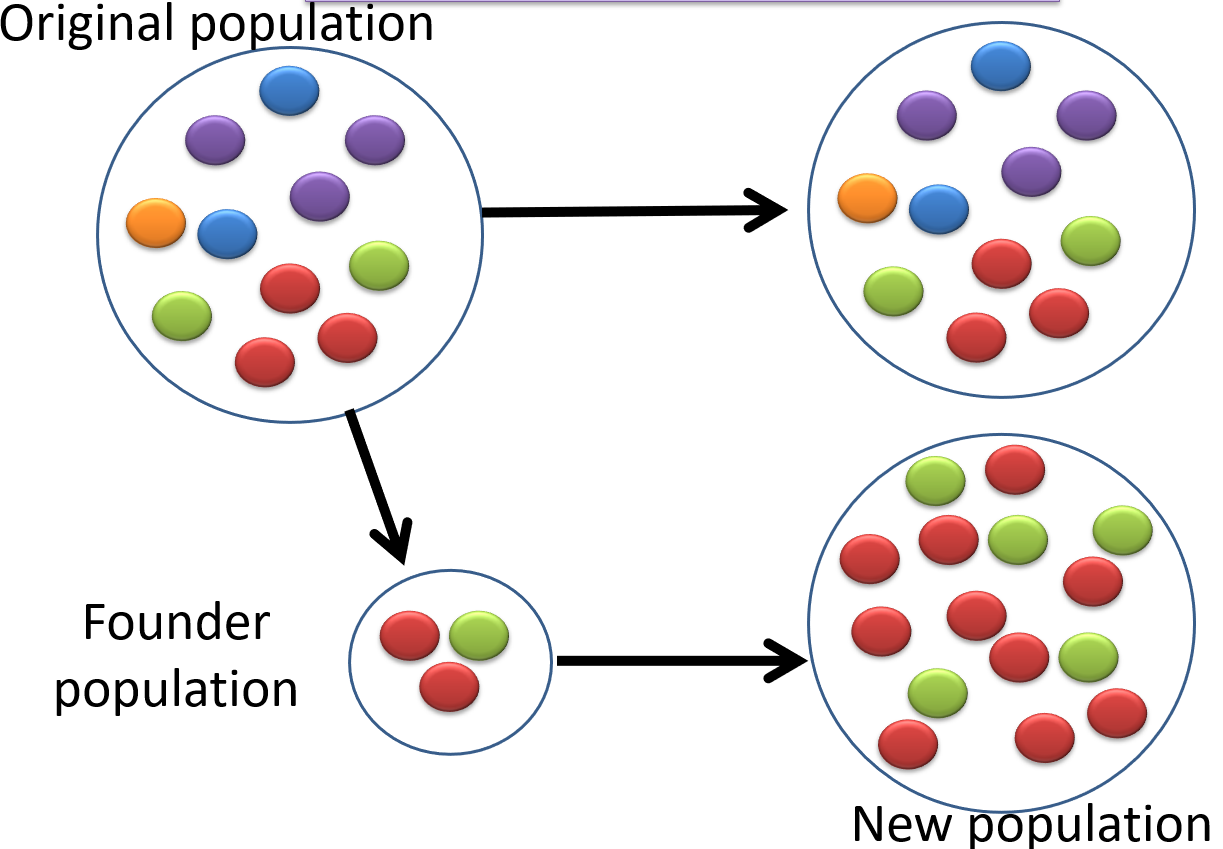
founder effect [include effects]
A small group of individuals leaves a population and starts a new population elsewhere
→ leads to a reduced gene pool and decreased genetic diversity
→rare alleles from the original population may become more common in the new population (may be beneficial, harmful or neutral)
→allele frequencies in new population are different to the original population
The size of a population influences its genetic variation. Factors that can limit population size?
Density-dependent factors [depends on the population density – the more crowded the population, the stronger the effect]
-competition
-predation
-disease
Density-independent factors [affect a population regardless of its size]
-natural disasters
genetic diversity in:
small population
large population
small
→small gene pools
→genetic diversity is low
large
→large gene pools
→genetic diversity is high
population
a group of organisms of the same species that live in the same habitat at the same time and can interbreed.
Hardy-Weinberg principle
states that allele frequencies remain constant across generations in a population that is not evolving.
state assumptions
the population must have:
No mutation
Large population size
Random mating
No migration into or out of the population (no gene flow)
No selection (all individuals survive and reproduce equally)
p + q=1
whats p and q
variable for:
homozygous dominant
homozygous recessive
heterozygous
p= dominant allele [tip: p is before q in alphabet]
q= recessive allele
p2 = frequency of homozygous dominant [pp]
2pq = frequency of heterozygous individuals [pq or pq]
q2 = frequency of homozygous recessive [qq]
→p2+2pq+q2 = 1
[read carefully if q asks to find probability/proportion or number of individuals
→ for number of individuals multiply probability by total number of species]
when would using Hardy-Weinberg principle be not appropriate? (2)
-population is small
-mating is not random
factors that cause allele frequencies to change in a population that meets the Hardy-Weinberg principle (4)
natural selection
genetic drift
mutation
migration