Muscular System: Functions, Anatomy, and Contraction Mechanics
 Call Kai
 Learn
Learn Practice Test
 Spaced Repetition
 Match
Match Flashcards
 Knowt Play
1/44

There's no tags or description
Looks like no tags are added yet.
Name | Mastery | Learn | Test | Matching | Spaced | Call with Kai |
|---|
No analytics yet
Send a link to your students to track their progress
45 Terms
What are the 5 functions of the Skeletal Muscles?
Movement, posture, joint stability, heat production, and protection.
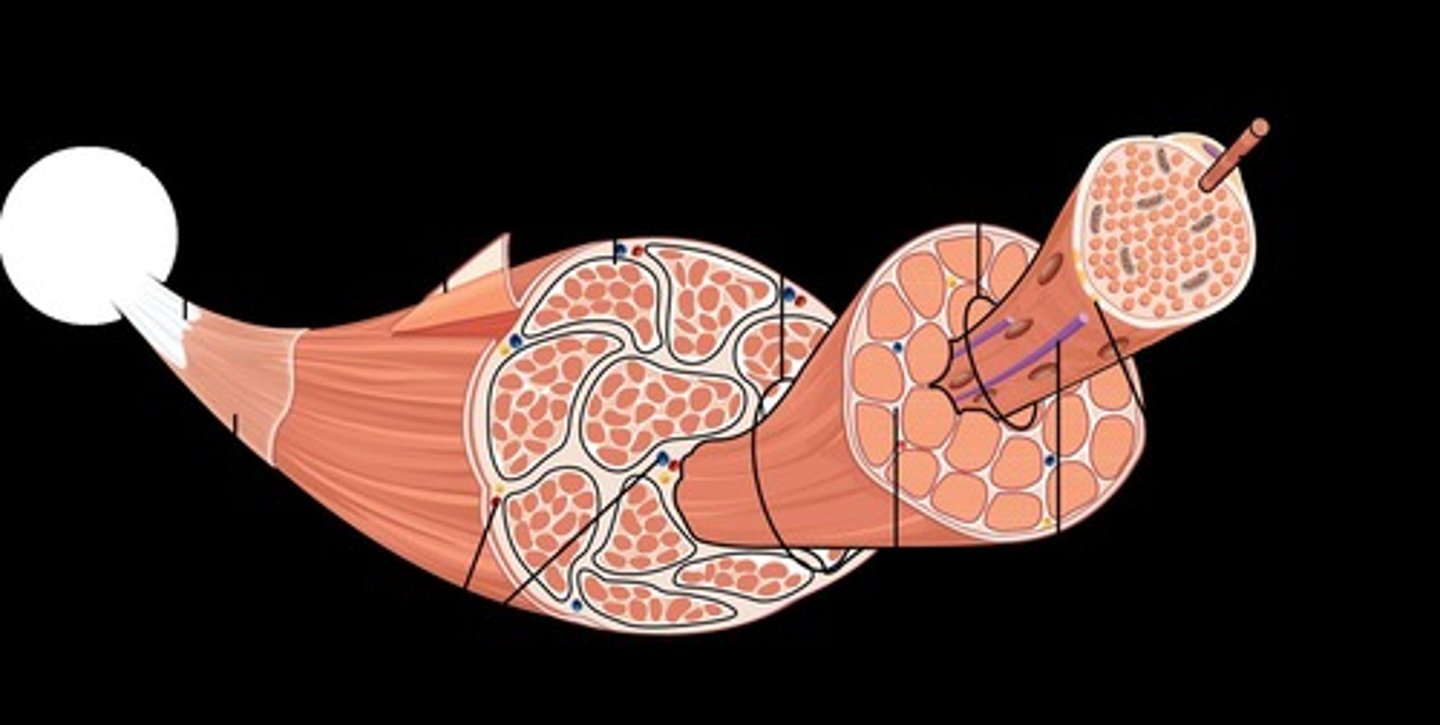
What is the Epimysium, Endomysium, Perimysium?
Epimysium surrounds the entire muscle, Perimysium surrounds fascicles, and Endomysium surrounds individual muscle fibers.
What is Botulism?
A rare but serious illness caused by a toxin produced by Clostridium botulinum, leading to muscle paralysis.
What is Rigor Mortis?
A postmortem condition where muscles stiffen due to chemical changes after death.
What is Tetanus?
A bacterial infection that causes painful muscle stiffness and spasms.
What are the different types of Tetanus?
There are generalized tetanus and localized tetanus.
What is the difference between Incomplete and Complete Tetanus?
Incomplete tetanus shows partial relaxation between contractions, while complete tetanus shows no relaxation.
What is a muscle twitch?
A single, quick contraction and relaxation of a muscle fiber.
What is the difference between isometric and isotonic contractions?
Isometric contractions involve muscle tension without shortening, while isotonic contractions involve muscle shortening with movement.
How does a muscle get fatigued?
Muscle fatigue occurs due to depletion of energy sources, accumulation of lactic acid, and ionic imbalances.
What is the difference between a Tendon and a Ligament?
A tendon connects muscle to bone, while a ligament connects bone to bone.
What are the components of a muscle from largest to smallest?
Muscle, Fascicle, Muscle Fiber, Myofibril, Sarcomere.
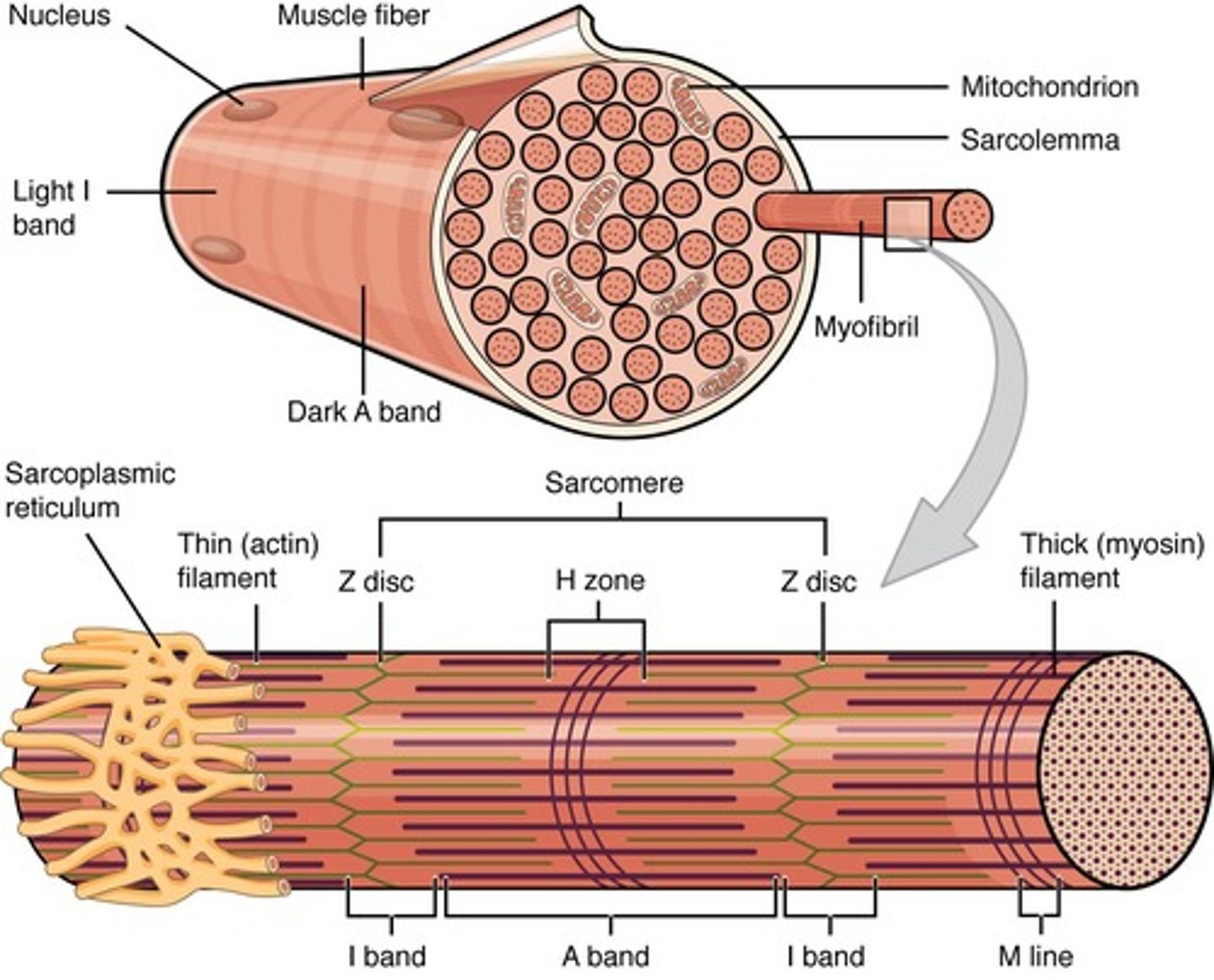
What are the parts of a Myofibril?
Endomysium, mitochondria, sarcolemma, stacks of sarcomeres, sarcoplasmic reticulum, T-tubules, Terminal Cisternae, actin, myosin.
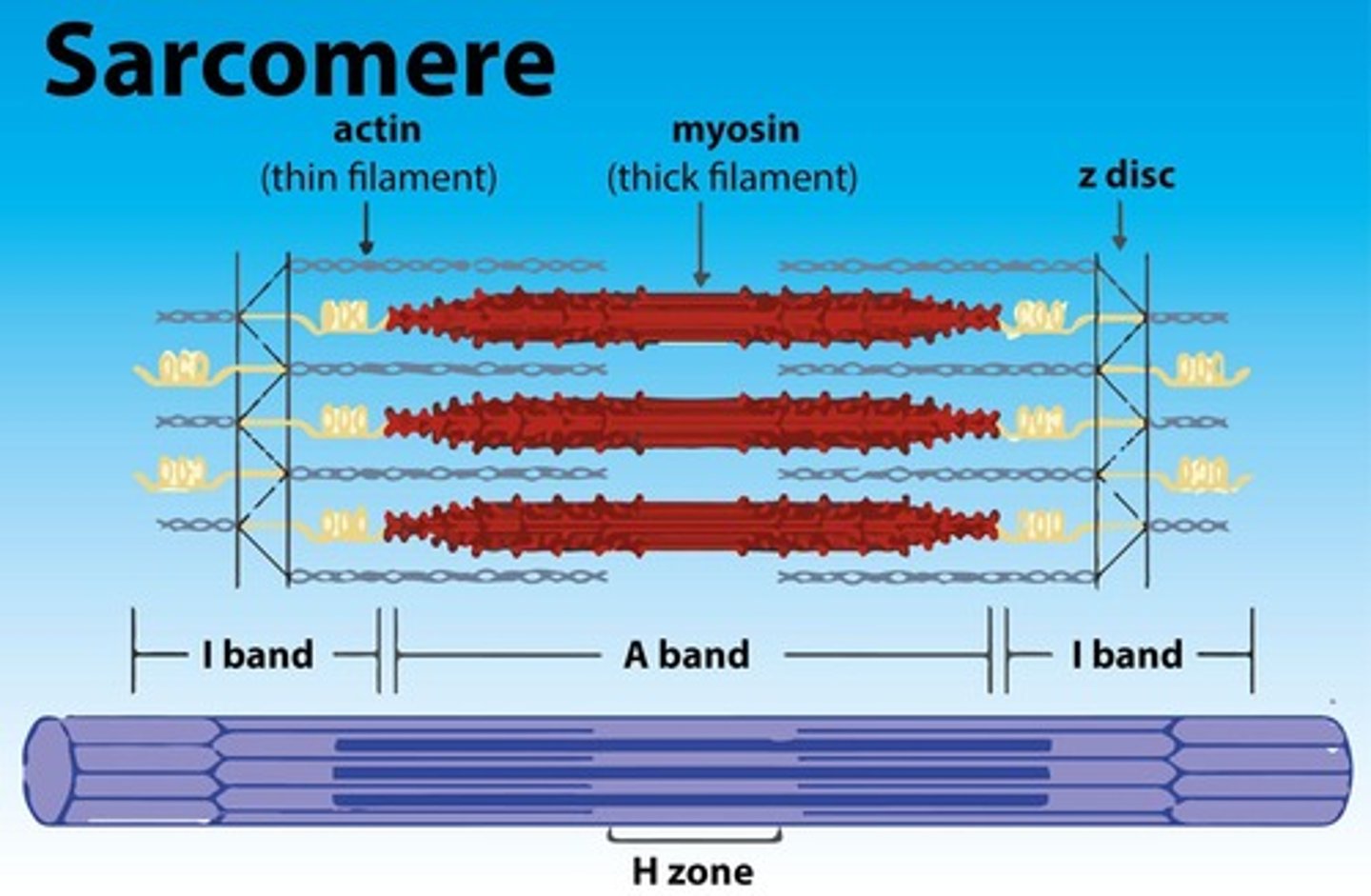
What are the parts of a Sarcomere?
Actin, myosin, M line, Z band, I band, A band, H band.
What is the neuromuscular junction?
A specialized synapse where a motor neuron communicates with a skeletal muscle fiber to trigger contraction.
How are skeletal muscle fibers classified?
Based on their action capabilities and arrangement of myofibrils, such as fast and slow fibers.
What is the difference between origin and insertion?
Origin is the stationary attachment site of a bone, while insertion is the movable attachment point of a bone.
What is an Agonist?
A prime mover muscle that initiates a movement.
What is an Antagonist?
A muscle that works in opposition to the agonist.
What is a Synergist?
A muscle that assists the agonist in performing a movement.
What are the steps of muscle contraction?
1. ACh release triggers action potential. 2. Action potential travels down T-tubules. 3. Calcium ions are released. 4. Myosin binds to actin. 5. Myosin pivots and pulls actin. 6. ATP binds to myosin, causing detachment. 7. ATP hydrolysis re-***** myosin. 8. Calcium is pumped back into the SR, leading to relaxation.
What is dystonia?
A disorder where the brain sends faulty commands to muscles, causing constant contractions.
What is the cause of Jason Dunn's dystonia?
Faulty signals from the basal ganglia.
What treatments are available for dystonia?
Medications to block faulty signals, working out, sleeping, and deep brain stimulation.
What is spinal muscular atrophy type 2?
A disorder where muscle atrophy starts in infancy due to nerve damage.
What causes muscle atrophy in spinal muscular atrophy?
A mutation in a gene that creates a protein necessary for nerve nourishment.
What are anabolic steroids?
Performance-enhancing drugs that speed up muscle building and recovery.
What are the potential side effects of anabolic steroids in men?
Pimples, breast enlargement, and testicular shrinkage.
What are corticosteroids used for?
To reduce inflammation, but they do not build muscle.
What are the three types of muscle tissue?
Cardiac, smooth, and skeletal.
What characterizes cardiac muscle tissue?
Branched, striated, and usually has one nucleus.
What characterizes smooth muscle tissue?
Non-striated, spindle-shaped, and has one nucleus.
What characterizes skeletal muscle tissue?
Striated, long cylinders, and multinucleated.
What are the four characteristics of muscle tissue?
Extensibility, elasticity, excitability, and contractility.
What is the sliding filament theory?
A theory explaining muscle contraction through the interaction of actin and myosin.
What is the longest skeletal muscle?
Sartorius.
What is the biggest skeletal muscle?
Gluteus Maximus.
What is the tiniest skeletal muscle?
Stapedius.
What do muscles do?
Muscles pull; they do not push.
What are motor units?
Groups of muscle fibers that receive signals from the same motor neuron.
What are the three stages of muscle contraction?
Latent, contraction, and relaxation period.
What is temporal summation?
The process of adding twitches on top of each other to increase force.
What is the size principle of recruitment?
Smaller motor units are activated first, and larger units are recruited as needed.
What is isotonic movement?
Movement where muscle fibers change length.
What is isometric movement?
Movement where muscle fibers do not change length.