Ecology Final
 Call Kai
 Learn
Learn Practice Test
 Spaced Repetition
 Match
Match Flashcards
 Knowt Play
1/67

There's no tags or description
Looks like no tags are added yet.
Name | Mastery | Learn | Test | Matching | Spaced | Call with Kai |
|---|
No analytics yet
Send a link to your students to track their progress
68 Terms
Communities
Groups of interacting species that occur together at the same place and time. Physical characteristics e.g., all species in a sand dune, mountain stream, or desert. Biological characteristics e.g., all the species associated with a kelp forest or a coral reef; implies importance of abundant species.
Taxonomic affinity
Organisms that are closely related to each other. Lineage. Diverge from a common ancestor. (E.g. all bird species in a community)
Guild
a group of species that use the same resources. Bat, humming bird and honey bee are all pollinators and feeding on nectar.
Function group
species that function in similar ways. Ex. symbiotic relations with nitrogen-producing bacteria that live in their root nodules.
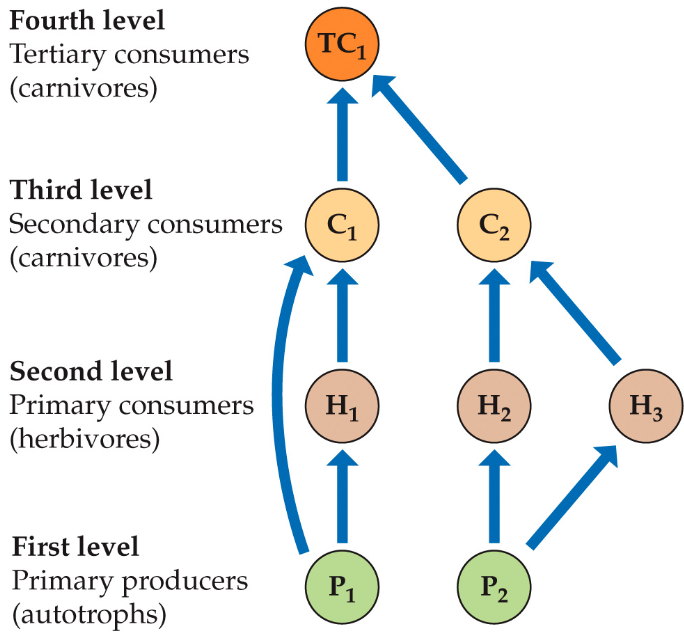
Food webs
organize species based on trophic or energetic interactions
Trophic levels
Primary producers (autotrophs)
Primary consumers (herbivores)
Secondary consumers (carnivores)
Tertiary consumers (carnivores)
Interaction webs
more accurately describe both trophic (vertical) and non-trophic (horizontal) interactions.
Community structure
set characteristics that shape communities. Provides basis for generating hypotheses and experiments to understand how communities work. Species diversity is the most common measure of community structure.
Species diversity
mean the number of species in a community.
Species richness (number of species)
Species evenness (relative abundance)
Biodiversity
describes diversity at multiple spatial scales, from genes to species to communities. Implicit is the interconnectedness of all the components.
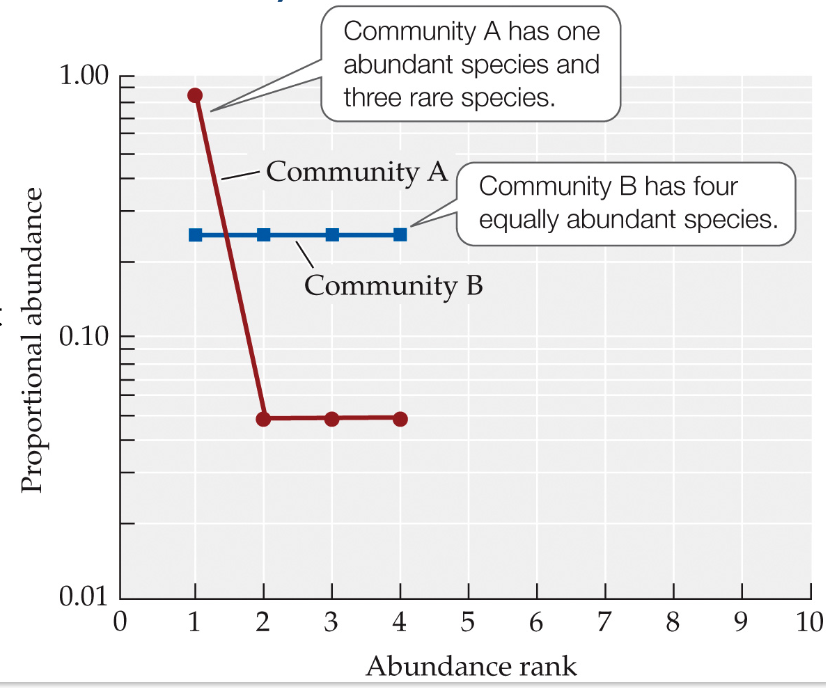
Rank abundance curves
plot the proportional abundance of each species (pi) relative to the others, in rank order. Suggests possible species interactions. Experiments that add or remove species are used to explore these relationships.
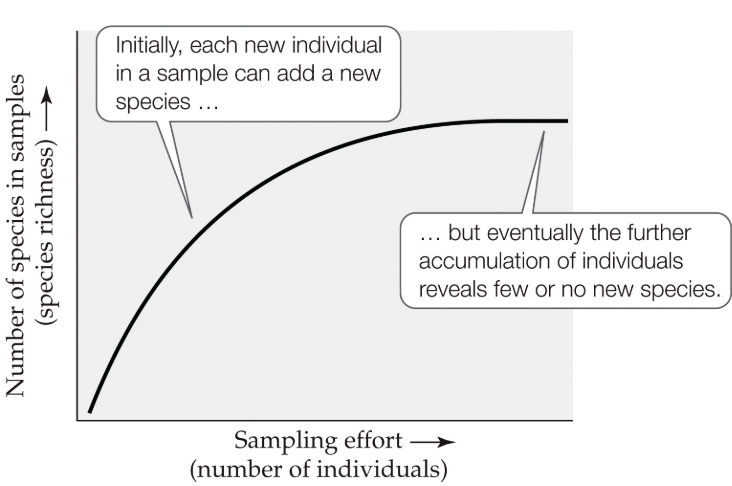
Species accumulation curves
species richness plotted as a function of total number of individuals counted. Help determine when most or all of the species in a community have been observed. The threshold where no new species are counted never occurs in natural systems because new species are constantly being found.
Species composition
identity of species in a community. Two communities could have identical species diversity values but completely different species. The identity of species is critical to understanding community structure.
Interspecific Competition
An interaction in which individuals of different species are harmed by their shared use of a resource that limits their ability to grow, reproduce, or survive. (Between members of different species)
Intraspecific competition
An interaction in which individuals of the same species are harmed by their shared use of a resource that limits their ability to grow, reproduce, or survive. (Between individuals of a single species)
Fundamental niche
The full set of resources, plus other biotic and abiotic requirements of a species, that are suitable for a species excluding the negative interactions with other species.
Realized niche
The part of a fundamental niche that species occupies as a result of species interactions.
Exploitation competition
An interaction in which species compete indirectly through their mutual effects on the availability of a shared resource. (Individuals reduce the supply of a resource as they use it, i.e., Pitcher plants)
Interference competition
An interaction in which species compete directly by performing antagonistic actions that interfere with the ability of their competitors to use a resource that both require, such as food or space.
Allelopathy
A mechanism of competition in which individuals of one species release chemicals that harm individuals of other species. (Plants of one species release toxins that harm other species.)
Amensalism
A species interaction in which individuals of one species are harmed while individuals of the other species do not benefit and are not harmed (-/0 relationship).
Competitive exclusion
Dominant species prevents another species from using essential resources; the inferior species may become locally extinct.
Competitive coexistence
The ability of two or more species to coexist with one another despite competing ofr the same limiting resources.
Competitive exclusion principle
Two species that use a limiting resource in the same way cannot coexist indefinitely.
Resource partitioning
The use of limiting resources by different species in a community in different ways. (Species using a limited resource in different ways can coexist.)
Character displacement
A process in which competition causes the phenotypes of competing species to evolve to become more different over time, thereby easing competition. (When two species compete for resources natural selection may favor phenotypes that allow them to partition resources, decreasing competition intensity.)
Direct interactions
An interaction that occurs between two species, such as predation, competition, or a positive interactions. (Occur between two species (e.g., competition, predation, facilitation))
Indirect interactions
Relationship between two species is mediated by a third (or more) species; often discovered when species are removed to study direct interactions.
Trophic cascade
A change in the rate of consumption at one trophic level that results in series of changes in species abundance or composition at lower trophic levels. (Rate of consumption at one trophic level results in change in species abundance or composition at lower trophic levels.)
Trophic facilitation
An interaction in which a consumer is indirectly facilitated by a positive interaction between its prey or food plant and another species.
Foundation species
A species that has a large, community-wide effects on the habitat or food of other species by virtue of size or abundance. (Large or abundant species, such as trees, that provide food or habitat for other species.)
Trophic efficiency
Amount of energy at one trophic level divided by amount of energy at the next lowest trophic level
Allochthonous inputs
Inputs produced outside the ecosystem.
Autochthinous energy
Energy produced within the ecosystem.
Trophic pyramids
portray the relative amounts of energy ir biomass in each trophic level
Consumption efficiency
proportion of available energy ingested - higher in aquatic ecosystems than in terrestrial ecosystems.
Assimilation efficiency
proportion of ingested food that is assimilated. Depends on food quality and consumer physiology.
Production efficiency
Proportion of assimilated food that goes into new consumer biomass. Related to thermal physiology and size of consumer.
Niche Partitioning
using different aspects of the resource. Change in the phenotypes in the organisms due to how they are displaced excreting selection pressure on each other - evolutionary changes for character displacement.
Define the difference between exploitation and interference compeitition
Analyze how and why competition can vary in its intensity
Describe the importance of competition within communities
Define the competitive exclusion principle and explain how it differs from competitive
Define and give examples of resource partitioning (or niche partitioning)
Describe how competition can lead to character displacement and resource partitioning
Describe how herbivores or predators can change or reverse the outcome of competition
Explain how the physical environment can affect the outcome of competition and distribution of species
Explain how disturbances can allow coexistence in highly asymmetrical competitive interactions
Define and quantify species diversity and compare biodiversity
Define and quantify species diversity and compare biodiversity
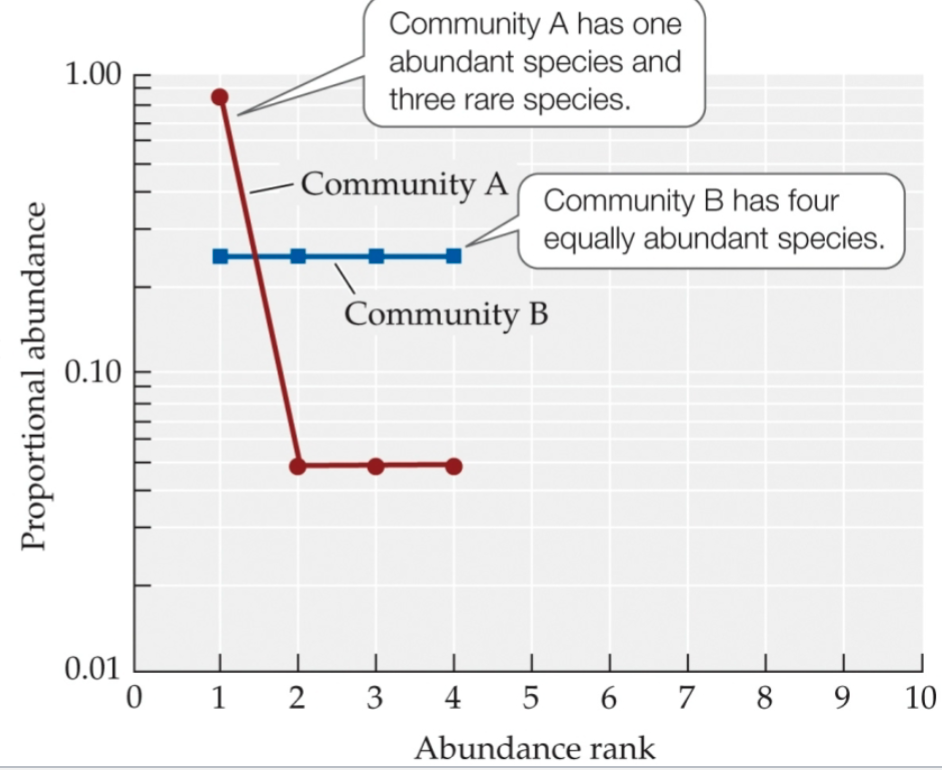
Define and graph rank abundance and species accumulation relationships.
Define species composition and explain why it is an important characteristic of communities
Compare direct versus indirect species interactions and describe the effects they have on communities.
Explain how species interactions can vary in strength and direction, and how these attributes can be measured experimentally.
Strength:
Compare foundation species, keystone species, and ecosystem engineers and the effects they have on communities under different environmental contexts
Keystone species: have strong effects because of their role in a community (ex. otters)
Foundation species: Large, abundant species that provide food or habitat for other species. Species that “are the environment” (ex. trees)
Ecosystem engineers: Actively change the environment, physically (ex. Beaver)
Describe how energy flow among trophic levels in an ecosystem is related to the food selection consumers
Explain how both primary production and detritus can be at the base of food chains
They can only be eaten.
Evaluate how terrestrial detrital energy inputs from outside an ecosystem (allochthonous) would change in a river from its source to where it reaches the ocean
Allocating energy in different areas.
Describe how the relationship between biomass and energy is influenced by the life span of primary producers
Shorter life span, abundant, more energy.
Summatize the factors that may influence why a greater proportion of net primary production is consumed in aquatic ecosystems relative to terrestrial ecosystems
Evaluate how consumer thermal physiology, body size, diet preference, and digestive specialization can determine trophic efficiency
Based on diet.
Compare the factors that influence energy flow in an ecosystem between bottom-up and top-down perspectives
Consumption, fitness, birth rates,
Describe how changes in the abundance of organisms at the fourth trophic level may impact rates of primary production through a trophic cascade
Explain how the size of an ecosystem, the rates of disturbance, and the amount of primary production can influence the number of trophic levels
Explain how food webs are helpful for envisioning ecosystem energy flow, and outline the factors that compromise their accuracy in portraying the full extent of interactions among organisms
Describe how the use of interaction strengths can aid in the construction of more accurate food web models
general strength of individual interactions those are the primary ones. Impact strengths shows how much of an important certain organisms have in each other. In cooperate it into an equation, understanding which one has a greater strength.
Summarize how ecologists have viewed the relationship between the complexity of food webs and the stability of associated communities and ecosystem processes
More complex food webs = stable community