MAE 130C - Turbulent Boundary Layers
 Call Kai
 Learn
Learn Practice Test
 Spaced Repetition
 Match
Match Flashcards
 Knowt Play
1/15

There's no tags or description
Looks like no tags are added yet.
Name | Mastery | Learn | Test | Matching | Spaced | Call with Kai |
|---|
No analytics yet
Send a link to your students to track their progress
16 Terms
Describe the physical difference between laminar diffusion and turbulent "mixing."
laminar diffusion is when there is momentum transfer between travelling layers of fluid due to random motion of molecules. Turbulent mixing is when the transport of momentum between locations is due to eddy motion causing fluctuations in the flow
Why is a turbulent boundary layer more resistant to separation than a laminar one?
Turbulent mixing transports high-momentum fluid from the outer flow toward the wall. This creates a fuller velocity profile with higher momentum near the wall, allowing the flow to better overcome adverse pressure gradients and delay separation.
Physically, why does a turbulent boundary layer grow much faster in thickness (δ) as it moves downstream compared to a laminar boundary layer?
Turbulent eddies mix high-momentum fluid from the outer flow down toward the wall and low-momentum fluid away from the wall. This enhanced momentum transport causes the velocity profile to spread out more rapidly and the boundary layer thickness to increase faster downstream.
What is Reynolds decomposition and why is it used?
A mathematical way to separate a flow variable in a turbulent fluid into a mean part and a fluctuating part. It is used to derive the time-averaged Navier Stokes equations and enable turbulence modeling
What are Reynolds stresses? Are they actual Newtonian stresses?
Reynolds stresses are apparent stresses that arise in the Reynolds-averaged Navier-Stokes equations due to the correlation of velocity fluctuations. They represent turbulent momentum transport and are not true Newtonian stresses
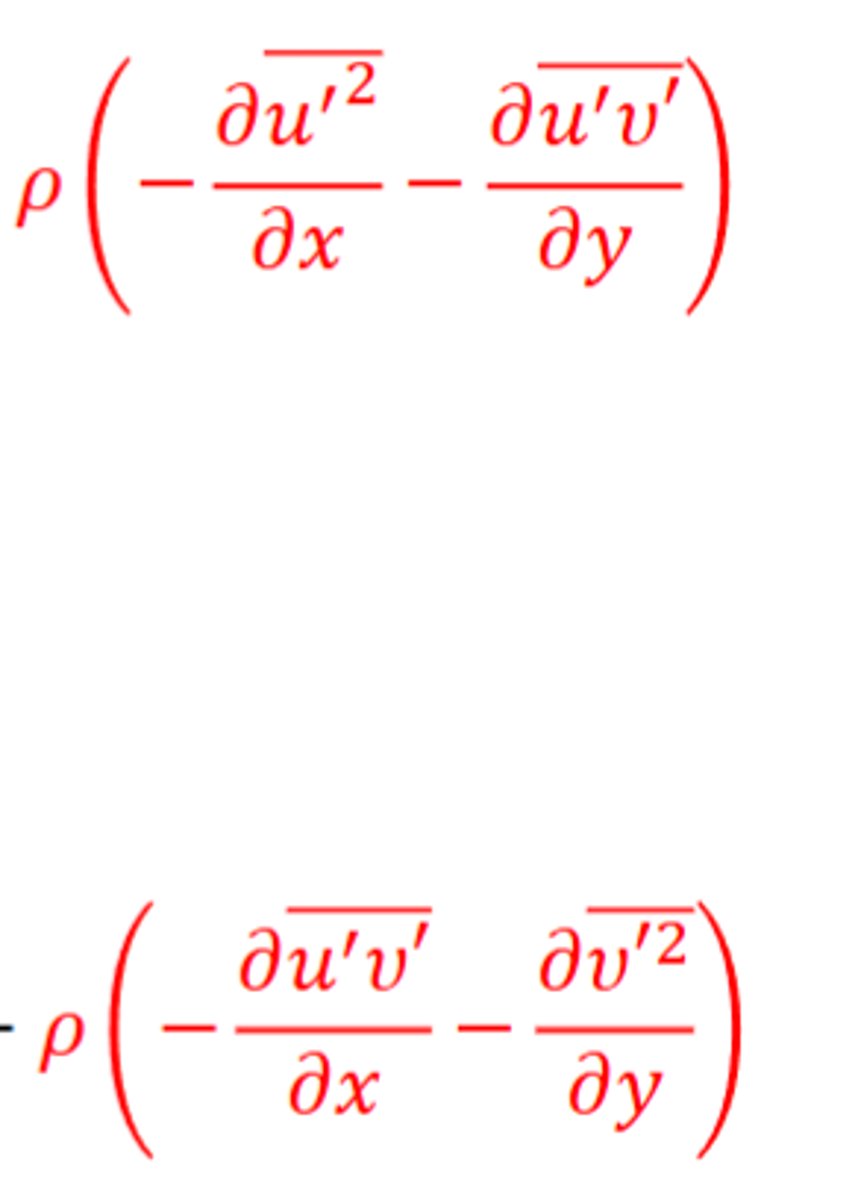
Briefly describe the "closure problem" encountered in the Reynolds-Averaged Navier-Stokes (RANS) equations. Why can we not solve these equations exactly without empirical models?
Reynolds averaging introduces additional unknowns (Reynolds stresses), resulting in more unknowns than available equations. Therefore, the system cannot be solved exactly and requires turbulence models to express these stresses in terms of mean flow quantities. Without such models, one would need to solve the full instantaneous Navier-Stokes equations and know the exact velocity fluctuations.
What is the physical significance of the Viscous sublayer?
The viscous sublayer is the region very close to a wall where turbulent fluctuations are strongly damped due to viscosity. In this region, momentum transfer is dominated by molecular (viscous) shear rather than turbulent eddies, and the velocity profile is approximately linear. It plays a key role in determining wall shear stress and skin friction.
In the "Log-Law of the Wall," what is the "Friction Velocity" ?
A velocity scale defined from the wall shear stess uτ=sqrt(τw/ρ)
Why does the turbulent velocity profile look "fuller" or flatter near the centerline compared to a laminar profile?
The turbulent velocity profile is fuller because turbulent eddies enhance momentum transport across the flow. This mixing transfers high-momentum fluid from the core toward the wall and low-momentum fluid away from the wall, reducing velocity gradients and producing a flatter profile compared to laminar flow.
How does the growth rate of a turbulent boundary layer (δ ∼ x^4/5) compare to a laminar
one (δ ∼ x^1/2)?
The turbulent boundary layer grows faster than a laminar boundary layer
What is the role of "Eddy Viscosity" in turbulence modeling?
It represents the enhanced momentum transfer caused by turbulent eddies. It treats the effect of turbulent mixing as an effective viscosity, allowing Reynolds stresses to be related to mean velocity gradients in a form analogous to molecular diffusion of momentum.
Explain the concept of the "Intermittency" region at the outer edge of a turbulent boundary
layer.
The thin, fluctuating zone at the outer edge of a turbulent boundary layer where the flow alternates between turbulent and non-turbulent (free-stream) fluid.
Why is the skin friction coefficient (cf ) significantly higher in turbulent flow than in laminar flow at the same Reynolds number?
Because eddy motion in turbulent flow greatly increases momentum transport toward the wall, the wall shear stress and therefore skin friction increases
What physical parameters determine the transition from laminar to turbulent flow on a flat plate?
Reynolds number (intertial forces dominate viscous forces), surface roughness, vibrations, and pressure gradients
Describe the "1/7th Power Law." In what region of the boundary layer is it most applicable?
An empirical velocity profile for fully turbulent boundary layers, mainly valid in the outer region, where it approximates how velocity increases with distance from the wall.
If you increase the surface roughness of a plate, how does it affect a turbulent boundary layer versus a laminar one?
Roughness significantly increases skin friction drag by enhancing momentum transfer in the near-wall region and disrupting the viscous sublayer, leading to higher wall shear stress. (Surface roughness only causes a laminar BL to transition to turbulent if large enough)