Sources of Executive Power & Rule of Law
 Call Kai
 Learn
Learn Practice Test
 Spaced Repetition
 Match
Match Flashcards
 Knowt Play
1/35

There's no tags or description
Looks like no tags are added yet.
Name | Mastery | Learn | Test | Matching | Spaced | Call with Kai |
|---|
No analytics yet
Send a link to your students to track their progress
36 Terms
Constraints on public power:
Electoral constraints
Political constraints
Constitutional conventions [limits not really a source of power]
All aren't really law eg legal rule that’s enforceable by the courts
The Rule of Law
No-one is above the law
No one sits outside of the reach of law, subject to it in the exact same way
The law applies to public officials in the same way as ordinary citizens.
Everyone is equal before the law
At the time this was created/proposed a lot of European countries had officials that had separate laws
Had different immunities, act without consequences.
He didn't like that the state with its power could make law that affects society without the constraints.
Not technically true eg the PM can do things we can't but it is specifically authorized in some way.
If it is necessary that official does something outside of the ordinary course [or has immunity etc] this needs to be expressly + specifically provided by law
Doesn't really breach the principles of same law applying -> would apply to us if we were PM.
Rule of law obviously applies to PE
Public law constraints are there to prevent PE from exercising public power in an arbitrary way
Reality: Govt can find a process to allow them to do what they want
***Entick v Carrington*** |
No right of the government to trespass
'if it is law, it will be found in our books. If it is not found there, it is not law'.
Facts:
Entick liked to publish newsletters, that were critical of the government [no right to freedom of expression, criticizing the govt = crime]
The Secretary of State wanted to lock him up -> ordered for Entick's private home for evidence -> Carrington was to do this, broke into the house and damaged and removed a bunch of personal items.
Entick sued in trespass [property law]
Becomes a public law case because of the excuse.
Carrington argued:
The Government told me to. The Secretary of State told me to -> allowed to because I was given permission/should do by the Sos
SoS issued a warrant so I fulfilled it - it has to be fine I've never been told it's not ok.
Under what authority can the Secretary of State do this?
Argument 1: The govt needs to do stuff like this to get stuff done
There is not but we are the Government excuse it needs to be said in the law that you can. It's not enough to just be the government.
'if it is law, it will be found in our books. If it is not found there, it is not law'
There are other non-statutory authorities. But in this case they are saying we can't see evidence of this law.
Carrington liable for trespass. Law applies to public officials in the same way as ordinary citizens
It's important not to just follow what the government says you can -> see what legal basis they have to say that.
Key points:
The Executive branch is bound by the ordinary law
Technically the crown is not bound
If the Executive wants special powers, there must be a lawful basis for those powers.
Parliament is not likely to pass laws that breach rights -> citizens will protest and criticize.
If the exec wanted it they could outline specific situations where it can be used e.g. reasonable suspicion. In built restraints
The courts determine what the law says; e.g. is there special legal authorisation, if not what are the consequences of acting contrary to the ordinary laws of the country.
If the SoS said it’s the law, it looks like arbitrary power law might as well not apply to you.
Entick in a modern context |
Webster v Police |
|
Entick in a modern context- Otago University Proctor. |
Mr Scott, was delivering leaflets for the student area, could see drug paraphernalia on the kitchen table [no drugs present], decided to enter through the sliding door and removed the stuff and disposed of it, thought students would rather deal with him than Police. Private property populated by students. Could only do it if there's legal authority. It's not illegal to own a bong, it's a fancy piece of plastic lol.
He didn't have authority to do this.
Proctor thought that because he was proctor he had right to enter into the private property and confiscate the stuff
See Edward Willis newsroom Otago proctor have a read if interested.
2 concerns about how power is used.
Abusive [bad] use of political power [not really a huge in NZ, we are pretty stable in our democracy]
Arbitrary use of political power [where it doesn't have a valid public interest purpose]
Way to determine if it is arbitrary = whether there is a legal authority for power
If none, you are acting arbitrarily, may be a good thing but even so if there's no basis its arbitrary
Fitzgerald v Muldoon |
Superannuation contributions
Bill of Rights 1688
Facts:
Labour passed compulsory superannuation scheme, where people had to pay, so when retirement there's money and invest it = more money than we started with
Muldoon campaigned on getting rid of this scheme - saying it will be done immediately will cancel it and everyone will get money back
Won election was PM and Minister of Finance, parliament not due to meet for a number of months, legislation was a while away
Muldoon makes announcement and says that its to be repealed in retrospect to this day of announcement
Employers to stop paying it immediately
Issue
Muldoon is telling people to do something against the law (as it's not been passed by parliament)
Fitzgerald argued based on:
Bill of Rights 1688 [imperial law], historical reason for parliamentary sovereignty -> remember all of the William of Orange stuff from laws101. Only got to be King if he signed it.
Section 1: says parliament is the only one who can change or make law -> Regal authority alone is not good for this.
This is what Muldoon did, PM cannot change legislation by himself
Supreme Court [Nowadays High Court] said:
PM's press statement was illegal
He was purporting to suspend the law without consent of parliament, parliament has made the law, therefore the law could be amended or suspended only by Parliament or with the authority of Parliament.
No lawful authority for what Muldoon wanted to do.
The rule of law requires that there is a legal source of power and say this is the source of authority.
Muldoon acted in breach of rule of law. = acting arbitrarily
May have been doing what the general public wanted but did so arbitrarily.
Remedy - adjournment
It was clear that Parliament was going to change the law, so there was no point in making them do something that would be undone later
Pragmatic or constitutional realism for outcome
Fallout - politics vs law
Muldoon was not happy with this decision, thought his authority was being under cut.
Did an interview and said that the chief justice got it wrong. -> if he actually believed this then he should just appeal it. CA would've just said the same thing
Fundamental principle - Only Parliament can legislate
Political exec is powerful and wide reaching in our lives, they can do virtually anything, it can't however legislate unilaterally, only parliament can legislate.
Example of separation of powers principle
Similarly Jacinda Ardern for lock downs said about travel limits and way said that made punishment - held the same thing.
Sources of Executive Power:
Statute
Legislation passed by parliament giving authority
Prerogative
Do what you want, from royal prerogative powers there is now a list of things that the government can do, recognized by common law
The 'third source'
Kinda like prerogative but kind of different -> Government can do anything that is not otherwise unlawful. Eg Government doesn't need authority to enter into a contract because it can do anything that a legal person can do.
How they authorize the state and what limits they impose.
When you are dealing with Public Power principle to keep in mind: no lawful power is unfettered, if something looks like it is broad and doesn't look like it has restrictions on it, it still probably does.
More generic the power the more the courts will read into restrictions.
Statute as a source
most of the things that government can do is authorized by legislation [vast majority]
In context of modern govt, the govt needs to be allowed to do things and parliament is the one that can adapt the most
Parliament legislates
Govt has majority in the house and thus can 'pass anything' so duh they can do it
BUT point in inquiring further, parliament hardly says do whatever you want, they are trying to fix a problem through giving power to the govt for a particular purpose, so they build restrictions to help achieve that purpose.
Need to look at statutory interpretation: text, purpose, values and context, need to look how the purpose shapes the text
But the courts interpret
Courts have authority to recognize legislation and interpret it, need to understand the separation of powers
Questions to ask yourself (statute/power)
What is the power for?
Purposive interpretation
Purpose section
What a reasonable and rational parliament would want to promote
Can't leverage power for one purpose to use it for another that isn't allowed
Are there any express limitations?
Built into statute about how the power is intended to be used
Eg Webster v Police all the requirements had to be satisfied; expect that there are restrictions on entering private property as it’s a pretty big deal
Are there any implied limitations?
May not be obvious on face
The broader the power appears the more likely there are implied limitations,
is power being exercised reasonably
Always think of NZBORA limitations, infringing on rights to the minimum extent possible [sections 5 and 6]
Eg going to be fine to put safety measures in, but can’t lock down prisoners for 23 hours a day because of human rights
Borrowdale v Director-General of Health (Example) |
Health Act empowered the DG of Health to take certain actions in the case of certain occasions
Powers were very broad to protect against pandemics.
Makes sense, pandemics are unpredictable and want a degree of flexibility.
This led to broad orders -> whole cities locked down, only necessary businesses open, most deeply reaching powers the state has imposed in recent history because of how broad and type of power they exercised.
Borrowdale said there should be some implied limitations to these powers to claim that DG was exceeding his powers.
The response was very successful, to have the court even running at the time, it would be brave for the courts to say they went wild with their powers [shows us which way this will go]
Borrowdale's argument:
Orders were to lock everyone down, Borrowdale thought it should only apply to individuals or classes of people, the only way this can be read consistently with HR of freedom of movement you'd have to give classes of people.
Only allowed to lock down/isolate people who are infected or it's highly likely they'll test positive, the scheme implies this, makes sense from HR perspective, freedom of movement shouldn't be restricted if you aren’t sick.
In terms of businesses that can operate, doesn’t think that they could say any place of business must cease trading unless you are on this list of exceptions [eg supermarkets etc], shouldn't be negatively worded, should have to positively say X must because of Y [much more prescriptive and time consuming but we had to act fast]. It's too draconian to act in this way.
These are credible arguments, and have some merit to them.
Arguing that broad ranging powers are dangerous, if we interpret them in the way the govt applied them we aren't ensuring the restrictions that ensure that the govt don’t use them unconstitutionally or arbitrarily.
Court says:
CM56 or 57, this isn't an unfettered power, worded broadly, needs to be a degree of looseness, for the purpose they needed to be able to do this to save lives = this is the sort of purpose that the govt should use it for
It's not unfettered; it's only to be used when there's a pandemic, or state of emergency that the govt of the day must declare [level of political oversight] = limitation on when the powers can be used.
Note: Ed's not sure who had the correct argument from a public law perspective, court likely wasn't going to go against what was considered a world leading response that saved heaps of lives.
Royal Prerogative as a source of executive power.
Can be unclear what the prerogative actually is but;
Those non-statutory rights and powers that only the Crown has (by virtue of being the Crown)
Stuff we never got around to replacing with a statute -> in an ideal world we would have put all power put into a statute.
Gives the crown some leeway/discretion
Sorts of powers that political accountability may be preferred than rather than legal accountability
Historical precedent
Tussle between Parliament and King, Parliament said they have right to legislate but King says I have residual powers that I can exercise (typically gets advice as they are large things) -
Recognized by the common law
Therefore common law powers, but not created by the judiciary, they just recognized the historical powers that are there already. Can only recognise pre-existing powers.
The Crown should point out where it happened in the past and if they can't, courts can't say well what you want to do is ok.
If the court does not think it’s a prerogative power then it's not.
Examples of the prerogative:
The office of the GG and EC is constituted by a prerogative instrument (Letters Patent [form of legislating by the Crown]) - e.g. there will be a GG, they appoint ministers and they serve the Sovereign.\
Appointment of ministers
Organization of the public service
The way the government conducts itself is a matter of prerogative [how it's set out]
Want for below for the govt to have more discretion over these areas
International relations
Foreign minister should be able to travel and meet other ministers eg in us and talk about what they want,
Trade deals etc
Matters of national defence and armed conflict
Going to war, do we need to do anything to ensure the security of NZ etc.
Prerogative of mercy
Govt retains discretion to pardon anybody convicted of a crime and being punished. [already gone through court system, so they petition to the crown to get pardoned]
May even get compensation [determined by minister of justice]
Prerogative can be replaced by statute:
Because of Parliamentary sovereignty, Parliament can choose what laws they want to pass.
Can modify the prerogative
Expressly extinguished
Rule of law reasons; you want it to be in statute, easy to find and read and know what the Crown can or can’t do.
What happens if statute extinguishes power then is repealed? Does the prerogative come back?
Arguments on both sides
yes, we need some source of power
No, parliament chose to repeal it and can replace it.
Not aware of any case where this actually has happened.
Impliedly extinguished if statute 'occupies the field'
If a statutory regime is put in place that does all the work the prerogative did then it occupies the field and the prerogative has been impliedly repealed.
Thus legislation prevails.
Good because you don't want the govt to pick and choose which power
De Keyser’s Royal Hotel (UK) |
Can't pick and choose between statute and prerogative
Facts:
Britain at war
The government has requisitioned a hotel to house soldiers, they could do this because of the Defence of the Realm Act 1914 (passed when WWI was ongoing), was said we can take these buildings and use them for military purposes.
Govt after war, there is a schedule of compensation payments that can be dished out
Crown refused to pay
Owners wanted their compensation
The Crown argued they were acting under the royal prerogative not the Act.
The House of Lords says you 'can’t pick and choose b/t the statute and the prerogative.’
Act covers the field where prerogative sat, prerogative was extinguished, only way that you could take the hotel was under legislation thus you are bound by the statute.
Makes sense from a rule of law perspective, govt can't choose which law/source applies, legislation just prevails.
Legal accountability with the Royal prerogative
The source of government authority does not determine justiciability
Judicial review -> courts giving effect to what parliament intended in relation to government actions.
-> works well for statutes passed by parliament but, prerogative is historical, there's no parliamentary intent. Used to be assumed that prerogative could not be reviewed by a judge and not really a legal standard there, not a legal question.
Council of Civil Service Unions (Uk) |
PM (Margarat Thatcher) made rule that no members of a spy agency could not join a union
Said was a matter of national security [going on strike would be detrimental to national security efforts]
CoCSU said that there was no consultation and it was unlawful.
House of Lords said;
'the source of government authority does not determine justiciability'
Courts can look and see if action was lawful - important when it comes to existence and scope of prerogative powers. Source is common law, so whether or not it exists and how it should apply is a legal question.
Where it gets tricky, Miller n.0 2
Gets tricky; Is there a prerogative power? -> yes -> stop being justiciable really quickly -> might not be able to be reduced to legal question easily
Eg matter of international relations, prerogative of mercy, don’t want to legalize a process that is of political judgement.
See example below
Miller number 2 |
The prime minister tried to prorogue parliament (pause parliament) around the time of Brexit. Prerogative power that the PM advises the Queen to action, PM had no good reason to do what he had done (it was arbitrary = unlawful). |
Existence and scope of prerogative are legal questions
Substantive exercise may also be a legal question.
Can't exercise prerogative arbitrarily but if you have some political reason courts will probs say its ok.
Political accountability with the royal prerogative
Non-justiciable prerogative matters will be held politically responsible in same way that ministers are kind of
Cabinet, Minister, govt stand up behind the exercise of the prerogative and stand on it be open to criticism and put credibility of their decision making in an election.
Political exec is always responsible
If law cannot help with judicial review the political responsibility would be helpful, -> parliament may legislate etc.
International Law as a feature of the prerogative and its interaction with the NZ legal system
A feature of the prerogative
Govt can join treaties and talk with other countries
Makes sense because we want effective government action, don't want paralysis because of too much checking but also don't want arbitrary power being used. We don't necessarily need a huge amount of checking in terms of international law/relations.
Some parts of the deal e.g. trade information may be confidential -> don't want other nations knowing everything about our bargaining position.
Want the government to have freedom to act
Mostly will be held accountable during elections if people don't like what they've done
Legal scrutiny and accountability is important
The Louisiana purchase (as an example):
Presidential powers unclear
President negotiating with France (Napoleon), to purchase land that was controlled by France.
France offered to sell whole thing because they needed money
The president should have gone to congress and asked for the money [they endorse public spending]. BUT there would have been debate, scrutiny etc that would have taken so long and tested patience of the French
Endorsed after the fact (when its really important to act fast)
Made a purchase anyway then asked for it to be endorsed after the fact by congress.
Different context of legal system but displays heads of state making decisions and acting quickly in international relations.
Our govt can negotiate with other countries etc due to the royal prerogative
International law instruments
Trade (bilateral and increasingly multilateral)
Free market with Australia, removes a lot of barriers.
For ages you'd negotiate one on one with the country
NZ wants to remove as many barriers as possible -> we want free trade to be able to share our food, wool, dairy products etc.
Now trying to do multilateral arrangements; CPATPP (transpacific countries, Canada, Aus, UK +) open up trade etc a lot more easily.
Human rights and other vital interests (multilateral) -[diplomatic]
Signatories to act respecting the rights of their citizens
International communities agree they are important.
Diplomatic immunity -> Vienna convention -> made on prerogative but now its statutory basis
Act as frameworks for international relations.
Eg why we have NZBORA -> gives affect to HR stuff we've signed in the international context
Membership to international bodies
Eg UN
Dualism (International law)
A consequence of parliamentary sovereignty
[legislature putting the international treaty into domestic law]
Parliament to have final say, Exec must say this is the best deal we have please ratify it. (usually will because exec have majority and their MP's will support it, -> India trade deal right now not though because NZFirst doesn't want to)
If parliament says no -> may have a bad reputation [if they don't want to deal] or you go back and negotiate more to make it work.
Important for scrutiny and accountability
We get a voice as we can make submissions
Monist theory: internation law
There is no distinction between the legislature and executive, once the executive government of a nation has agreed to an international arrangement it becomes binding as a matter of law.
NZ does not subscribe to this.
International law needs to go through 2 steps to become apart of our domestic law:
Exec agreeing internationally
Legislature to put it into domestic law
International implications of non-compliance with international obligations
If we enter into agreements at an international level and we breach them we would possibly have/get:
Reputational damage
Eg why would we trust them and deal with them?
HR context: NZ representatives go to different places and have to stand up in front of the world people and show what we have implemented
We have credibility as we like to follow what we have agreed to. Other nations may follow along if we are.
Tariffs and taxes
Economic retaliation.
Judicial role.
For unincorporated treaties: Courts can't just apply the arrangement because of dualism [not apart of NZ law just yet], but they [especially for rights based ones] will not just leave it be or not try and give effect to do it: so they do such:
Presumption of consistency (interpretive approach)
Lean towards a rights affirming interpretation of the statute [think like section 6 NZBORA]
Slightly stronger approach
Mandatory relevant consideration (judicial review approach)
Take into account the commitments the government has made, no obligation to give effect to it.
If we have statutes put in place to give effect to international agreements [rights typically] can look at the agreement to see purpose and perhaps give interpretation to words.
The third source
The third source does the least work but is the most controversial [especially in relation to rule of law]. (Can be misused, not a positive power [residual]), Govt won't rely on it for a major policy change.
Residual or 'ordinary person' power
The executive government can take any action that is not specifically authorized, as long as it does not do anything that is expressly prohibited or breaches someone's rights.
Different from prerogative because it's about doing very ordinary things not government things.
Eg ordering pens, they don’t have anything that tells them they can do it because any normal person can do that.
Provision of information -> govt can tell us about what is going on, so long as they just provide information they aren't breaching rights or laws. {if they direct people to take action though they may be breaching if there is no power source they can point back to}
Scope of the 3rd source
Quite narrow
Doesn't cover 'government things' that ordinary people can't do.
Eg taxation, ministries etc
Doesn't cover incidental powers
(where it's necessarily incidental to do x to complete the goal of the statute) Govt are allowed to do this but it comes from statutory authority
If its non-governmental things and not incidental to statutory authority there's not a lot left
No need to engage the 3rd source.
Classic examples are ordinary contracting and information provision
contracting out management of prison facilities, question is can you contract for this (something typically only the government can do) or do you need some other source of authority (Probably). Typically we only do this for building maintenance.
There is a line where the 3rd power stops and another power must step in eg legislation.
Can't contract political responsibility [eg if a private company was to run our prison and something happens]
Thus these ^^ are why we can accept it
Controversy surrounding the 3rd source
Inconsistent with the rule of law, because it's not specifically authorized
If govt can do what they want without positive legal authority, may risk arbitrary use of power then abuse of power
But pragmatically very useful, and risk of abuse diminishing
Impossible for parliament to anticipate everything that needs to be done by the executive -> third source is a good safety net
As there is more legislation and increase in legislation authorizing govt power and recognition of where 3rd source abuses can happen thus legislation made to fill in, there is a lower risk of abuse.
Malone (older UK case) |
f such tapping can be carried out without committing any breach of the law, it requires no authorisation by statute or common law; it can be lawfully done simply because there is nothing to make it unlawful… see slide for the rest
FACTS: Police were tapping Malone's phone, he objected to it, said this is my private business, no legislation that regulated or restricted them from taking this action.
Nothing saying the police can't do it so it's legal [though a private citizen probably wouldn't succeed in doing it without being found out]
Not the most ideal outcome for rule of law it's Orwellian [think 1984]
Implemented a statutory regime of when police can tap phones.
More understanding of privacy rights.
Different when the state vs a person does it -> state has more risks to any other ordinary person tapping it
Hamed
After 9/11 police were encouraged to be vigilant and clamp down on domestic terrorism . Became aware of people training on this land and were concerned they were training to be terrorists, wanted to find out what the training consisted of. {Note: anyone can train as much as they want, not breaking laws}
|
Quake Outcasts |
Govt assessed homes to see how damaged they were: red zone houses, weren't able to return there because it was unsafe
The government response said if you were red zoned and insured then you have a bunch of repurchasing options [give a degree of financial assistance to those insured {doing the reasonable thing}].
Uninsured home owners in the zone could not receive government assistance [not all of them had made the active decision to be uninsured -> some people literally ran out the day before and had not yet been renewed.]
Quake outcasts argued that government could not redzone their properties because there was not statutory provision that allowed them to do this to peoples property
The government argued that they didn't need legislation authority, they are merely telling the people that their house is unlivable [providing information] -> it's the 3rd source.
The court said: The decision to red zone a house could not be third source as rights are affected. [Because they cannot live in the house and has no way to get recourse, an ordinary person cannot do this, it’s a serious decision by the state] -> you need statutory authority.
The third power is extinguished if legislation covers the field. (Canterbury Earthquake Recovery Act covered the field)
The statutory regime gives limits and restrictions which provides rights to the owners of the house.
You would be breaching peoples rights if you used the 3rd source when legislation exists.
International law obligations
NZ takes our international obligations very seriously
NZ must give full effect to a treaty or it will risk breaching its international obligations. Non-compliance places NZ’s international reputation at risk and exposes it to any applicable sanctions under said treaty.
Care must be taken to ensure that any proposed legislation does not inadvertently cause NZ to breach any existing treaty obligations
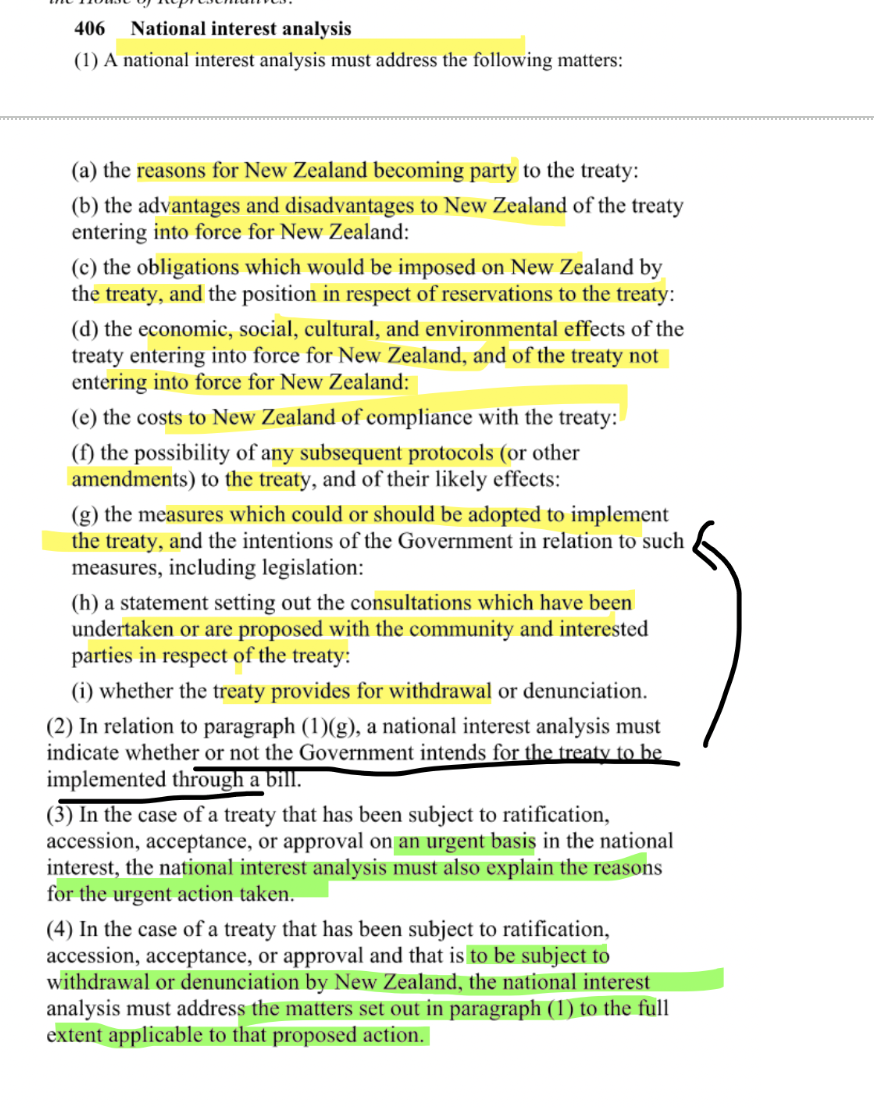
Limits on executive with international law (general and national interest analysis)
Any proposal to sign a treaty or take binding treaty action must be submitted to cabinet for approval (Cabinet Manual, 7.127)
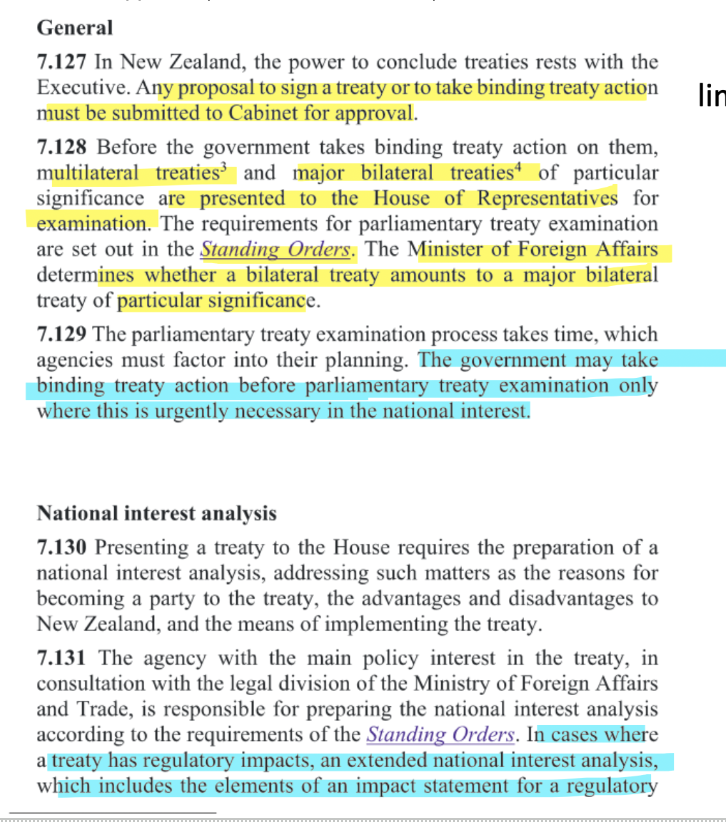
Limits on executive with international law (Select Committee consideration, related bills)
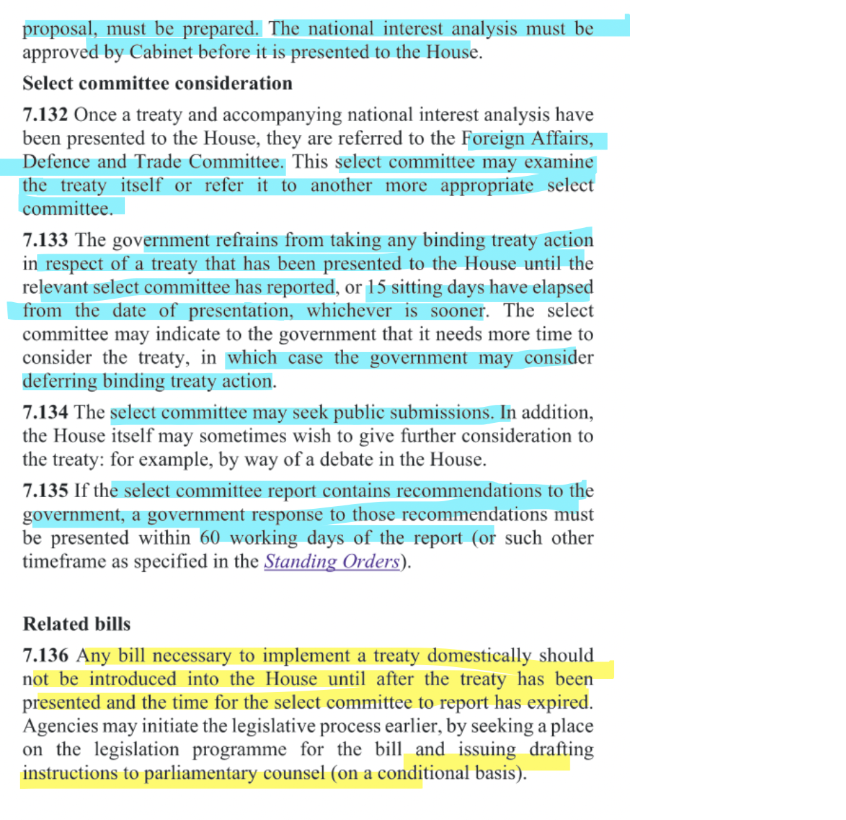
National interest analysis international law reading