ALL IB SL PHYSICS
 Call Kai
 Learn
Learn Practice Test
 Spaced Repetition
 Match
Match Flashcards
 Knowt Play
1/165

Earn XP
Description and Tags
Name | Mastery | Learn | Test | Matching | Spaced | Call with Kai | Chat |
|---|
No analytics yet
Send a link to your students to track their progress
166 Terms
That the motion of bodies through space and time can be described and analysed in terms of position, velocity, and acceleration
position: an object's distance and direction from a reference point, the coordinate on a number line
Velocity is the rate of change of position, and acceleration is the rate of change of velocity
velocity: the rate of change of displacement. velocity = change of displacement / time taken (v/u). Vector quantity
acceleration: the rate of change of velocity. acceleration = change of velocity / time taken (a). Vector quantity
The change in position is the displacement
displacement is the change in position, vector quantity. The displacement gives information on the direction of the change in position relative to the starting position.
displacement = final position - intial position
The difference between distance and displacement
Displacement: Vector quantity. The displacement gives information on the direction of the change in position relative to the starting position.
Distance: Scalat quantity. Distance shows the length of the path followed
The difference between instantaneous and average values of velocity, speed and acceleration, and how to determine them
Velocity
Average Velocity = total displacement / total time
Instantaneous velocity is the velocity (speed with direction) at a particular instant.
Speed
Average speed = total distance / total time
Instantaneous speed is how fast an object is moving at a particular point in time
Acceleration
Average acceleration = change in velocity / total time
Instantaneous acceleration is the rate of change of velocity at a single point in time.
To find instantaneous values, you look at a graph and find the value at a certain point (using the gradient or reading it directly from the graph)
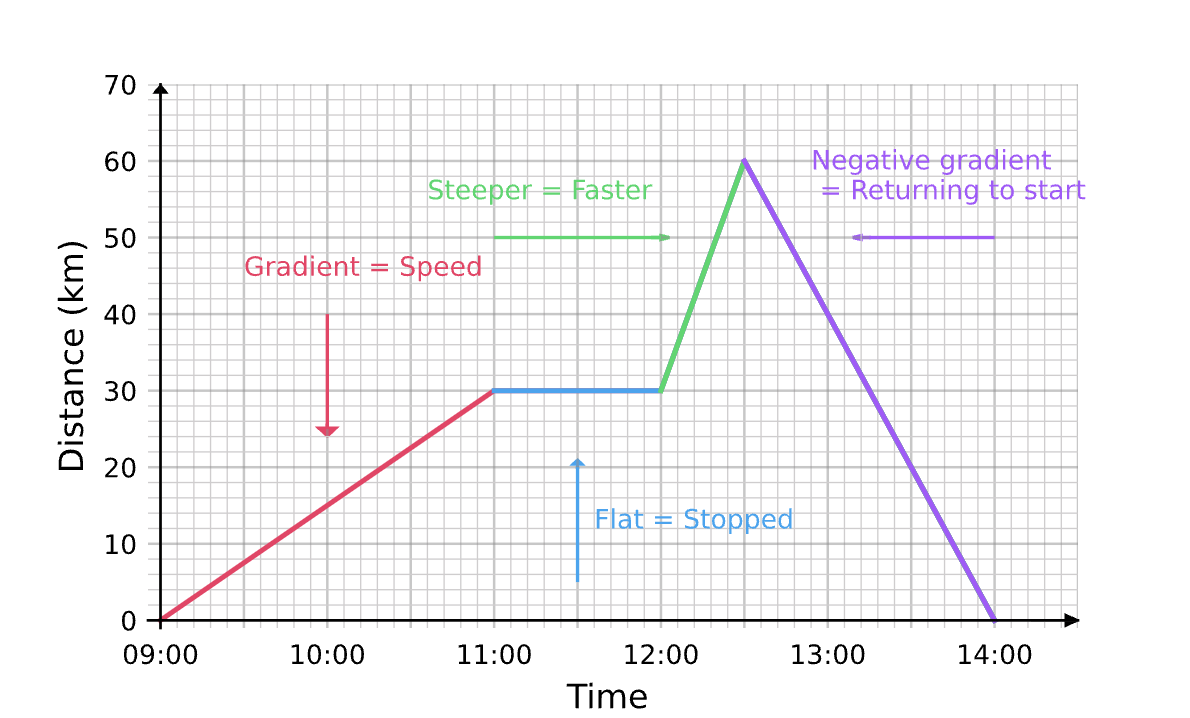
Displacement-time graphs
The y-axis represents displacement, while the x-axis represents time.
The slope of the graph indicates the object's velocity.
A flat line represents zero velocity, a positive slope indicates constant forward motion, and a negative slope indicates constant backward motion.
Velocity-time graphs
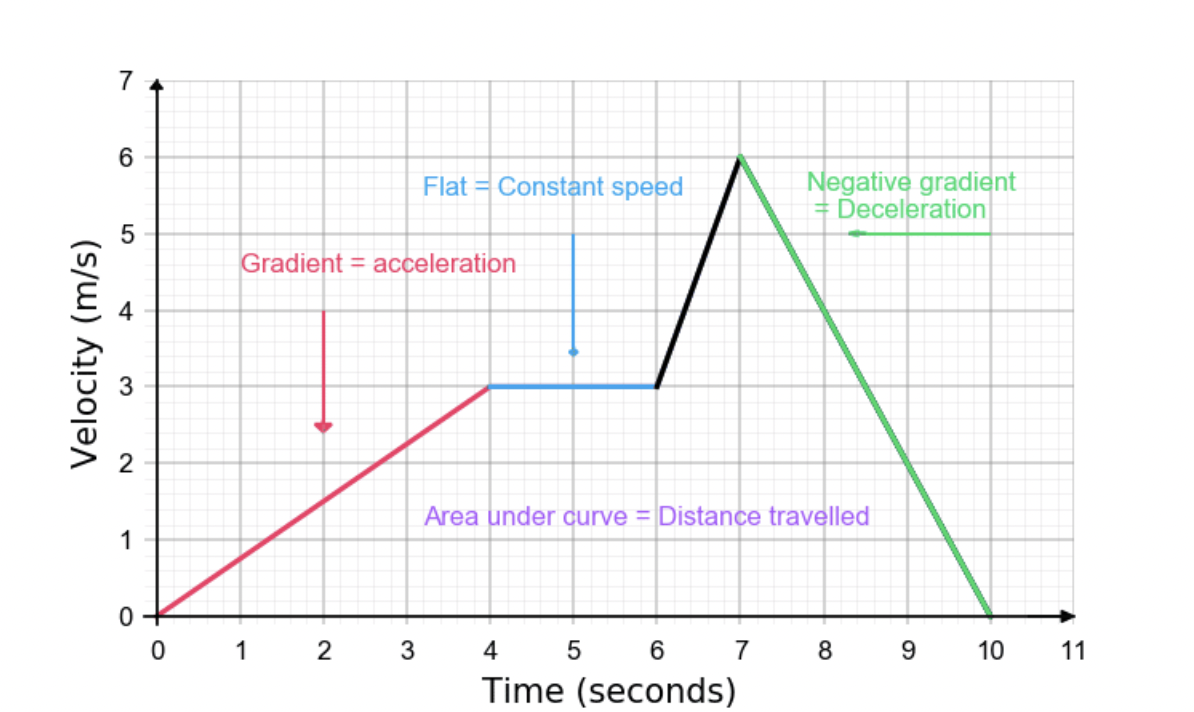
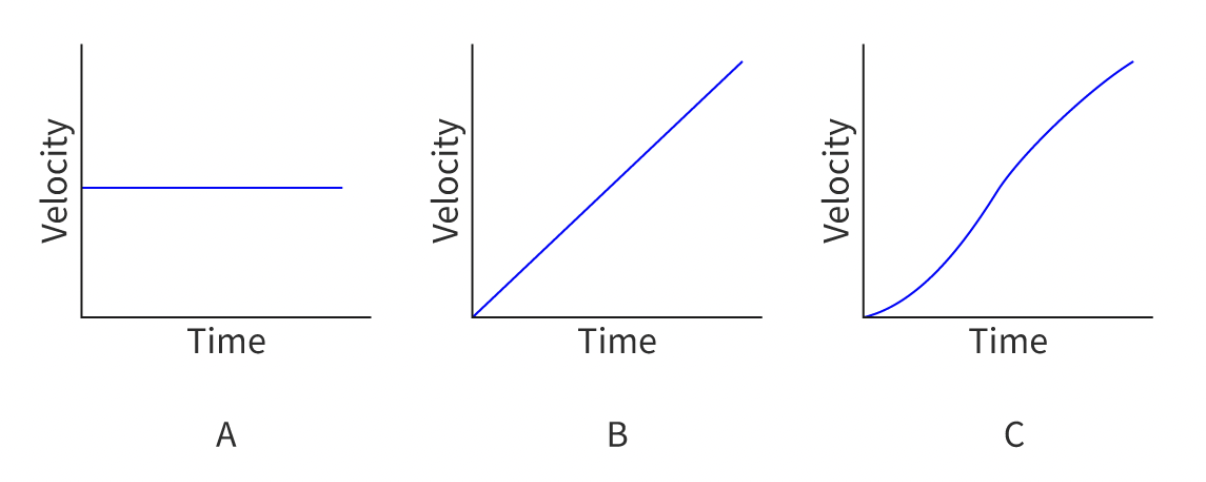
Graph that shows how an object's velocity changes over time.
Steeper slope = acceleration.
Flat line = constant speed.
Negative slope = moving backwards.
Area under the curve represents displacement.
acceleration-time graphs
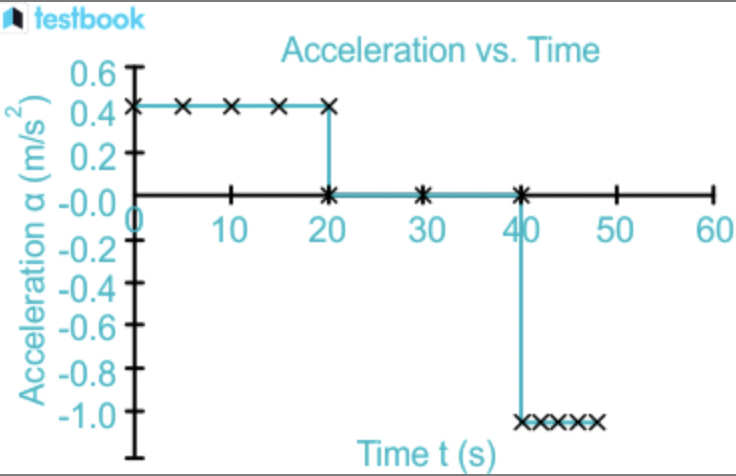
The slope of the graph indicates the object's acceleration.
A steeper slope represents a higher acceleration, while a flatter slope indicates a lower acceleration.
The area under the graph represents the object's change in velocity.
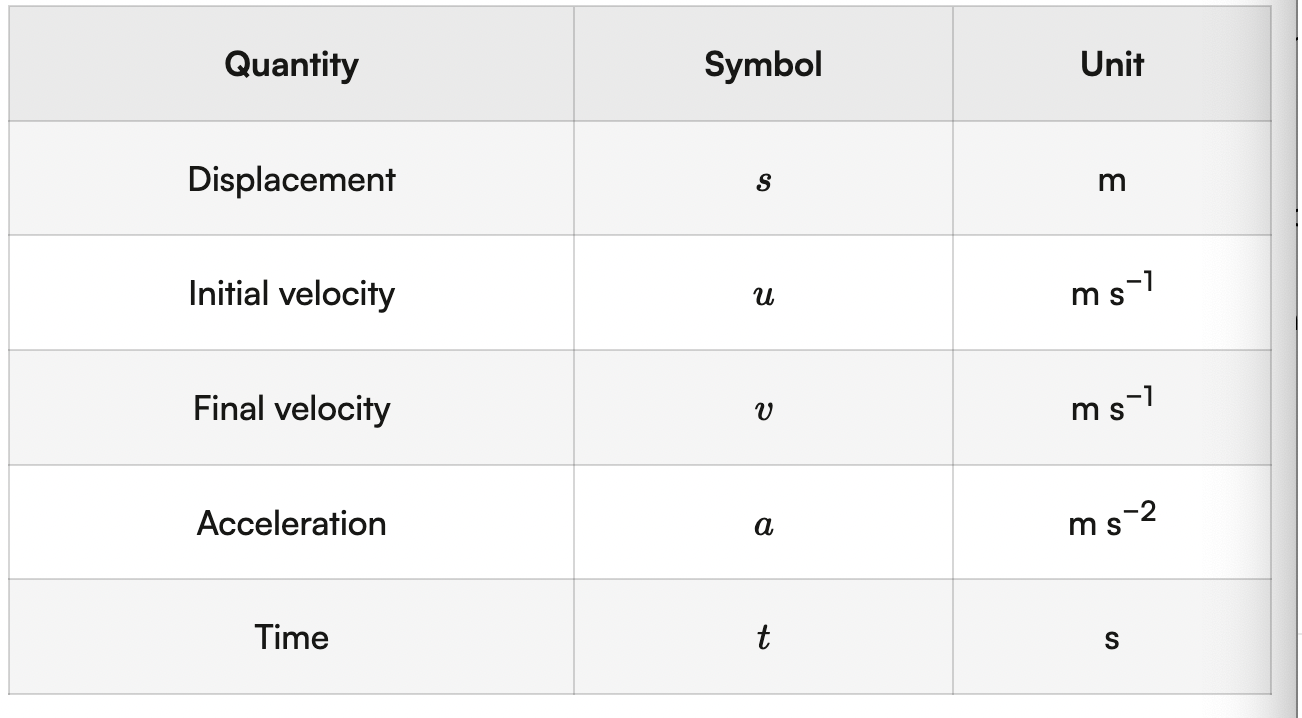
The equations of motion for solving problems with uniformly accelerated motion as given by s = (u + v)/2 *t, v = u + at, s = ut + 1/2 at^2 and v^2 = u^2 + 2as
u - initial velocity
v - final velocity
a - acceleration (constant)
t - time taken
s- distance travelled
Motion with uniform and non-uniform acceleration
a. uniform motion is motion with constant velocity
b. uniform acceleration = Velocity changes at a constant rate.
c. non-uniform acceleration = Velocity changes at a rate that is not constant.
The behaviour of projectiles in the absence of fluid resistance, and the application of the equations of motion resolved into vertical and horizontal components
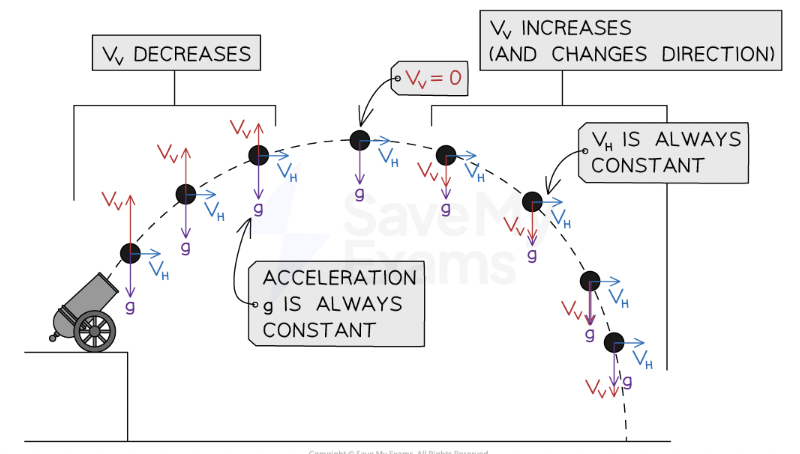
When a body is allowed to fall freely ignoring the effects of air resistance, it is called free fall. Bodies falling freely on the Earth fall with an acceleration of about 9.81 ms^-2 (g)
A projectile is a particle moving freely (non-powered), under gravity, in a two-dimensional plane. It is assumed that:
Resistance from the air or liquid (known as fluid resistance) the object is travelling through is negligible
Acceleration due to free-fall, g is constant as the object is moving close to the surface of the Earth
An object is sent into a projectile motion trajectory with a resultant velocity, u at an angle, θ to the horizontal. The trajectory of an object undergoing projectile motion consists of a vertical component and a horizontal component. These quantities are independent of each other
Vertical component = opposite = sinθ × hyp = u sinθ
Horizontal component = adjacent = cosθ × hyp = u cosθ
time of flight - uses vertical component when v=0 doesnt use s * by 2
maximum height - uses vertical component when v=0 finding s
range - uses horizontal component and the time of the flight (2u sin θ / g) and acceleration is zero. distance = speed * time
The qualitative effect of fluid resistance on projectiles, including time of flight, trajectory, velocity, acceleration, range and terminal speed
Fluid resistance refers to the effects of gases and liquids on the motion of a body. When an object moves through a fluid (a gas or a liquid), there are resistive forces for that movement, frictional force. Frictional forces:
Always act in the opposite direction to the motion of the object
Always slow down an object or keep them moving at a constant speed
- Time of flight: With air resistance, the object spends less time in the air.
It slows down the upward motion faster, and though it also slows the fall, the total time is usually shorter
- Trajectory: Without air resistance, the path is a perfect parabola. With air resistance, the trajectory becomes steeper and less symmetric
- Velocity: Air resistance reduces velocity in both horizontal and vertical directions. So, the object slows down more than it would without resistance.
- Acceleration: Gravity still pulls downward, but air resistance adds an upward or backward force, depending on the direction of motion.
This means acceleration is no longer constant — it changes throughout the motion.
- Range: The projectile travels a shorter horizontal distance because the horizontal velocity is reduced by air resistance.
- Terminal speed: As the object falls, air resistance increases until it balances the force of gravity. At this point, the object reaches terminal speed, a constant downward velocity where acceleration = 0.
Newton’s three laws of motion
First law: If the net force on an object is 0 on an axis, the acceleration is 0 on that axis and vice versa (if there is a nonzero net force on an axis, there is a nonzero acceleration on that axis). it tells us that if an object is slowing down there must be a nonzero net force slowing it if there were no forces acting on an object it would keep the same velocity forever
inertia means an objects tendency to keep its same velocity unless acted on by a force. objects with more mass have more inertia because it takes more force to change their velocity by the same amount.
second law: the net force on an object is equal to the mass of the object multiplies by the acceleration that the force creates. the acceleration always point in the same direction as the net force.
F = ma (Fx=max, Fy=may) (only works for net force, so find the forces acting on the object in the x and y direction (which equals the net force in that direction) and set them equal to ma)
this connects with first law since if net force is 0 acceleration is 0
Third law: if object 1 puts a force on object 2, object 2 puts a force with an equal magnitude and opposite direction on object 1
ma = ma (if one has a bigger mass than the other it would mean that the acceleration on the smaller object would be much larger than the acceleration on the larger object)
Force is the same but acceleration is different due to different masses
action-reaction pair is a set of 2 equal and opposite forces that are created by 2 objects interacting with each other. (x pushes on y, y pushes on x)
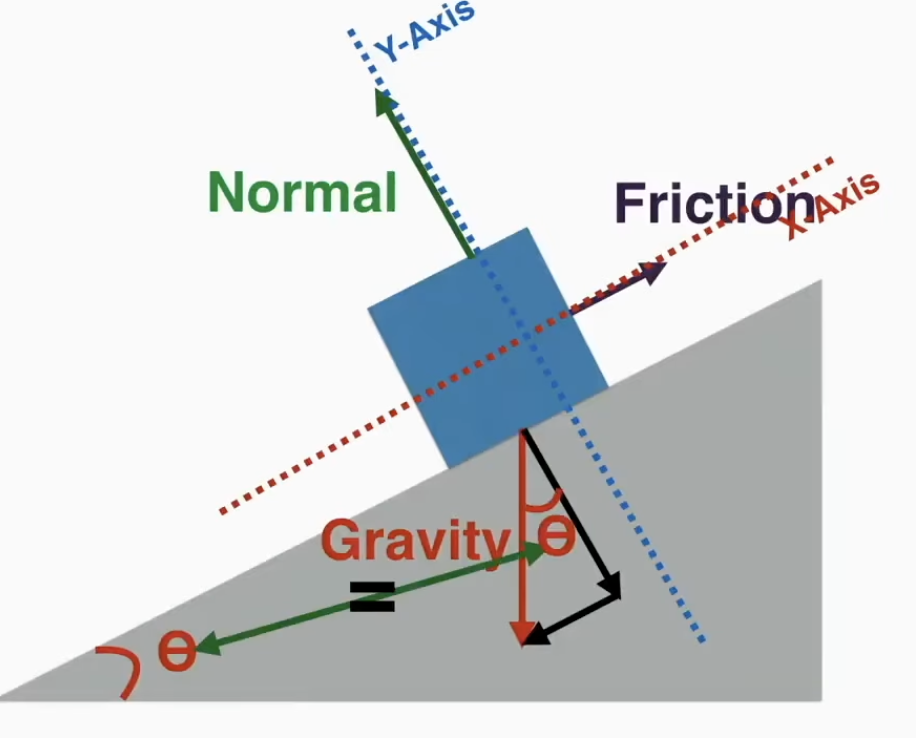
ramp problemss
normal
friction
gravity (mg)
rotate x and y axis so only gravity has a x and y component
if not moving then normal = y component of gravity and friction = x component of gravity
forces as interactions between bodies
A force is a push or a pull on an object, vector, measured in newtons (N)
add multiple forces together for net force (sum of all forces acting on an object)
that forces acting on a body can be represented in a free-body diagram
that free-body diagrams can be analysed to find the resultant force on a system
free-body diagrams use a box with vectors as arrows showing magnitude and direction of all the forces acting on an object (taking all x components and y components and using pathagoras to find net force)
Net force: total net force in the x direction and in the y direction (missing forces found is net force equals zero)
normal force FN is the component of the contact force acting perpendicular to the surface that counteracts the body
the force created by a surface to oppose a force pushing on it
normal force always acts at a 90 angle to the surface that is creating it
always matches the net force that is pushing he object into the surface
surface frictional force Ff acting in a direction parallel to the plane of contact between a body and a surface, on a stationary body as given by Ff ≤ μsFN or a body in motion as given by Ff = μdFN where μs and μd are the coefficients of static and dynamic friction respectively
The force created by a surface on an object that opposes the object's motion. Friction always acts parallel to the surface and in the opposite direction of the object's motion. Its strength depends on the material of the surface and the object itself.
Friction depends on the normal force acting on the object from the surface, and the material the surface and object are made of. the bigger the normal force the bigger the force of friction.
So the coefficient of friction (μ) is the ratio of the force of friction to the normal force. It depends on the materials the surface and object are made of. bigger coefficient of friction means bigger force of friction.
so: μ = Ff/FN meaning Ff = μ*FN
2 types of friction:
Static friction: prevents an object from moving. Balances out forces acting parallel to the surface of the object as long as those forces are below a certain maximum. Ff ≤ μsFN. (normal force can be found from weight and coefficient is given to find static friction. this is the maximum amount that the static friction can push back before it begins to move)
Kinetic friction: acts against a moving object's velocity. Always points opposite the velocity. Only depends on the normal force. Ff = μdFN (if velocity is more it will speed up and if kinetic friction if more it will slowly come to a stop)
The coefficient of static friction is greater than the coefficent of kinetic friction for any surface
Applied force (Fa) (dont have to know)
the force of a push or pull from a person or another object
Spring force (Fs) (dont have to know)
the force exerted on an object by a spring. the more the spring the stretched or compresses the more force acts on the object. a spring does not apply any force if it is at its natural length
Air resistance (Fair) (dont have to know)
When an object is moving through air, the air applies a force in the opposite direction. An object experiences more air resistance if it is moving faster or if it has more surface area.
A falling object reaches "terminal velocity" or its maximum velocity when the force of air resistance up equals the force of gravity down.
tension
the force created by a pull of a rope or string. tension always pulls in the exact opposite direction of the rope or string itself.
tension pulls with equal force and opposite direction on both ends of the rope
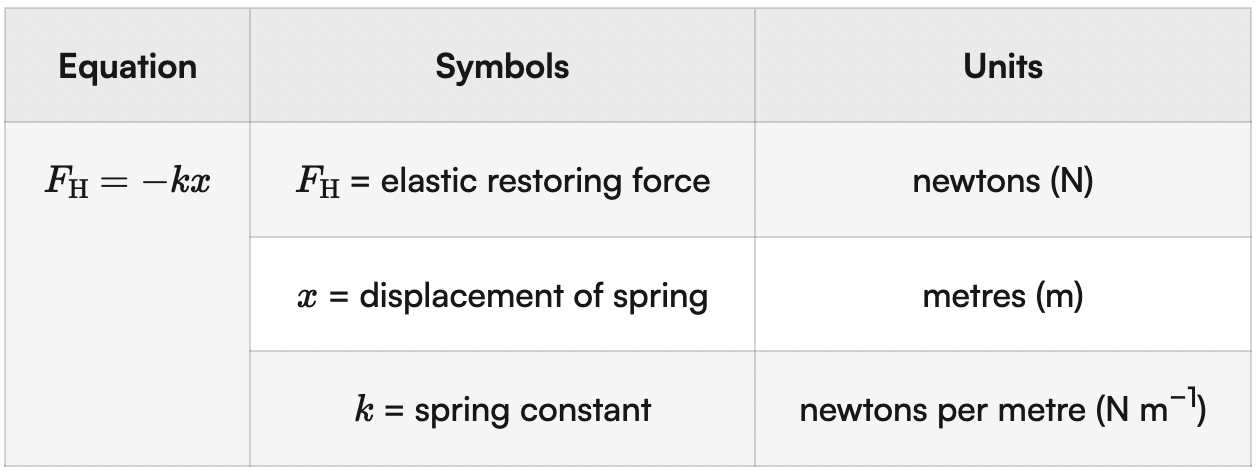
elastic restoring force FH following Hooke’s law as given by FH = –kx where k is the spring constant
When a spring is stretched, it exerts an equal and opposite force on the objects attached to each end of the spring. The force is directly proportional to the extension, according to Hooke's law
Elastic restoring force (FH) is the force that counteracts the force extending or compressing a spring and restores the spring to its natural length.
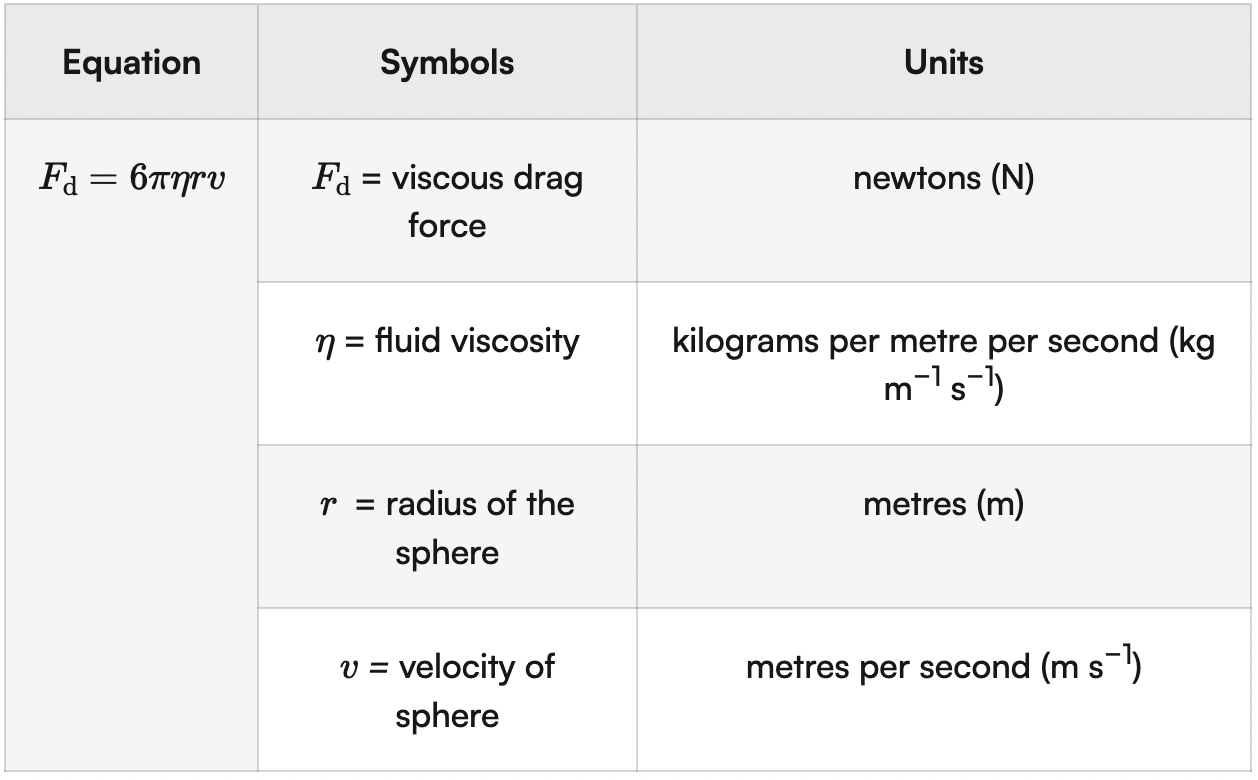
viscous drag force Fd acting on a small sphere opposing its motion through a fluid as given by Fd = 6πηrv where η is the fluid viscosity, r is the radius of the sphere and v is the velocity of the sphere through the fluid
Viscous drag force (Fd) is the resistive force opposing the motion of a body inside a fluid. Viscous drag force depends on the viscosity of a fluid. Viscosity is the property of a fluid that describes the fluid’s resistance to flow.
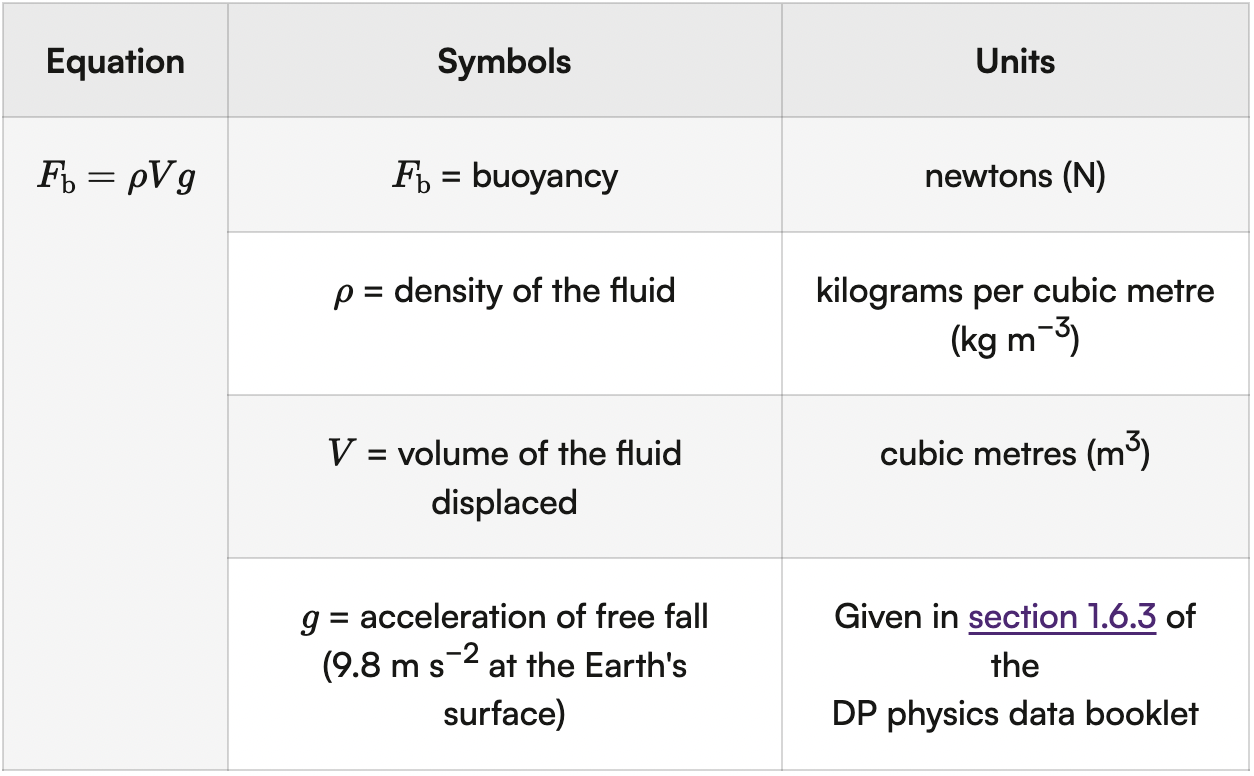
buoyancy Fb acting on a body due to the displacement of the fluid as given by Fb = ρVg where V is the volume of fluid displaced
Buoyancy (Fb) is the force experienced by a body when it is partly or fully immersed in a fluid (The force exerted by a fluid on an object partly or wholly immersed in the fluid, that counteracts the weight of the body.)
gravitational force Fg is the weight of the body and calculated is given by Fg = mg
the force of gravity is created between any 2 objects with mass (more mass = more gravitational force)
always points towards the centre of earth (on a ramp straight down)
also known as weight (weight = mass x acceleration of gravity (weight = m*g))
mass vs weight
mass is the amount of matter in an object (Kg), scalar. would stay the same in space as there is no gravity
weight is the force of gravity acting on an object (N), vector, would be no weight in space as there is no gravity
Force = mass * acceleration
Weight = mass * acceleration of gravity
electric force Fe
Electric force (Fe) is the interaction between bodies that can change the motion of a body, or change the shape or size of a body.
Like charges (two positive charges or two negative charges) repel each other.
Opposite charges (positive charge and negative charge) attract each other.
The greater the charge, the greater the electric force.
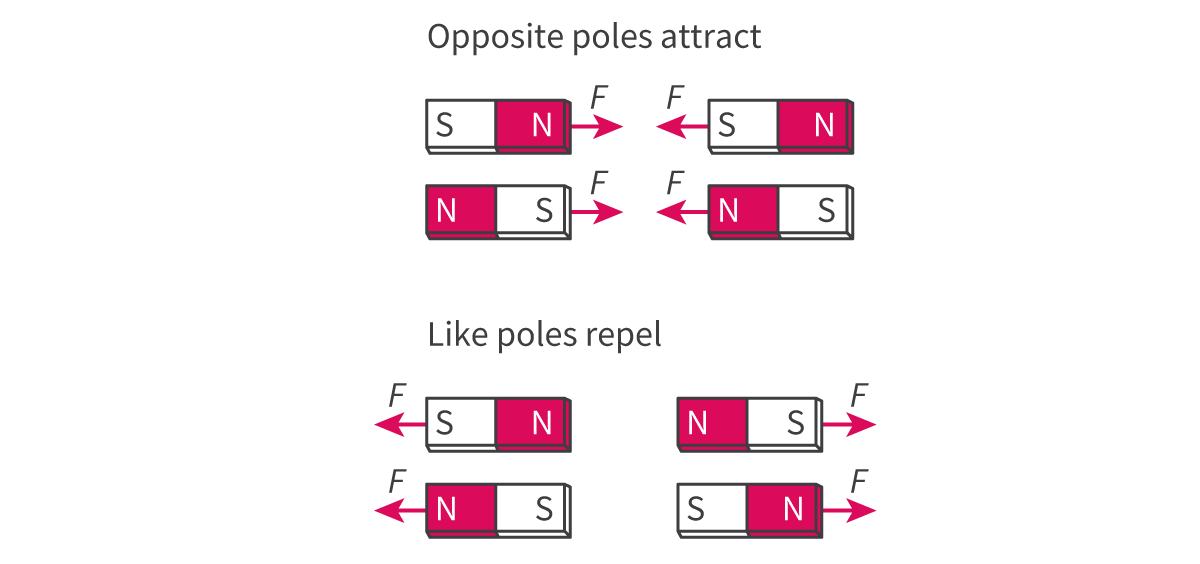
magnetic force Fm
Magnetic force (Fm) is a non-contact force caused by the interaction between a magnet and a magnetic material, or between two magnets.
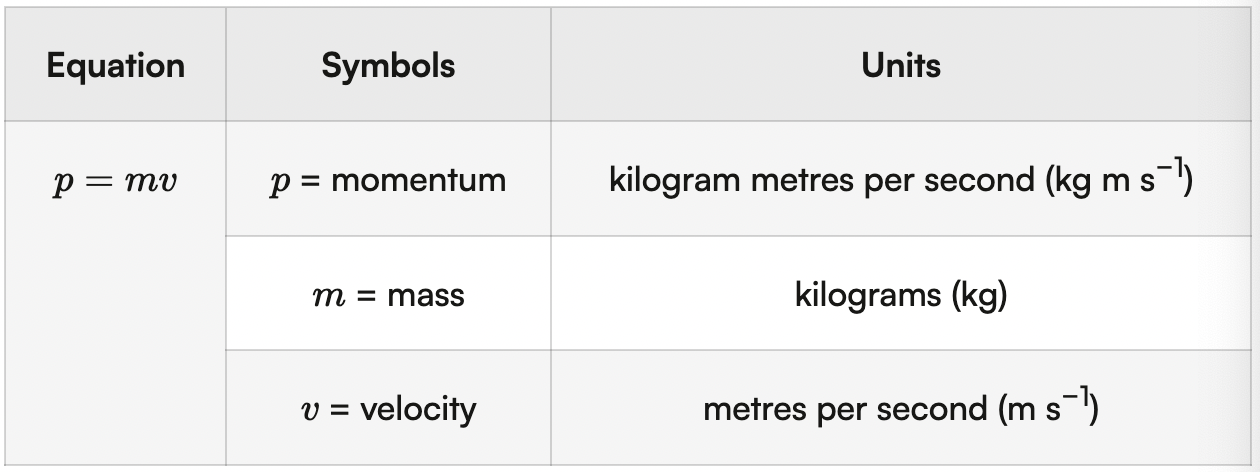
that linear momentum as given by p = mv remains constant unless the system is acted upon by a resultant external force
The linear momentum, p, of a body is the product of the mass of the body and its velocity. Linear momentum is a vector quantity. The direction of linear momentum is the same as the direction of the velocity of the body. Linear momentum remains constant unless the system is acted on by a resultant external force.
momentum (p) is how difficult it is to make an object stop (Ns), vector
more mass = more momentum
more velocity = more momentum
so: p = mv
that a resultant external force applied to a system constitutes an impulse J as given by J = FΔt where F is the average resultant force and Δt is the time of contact
that the applied external impulse equals the change in momentum of the system
Impulse (Δp) is a change in momentum (final momentum - initial momentum) (Ns)
Δp = ΣFt (=m(v-u)) or J = FΔt
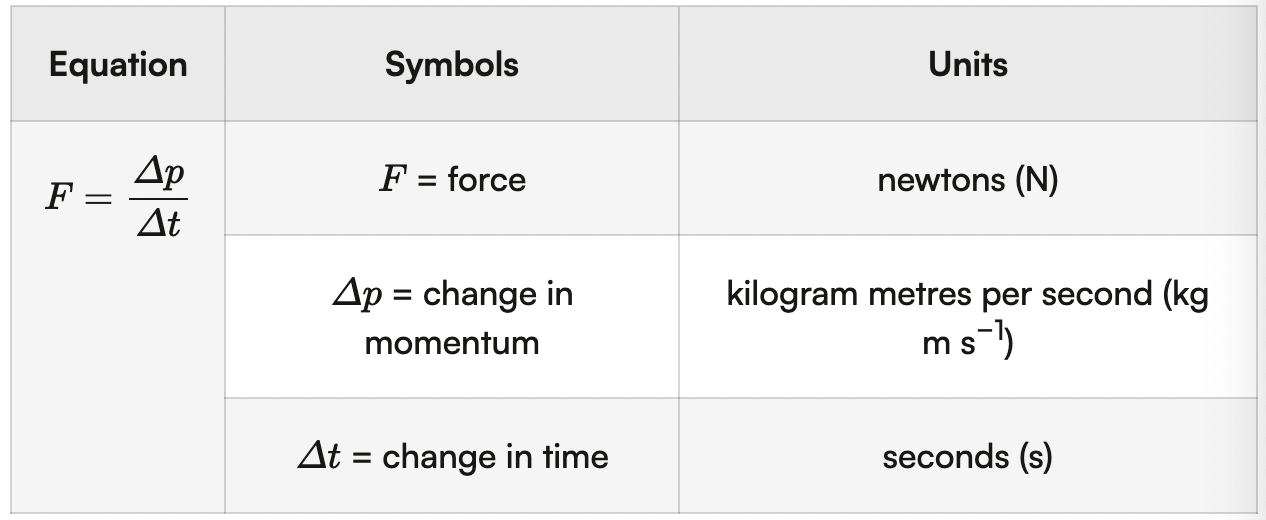
F = Δp/t is identical to F=ma
a force-time graph shows to net force applied on an object on the graph’s y-axis and the time on the x-axis. the area under the curve of a force-time graph is equal to the impulse on the object. Can be used for a constantly changing force
Conservation of momentum
During a collision:
Newton's 3rd Law says the magnitudes of these two forces are the same, and their directions are opposite.
The time is the same amount for both, because the collision always lasts the same time for both objects.
So Ft = -Ft or Δp1 = -Δp2
Σp = p1 + p2
The Law of Conservation of Momentum says that when two objects put forces on each other, the individual momentums of the objects change, but the total momentum of the two objects stays the same. This means that momentum can never be created or destroyed, only transferred from one object to another object.
this can be used in calculations by finding the total momentum in the system as this must stay and can only be transferred
open & closed system
a system is a group of objects
A Closed System is a group of objects that do not have a net force on them from any object outside the system. They can still put net forces on each other. In a closed system, the total momentum does not change.
An Open System is a group of objects with a nonzero net force acting on them from some object outside of the system. In an open system, the total momentum changes. The total momentum after = the total momentum before + the impulse given by the outside object.
that Newton’s second law in the form F = ma assumes mass is constant whereas F = Δp allows for situations where mass is changing
Objects we encounter every day undergo changes in momentum so we use this:
the elastic and inelastic collisions of two bodies
An elastic collision is when two objects collide and do not attach to each other. Σp = m1v1 + m2v2 = m1v1 + m2v2
if an objects hits a wall with an elastic collision, it bounces off with a velocity of the same magnitude and opposite direction that had pointed directly into the wall (total momentum changes since it is an open system (wall connected to earth) & because the velocity is now in the opposite direction
if it hits the wall at an angle only the part of the velocity that flipped is the component perpendicular to the wall (so angle an object impacts a wall will be equal to the angle it leaves the wall)
An inelastic collision is when two objects collide and attach to each other. After the collision, they behave as one single object. Σp = m1v1 + m2v2 = (m1+m2)v
The total momentum in the system is the same before and after the collision meaning m1v1=m2v2
explosions
an explosion is when one object splits into two object. The total momentum in the system is the same before and after the collision
Σp = MV = m1v1 + m2v2
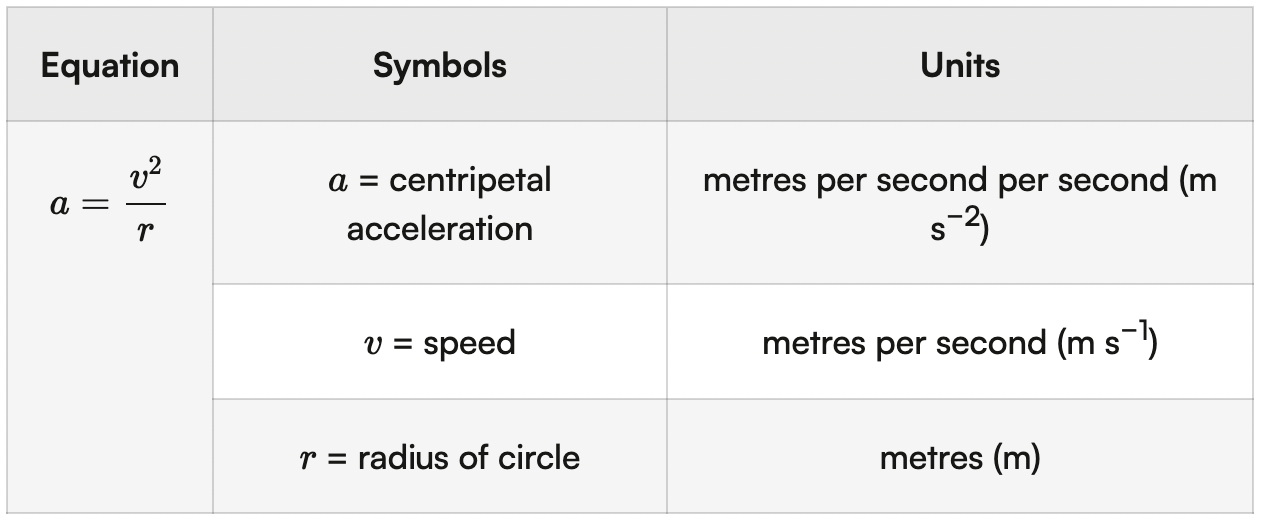
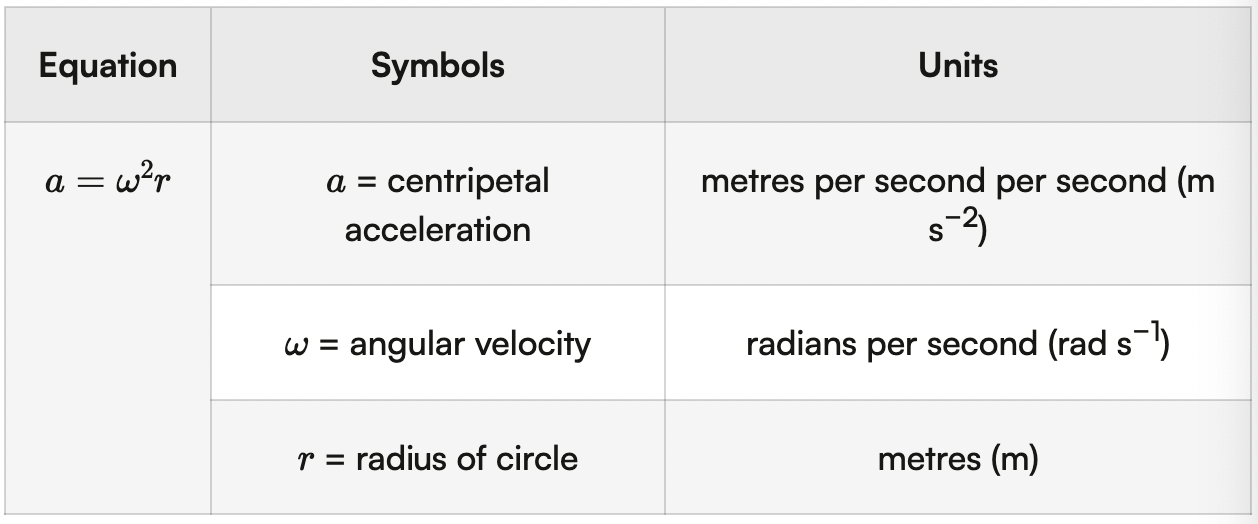
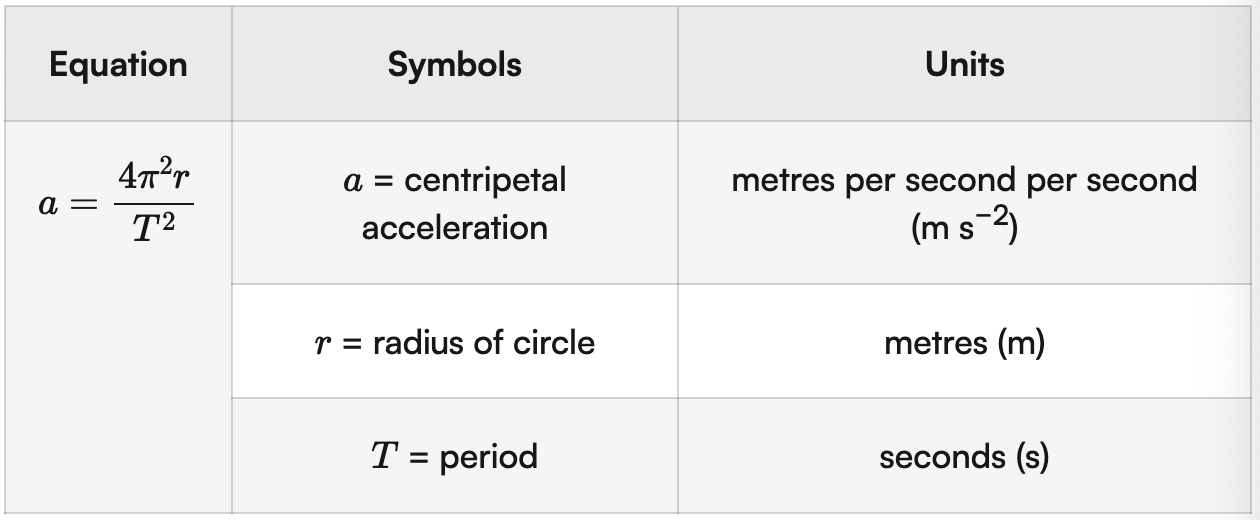
that bodies moving along a circular trajectory at a constant speed experience an acceleration that is directed radially towards the centre of the circle—known as a centripetal acceleration as given by
a= v2 =ω2r= 4π2r r T2
The net force has to be constant and always pointing toward the centre
There has to be a constant velocity at a 90 degree angle to the net force
Centripetal acceleration: (ac) the acceleration of the object (points in the same direction as the centripetal force (ms^-2). Accelerations shows the direction of the change in velocity which is how the object is kept moving in a circle. Ac = Vt^2/r
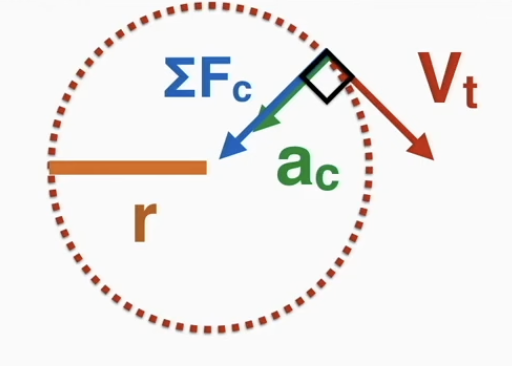
that circular motion is caused by a centripetal force acting perpendicular to the velocity
that a centripetal force causes the body to change direction even if its magnitude of velocity may remain constant
Centripetal force: (ΣFc) the net force on the object. It always points towards the centre of motion (N). Any combination of forces can add to make it. ΣFc = mac = m*(Vt^2/r)
Radius: (r) the radius of the circular path (m)
Tangential velocity: (Vt) the distance the object moves around the circle over change in time (m/s) Vt = d/t so Vt = 2πr/T = 2πrf
Vt = ωr
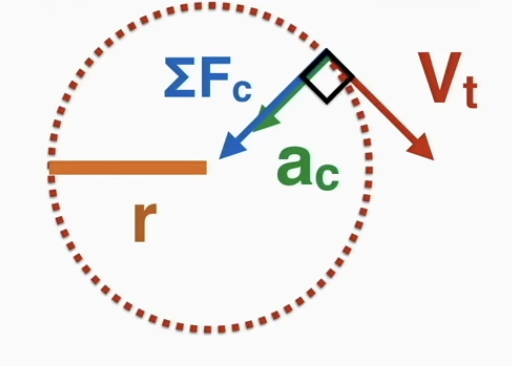
that the motion along a circular trajectory can be described in terms of the angular velocity ω which is related to the linear speed v by the equation as given by v = 2πr = ωr.
Angular velocity: (ω) the change in angle around a circle over the change in time (rad/s). This is different from tangential velocity as Vt takes the distance travelled into consideration (v=d/t) whilst ω tracks the angle from the starting position (meaning the circle could be much smaller but the ω is still the same, goes around the circle at the same rate) ω = Δθ/t = 2π/T = 2πf
Period and frequency
Period (T): the amount of time an object takes to complete one full cycle (s)
Frequency (f): the amount of repetitions a cycle completes in 1 second (Hz)
T=1/f
spinning surface
p
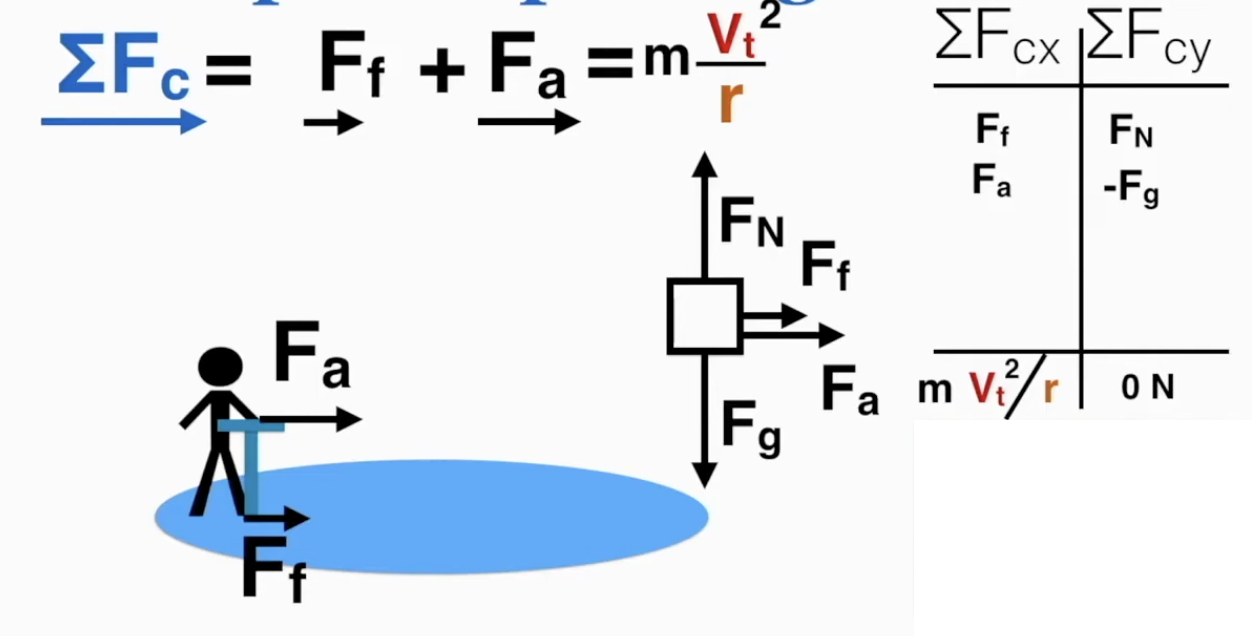
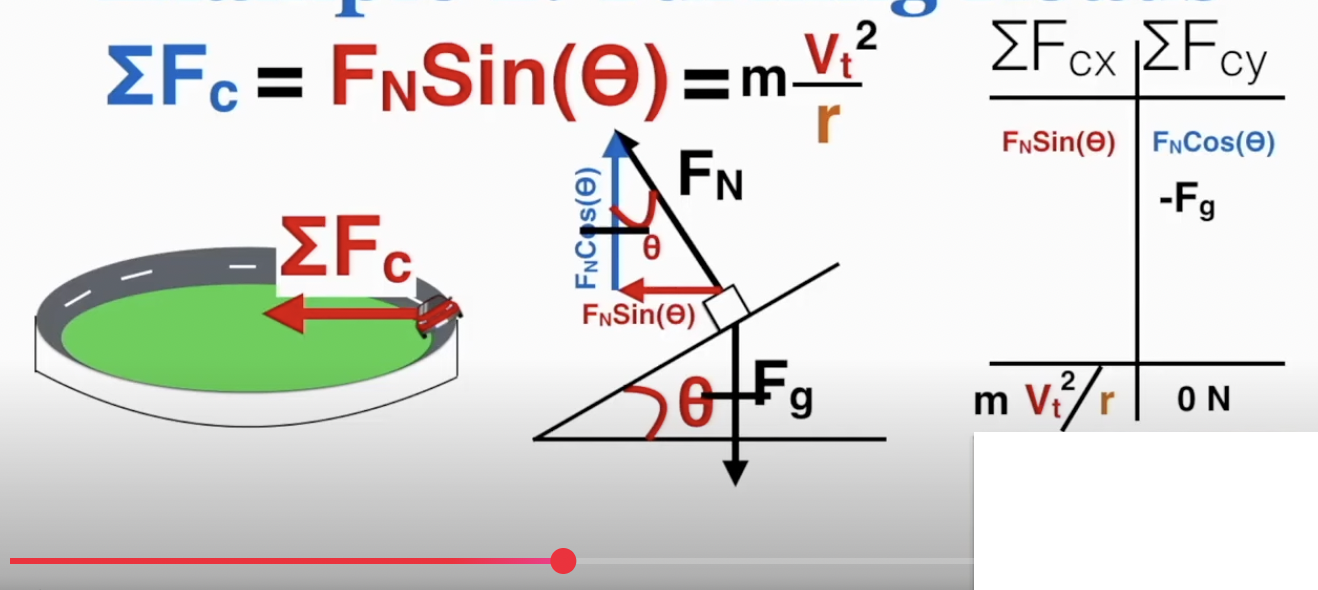
turning roads
p
tension at an angle
p
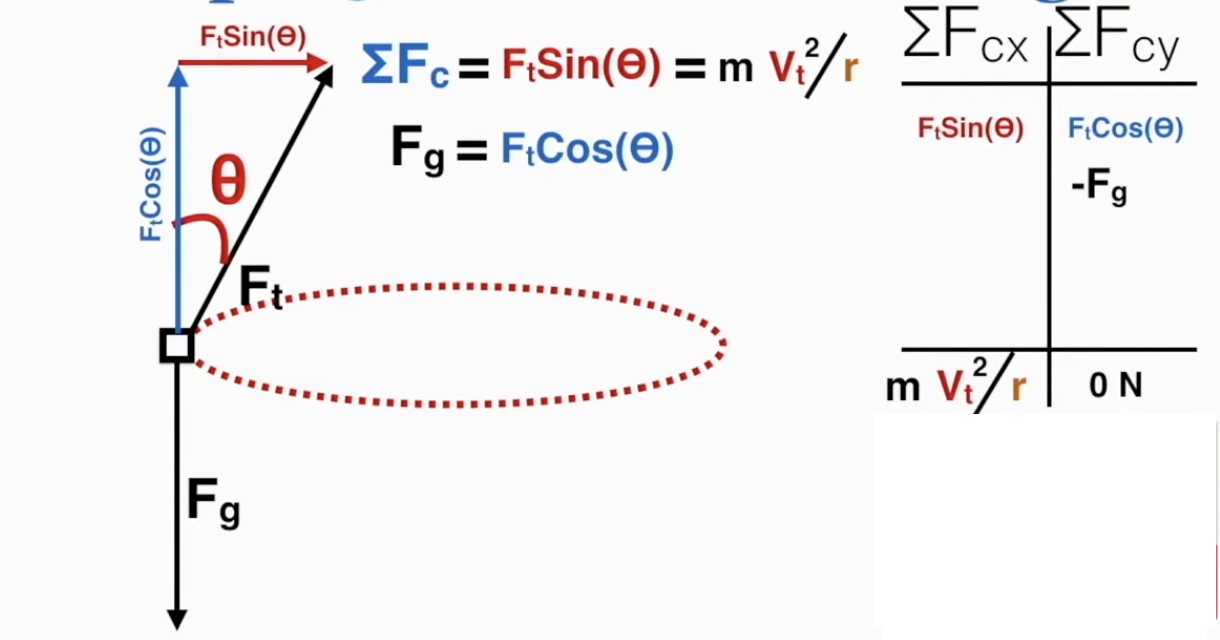
hills
p
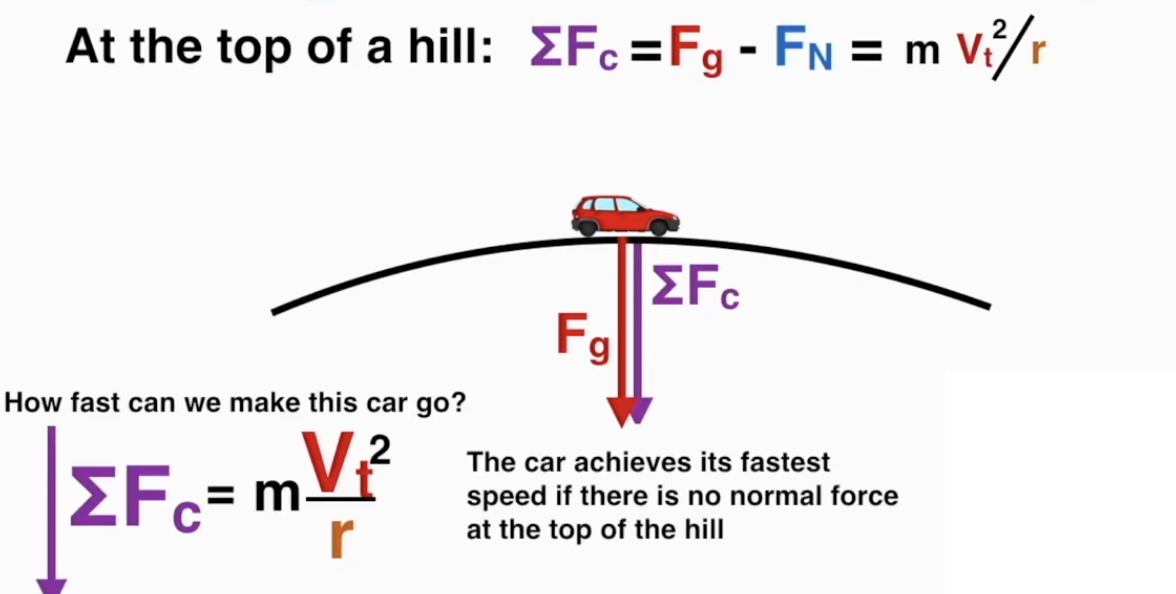
throughs
p
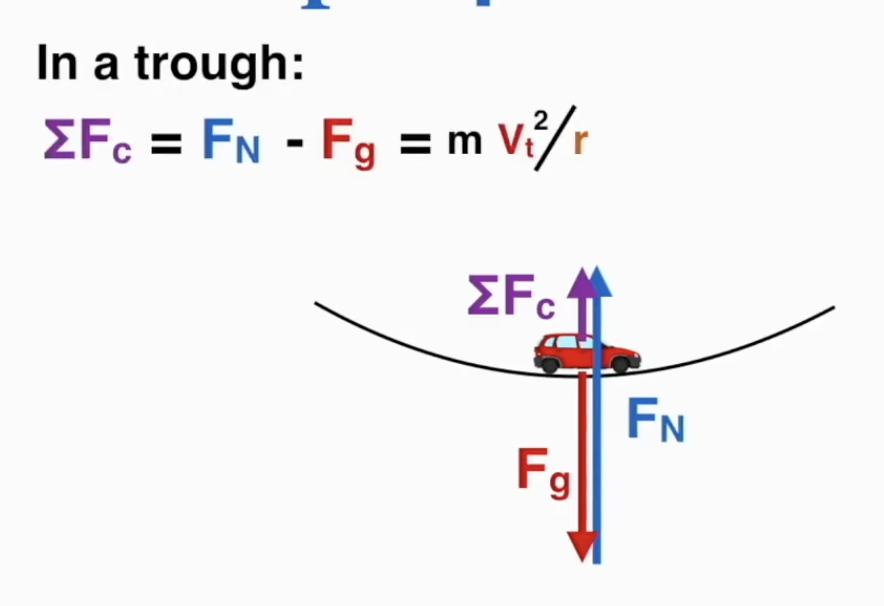
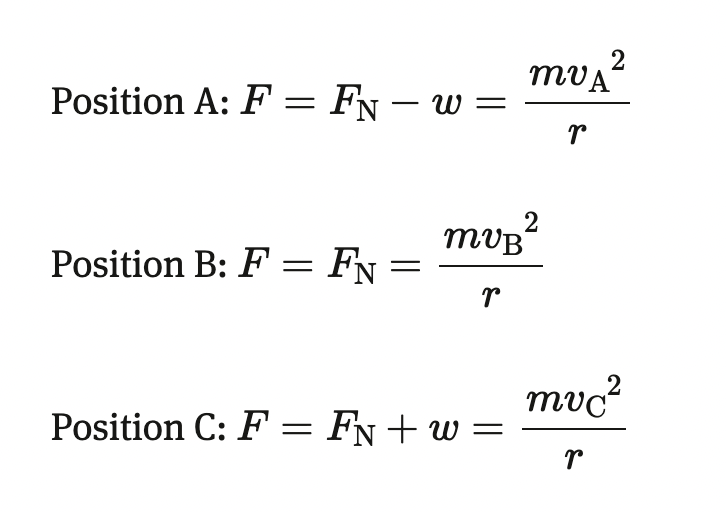
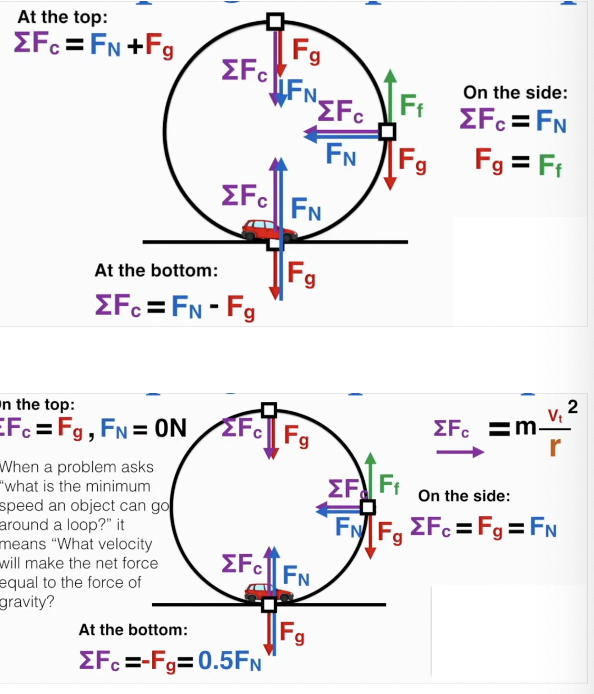
Loop
Fc would need to be bigger than Fg to stay on the circle
The principle of the conservation of energy
The Law of Conservation of Energy says that energy can NEVER be created or destroyed, only transferred from one object to another or transformed from one type of energy to another type of energy.
that work done by a force is equivalent to a transfer of energy
A force is said to do work when it acts on an object, and it transfers energy to it. Work done and energy transferred are both measured in joules (J), and they are equivalent.
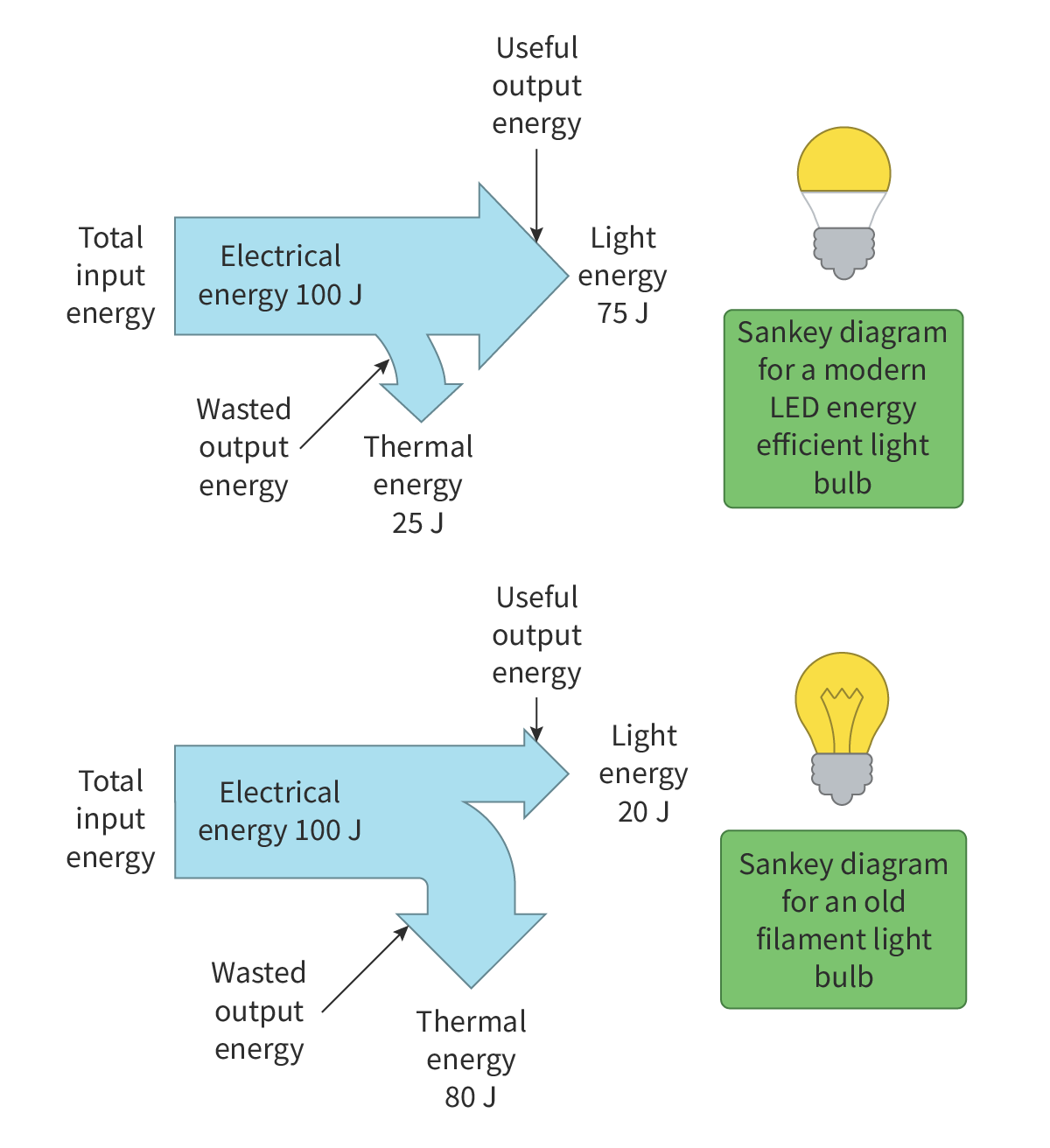
that energy transfers can be represented on a Sankey diagram
A sankey diagram is a scale diagram used to represent the total input, the useful output and the wasted output energies within a system. The thickness of each arrow is proportional to the amount of energy in each store.
that work W done on a body by a constant force depends on the component of the force along the line of displacement as given by W = Fs cos θ
Work (W) is an objects displacement multiplied by the component of force parallel to the displacement (J), scalar
W = Fs cos θ
if force is perpendicular no work is being done
force and displacement in the same direction the work done is positive, if they point in opposite directions work is negative
total work done use net force (or net force in the x component and y component)
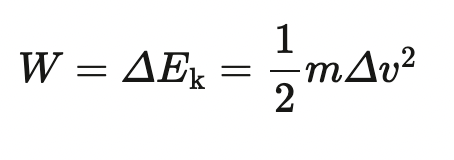
that work done by the resultant force on a system is equal to the change in the energy of the system
Every time a force does work on an object, energy is transferred to the object. So the work done by the resultant force on the car is equal to the change in energy of the system. If the resultant force on the system is zero, the kinetic energy of the system will remain constant, and the change in energy will be equal to zero.
energy (E) is a measurement of the amount of work and object can do (J), scalar. object uses energy when it does work.
W = ΔE
that mechanical energy is the sum of kinetic energy, gravitational potential energy and elastic potential energy
Mechanical Energy: Types of energy associated with the motion & position of an object that we can easily calculate and predict.
Kinetic
Gravitational Potential
Elastic Potential
Non-Mechanical Energy: Other types of energy that are difficult to calculate and predict.
Thermal (Thermal energy (Eint) is the energy associated with heat and temperature. Thermal energy appears as a result of friction, air resistance, impacts, and other interactions between objects. Thermal energy is actually a measurement of the random kinetic energy of vibrating particles in an object. (Eint = internal energy) (J). almost always lost from the system. So find for example Ep and Ek and the difference is lost as thermal energy. (perfectly elasatic nothing is lost))
Electrical (Electrical energy is the energy carried by electrons. People normally use electricity to deliver energy created in power plants to buildings where we convert it into types of energy we use: light energy, heat energy, kinetic energy, etc.)
Sound (Sound energy is the energy carried by sound waves. In almost all collisions at least some kinetic energy is transformed into sound energy. Sound itself is a wave of energy moving through a medium like air. The energy moves through without carrying the matter along with it.)
Chemical (Chemical potential energy is the energy stored in the bonds between atoms or ions. It can be released or stored in chemical reactions.)
Nuclear (Radiant energy is the energy carried by light and other forms of electromagnetic radiation (x-rays, microwaves, radio waves, gamma waves etc).)
Radiant (Nuclear energy is the energy released during nuclear fission or fusion. It is contained within the nuclei of atoms until released.)
that in the absence of frictional, resistive forces, the total mechanical energy of a system is conserved
A Closed System in energy is a system where the only energy transfer and transformation that happens involves mechanical energy. Energy is not transferred to objects outside the system. The total energy of the objects in the system stays the same.
An Open System in energy is a system where energy is transformed from mechanical to non-mechanical or vice versa, or mechanical energy is transferred from or to an object outside the system. The total energy in the system changes.
that if mechanical energy is conserved, work is the amount of energy transformed between different forms of mechanical energy in a system, such as:
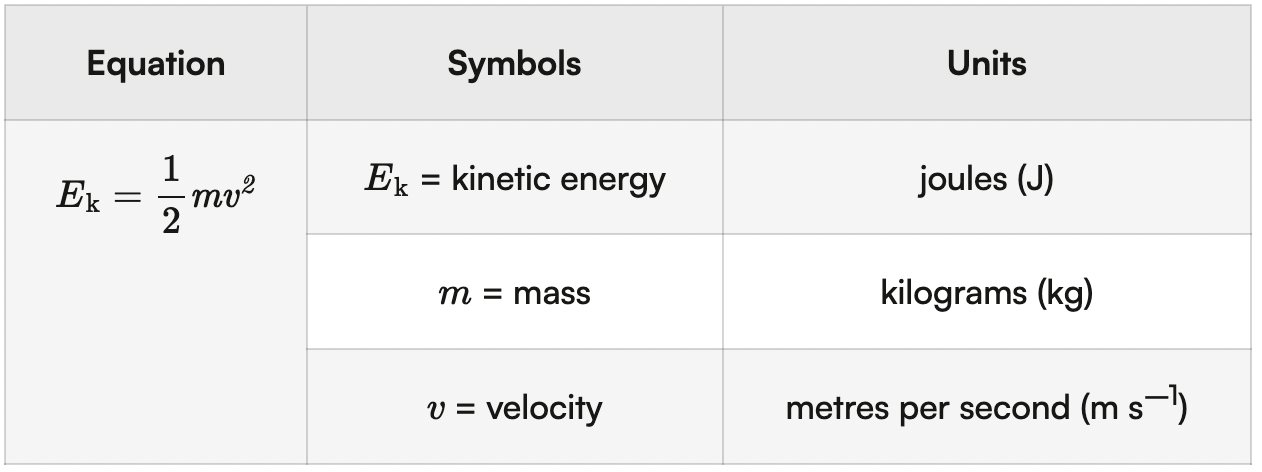
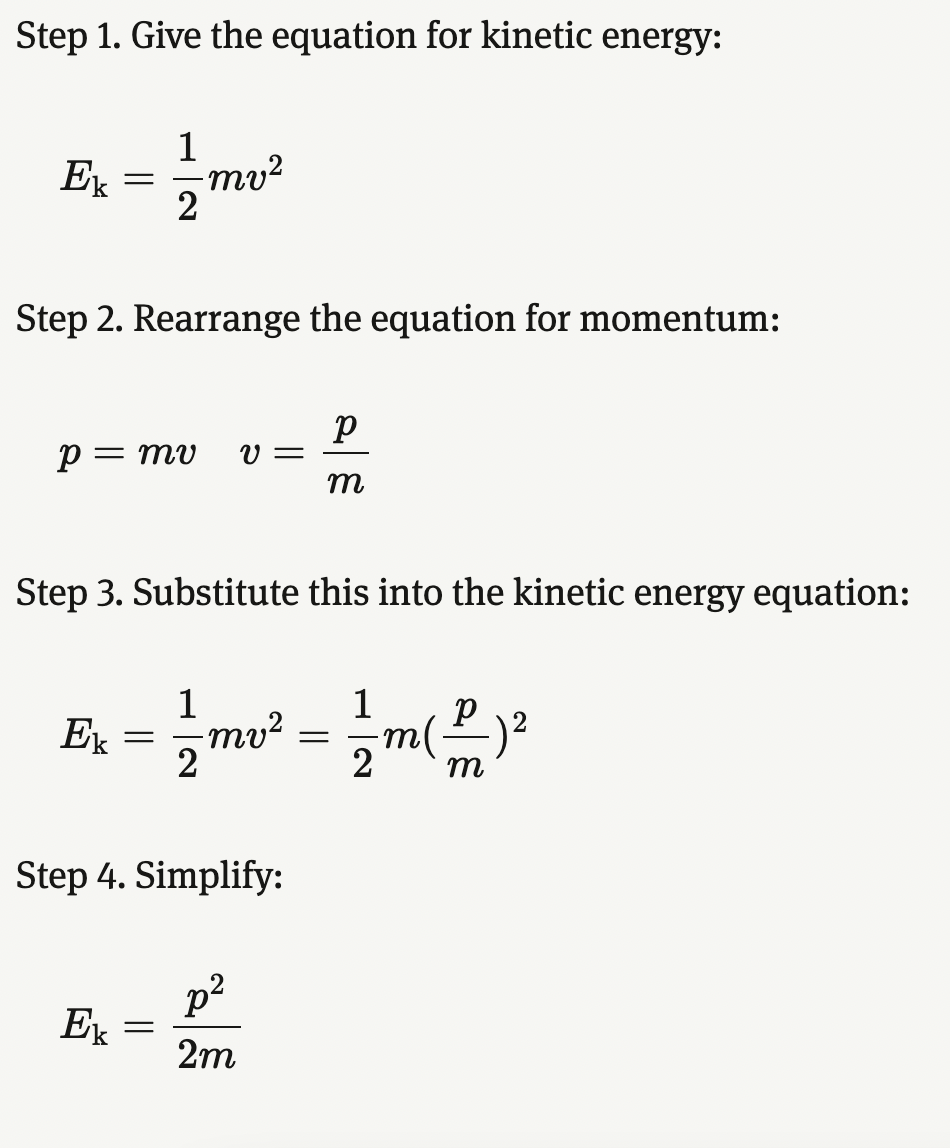
the kinetic energy of translational motion as given by Ek = 1 mv2 = p2 2 2m
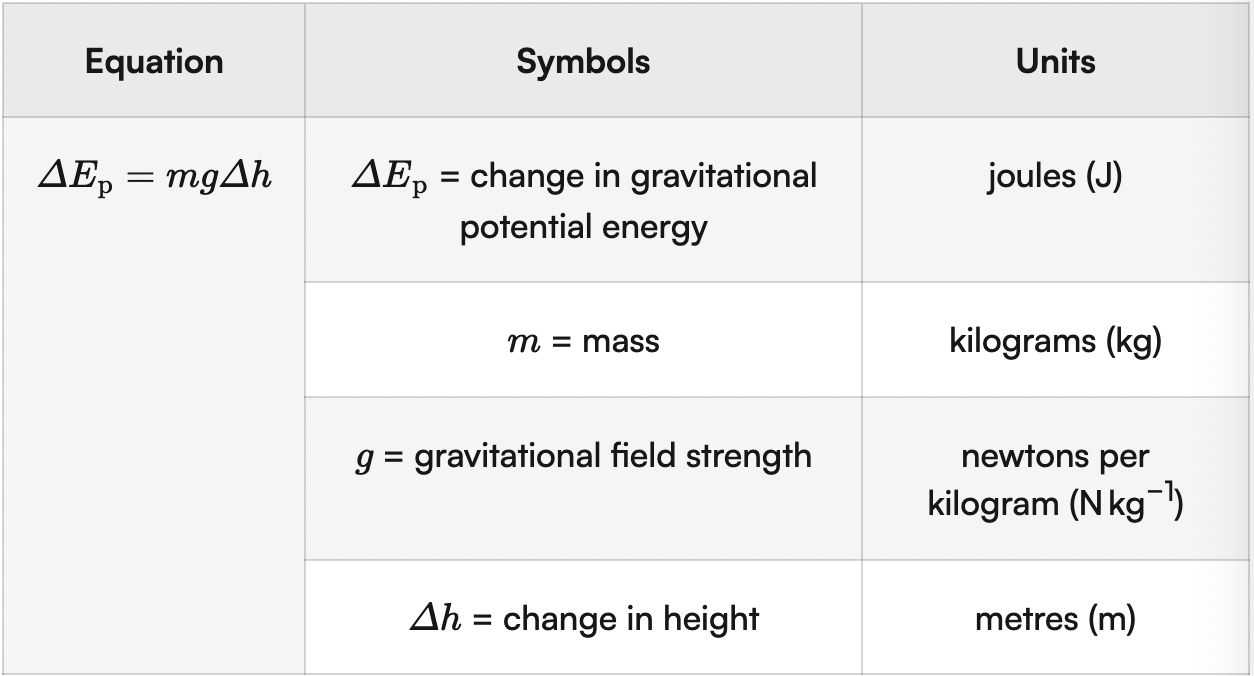
the gravitational potential energy, when close to the surface of the Earth as given by
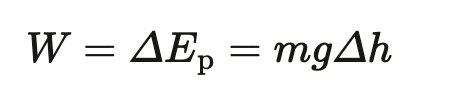
ΔEp = mgΔh
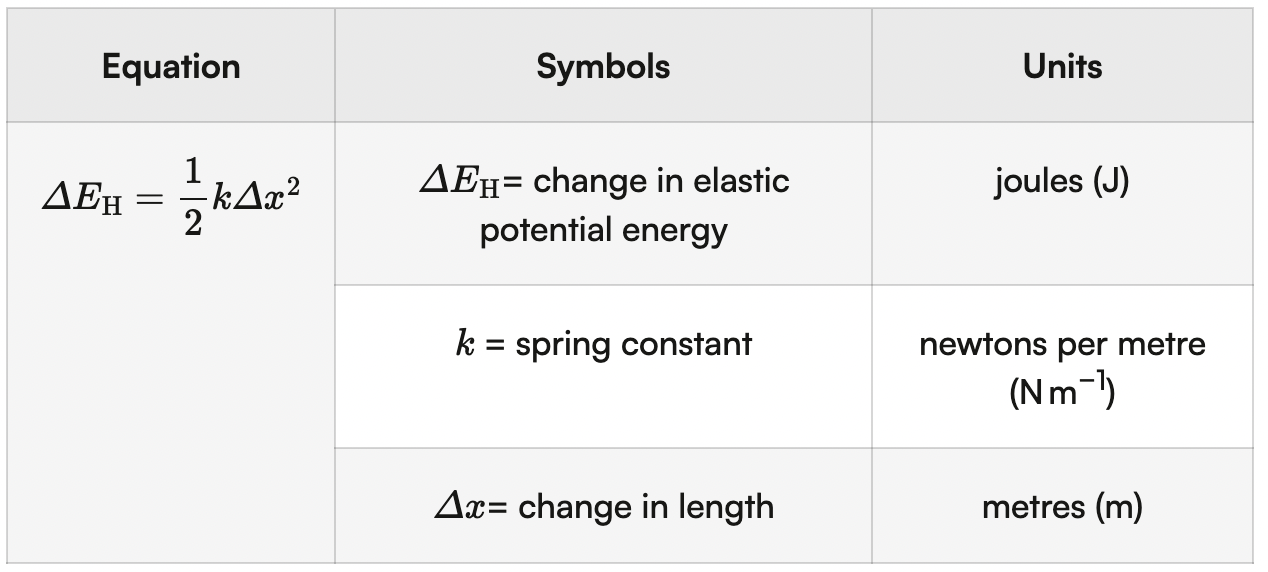
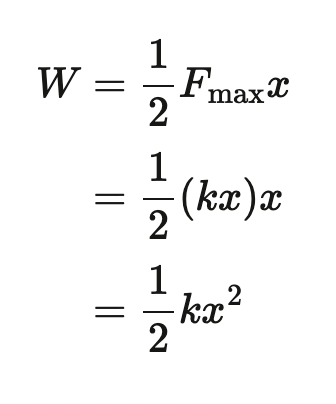
the elastic potential energy as given by EH = 12k(Δx)2
Kinetic Energy (Ek) is the energy an object has as a result of moving. Thus, moving gives an object the ability to apply a force for a displacement, which is the ability to do work (J), can never be negative
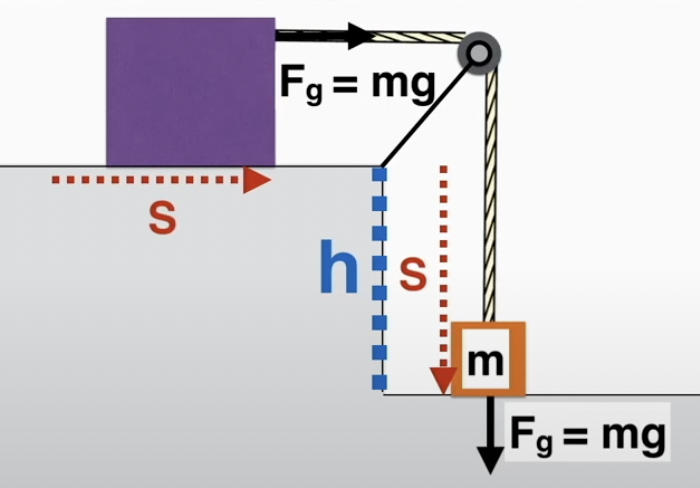
Gravitational Potential Energy (Ep) is the energy an object has as a result of its ability to fall. As long as it has a vertical displacement (height) that it can move down, it can push or pull objects with its weight until it hits the bottom (J)
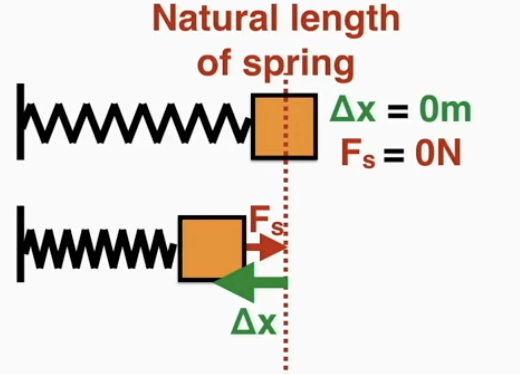
Elastic potential energy (Ep) is the energy stored in a spring that has been stretched or compressed from its natural length. When the spring is released, it will apply a force for a displacement until it returns to its natural length, so it has the potential to do work, so it has energy (J)
force displacement graph has slope of k and the area under the curve is the work done.
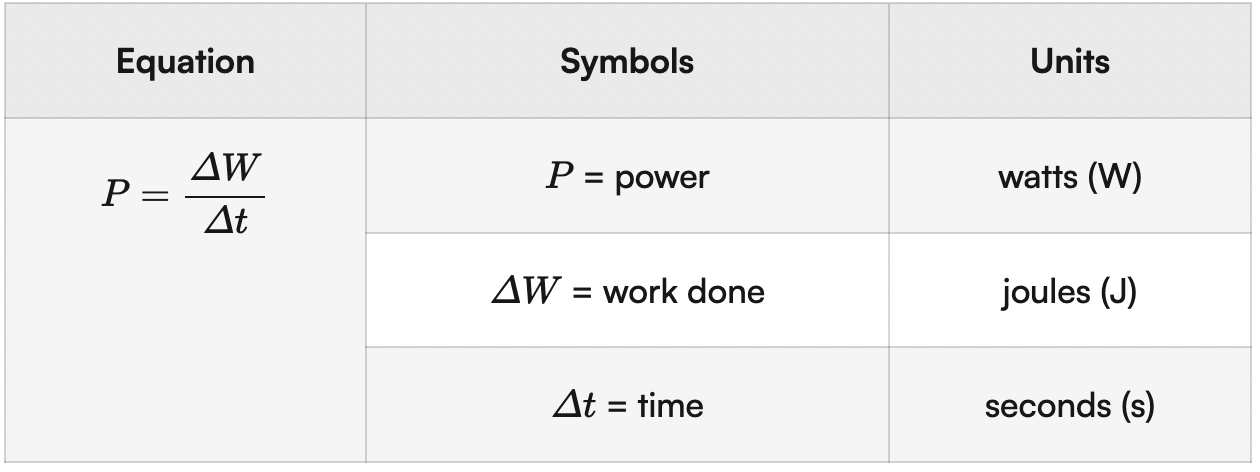
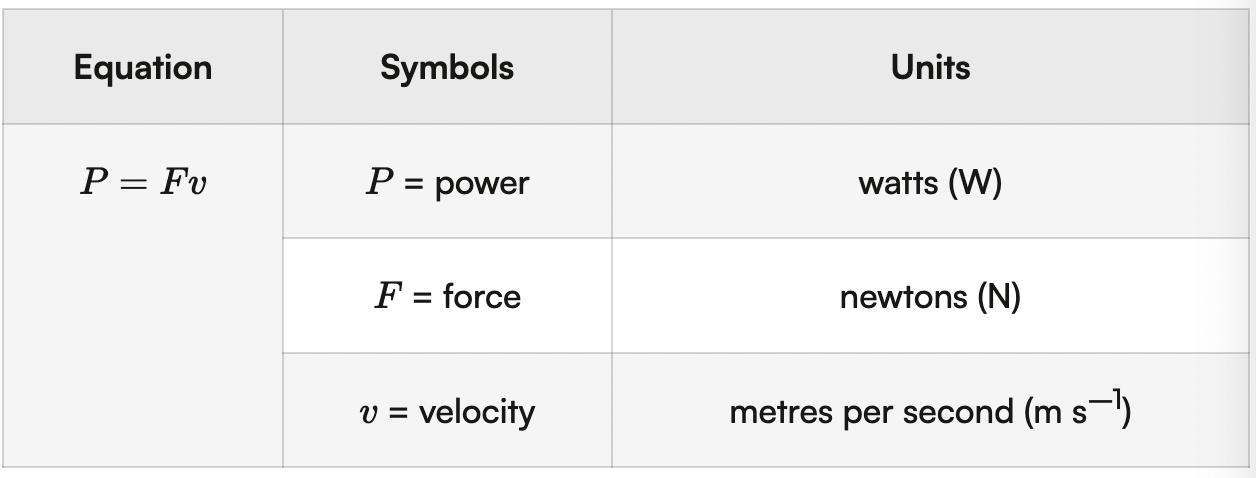
that power developed P is the rate of work done, or the rate of energy transfer, as given by P = ΔW/Δt = Fv
Power (P) is a measurement of a change in energy per time (The rate of work done). It's measured in units of watts. scalar. Power supplied to an object is also equal to the force applied to an object times the velocity of the object. (W)
P=ΔE/t = W/t = Fs/t = Fv
efficiency η in terms of energy transfer or power as given by η = Eoutput = Poutput
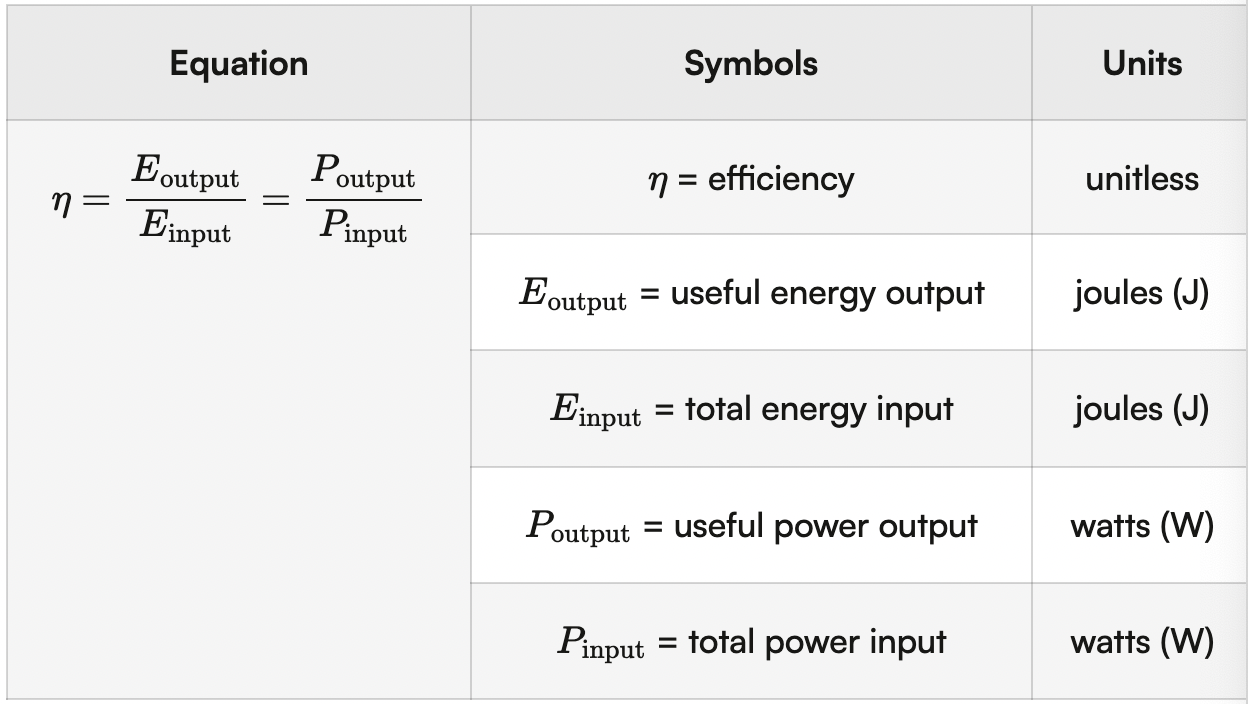
Efficiency is the ratio of how much useful energy or power we get out of a system vs. how much energy we put into the system.
Efficiency = Useful work out / Total work in = Useful power out / Total power in
energy density of the fuel sources.
A fuel is a material that can be made to react with other substances in order to produce thermal energy or mechanical energy that can be used to do work. One of the things to consider when choosing a suitable fuel is energy density, which is defined as the amount of energy in a fuel per unit volume. Energy density is measured in joules per cubic metre (J m–3)
molecular theory in solids, liquids and gases
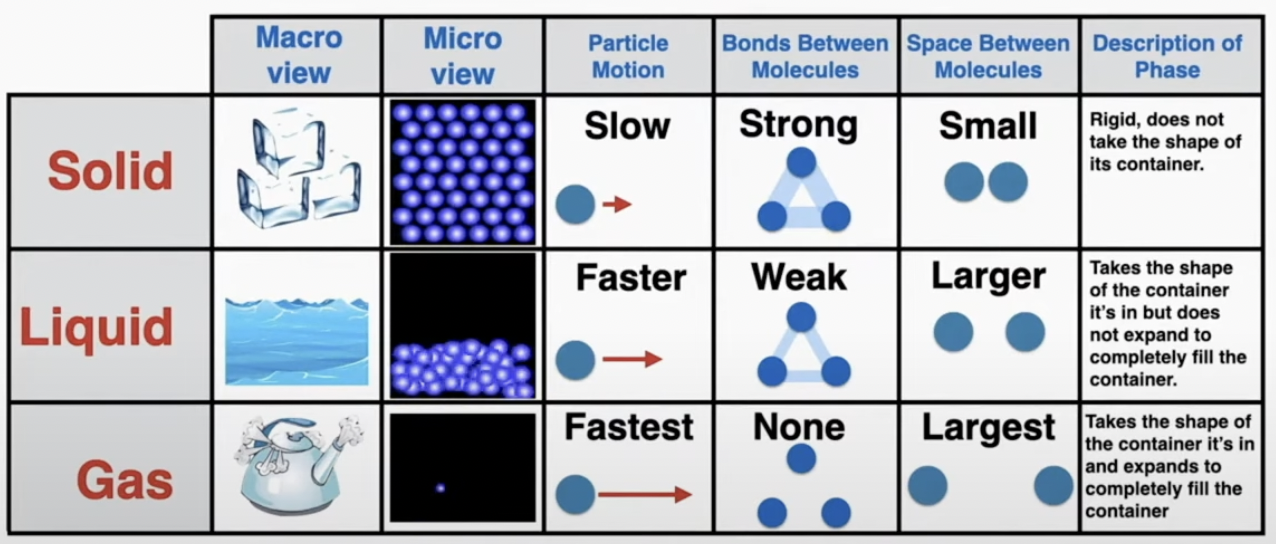
The Kinetic Theory of Matter: Matter is made up of a large number of tiny particles. The microscopic (small) behavior of the particles determines the macroscopic (large) behavior of the material.
Solids
They have a fixed volume and do not flow.
The particles are arranged in regular rows.
The particles have relatively little energy and vibrate around fixed positions.
The particles have relatively strong forces of attraction between them, called intermolecular forces.
When a solid is heated, the particles gain energy and move further apart, weakening the intermolecular forces.
This results in the thermal expansion of the solid. For the same increase in temperature, a substance in its solid phase expands less than the same substance in its liquid and gaseous phases.
Liquids
They can flow and take the shape of their container.
The particles are arranged randomly.
The particles have more energy than those in a solid of the same substance and can move around each other.
The strength of the intermolecular forces is weaker than in a solid of the same substance, but stronger than in a gas of the same substance.
When a liquid is heated, the particles gain energy and move further apart, weakening the intermolecular forces.
This results in the thermal expansion of the liquid. For the same increase in temperature, a substance in its liquid phase expands more than the same substance in its solid phase but less than the substance in its gaseous phase.
Gases
They can flow and fill their container completely.
Their volume can change by altering the pressure and/or temperature.
The particles are comparatively far apart and in a random arrangement.
Compared to the solid and liquid states of the same substance, the particles have high amounts of energy and move quickly in all directions.
For the same increase in temperature, a substance in its gaseous phase has the largest thermal expansion.
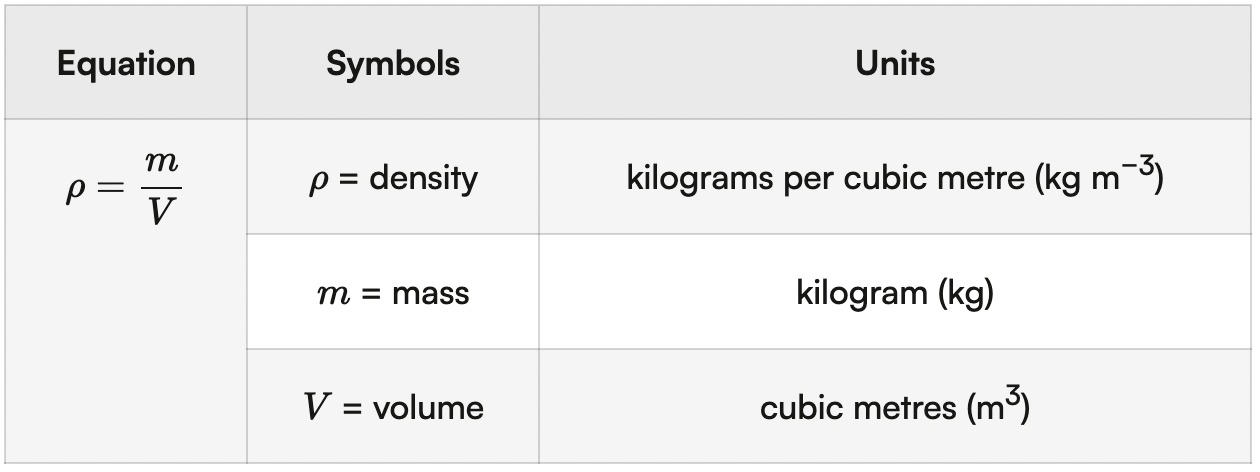
density ρ as given by ρ = mV
Density (ρ) of a substance is defined as the mass per unit volume. The greater the mass of 1 m3 of a substance, the greater its density. The unit of density is kilograms per cubic metre (kg m−3)
that Kelvin and Celsius scales are used to express temperature
In the Kelvin scale, the difference between the freezing point and boiling point of water is divided into 100, meaning that a temperature change of 100 °C is the same as a temperature change of 100 K. This means that a temperature change in degrees Celsius is the same as a temperature change in kelvin.
temperature (K) = temperature (°C) + 273
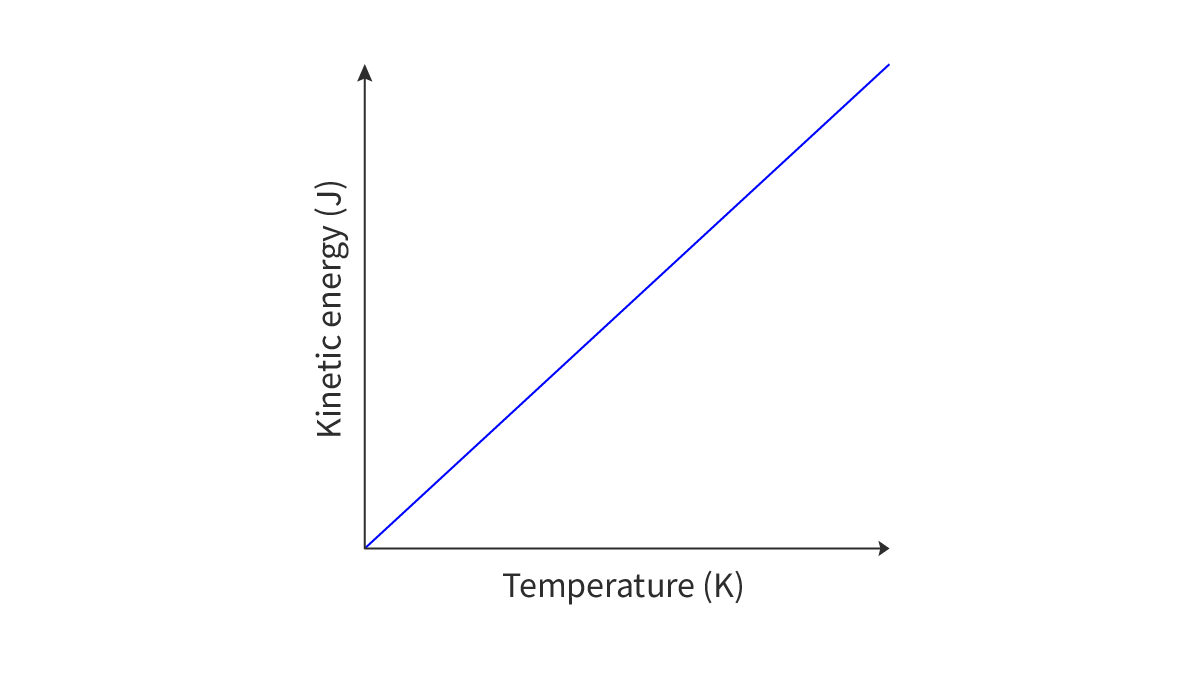
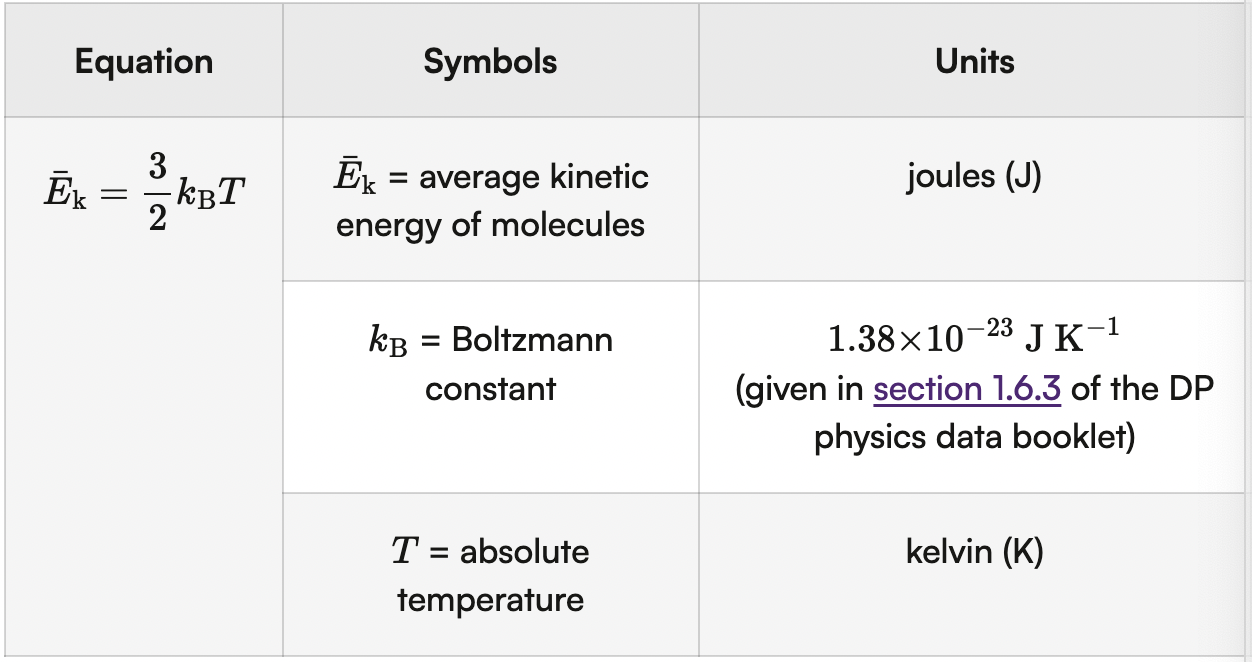
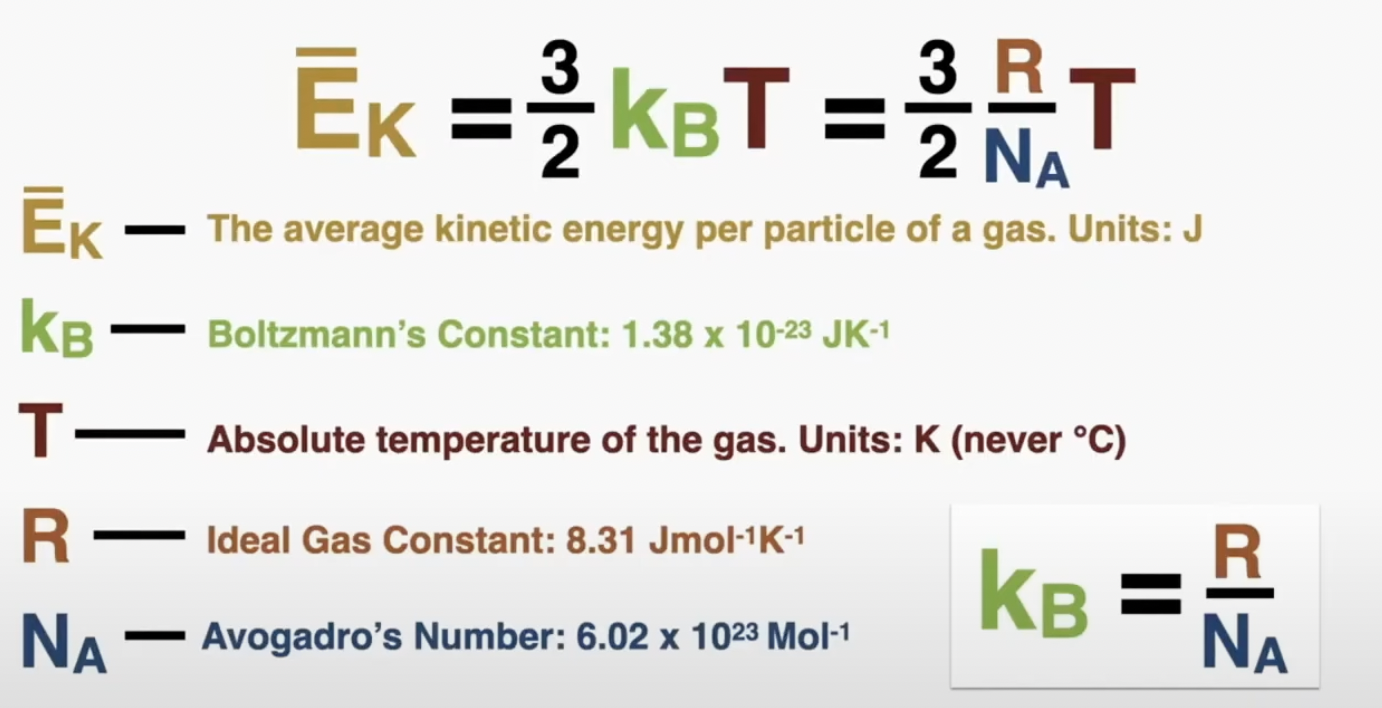
that Kelvin temperature is a measure of the average kinetic energy of particles as given by Ek = 3/2 kBT
Temperature (T) is a measurement of the average kinetic energy per particle in a material (C/K)
The kinetic energy of the particles of a substance is zero when its absolute temperature is zero kelvin (0 K). Kinetic energy is proportional to temperature. From this, you can infer that the absolute temperature of a substance is dependent on the average kinetic energy of its particles.
that the internal energy of a system is the total intermolecular potential energy arising from the forces between the molecules plus the total random kinetic energy of the molecules arising from their random motion
Internal Energy or Thermal Energy (Eint) is a measurement of the total intermolecular potential energy arising from the forces between the molecules plus the total random kinetic energy of the molecules arising from their random motion (J)
that temperature difference determines the direction of the resultant thermal energy transfer between bodies
Heat (Q) is the total change in thermal energy, or final thermal energy minus beginning thermal energy (J). heat gained by one is lost by the other
When two substances at different temperatures are mixed, thermal energy is transferred from the hotter substance to the colder substance. The amount of energy leaving the hotter substance must be the same as the amount of energy being absorbed by the colder substance, so that energy is conserved
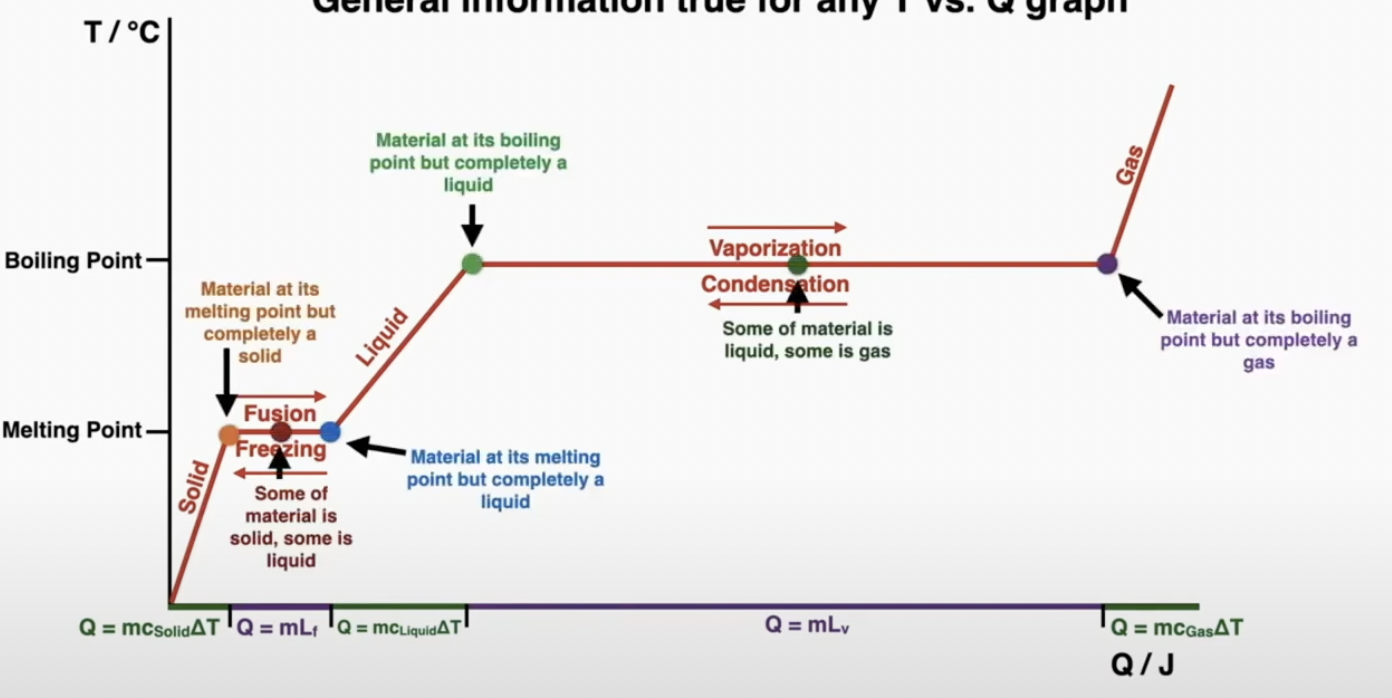
that a phase change represents a change in particle behaviour arising from a change in energy at constant temperature
during a phase change only the potential energy changes (the energy that holds the particles together). no temperature change
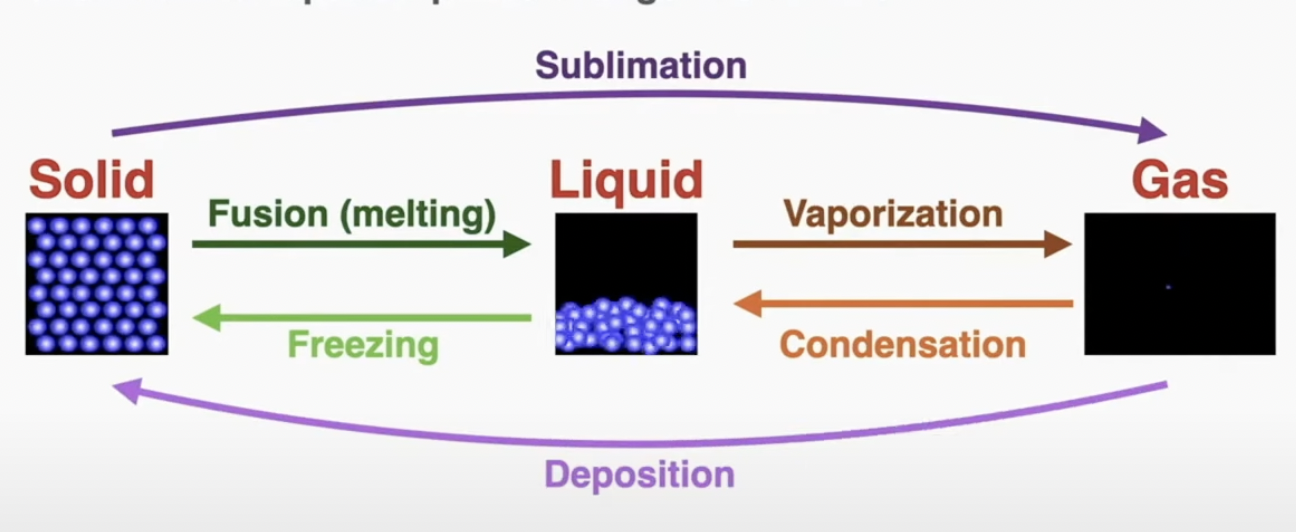
The melting point of a material is the temperature at which the phase changes from solid to liquid or vice versa.
The boiling point of a material is the temperature at which the phase changes from liquid to gas or vice versa.
When a material is not at its melting or boiling point, energy added to it changes its temperature (the kinetic energy of the particles). When a material is at its melting or boiling point, energy added to it changes its phase (the potential energy in the bonds of the particles).
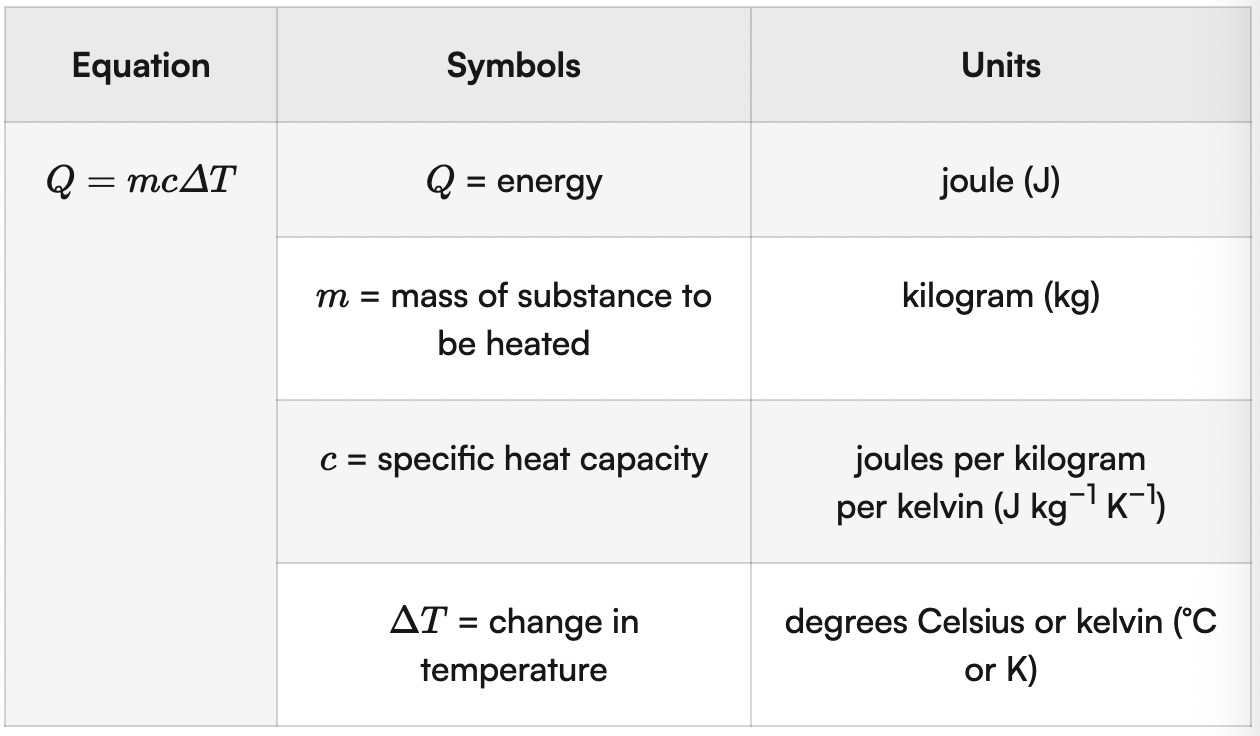
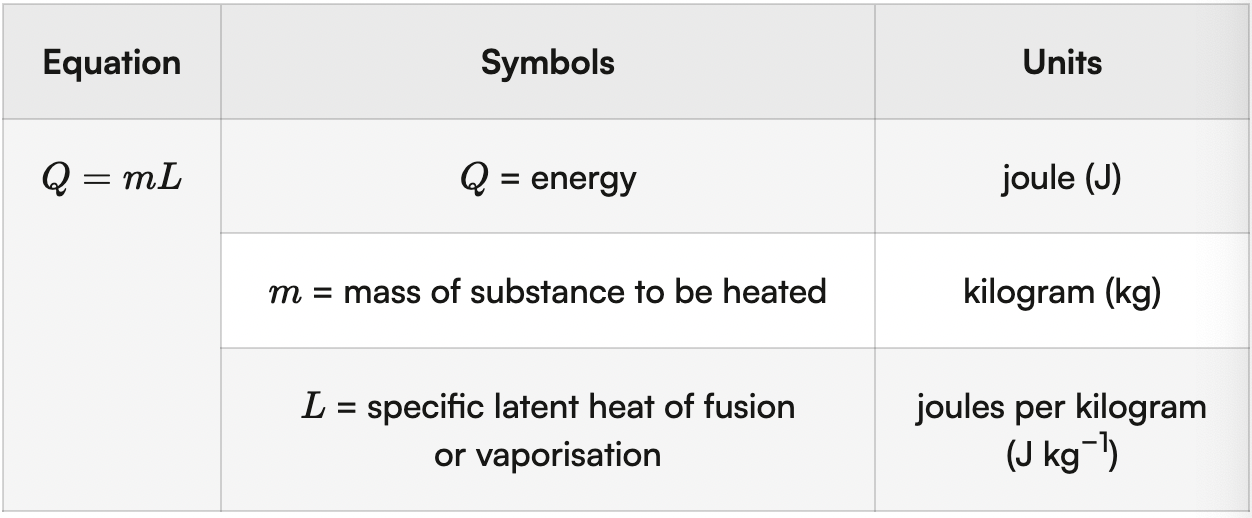
quantitative analysis of thermal energy transfers Q with the use of specific heat capacity c and specific latent heat of fusion and vaporization of substances L as given by Q = mcΔT and Q = mL
Q is the heat energy released or absorbed by a substance undergoing a change of phase
Specific heat capacity is the amount of energy required to increase the temperature of 1 kg of a substance by 1 K.
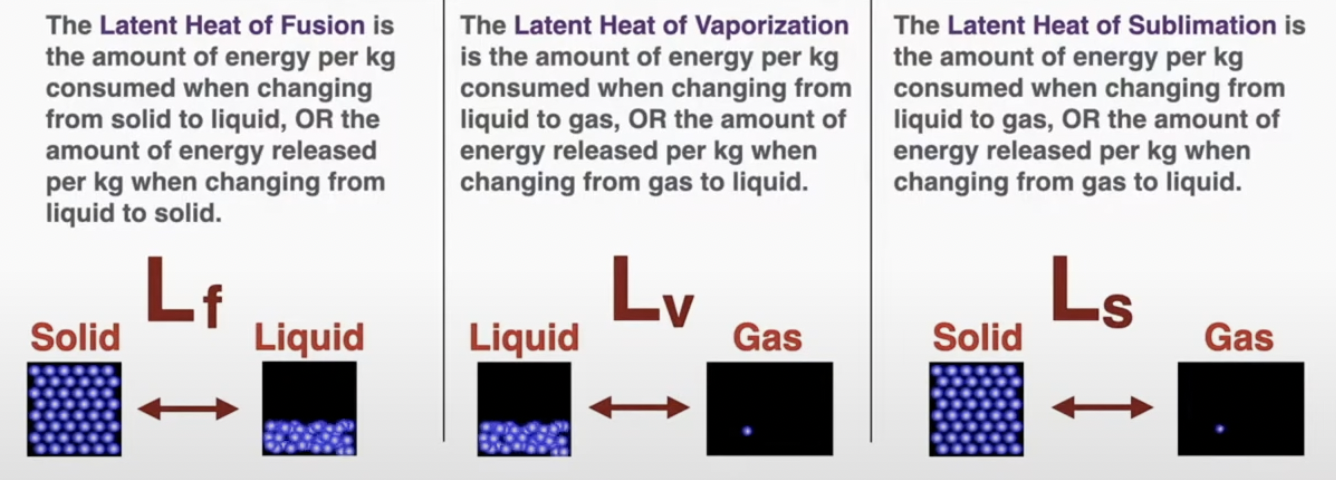
Latent Heat is a measurement of how much energy it will take to change 1 kilogram of material from one phase to another when the material is at the correct temperature to change its phase.
Specific latent heat of fusion, Lf: the amount of energy required to change the phase of 1 kg of a substance at constant temperature from solid to liquid.
Specific latent heat of vaporisation, Lv: the amount of energy required to change the phase of 1 kg of a substance at constant temperature from liquid to gas.
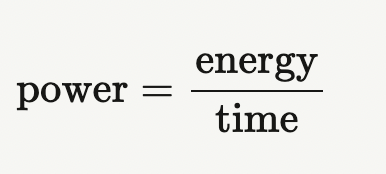
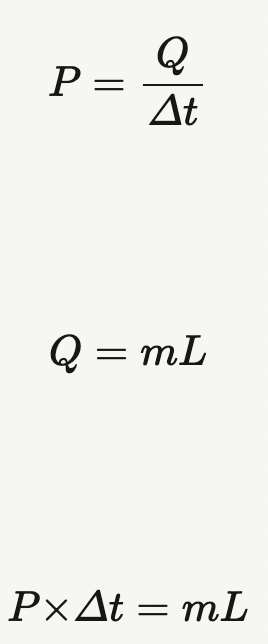
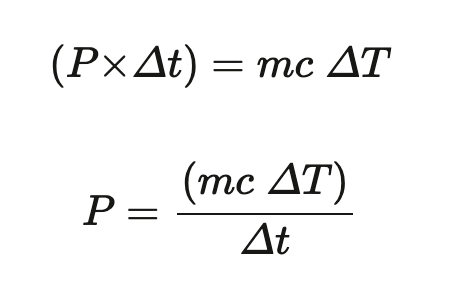
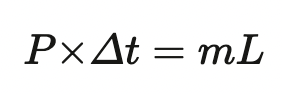
Power in heat equations
that conduction, convection and thermal radiation are the primary mechanisms for thermal energy transfer
Thermal equilibrium: Two objects are In Thermal Equilibrium if they have the same temperature
The 0th Law of Thermodynamics:
"If A and B are in thermal equilibrium, and B and C are in thermal equilibrium, A and C are also in thermal equilibrium"
Thermal contact is when two objects are usually physically touching so that heat can move between them.When two objects are in thermal contact, heat will move from the higher temperature to the lower temperature object until the two objects are in thermal equilibrium. Once they reach thermal equilibrium, heat stops moving between them.
Tfinal = Tfinal
-Q1 = +Q2
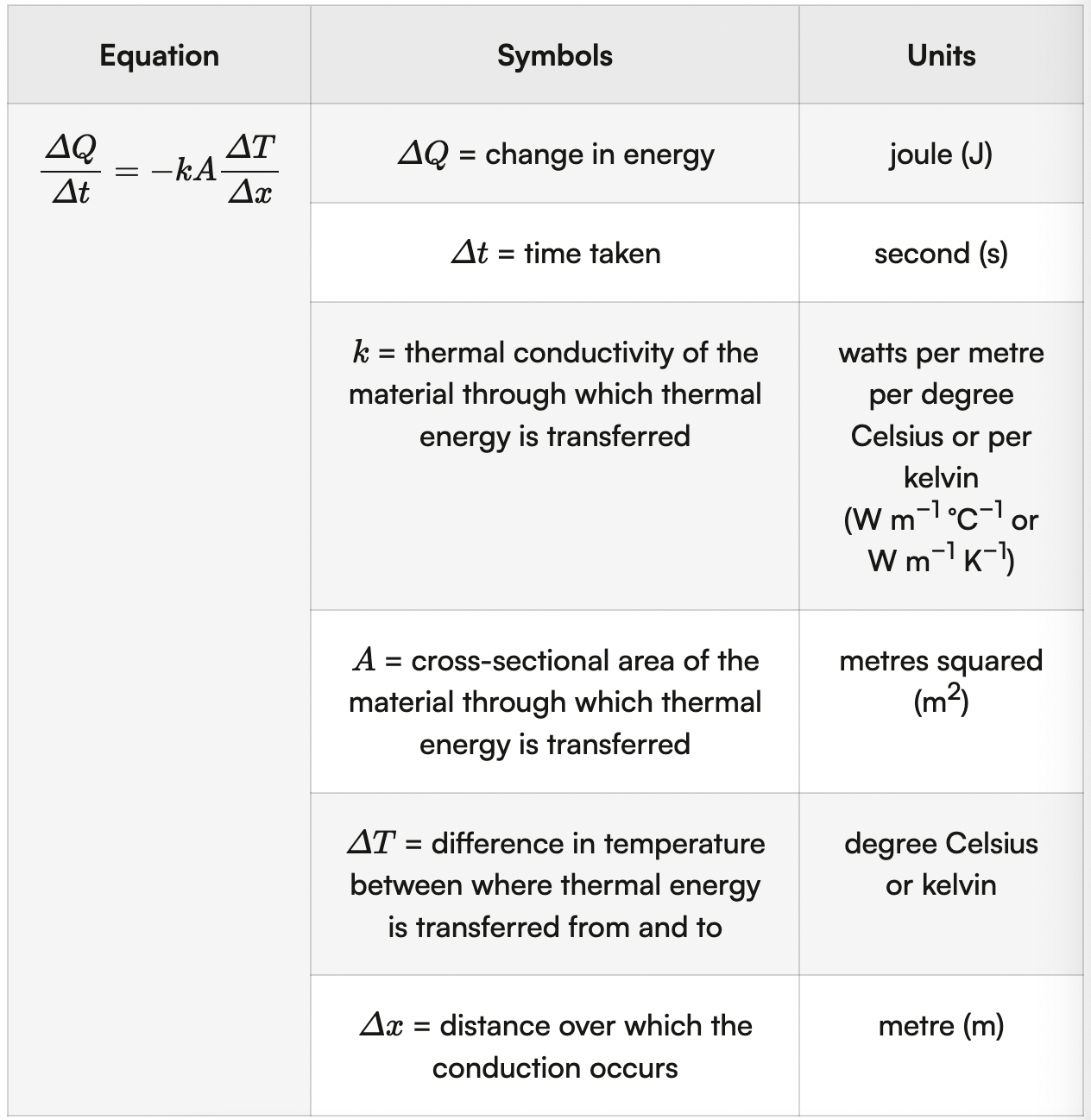
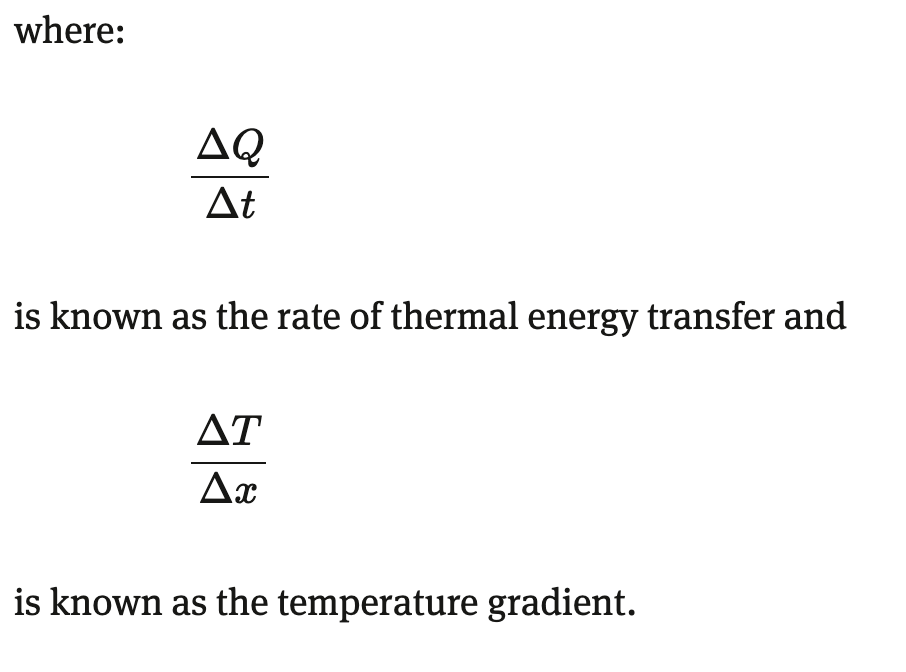
Conduction is the transfer of thermal energy between particles in direct contact. It occurs best in solids because the particles are in contact with each other. In conduction:
Thermal energy is supplied to one part of the solid.
This energy is transferred to the kinetic energy of the particles closest to the heat source, and they start to vibrate more.
They collide with neighbouring particles, transferring energy to them.
When thermal equilibrium is reached, the net energy transfer is zero.
Convection is the transfer of thermal energy due to the mass movement of molecules caused by differences in density. It occurs best in liquids and gases because the molecules can move freely. In convection:
Thermal energy is supplied to one part of the fluid.
This energy is transferred to the kinetic energy of the particles closest to the heat source, and they start to move faster.
They collide with neighbouring particles more energetically, so the particles spread further apart.
This part of the fluid is now less dense and therefore rises. A cooler, denser, volume of particles moves into the space.
This process repeats in a continuous cycle known as a convection current.
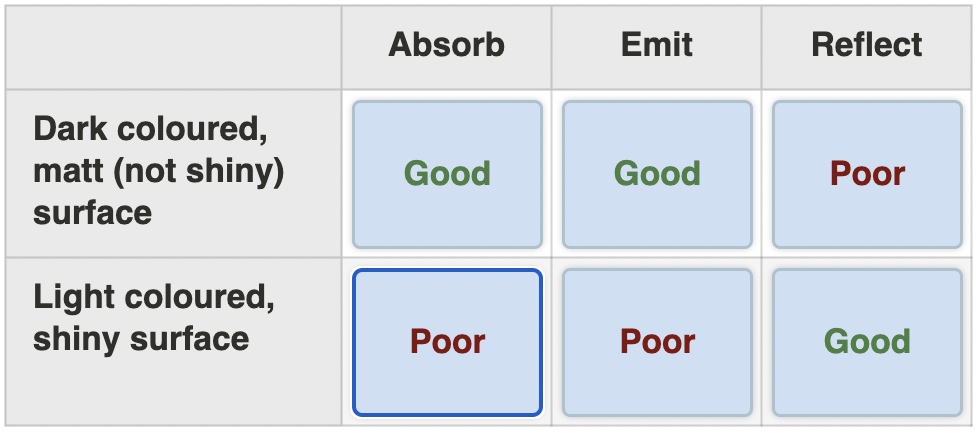
Thermal radiation is the transfer of energy by electromagnetic waves it does not need particles to travel, and can transfer energy through a vacuum. All objects with a temperature above zero kelvin (0 K) emit thermal radiation. The greater the temperature, the higher the intensity of emitted thermal radiation.
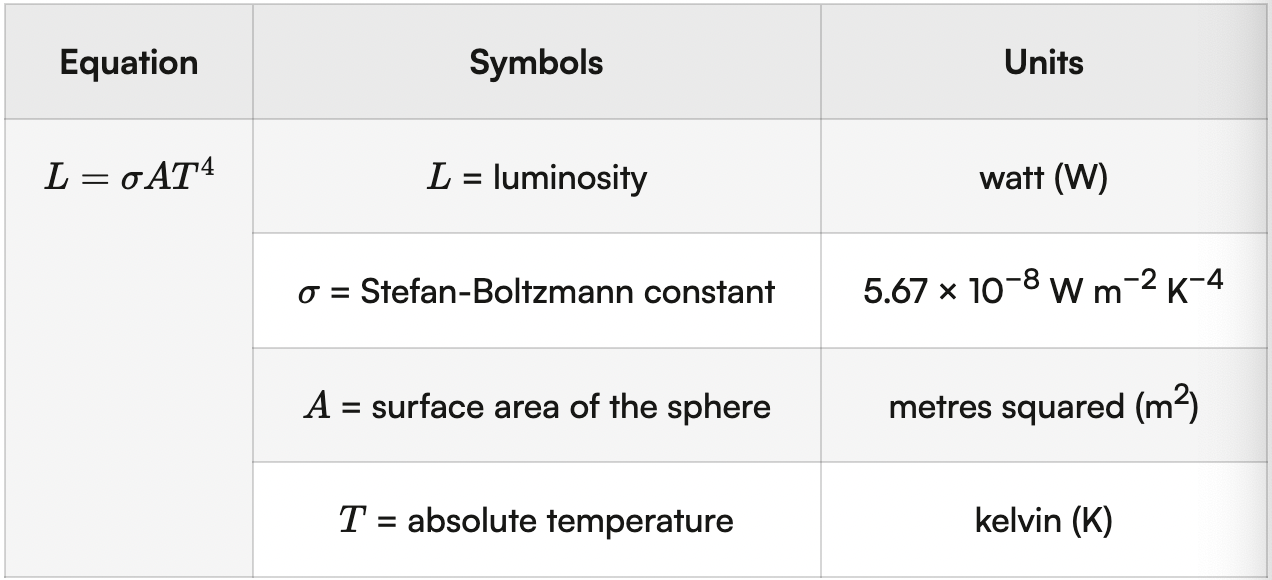
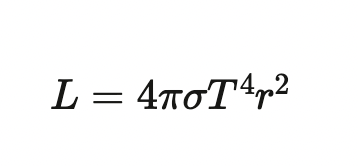
quantitative analysis of energy transferred by radiation as a result of the emission of electromagnetic waves from the surface of a body, which in the case of a black body can be modelled by the Stefan-Boltzmann law as given by L = σAT4 where L is the luminosity, A is the surface area and T is the absolute temperature of the body
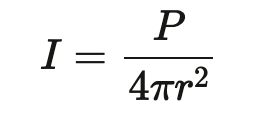
Intensity is the amount of power incident on one square metre of the surface of an object.
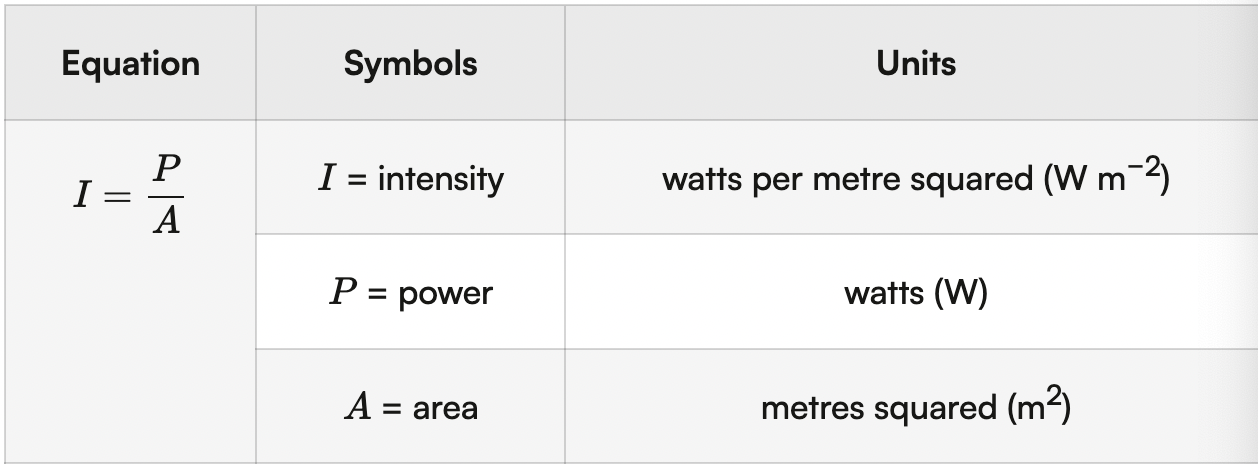
As the energy from a star is distributed over a spherical surface, the area in the equation is of a sphere, with radius r.
A black body is an object that absorbs all the energy of all the wavelengths of the electromagnetic spectrum that fall incident upon it. Once the object is in equilibrium, it will emit all wavelengths of the electromagnetic spectrum. As the best emitters are also the best absorbers of radiation a black body can be described as an object that absorbs and emits all wavelengths of the electromagnetic spectrum.
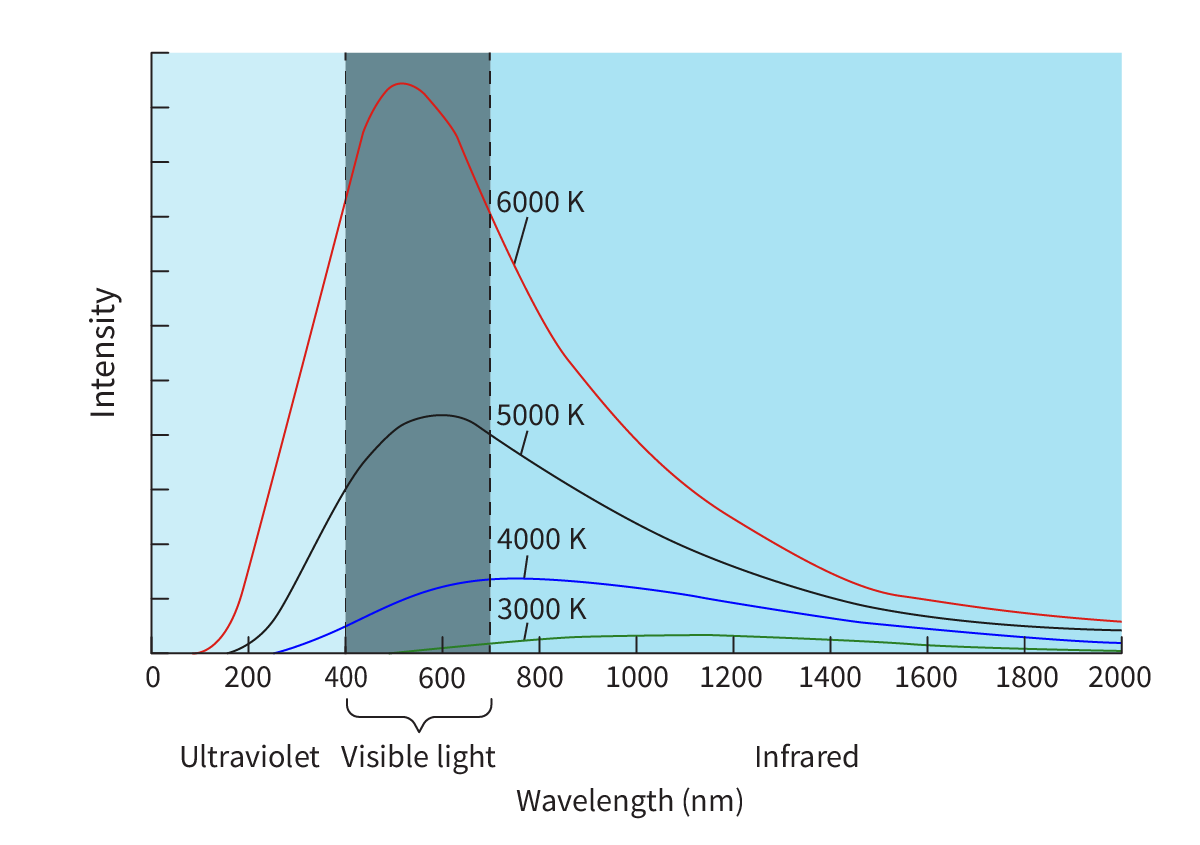
The shape of these graphs and the peak wavelength are not dependent on the material. The only thing that affects the peak wavelength is the temperature of the black body. This peak value can be used to determine the temperature of any black body.
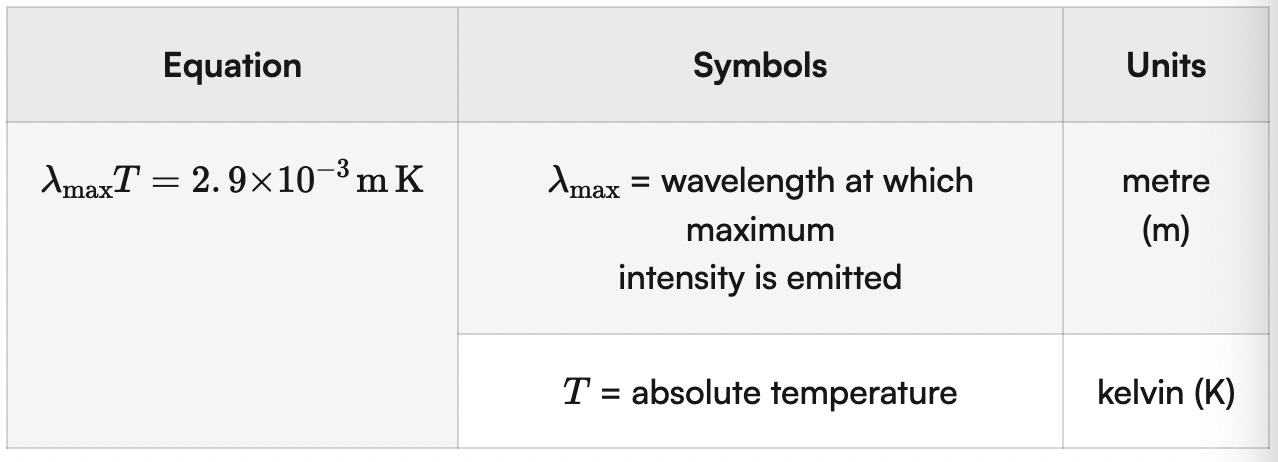
The luminosity of a black body, such as a star, is the amount of energy it emits per second, measured in watts (W).
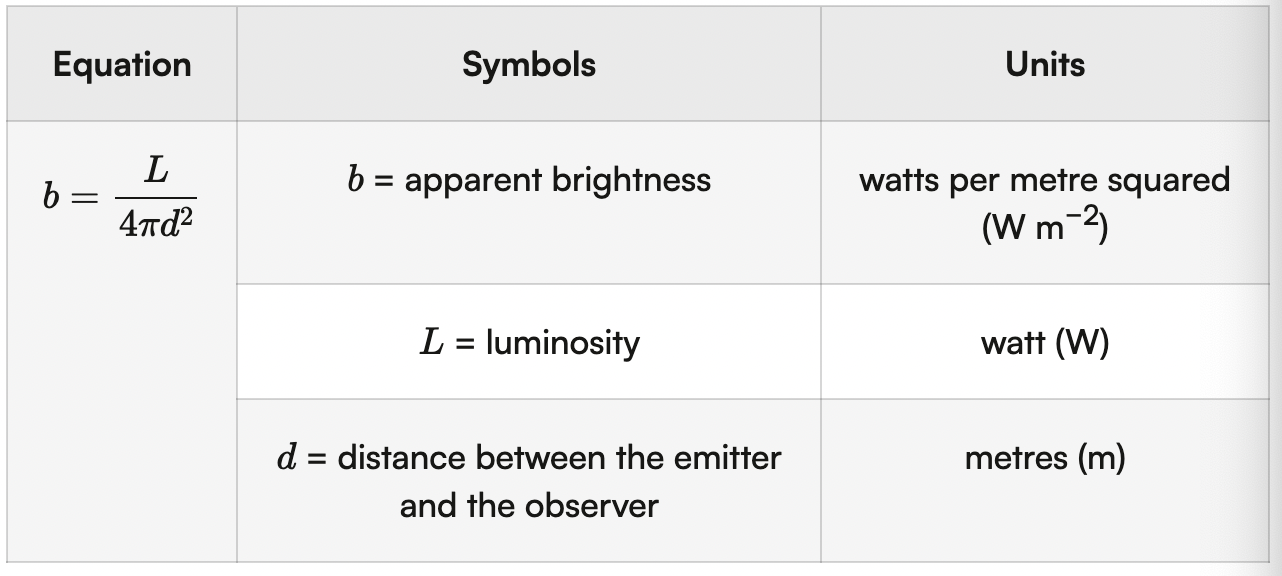
the concept of apparent brightness b
If two stars are the same distance away from an observer on Earth, the star with the greater luminosity will appear brighter to the observer. This leads us to a concept known as apparent brightness, which is how bright a star appears to an observer.
apparent brightness b is the amount of power per square metre received by an observer from the star, measured in watts per metre squared (W m−2).
luminosity L of a body as given by b = L4πd2
The key difference between luminosity and apparent brightness is that luminosity is a property of the star’s power output, whereas apparent brightness depends on the intensity of light received by an observer.
the conservation of energy
Energy cannot be created or destroyed, only transferred.
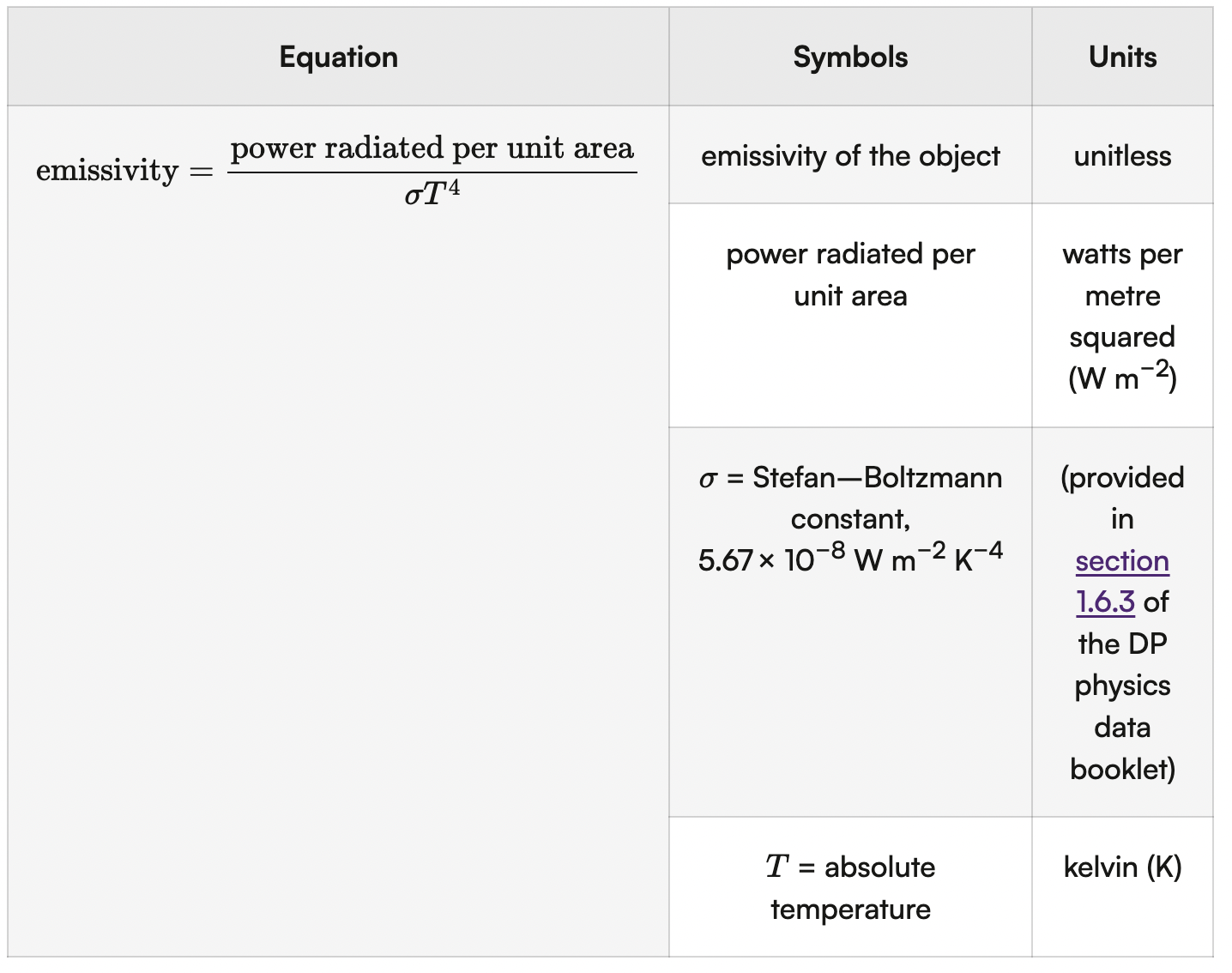
emissivity as the ratio of the power radiated per unit area by a surface compared to that of an ideal black surface at the same temperature as given by emissivity = power radiated per unit area σT4
The ratio of the power emitted per unit area by a real object to the power emitted by a perfect black body of the same size and temperature is known as emissivity
albedo as a measure of the average energy reflected off a macroscopic system as given by
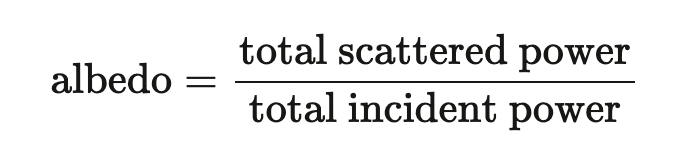
albedo = total scattered power total incident power
The average energy reflected off a macroscopic system compared to the energy incident on the system is known as albedo
that Earth’s albedo varies daily and is dependent on cloud formations and latitude
The Earth’s average albedo is about 0.30, but its albedo varies daily due to a number of factors including the following:
The thickness of the clouds above the Earth. If a thick white cloud is above a deep ocean, the albedo will be higher because the light surface of the cloud is more reflective than the dark surface of the ocean.
The type of cloud cover. Thick, fluffy clouds, like cumulonimbus, have a high albedo, while thin, wispy clouds, like cirrus, have a low albedo
Latitude: the further away from the Equator, the higher the albedo. This is geographical (not a mathematical relationship) because there are more light-coloured surfaces further away from the Equator, such as the snow and ice found at the North and South Poles, which reflect more radiation, thus increasing the albedo.
The type of terrain on the Earth’s surface. The material that covers the surface, such as snow and ice, desert, ocean or forest, affect the albedo.
the solar constant S
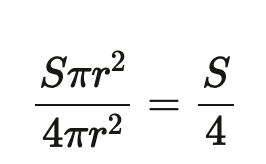
The solar constant (S) represents the average intensity of electromagnetic radiation incident on the Earth’s outer atmosphere, and its value is equal to the average apparent brightness of the Sun from Earth.
S = 1.36 × 10³ W m−2.
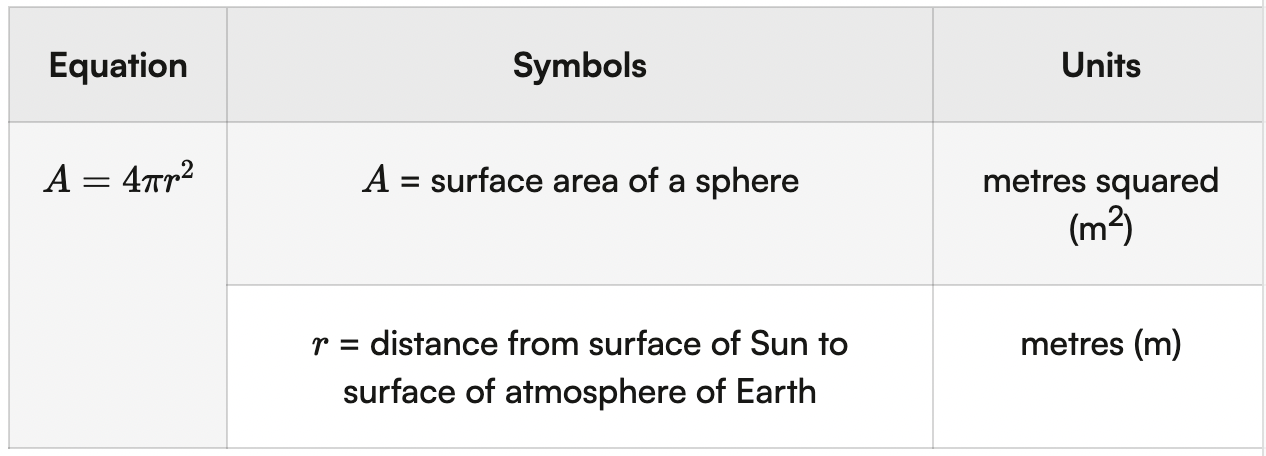
sun energy per second / A
that methane CH4, water vapour H2O, carbon dioxide CO2, and nitrous oxide N2O, are the main greenhouse gases and each of these has origins that are both natural and created by human activity
Greenhouse Gas: A gas that absorbs and emits radiant energy from the sun. We call them greenhouse gases because they store energy in the Earth's atmosphere like the roof of a greenhouse. If we significantly change the amount of greenhouse gases in the atmosphere, we will change the energy in the atmosphere. This causes climate change.
The gases that make up most of the Earth’s atmosphere are nitrogen and oxygen. They do not absorb infrared radiation. The greenhouse gases that do absorb infrared radiation are carbon dioxide (CO2), methane (CH4), nitrous oxide (N2O) and water vapour (H2O).
that the greenhouse effect can be explained in terms of both a resonance model and molecular energy levels
The resonance model
All objects have a natural frequency of vibration. If the incident radiation has a frequency equal to that of the molecules’ natural frequency of vibration, the molecules absorb the energy and resonance occurs. This means that the amplitude of vibration of the molecules is maximum. The natural frequency of vibration of the greenhouse gases is within the range of frequencies of infrared radiation. So the greenhouse gases absorb this radiation. Other gases, such as oxygen and nitrogen, have a different natural frequency of vibration so they do not absorb a significant quantity of infrared radiation.
Molecular energy levels
Light can exist as a wave and as a particle, called a photon, which has a specific amount of energy depending on the frequency of the light.Molecules can be interpreted to have discrete energy levels and they can only exist at these set energy levels. If a photon energy matches the gap between molecular energy levels the photon will be absorbed and the molecule increases its energy. At some later point in time, the molecule will drop back down an energy level and re-emit the photon in a random direction. Nitrogen and oxygen molecules have gaps between energy levels that are different to the photon energies of ultraviolet or infrared radiation, therefore no interaction occurs.
that the augmentation of the greenhouse effect due to human activities is known as the enhanced greenhouse effect.
the natural green house effect (The absorbtion of thermal energy in the Earth surface–atmosphere system due to the naturally occuring concentrations of greenhouse gases in the atmosphere.) is essential for keeping the temperature of the Earth in the narrow range of temperatures that will support life as we know it.
Natural variations and human activity have increased, and continue to increase, the concentration of greenhouse gases in the atmosphere, leading to the enhanced greenhouse effect
pressure as given by P = F/A where F is the force exerted perpendicular to the surface
Pressure (p) is the fore applied per unit area (Pa), scalar
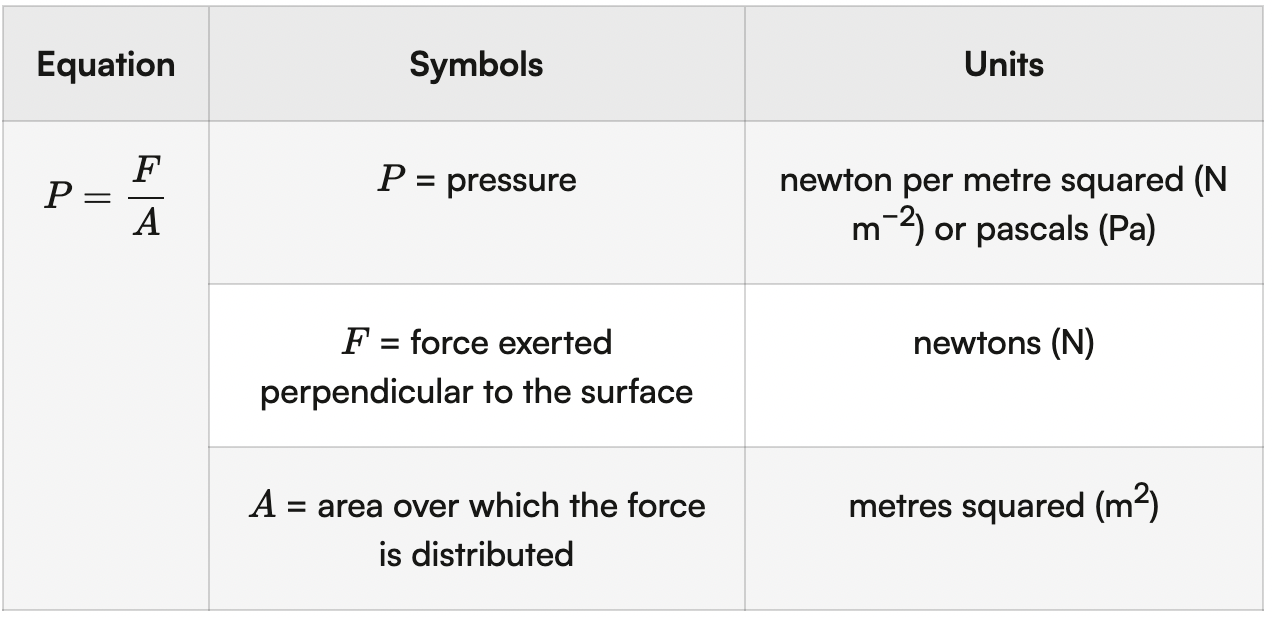
gas always flow form a highe pressure to a lower pressure region until the two pressures are equal
the amount of substance n as given by n = N/NA where N is the number of molecules and NA is the Avogadro constant
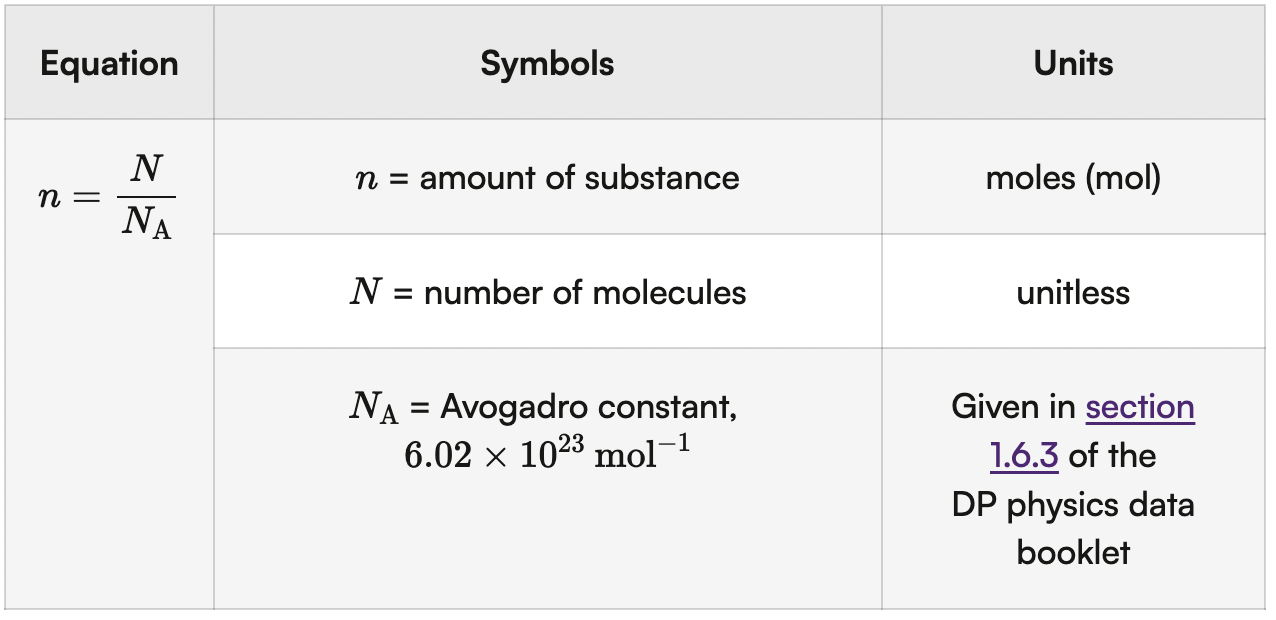
that ideal gases are described in terms of the kinetic theory and constitute a modelled system used to approximate the behaviour of real gases
ideal gas: all internal energy added becomes kinetic energy
The gas is made up of a very large number of small identical molecules in random motion.
There can be no intermolecular forces or bonds between the particles.
All collisions between particles, and between particles and the barrier, must be perfectly elastic.
There are just as many molecules moving in one direction as any other direction (the gas as a whole doesn't travel in any one direction)
The individual forces from collisions between molecules average out to a uniform pressure throughout the gas.
more kinetic = more like ideal]
less potential = more like ideal
lower pressure (less interactions = less intermolecular forces) = more like ideal
higher temps (more kinetic) = more like ideal
lower density (less interactions) = more like ideal
that the ideal gas law equation can be derived from the empirical gas laws for constant pressure, constant volume and constant temperature as given by PV/T = constant
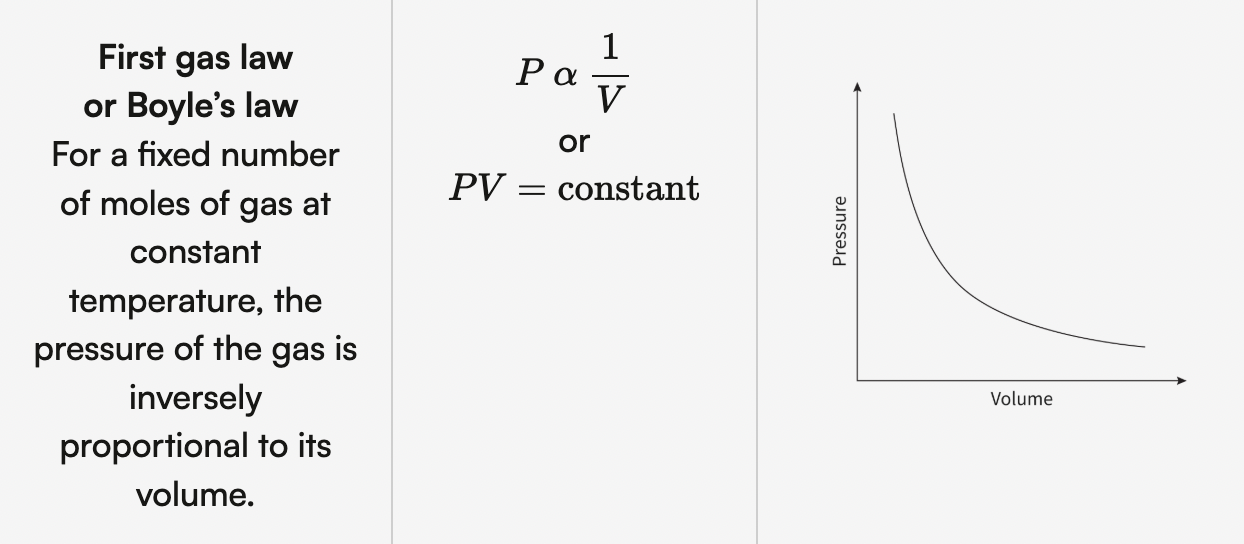
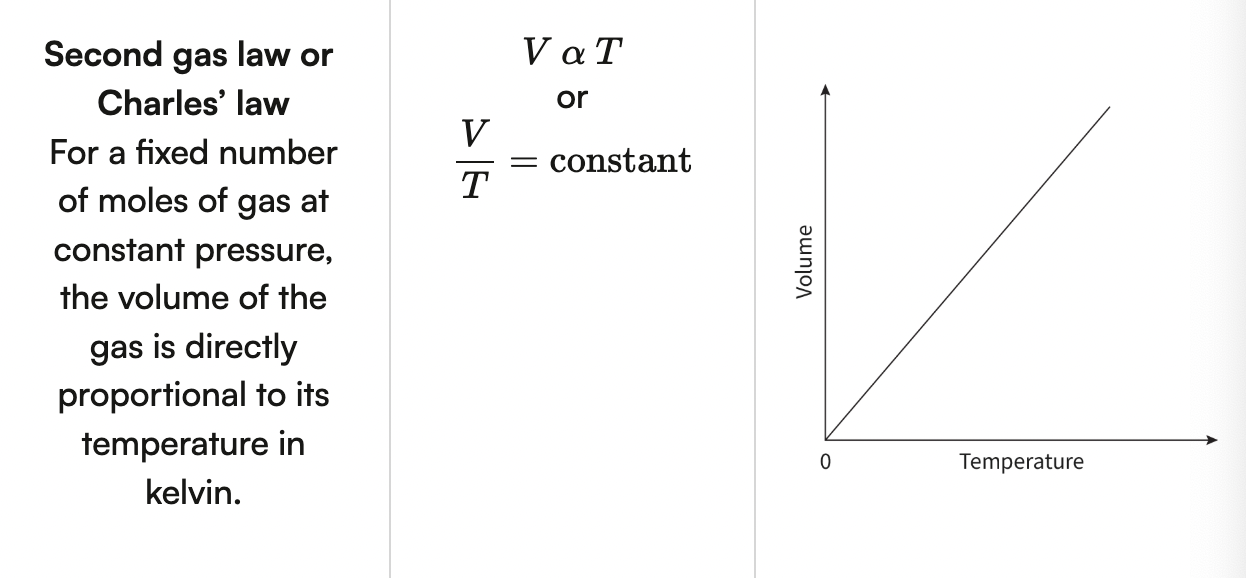
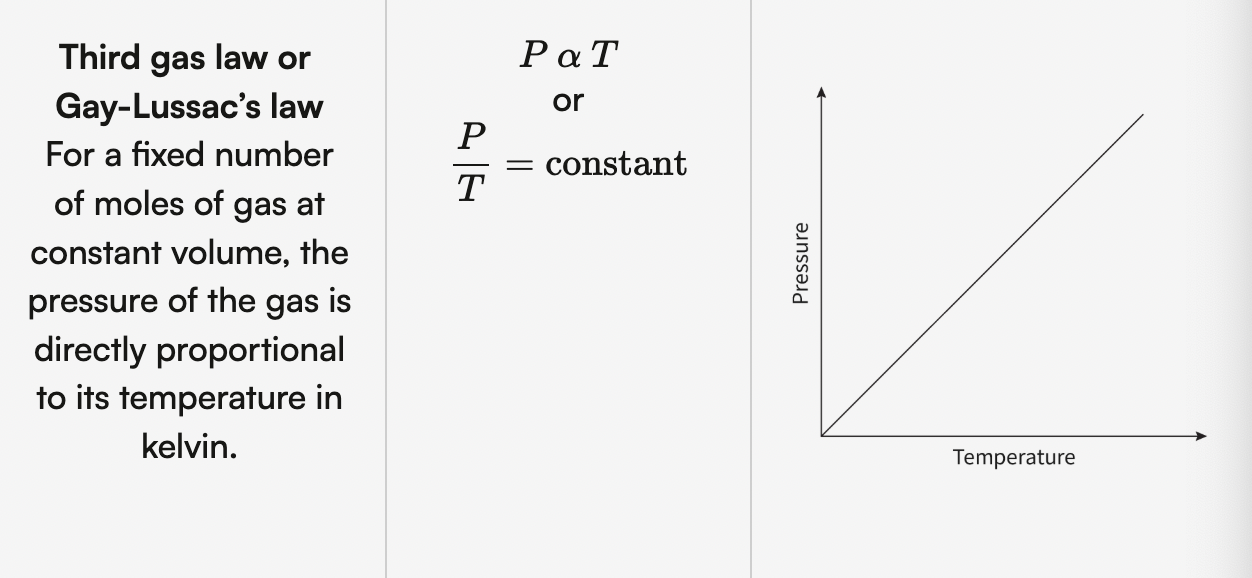
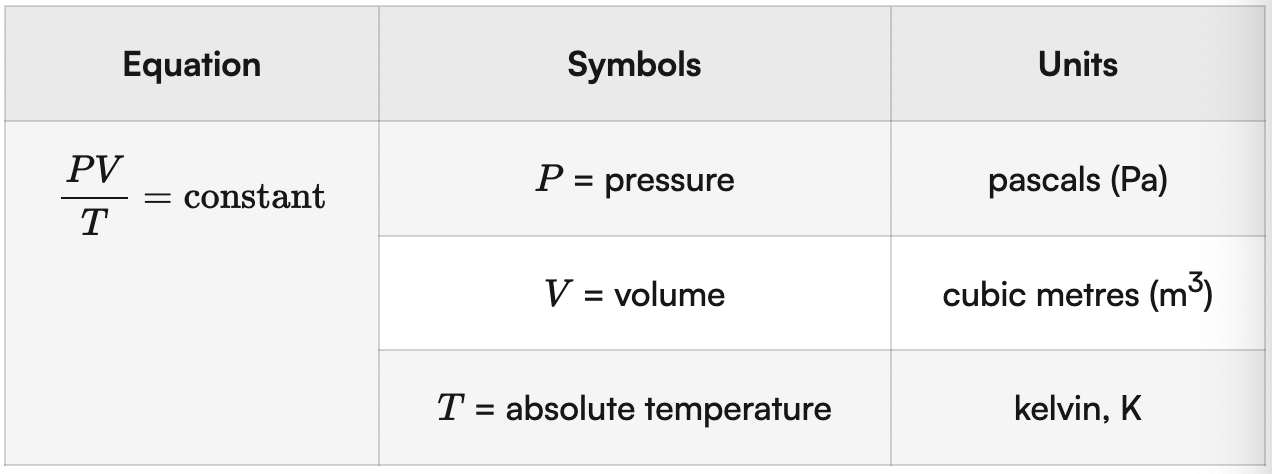
This can also be written as:
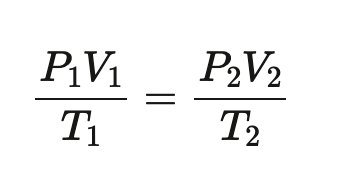
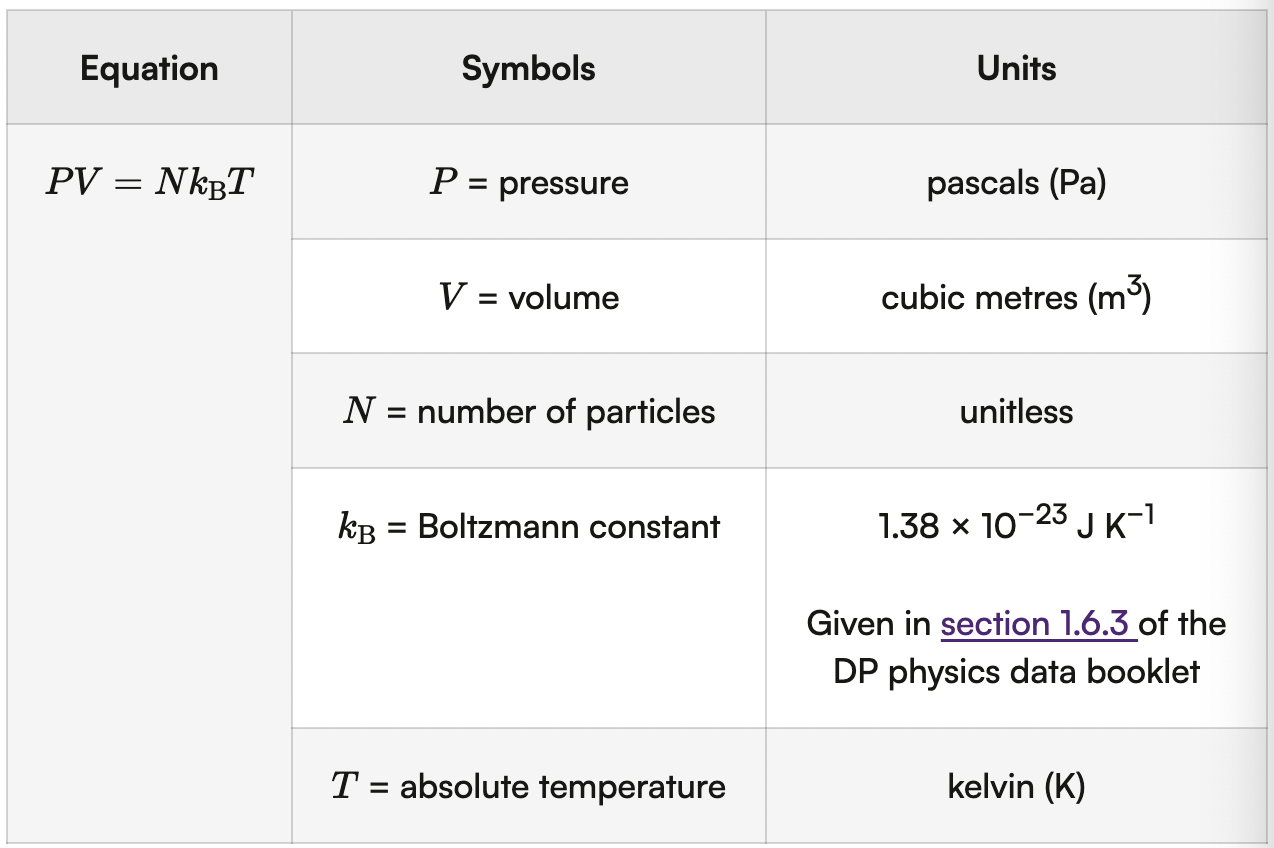
the equations governing the behaviour of ideal gases as given by PV = NkBT and PV = nRT
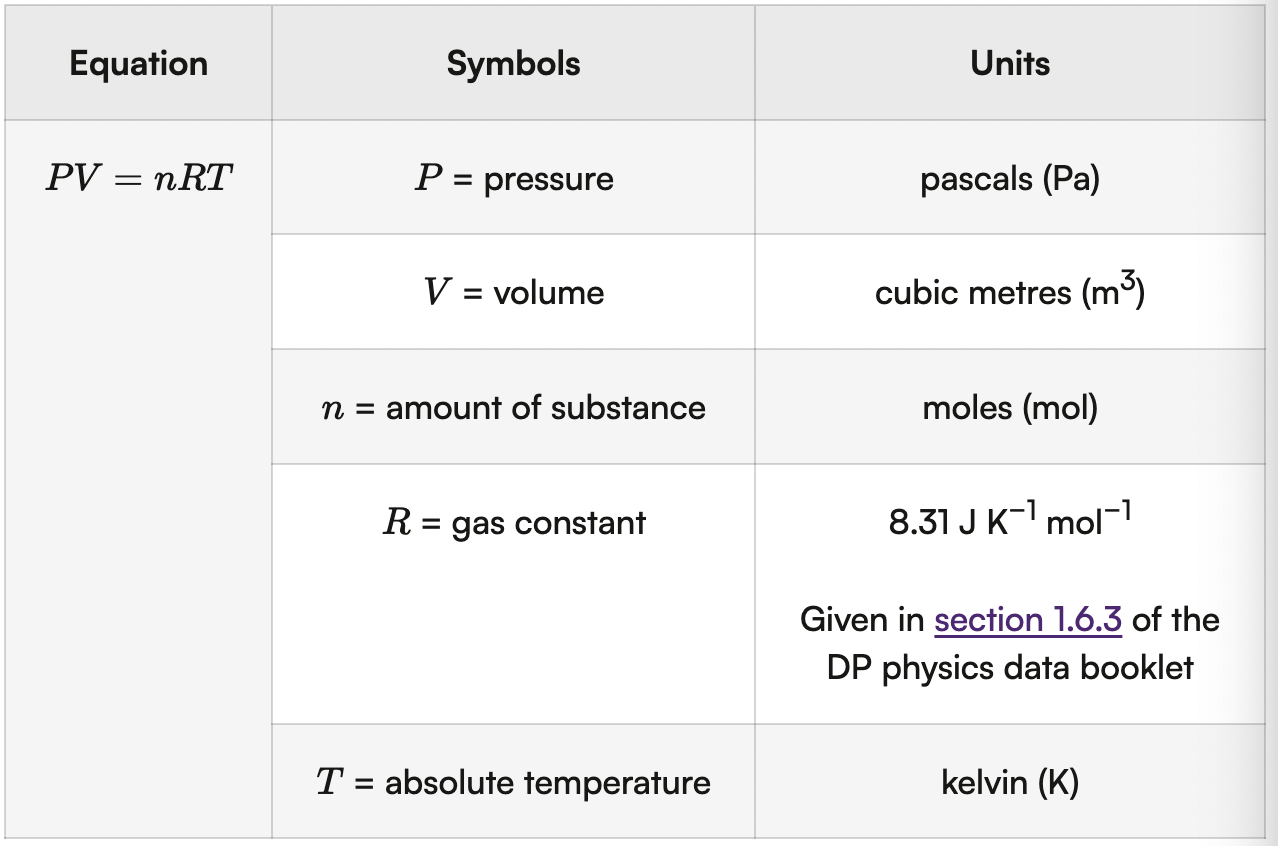
Substitute the equation for n
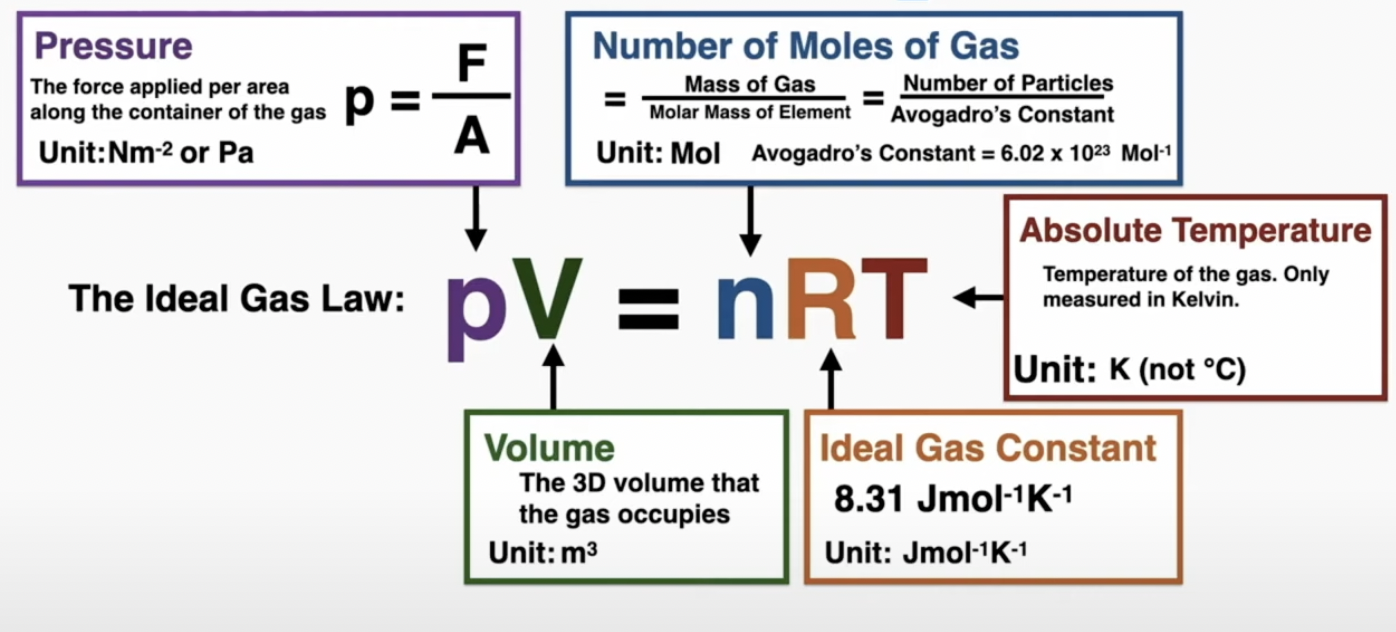
that the change in momentum of particles due to collisions with a given surface gives rise to pressure in gases and, from that analysis, pressure is related to the average translational speed of molecules as given by P = 1/3 ρv^2
A single particle of mass m, travelling at a velocity v, collides with the wall of its container and bounces back. Because the collision is elastic, the magnitude of the particle’s velocity (speed) is the same, but the direction has reversed, thus there has been a change in velocity. The collision and change in velocity is equally well described as a change in momentum. As there is a change in momentum happening in time t, there is a force exerted on the wall of the container.
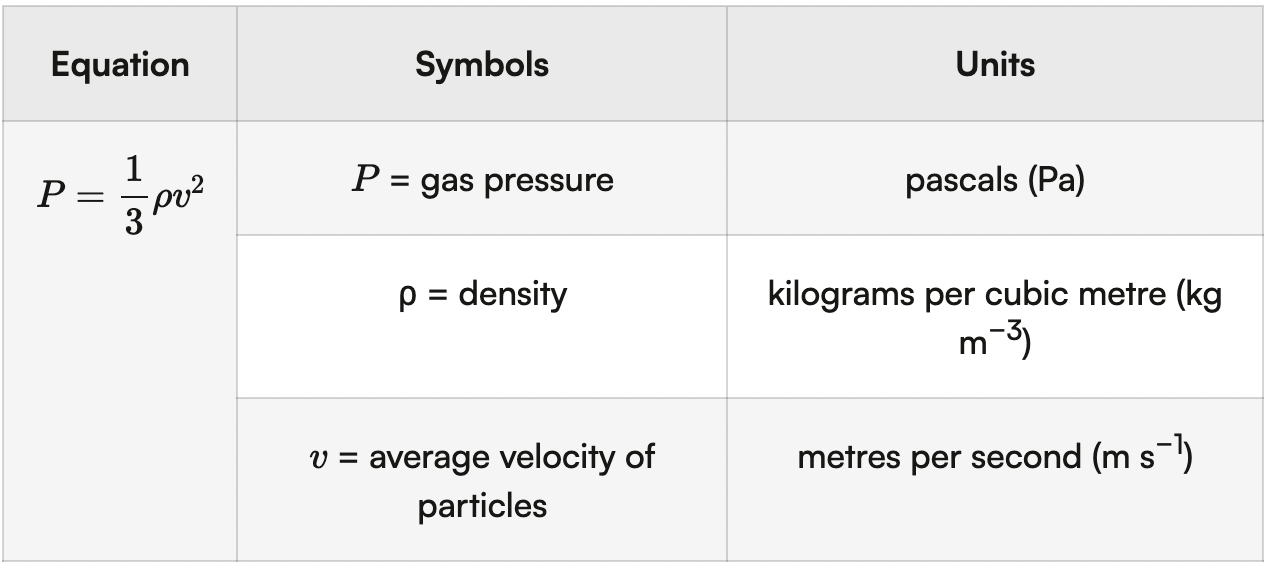
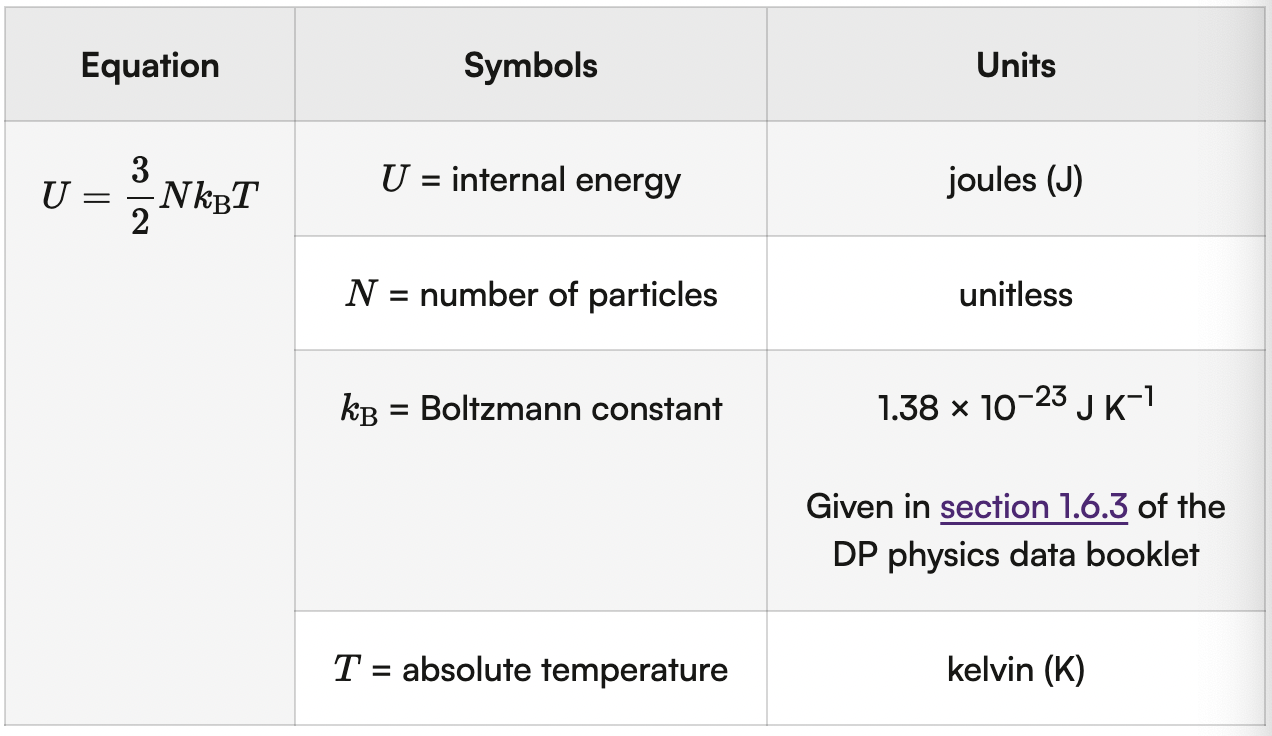
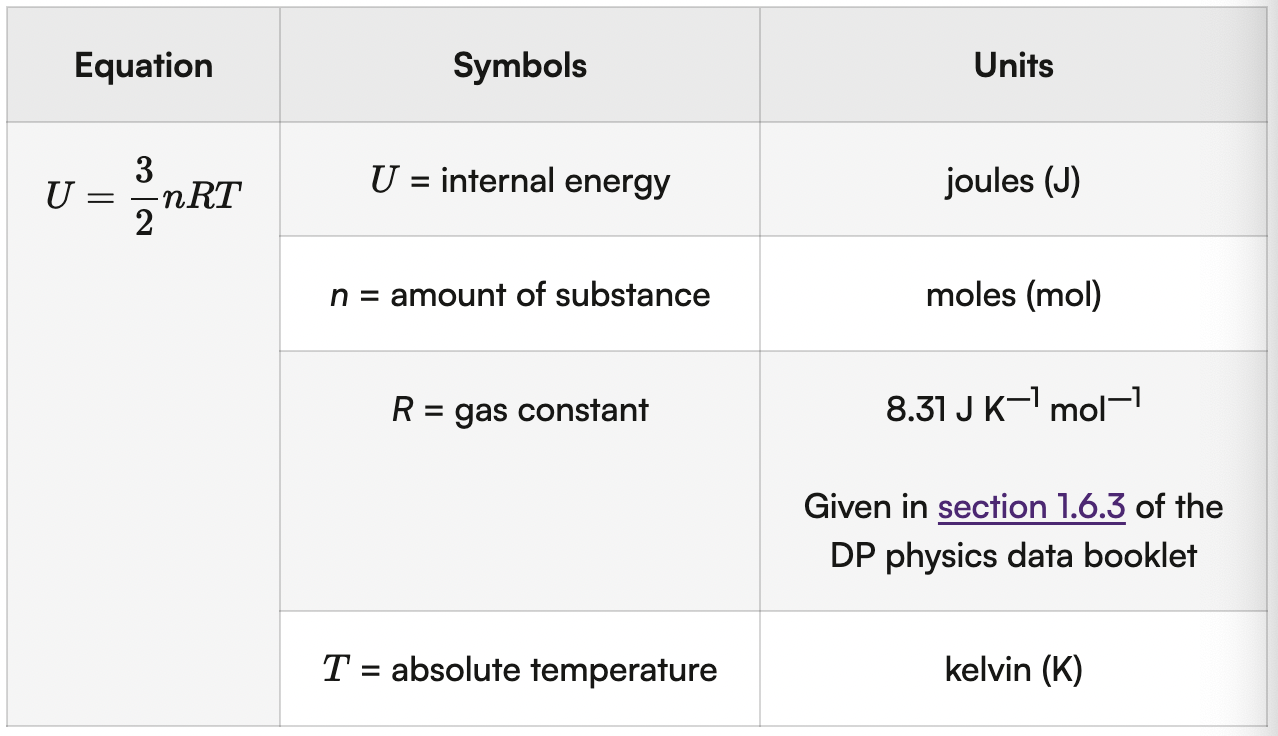
the relationship between the internal energy U of an ideal monatomic gas and the number of
molecules or amount of substance as given by U = 32NkBT or U = 32RnT
According to the ideal gas assumptions, there are no intermolecular forces between particles in an ideal gas. So all of the internal energy must be kinetic energy.
The temperature of a substance is a measurement of the average random kinetic energy of a single particle in the substance. As energy is measured in joules and temperature in kelvin, which are not equivalent, we need to use a physical constant to convert between the two. In this case, we use 3/2kB. This conversion gives us the average kinetic energy of one particle. The total kinetic energy, and therefore the total internal energy of the gas, also depends on the number of particles, N.

that cells provide a source of emf
The amount of energy that a cell transfers to each unit of charge is known as the
electromotive force (emf). It is measured in volts (V).
chemical cells and solar cells as the energy source in circuits
A chemical cell (battery) is a source of energy for an electric circuit, in which chemical energy is converted to electrical energy. Another type of cell is a solar cell, which converts radiation energy to electrical energy.
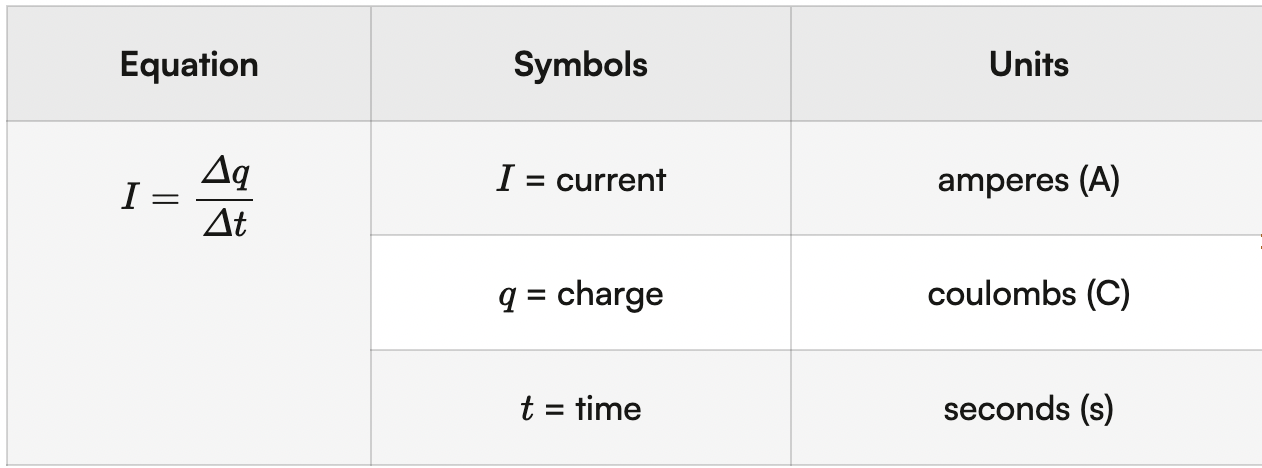
direct current (dc) I as a flow of charge carriers as given by I = Δq
Electric current is the rate of flow of charge. It is a measure of how much charge flows past a point per second. Current is measured in amperes (amps) (A).
Direct current (dc) flows in one direction only.
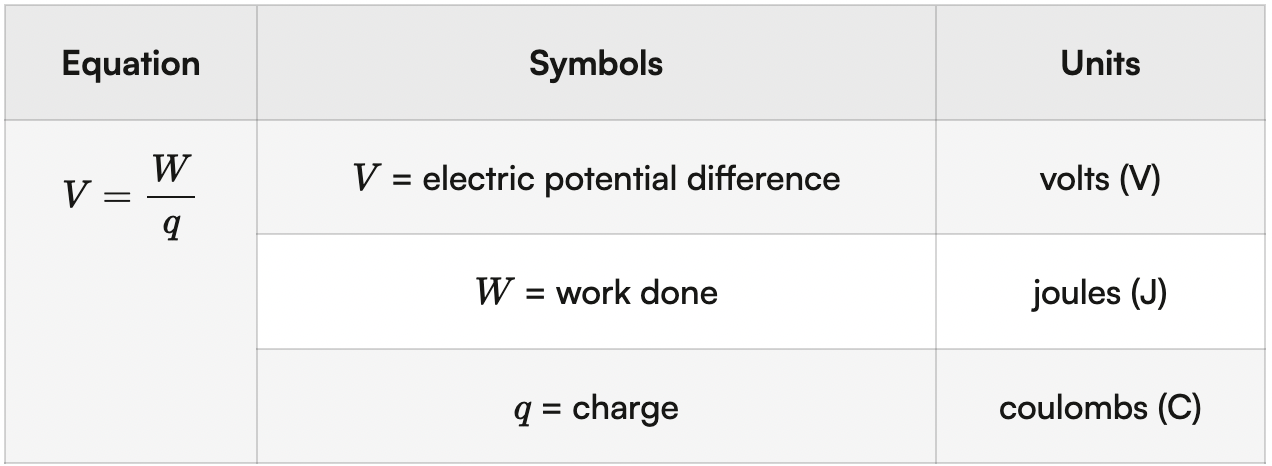
that the electric potential difference V is the work done per unit charge on moving a positive charge between two points along the path of the current as given by V = Wq
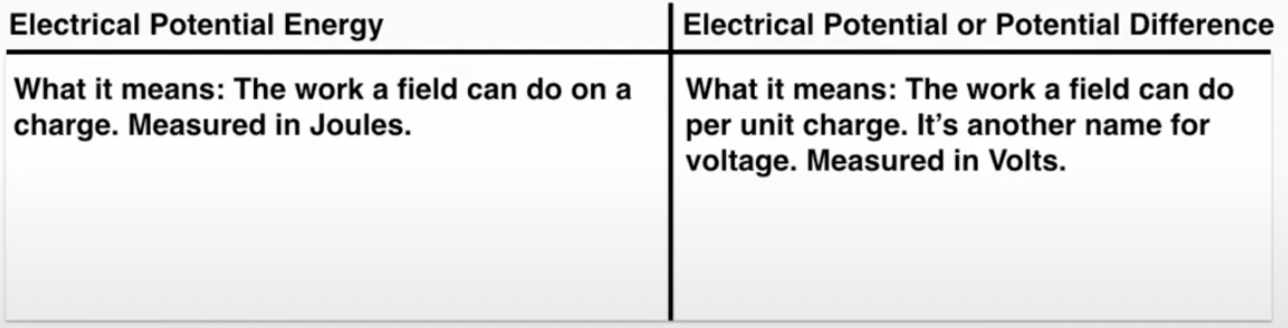
Voltage (V) is a measurement of the electrical potential energy per unit charge between two points in an electric field. It is a scalar. Voltage tells you how much energy will be added to a charge as it moves a given distance in an electric field based on the amount of charge. (V)
V = Work/q
V = Ed
Electric potential difference,V, is defined as the work done per unit charge on moving a positive charge between two points along the path of the current
the properties of electrical conductors and insulators in terms of mobility of charge carriers
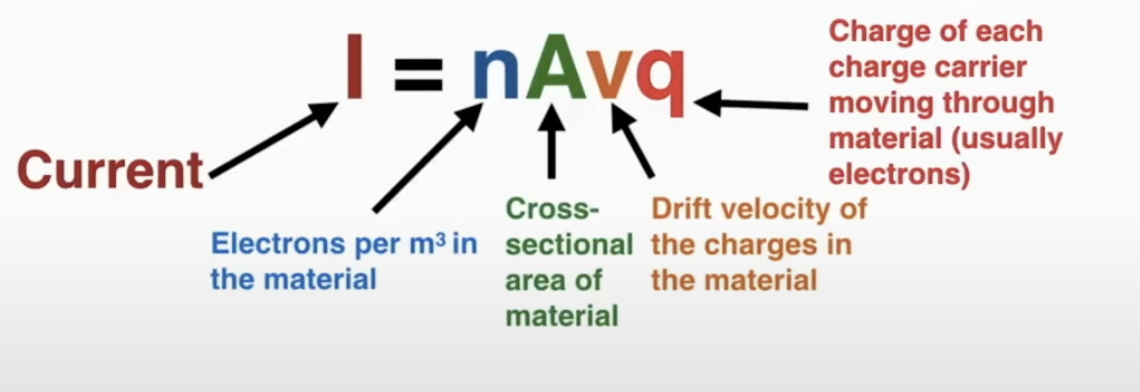
Electricity is the movement (or flow) of mobile charge carriers through a material. Usually, the charge carrier (the charged particle that moves through a material) is the electron.
Materials with lots of mobile charge carriers conduct electricity better. They are known as electrical conductors. Metals are electrical conductors. Electrical circuits are usually made from metals to take advantage of the mobility of the electrons.
Electrical insulators are materials, such as wood, that have fewer mobile charge carriers, and therefore electricity does not flow through them easily
electric resistance and its origin
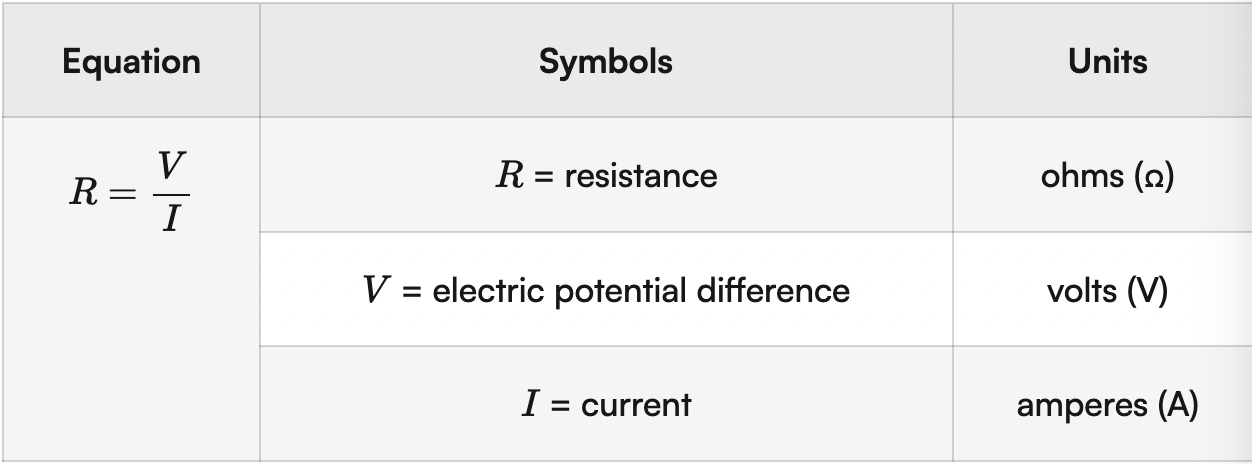
electrical resistance R as given by R = V/I
Resistance (R) is the amount of opposition current will experience to its flow when moving through an object. It can be thought of as the amount of electrical energy per charge (voltage) lost per current moving through the material. (Ω)
R = V/I
Electrical resistance is a measure of the opposition to the flow of current through a component. The unit of resistance is the ohm (Ω)
Resistance is defined as the potential difference across a component per unit current passing through it.
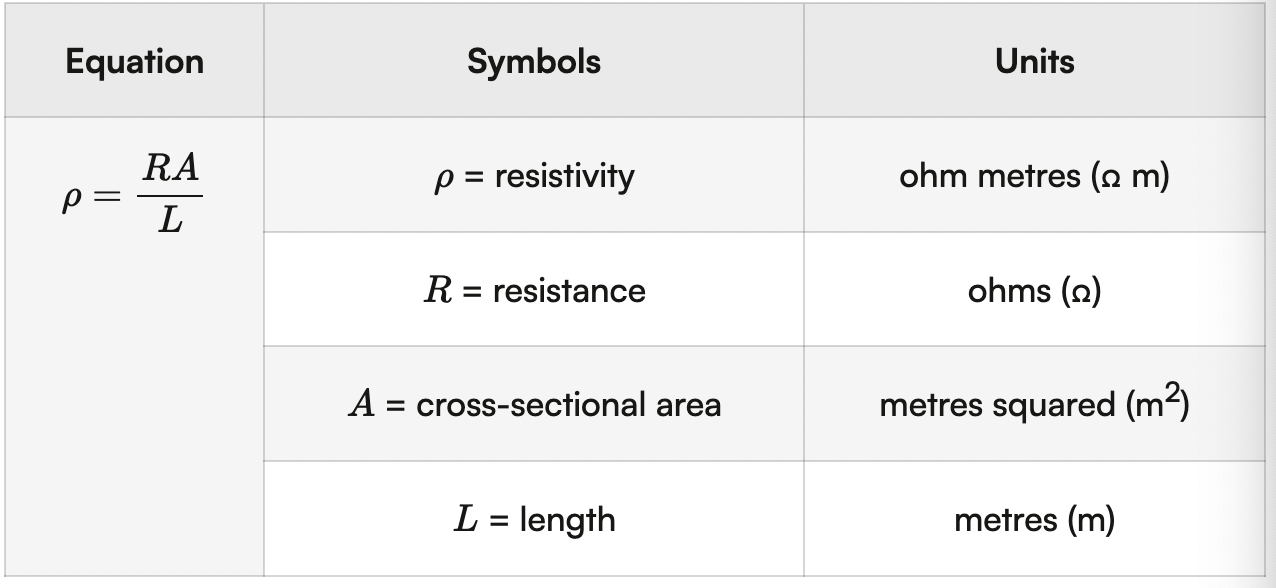
resistivity as given by ρ = RA/L
Resistivity (ρ) is the amount of resistance a given cross-sectional area of a material will experience per unit of length of the material. (Ωm)
ρ = RA/L
Resistivity is an intrinsic property of a material. Different materials have different resistivities. The resistance of an electrical component (such as a wire) depends on its resistivity, length and cross-sectional area.
Ohm's law
Ohm's law relates electric potential difference to current and resistance
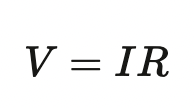
It states that the electric potential difference across a conductor is directly proportional to the current flowing through it, at constant temperature.
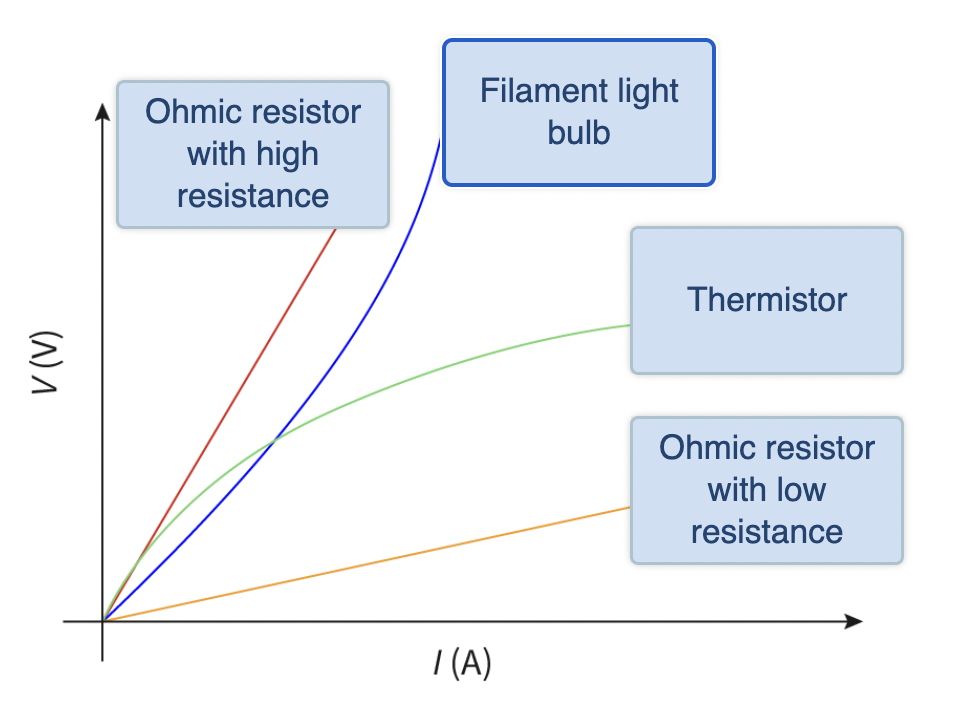
Electrical conductors that obey Ohm’s law are called ohmic conductors
Electrical conductors that do not obey Ohm’s law are called non-ohmic conductors
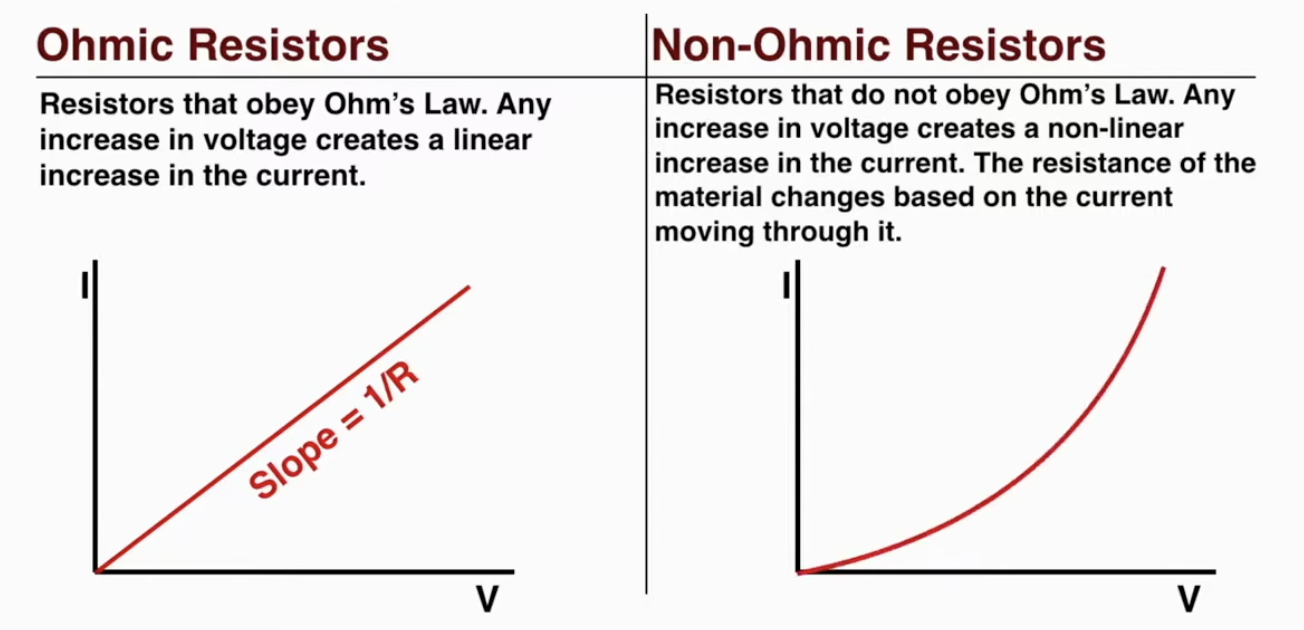
For an ohmic conductor, the resistance is constant.
For a non-ohmic conductor, the resistance changes.
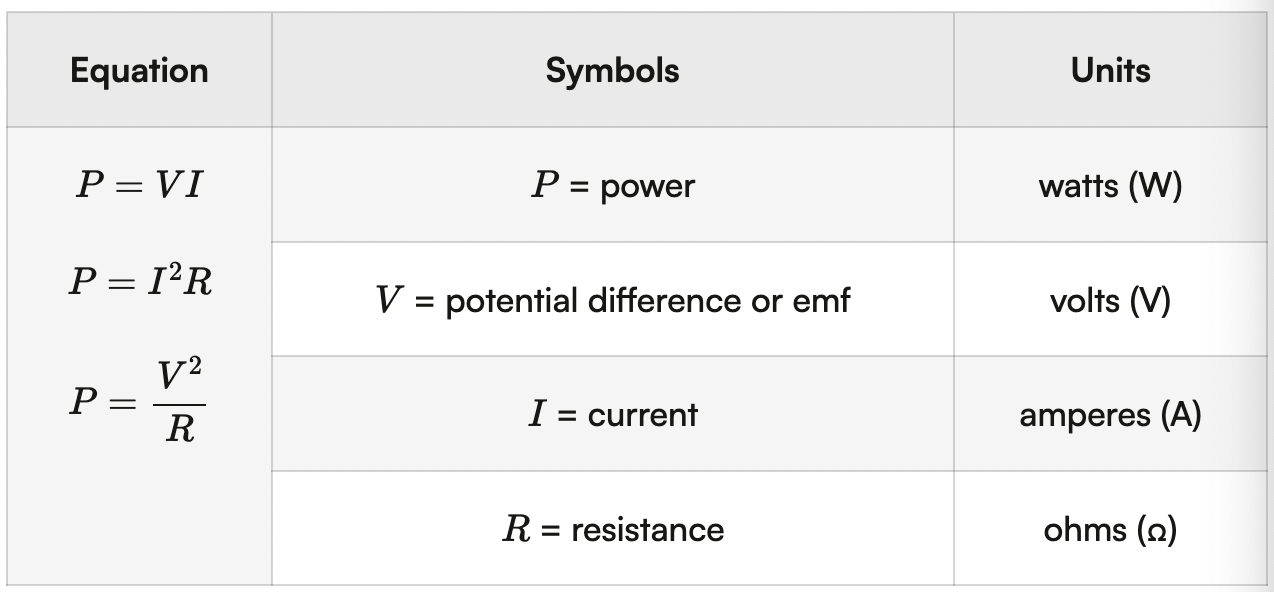
electrical power P dissipated by a resistor as given by P = IV = I2R = V^2/R
Electrical power is the amount of work done per second, or the amount of electrical energy transferred per second
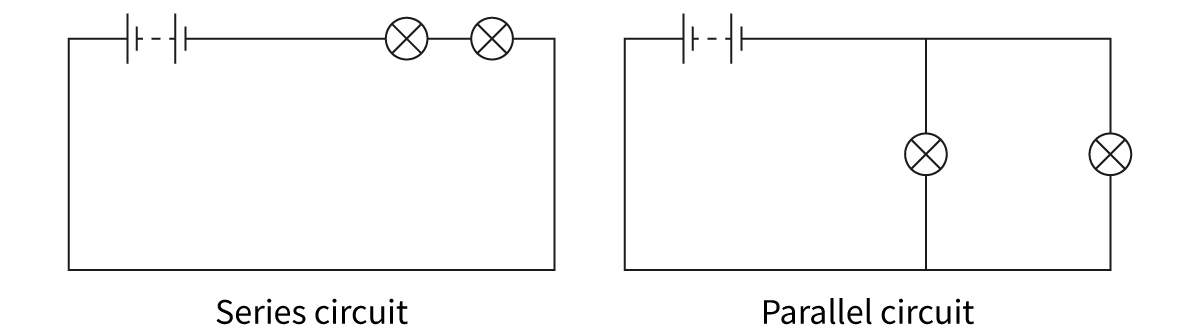
the combinations of resistors in series and parallel circuits
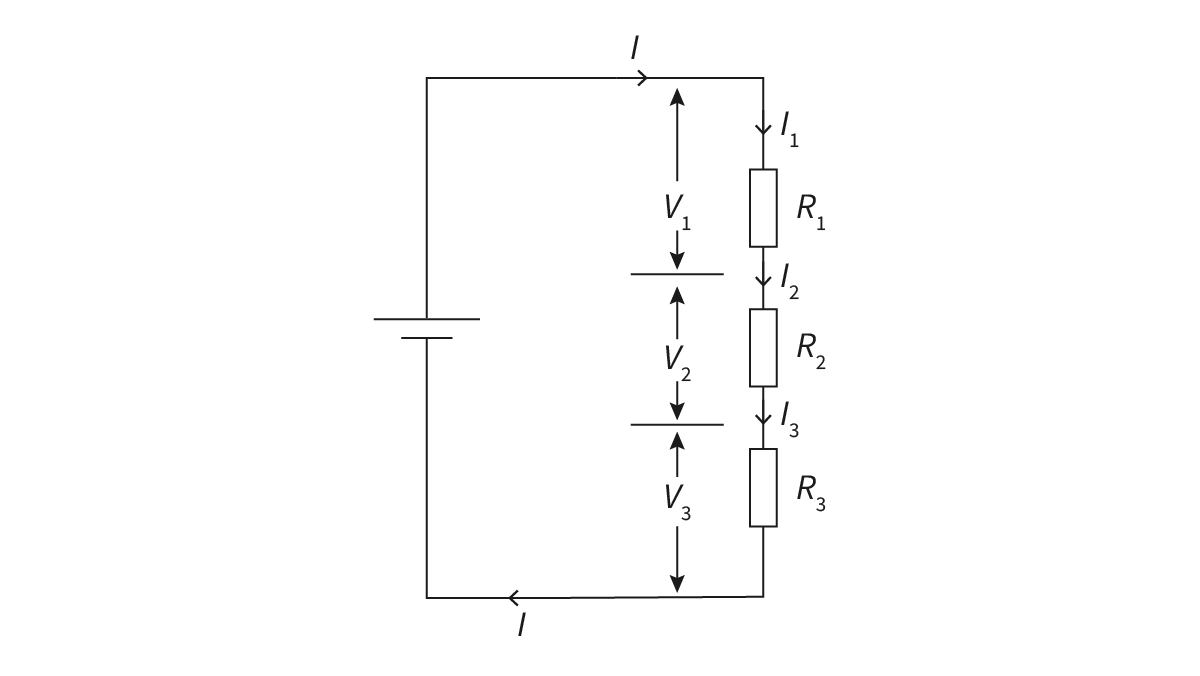
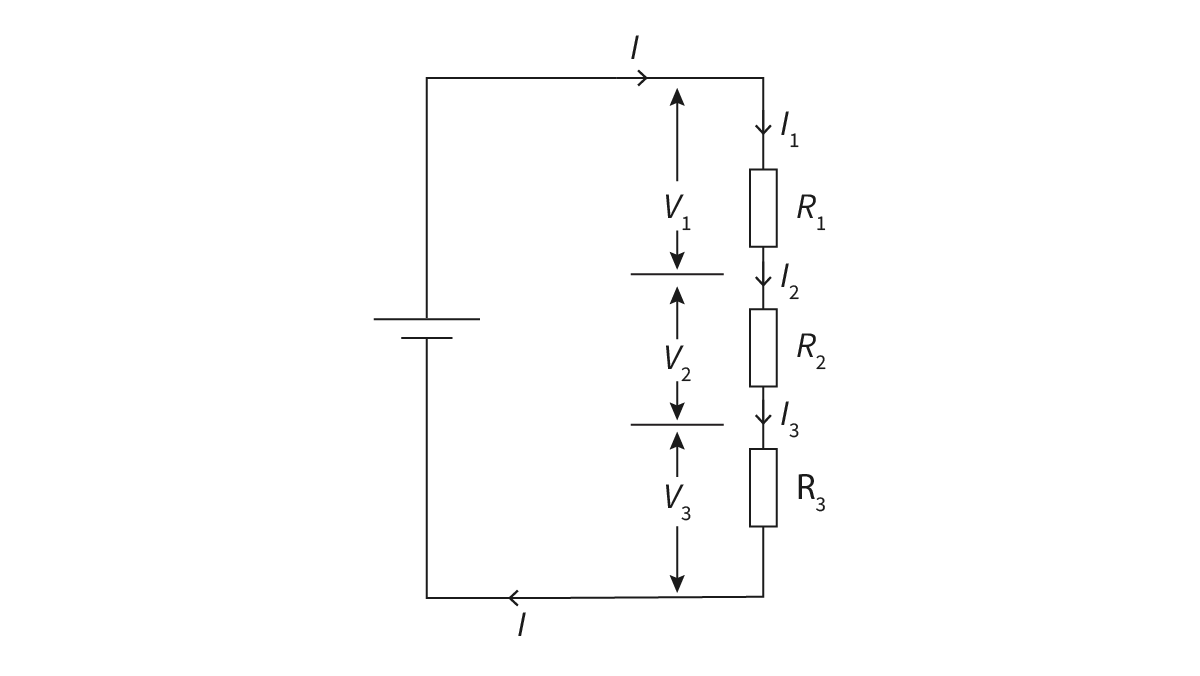
The current in a series circuit is:
I=I1=I2=I3=…
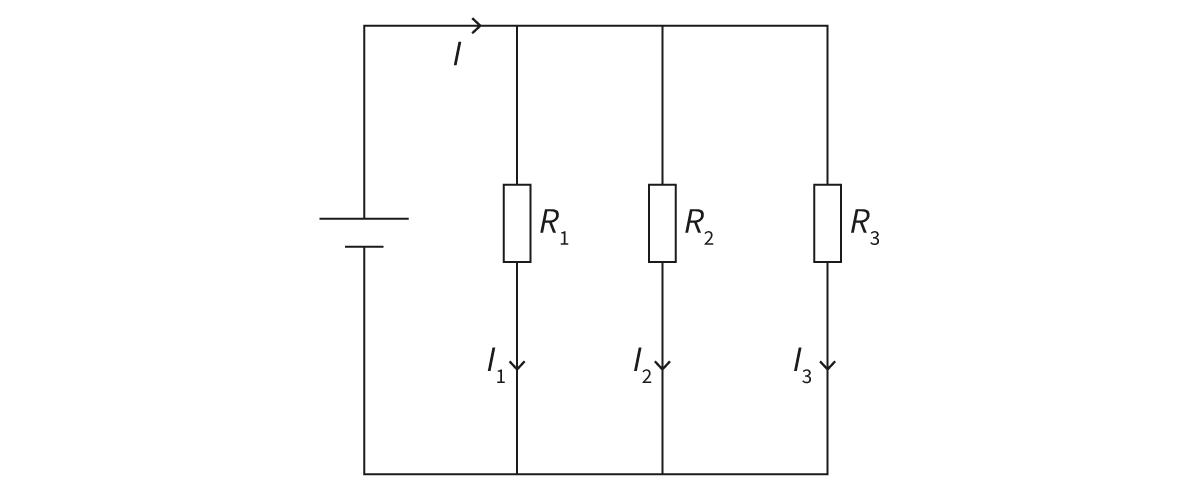
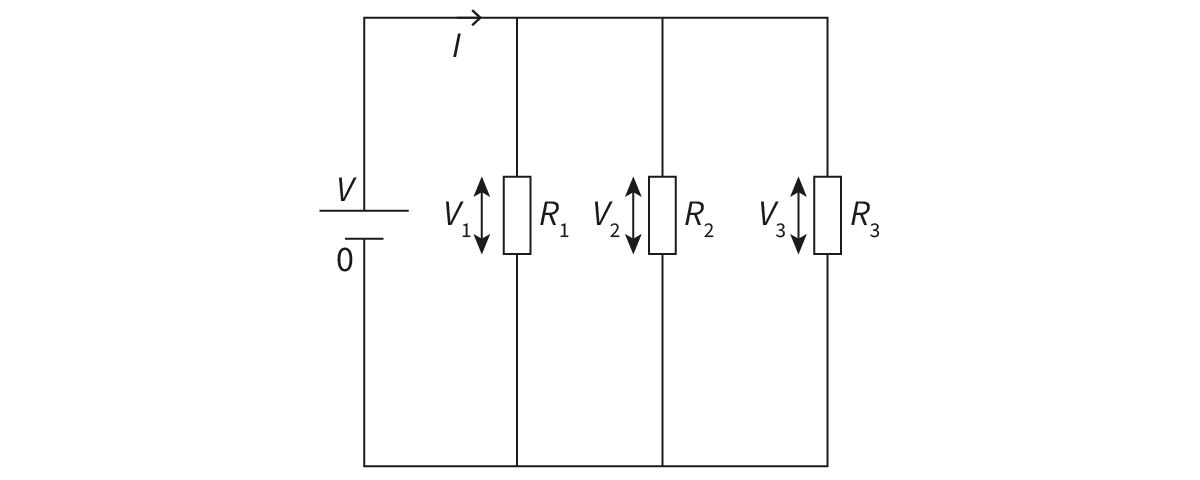
The current in a parallel circuit is:
I=I1+I2+I3+…
the electric potential difference in a series circuit is:
V=V1+V2+V3+…
The electric potential difference in a parallel circuit is:
V=V1=V2=V3=…
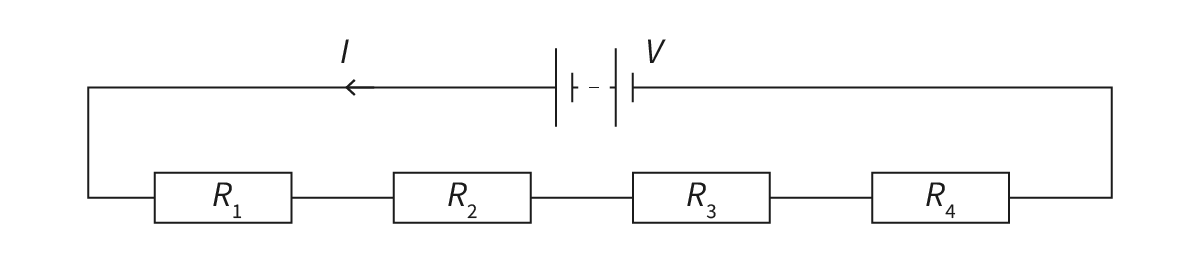
the total resistance in a series circuit is:
Rs=R1+R2+R3…
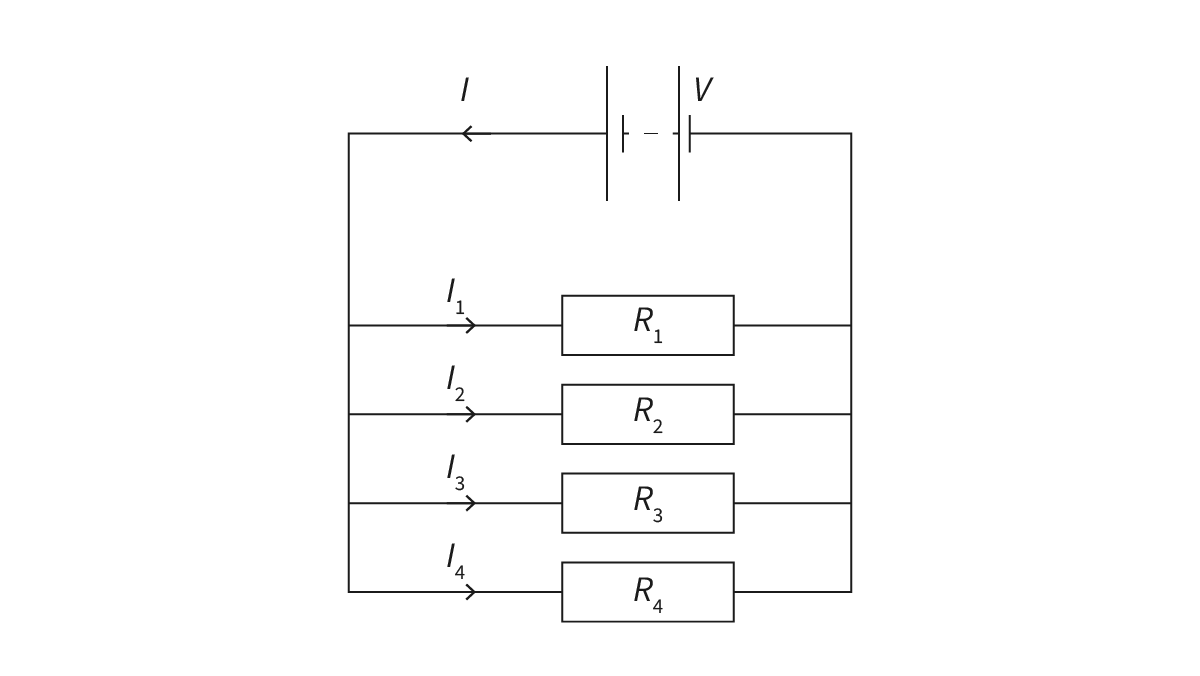
the total resistance in a parralel circuit is:
1/Rp=1/R1+1/R2+1/R3…
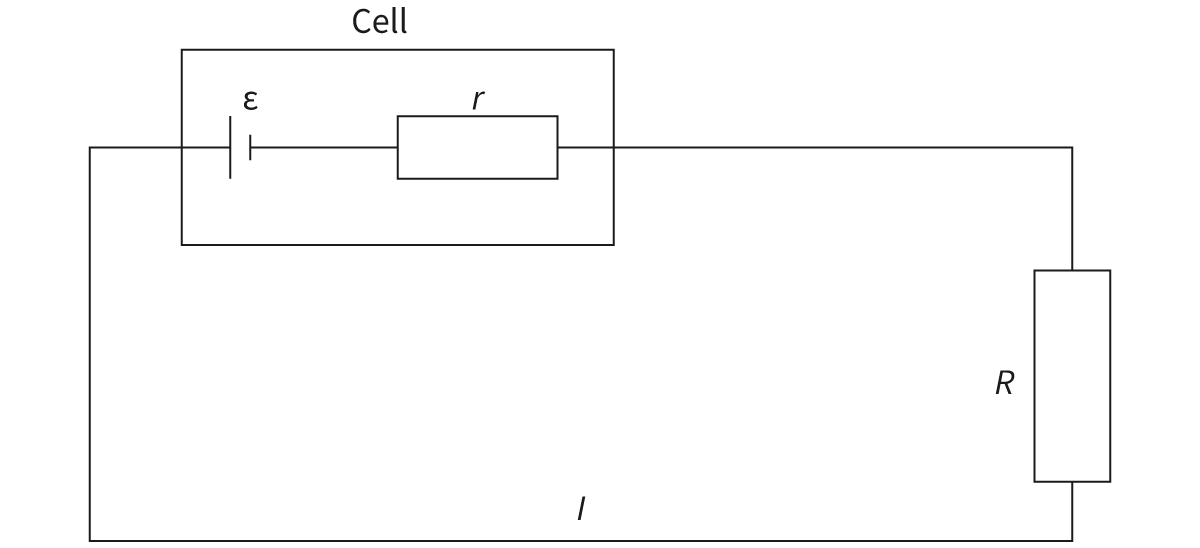
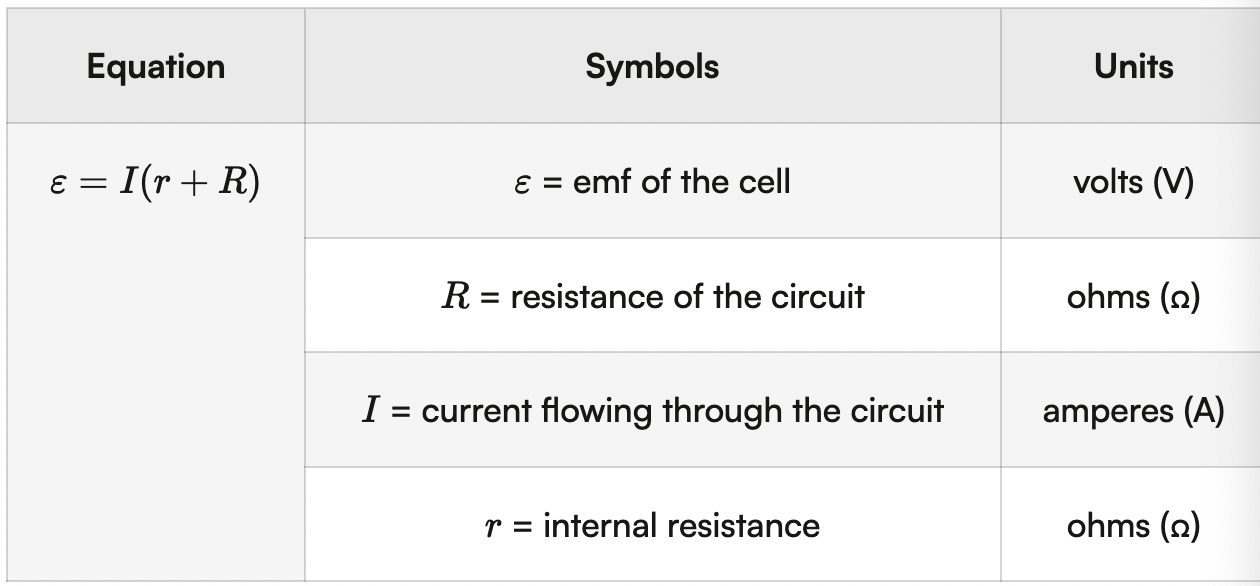
that electric cells are characterized by their emf ε and internal resistance r as given by ε = I(R + r)
Internal resistance (r) refers to the resistance inside of a battery. No battery is
ideal and all contain at least a little resistance. We call the voltage that the battery delivers to the rest of the circuit (excluding the voltage drop in the internal resistance) the terminal voltage.
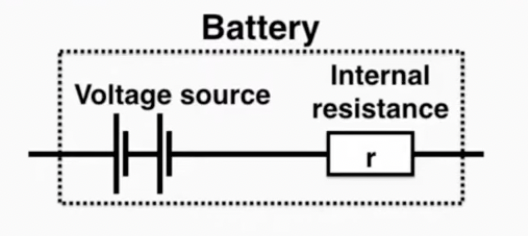
voltage source: electromotive force/EMF (ε) is the voltage causing elecyrons to move
ε = Ir + V = I(R + r)
A cell consists of conductive components and a store of chemical energy. All these materials have resistance. This resistance is known as the
internal resistance, r.
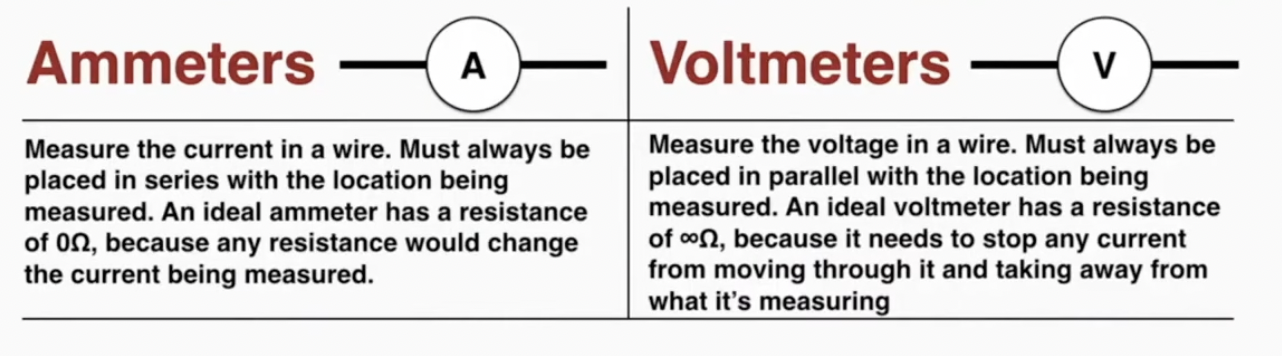
Ammeters and Voltmeters
A & V
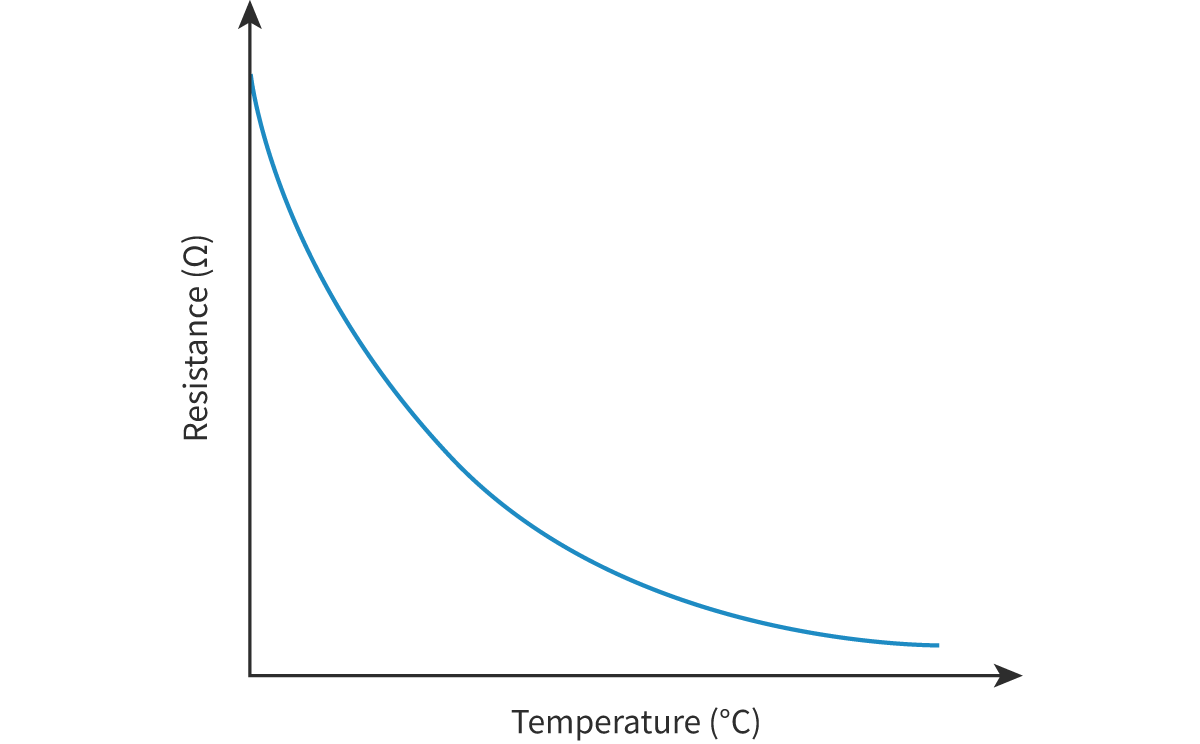
that resistors can have variable resistance.
A thermistor is a type of resistor. When the temperature of the thermistor increases, its resistance decreases. When the temperature decreases, its resistance increases
A light-dependent resistor (LDR) is another type of resistor. When light intensity increases, its resistance decreases. When light intensity decreases, its resistance increases.
conditions that lead to simple harmonic motion
Simple harmonic motion: Periodic motion around a central point of equilibrium where there is no net force. There is a restoring force that acts on the object that is directly proportional to the displacement from the equilibrium position and acts in a direction opposite to that displacement.
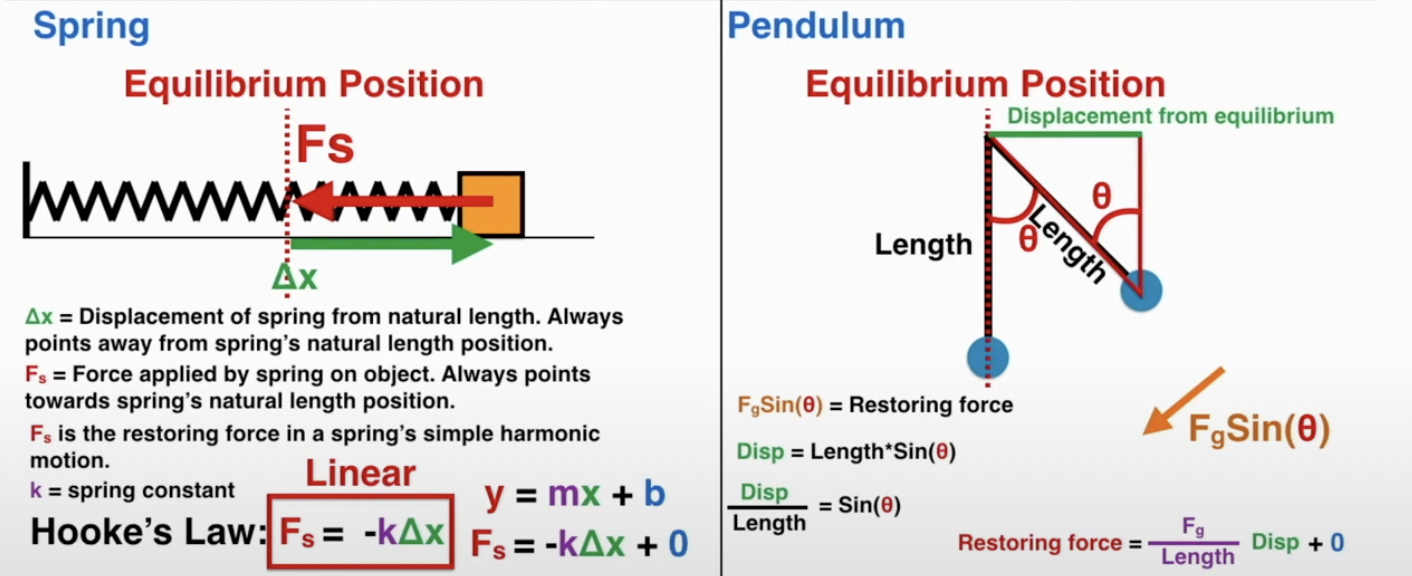
Simple harmonic motion is defined as repeated motion around an equilibrium position where the acceleration of the object is proportional to its displacement, but in the opposite direction.
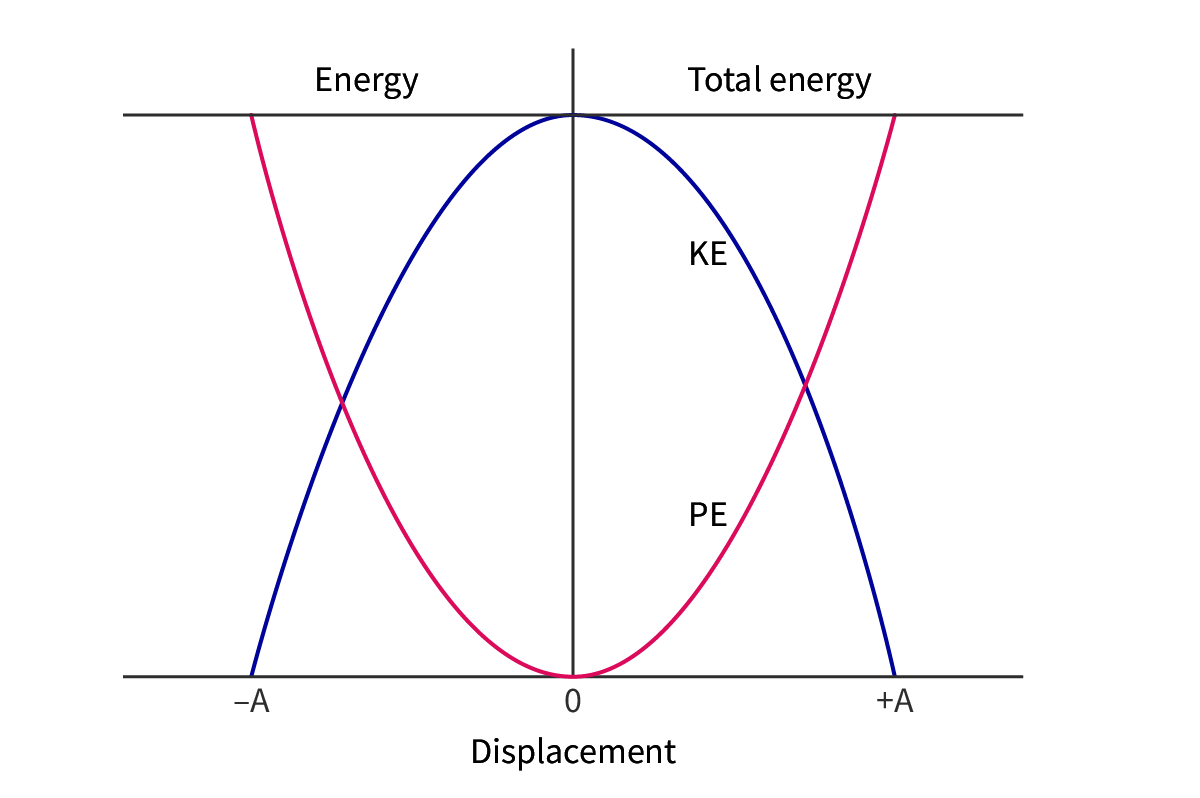
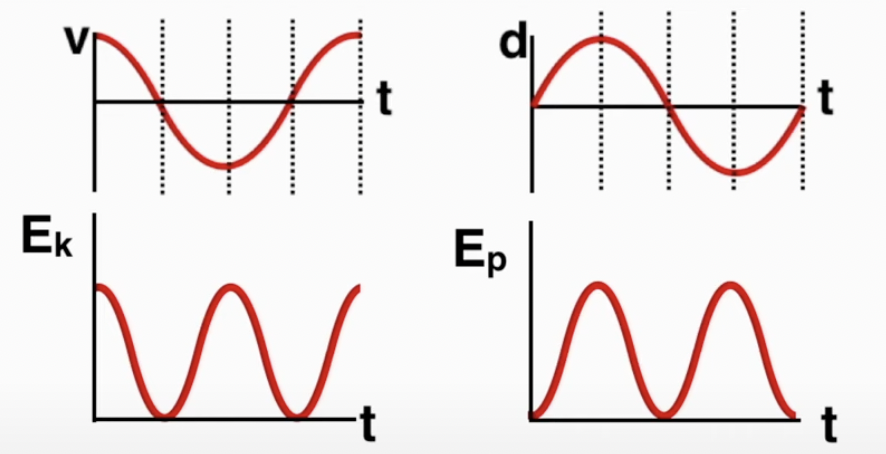
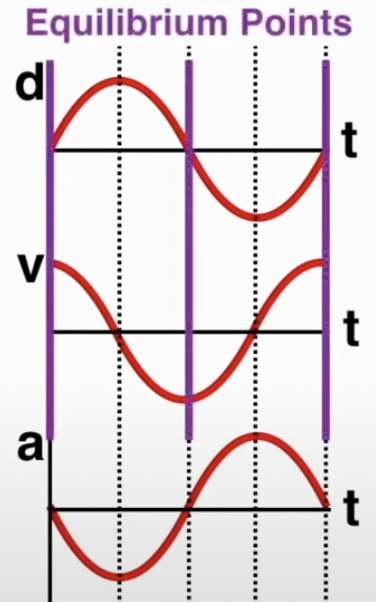
for springs the potential energy is elastic potential energy while for pendulums it is gravitational potential energy
phase difference: the differebce between which part of the wave’s full period or wavelength wach wave is on expressed as the angle differnece ebtween the two
the defining equation of simple harmonic motion as given by a = –ω2x
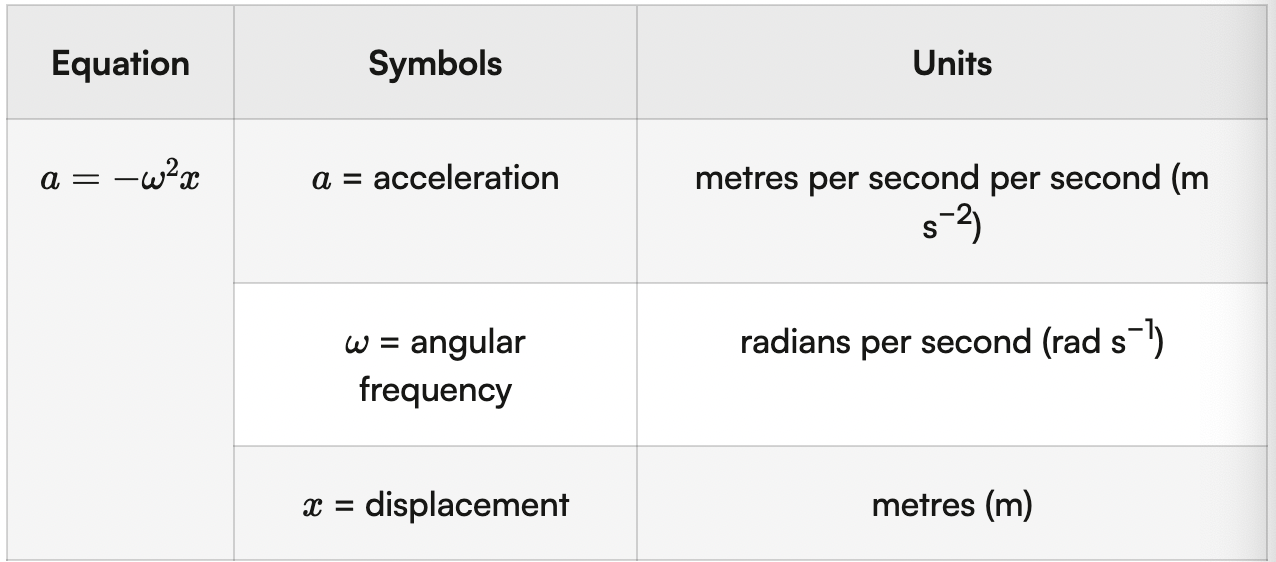
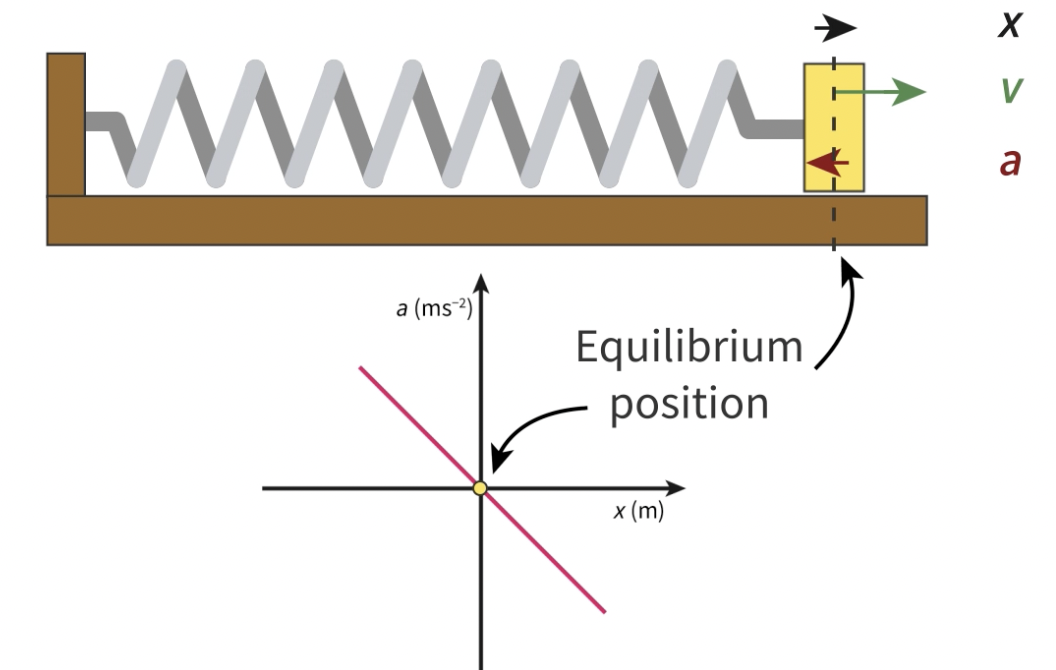
The gradient of the graph is equivalent to the square of the angular frequency and, because acceleration and displacement are in opposite directions, it is negative