Physics Honors: Waves Unit
 Call Kai
 Learn
Learn Practice Test
 Spaced Repetition
 Match
Match Flashcards
 Knowt Play
1/65

There's no tags or description
Looks like no tags are added yet.
Name | Mastery | Learn | Test | Matching | Spaced | Call with Kai |
|---|
No analytics yet
Send a link to your students to track their progress
66 Terms
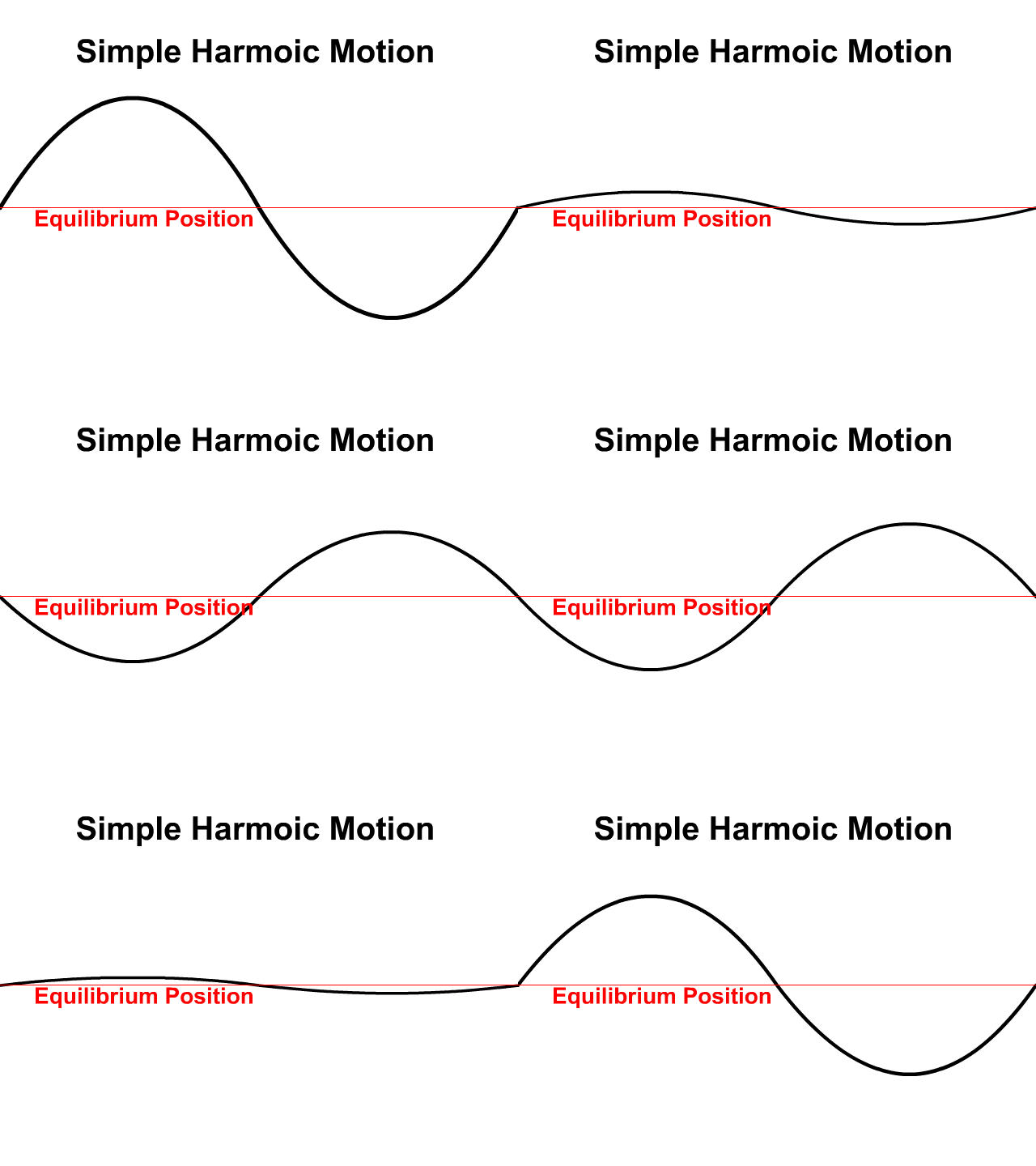
Parts of the Wave: What is equilibrium?
the "rest position" of the medium. It is the state of the substance when no energy is passing through it
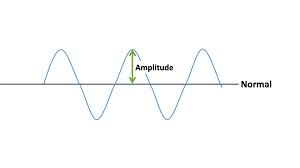
Parts of the Wave: What is the amplitude?
The maximum distance a wave moves from its resting position. It represents the "height" of a crest or the "depth" of a trough relative to the center line.
For longitudinal waves, the amplitude is the maximum displacement of a particle from rest
As the amplitude increases, the energy is the squared amount (ex: amplitde is doubled, and the energy increases by 4)
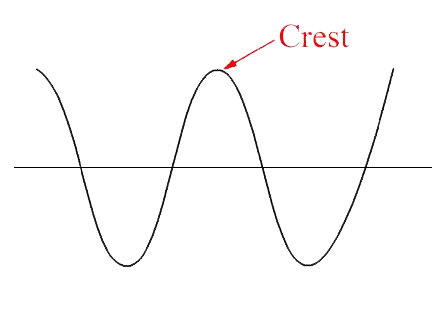
Parts of the Wave: What is the Crest?
the highest point or peak of a wave
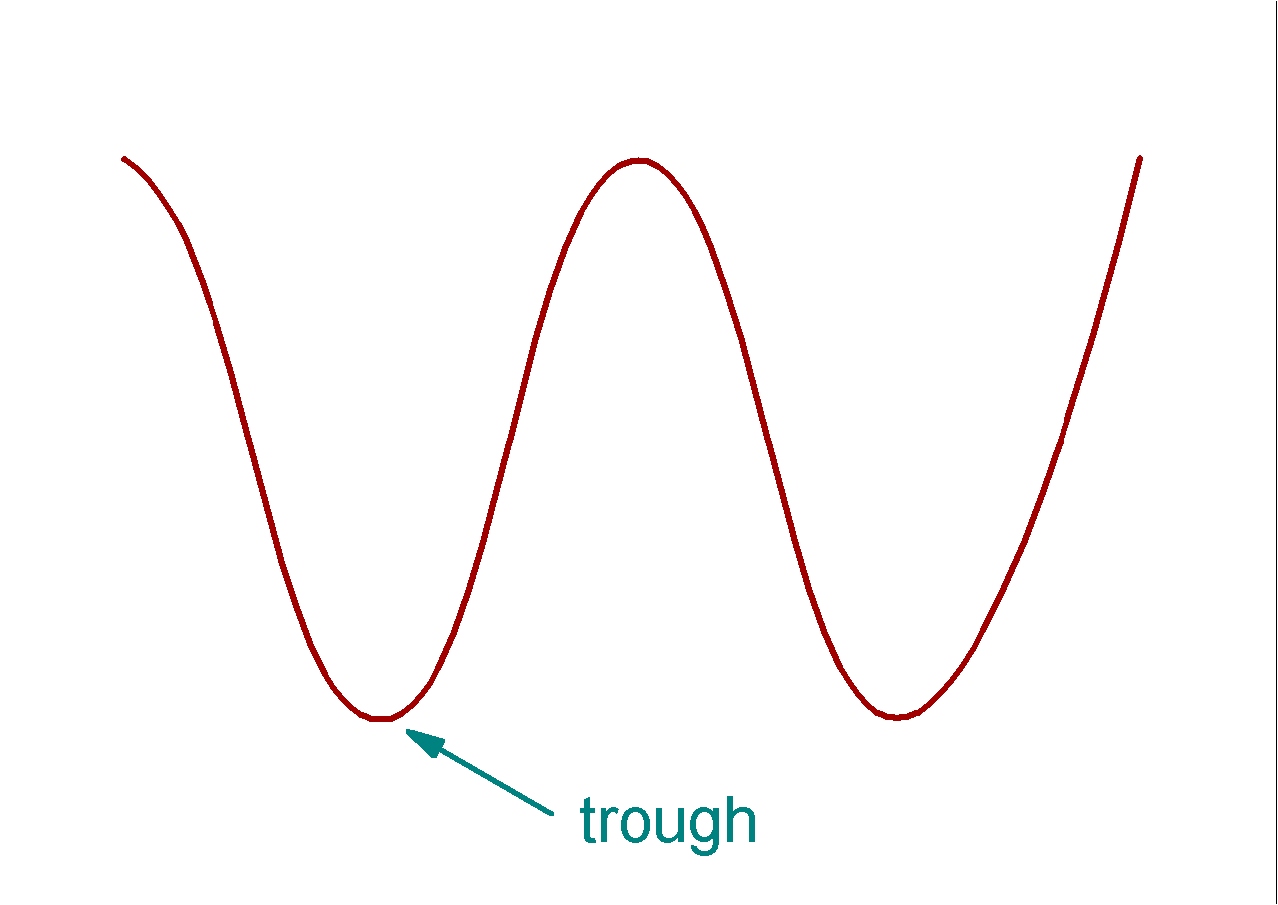
Parts of the Wave: What is the Trough?
the lowest point of a wave cycle
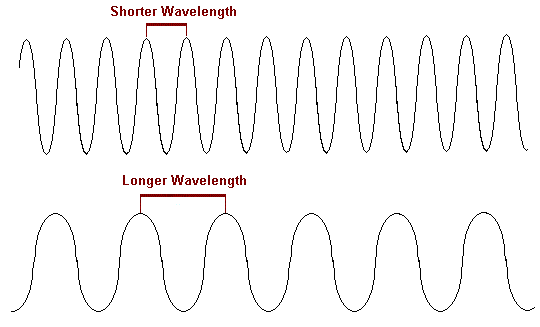
Parts of the Wave: What is the Wave Length?
the physical distance between two consecutive, corresponding points of a wave
For longitudinal waves, is the length of the repeating pattern (distance from compression to adjacent compression)
What is the frequency of a wave?
the number of waves that pass a certain spot each second
Equation: Waves/Second
Frequency does NOT convey information about the speed of the wave
What is the Period of a wave?
the time for one wave to pass a certain spot
Equation: seconds/wave
What is a mechanical wave?
they propagate through a medium by means of particle to particle interaction
These particles of the medium do NOT move though the medium; waves propagate when a particle interacts with its neighboring particles
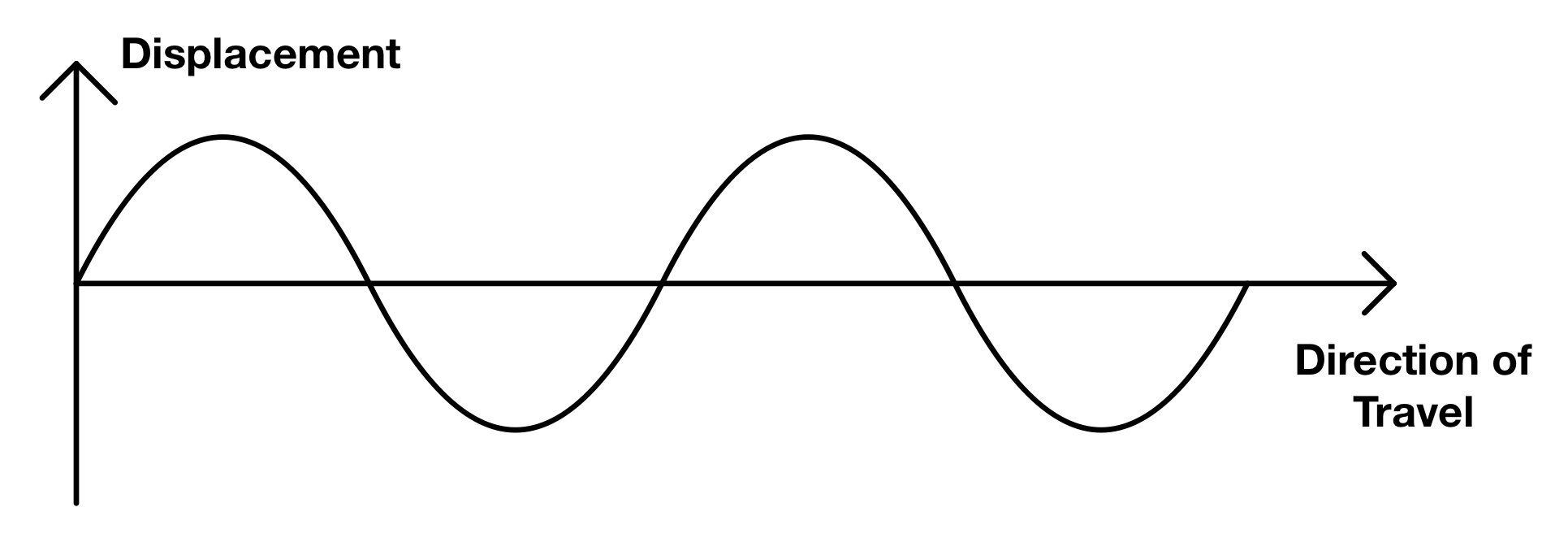
What is a transverse wave?
a type of wave where the disturbance moves perpendicular (at right angles) to the direction of energy transfer
Crests are high points and troughs are the low points
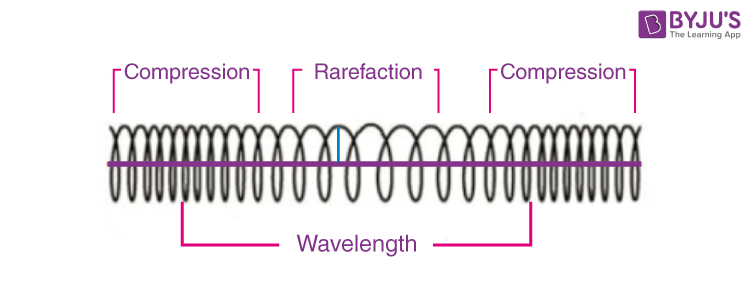
What is a longitudinal wave?
a type of wave where the particles of the medium vibrate parallel to the direction of energy transfer. These waves travel by creating alternating regions of high pressure/density (compressions) and low pressure/density (rarefactions).
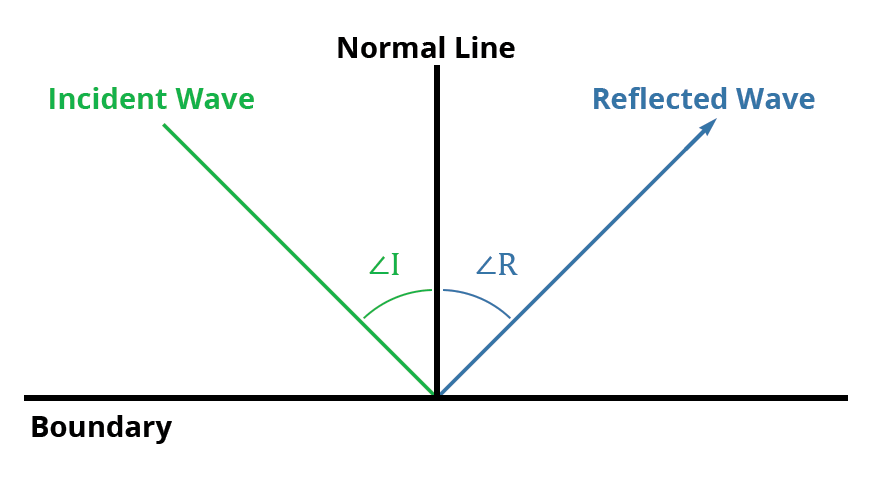
What is reflection of a wave?
the process where a wave, such as light, sound, or water, strikes a boundary or obstacle and bounces back into its original medium rather than passing through.
The wave changes direction and propagates back, with the angle of incidence equal to the angle of reflection
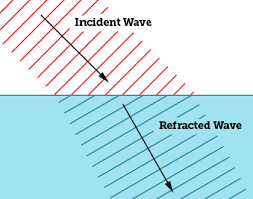
What is refraction of a wave?
a wave that changes direction, speed, and wavelength when passing at an angle from one medium into another, such as light moving from air into glass. This bending happens because different materials have varying densities, causing parts of the wavefront to travel at different speeds
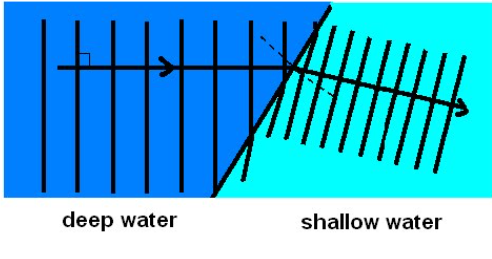
What happens when waves go to shallow water?
waves get shorter and slow down (turns towards normal line)
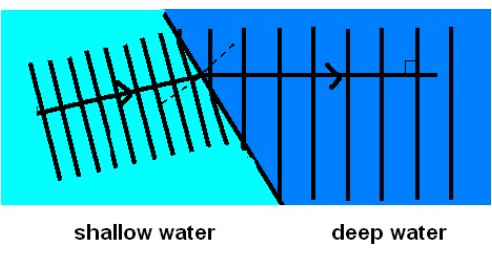
What happens when waves go to deeper water?
waves get longer and get faster (turns away from normal line)
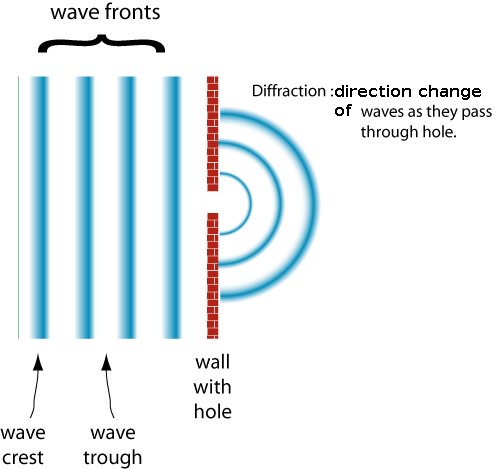
What is diffraction of a wave?
the bending, spreading, and scattering of waves when they encounter an obstacle or pass through a narrow opening
What is wave interference?
the phenomenon where two or more waves overlap, combining to form a new wave pattern according to the principle of superposition.
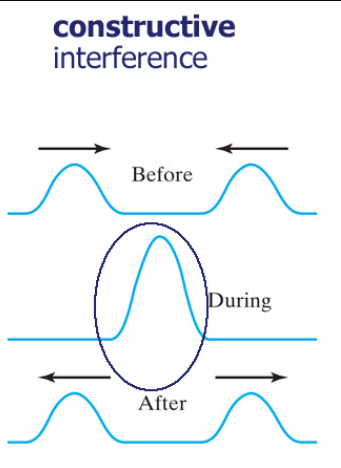
What is constructive interference?
where two or more waves of the same frequency and wavelength overlap in phase (crests align with crests, troughs with troughs) to produce a single, larger wave with a greater amplitude
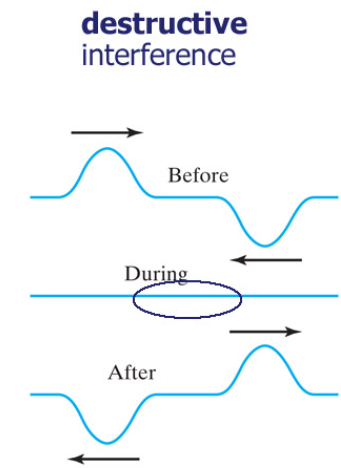
What is destructive interference?
wave phenomenon where two or more waves with equal frequency and opposite phase meet, causing their crests to align with troughs, resulting in a lower-amplitude or cancelled-out wave
How is wave speed influenced?
primarily determined by the properties of the medium through which it travels (such as density, elasticity, temperature, or depth) rather than the wave's amplitude or frequency
Explanation of Wave equation
The wave equation states that the speed () of a wave is calculated by multiplying its frequency (, in Hz) by its wavelength (, in meters). It describes how fast a wave travels by determining how many wavelengths pass a point per second. If speed is constant, frequency and wavelength are inversely related
What are wind swells of waves ?
short-period ocean waves (typically <10 seconds) generated by local winds blowing near the coast.
They are characterized as steep, choppy, and disorganized waves that form within 100 miles of shore, creating low-energy surf compared to long-period groundswells
What are the ground swell of waves?
long-period, powerful ocean waves generated by distant storms or seismic activity over 500–1,000+ miles away.
Ground swells travel thousands of miles across the ocean, maintaining energy to create clean, well-spaced, and large breaking waves, making them ideal for surfing
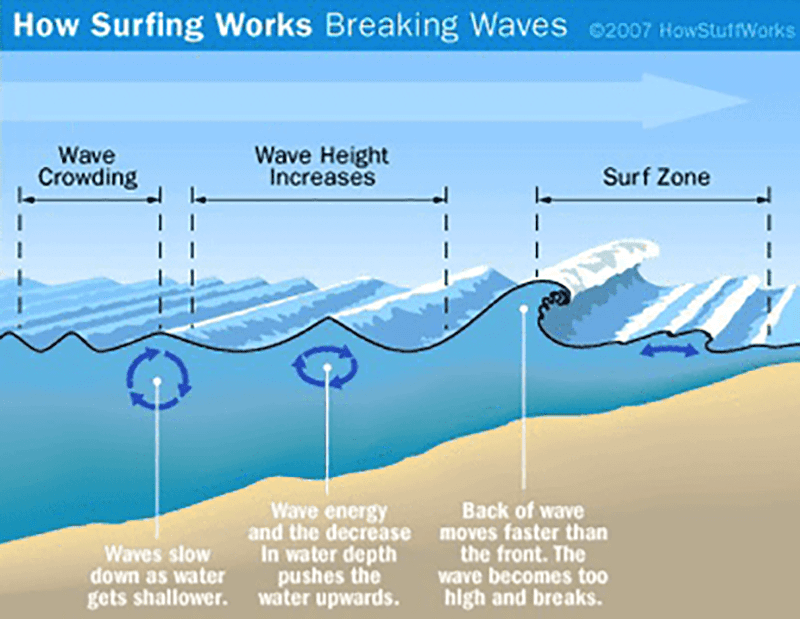
How do waves break?
They enter shallow water, causing the bottom of the wave to slow down due to friction with the seabed, while the top continues at its original speed.
This speed imbalance makes the wave too steep, causing the crest to become unstable, lean forward, and eventually collapse or "break
How are sound waves generated?
sound waves are generated by anything that vibrates
What can’t sound travel through?
sound can’t travel through a vacuum because there are no medium to pass the vibrations and energy
How are sound level measured?
sound levels are measured in decibels
Louder energy sounds carry____
greater energy
What is the average speed of a wave?
the average speed of sound waves through air is 340 meters per seconds
What is the pitch of the sound?
the pitch of a sound is its frequency
Higher pitch means
higher frequency
What waves are sound waves?
longitudinal waves; this means that the direction of energy travel is parallel to the direction the particles in the medium move
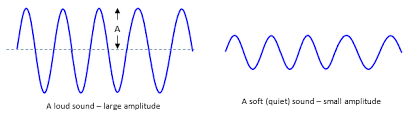
How to make a loud sound wave become a quiet sound wave?
reducing its amplitude (height) and intensity (energy) through absorption, barrier blocking, distance, or active cancellation
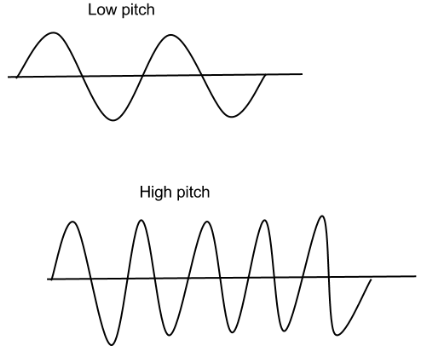
How to make a high pitch wave become a low pitch wave?
decrease its frequency—the number of oscillations per second—effectively lengthening its wavelength.
What is the Doppler effect?
is the apparent change in the frequency of a wave caused by relative motion between the source of the wave and the observer
What is the fastest medium sound can travel through?
solids, such as steel or diamond. Because molecules in solids are packed more tightly together and have higher elasticity, they transmit sound energy much faster than liquids or gases
What are sonar sound waves?
underwater sound waves, often high-frequency, to detect, map, and locate submerged objects, ranging from submarines to fish schools. It works by emitting pulses (active) or listening (passive) for echoes to measure distance
What is an ultrasound wave?
a safe, non-invasive imaging test that uses high-frequency sound waves to create real-time, 2D or 3D pictures of organs, tissues, and blood flow inside the body
What is radar?
a system that uses radio waves to detect, locate, and track objects such as aircraft, ships, and vehicles, as well as weather patterns.
It works by emitting electromagnetic pulses that bounce off objects, allowing the system to measure distance, speed, and direction based on the returning "echo"
What is the range of human hearing?
0 to 120 decibels
How are frequency, wavelength, and speed related?
frequency and wavelength are inversely proportional, and speed continues to be constant
What is boundary behavior?
describes the manner in which a wave behaves when it reaches the end of the medium or when it reaches an obstacle in its path
When the energy carried by a wave reaches the end of the medium, a portion is reflected back into the medium, and a portion is transmitted across the boundary
What is the incident wave?
is the wave that approaches the boundary
What is the reflected wave?
is the wave that bounces off the boundary and remains in the original medium
What is the transmitted wave?
is the wave that passes into the obstacle or the new medium on the opposite side of the boundary
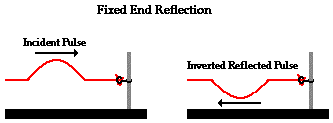
What is a fixed end-reflection?
the reflected pulse is inverted and does not result in any changes in frequency, speed, or wavelength; since some energy is transmitted across the boundary, the reflected wave may have less amplitude than the incident wave.
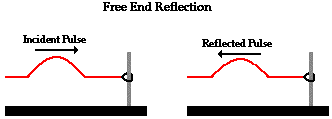
What is a free-end reflection?
the reflected pulse is upright (not inverted), and does not result in changes in frequency, speed, or wavelength; some energy is transmitted across the boundary, and the reflected wave may have less amplitude than the incident wave
What is a boundary crossing?
the pulse is upright, the frequency remains the same, the speed of the incident pulse is the same as the speed of the reflected pulse, but the speed of the reflected pulse is less than the speed of the transmitted pulse.
The wavelength of the reflected pulse is the same as the incident pulse, and the wavelength of the reflected pulse is less than the wavelength of the transmitted pulse.
The amplitude of the incident pulse is greater than the amplitude of the reflected pulse
What is the principle of superposition?
states that when two waves interfere, the resulting displacement of the medium at any location is the algebraic sum of the displacements of the individual waves at that same location.
What is a traveling wave?
is a repeating pattern that is observed to move through a medium in an uninterrupted fashion
What is standing wave?
is a wave pattern with a permanently-positioned point that appears to be standing still; it results from the presence of two traveling waves of the same frequency with different directions of travel within the same medium
What are nodes?
are points of no displacement
destructive interference happens at these positions
What are antinodes?
are points of maximum displacement
constructive interference occurs at these positions
For sound waves, frequency is what?
refers to how often particles of the medium vibrate back and forth about their fixed position
A sound’s frequency is known as pitch
A high pitched sound is
is a high-frequency sound wave
a low-pitched sound is a low-frequency sound wave
A higher amplitude in a sound waves means
the more intense and louder a sound is (volume)
What is the intensity of sound wave?
The amount of energy that is transported past a given area of the medium per unit of time
What does the outer ear do to contribute to the hearing of sound?
serves to collect and channel sound to the middle ear
Sound moves through the outer ear as a pressure wave of alternating high and low pressure, and only when it reaches the eardrum is this energy converted into vibrations of the ear’s inner bones.
What does the middle ear do to contribute to the hearing of sound?
serves to transform the internal vibrations of the bone structure of the middle ear and ultimately transform these vibrations into a compressional wave in the inner ear.
The eardrum’s motion moves the hammer, anvil, and stirrup at the same frequency, and the stirrup then transfers these vibrations into the inner ear fluid, creating a compression wave.
What does the inner ear do to contribute to the hearing of sound?
serves to transform energy of the compressional wave within the inner ear into impulses that can be transmitted to the brain
As the wave travels through the cochlea, hair cells tuned to specific frequencies vibrate most when matched, triggering electrical signals sent along the auditory nerve to the brain.
How does the Doppler effect work?
For a given amount of time, the same number of sound waves travel from the source to the observer. If the source is far away, the waves are spaced farther apart. If the source is closer, the waves are packed closer together.
Because of this, when the source moves toward the observer, the waves bunch up and arrive more often, so the sound has a higher pitch. When the source moves away, the waves spread out and arrive less often, so the sound has a lower pitch.
What is oscillating?
a repeated, back-and-forth motion or fluctuation around a central, equilibrium point over time (like waves)
String harmonics have
nodes on both ends
Open pipes have
antinodes on both ends
counted by ½ wavelength
similar to string harmonics
Close pipes have
nodes and antinodes on each end
counted by ¼ wavelength
counted in odds
What do frequency and wavelength do to the speed?
they only help measure it, not determine it
What is speed only dependent by?
the medium