Factors affecting the choice of statistical test
 Call Kai
 Learn
 Practice Test
 Spaced Repetition
 Match
 Flashcards
 Knowt Play
1/14

Earn XP
Description and Tags
15 Terms
What is a statistical (inferential) test?
They are used in psychology to determine whether a significant difference or correlation exists (and consequently whether the null hypothesis should be rejected or accepted).
What are the 3 factors used to decide which statistical test to use?
Whether the researcher is looking for difference (experiment) or correlation/association
In the case of a test of difference (experiment), what experimental design is being used
The level of measurement (nominal, ordinal, categories)
What are the levels of measurement?
The way researchers measure or record the data they collect in an experiment. This is the third factor influencing the choice of statistical test.
Nominal
Ordinal
Interval
What is nominal data?
Data is in separate categories.
e.g. grouping people according to their favourite animal, male/female, yes/no
What is ordinal data?
Data that is ordered in some way, and the data isn’t in equal intervals.
e.g. asking someone to order animals; dogs may be first, followed by cats but the person might like dogs a lot more than they like cats
What is interval data?
Numerical data, with equal intervals between values.
e.g. reaction times, temperature in °C
What is a test of difference?
When the researcher wants to find out whether two groups of conditions produce different results (as a result of manipulating the independent variable - an experiment).
What is an unrelated design?
A test of difference. The researcher uses two different groups of participants - each participant only takes part in one condition.
Independent groups design
What is a related design?
A test of difference. The researcher uses the same participants in both conditions or matches participants based on relevant characteristics.
Matched pairs design
Repeated measures design
What is a test of association/correlation?
When the researcher wants to find out whether there is a relationship between two variables. e.g. a relationship between hours spent revising and exam results.
What is a parametric test?
A statistical test that makes certain assumptions about the population distribution, including that it is normally distributed. This means that the data follows a symmetrical, bell shaped distribution, with most scores clustering around the mean.
Related t-test, unrelated t-test and Pearson's r
What is a non-parametric test?
A statistical test that does not require the same distributional assumptions as parametric tests.
Chi-squared, Mann-Whitney U, Wilcoxon, Sign test and Spearman's Rho
Draw out the statistical test table
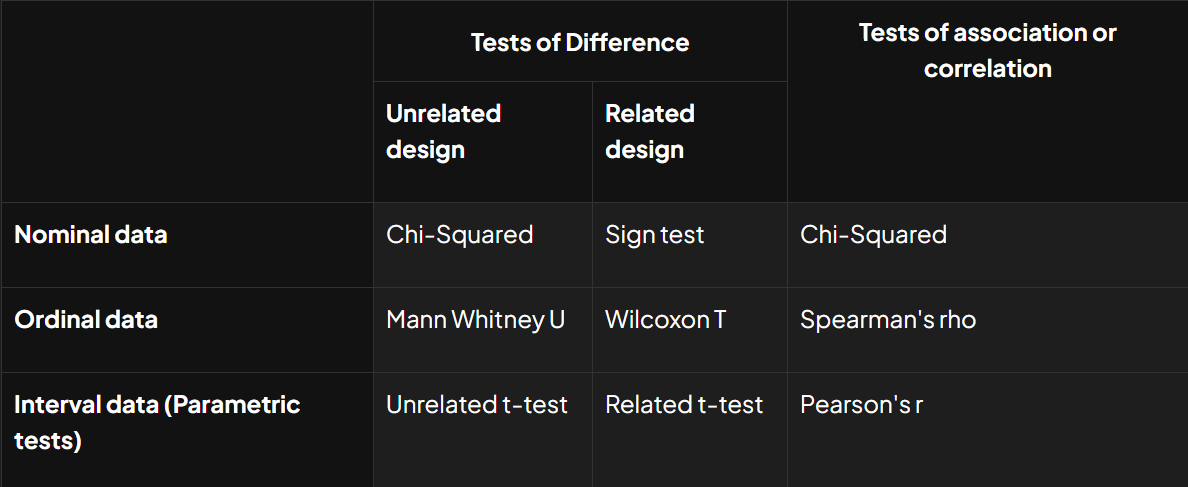
How do you determine whether a result is statistically significant using a statistical test?
Once you have chosen the appropriate test, you need to put your data into the mathematical formula, work out the sum and you will end up with a number.
This number is called the calculated statistical value, you won’t need to calculate it for yourself, it will always be given to you.
The observed value is then compared to another number called the critical value. Each statistical test has its own set of critical values, these always remain the same.
Whether your observed value is less than or greater than the critical value, tells you whether your results are significant or not.
What is the rule of R?
The statistical tests with the letter ‘R’ in their name are those where the calculated value must be equal to or moRe than the critical value, for statistical significance.