2: Prescription writing .
 Call Kai
 Learn
Learn Practice Test
 Spaced Repetition
 Match
Match Flashcards
 Knowt Play
1/37

There's no tags or description
Looks like no tags are added yet.
Name | Mastery | Learn | Test | Matching | Spaced | Call with Kai |
|---|
No analytics yet
Send a link to your students to track their progress
38 Terms
R: -1.00 / -0.50 × 180
L: -1.25/ -0.75 × 175
R:
-1.00 means spherical power of the lens. Small amount of hsort sightedness as only -1.00
-0.50 means cylinder power. Used to correct astigmatism
180 is axis, the orientation of the cylinder
ALWAYS WRITE TO 2 DECIMAL PLACES
R: plano / -1.00 × 90
L: +0.25 / -1.50 × 175
R:
Plano means no power, so no spherical power , just -1.00 astigmatism on an axis of 90
L:
+0.25 spherical power and -1.5 cylider power on an axis of 85
R; +1.25 DS
L; +1.00 / + 0.25 × 90
R:
+1.25 DS means patient has just a spherical presciption. No cylinder power
L:
cylinder is positive
R: +9.00 / -1.25 × 180 BVD= 12mm
L: + 8.75 / +0.25 × 90
R:
BVD= back vertex distance. This is the distance between the rear surface of the spectacle lens at the visual point and the cornea.
Tells you how far away from the persons eyes the spec lenses need to go.
if a prescription is more than 4 dioptres a BVD is needed
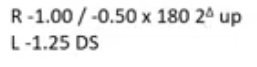
R:
the 2 with the triangle means prism: prismatic power, means image needs to be moved with a prism. 2 prism dioptres needed. Up tells you where the base of the prsim is so its saying up so at the top
L:
spherical only
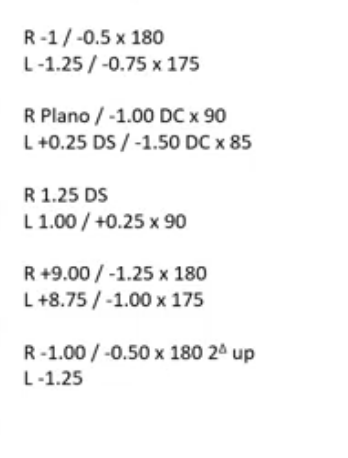
wrong as its not to 2 decimal places
DC and DS is not needed
no plus or minus signs written
no BVD for the +9.00 prescription
no DS written for the left eye
sphero-cylindrical transpostion
first one i a sphero-cylindrical prescription in the negative cylinder fomr
second one is a sphero-cylindrical power in the positive fomrm
the prescriptions are the same power just written differently
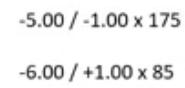
rules for transposing between positive and negative cylinder forms
Add sphere and cylinder powers tpgether to make new sphere power
change sign of cylinder. Leave cylinder power the same
turn the cylibder axis through 90 degrees
so,
for the prescription -5.00 / -1.00 × 175
-5.00 + -1.00 = -6.00
-1.00 = +1.00
175 - 90 = 85
usually minus 90 if over 100 and add if less than 100
so new prescipt is -6.00 / +1.00 × 85
eg: +3.00 / +1.00 × 5
+4.00 / -1.00 × 95
+5.00 / -0.50 × 180
+4.50 / +0.50 × 90
+2.00 / -4.50 × 45
-2.50 / +4.50 × 135
crossed cylinder notation is of the form:
instead of a sphere and a cylinder its 3 cylinders crossed at 90 degrees
+1.00 × 90 / +1.50 × 180
conversion to spherocylindrical form in negative form
+1.50 / -0.50 × 90
conversion to sphero cylinder in positive
+1.00 / + 0.50 × 90 :
another e.g. -5.00 × 85 / -4.25 × 175
negative cylinder form when converting to sphero cylinder
-4.25 / -0.75 × 85
positive cylinder form
-5.00 / + 0.75 × 175
prescription analysis
eg:
R: -5.00 / -2.00 × 90
L: -5.50 / 2.25 × 85
its not a complete prescripton as theres no BVD
myopia present and astigmatism
myopic as lens is negative so the eye focuses light in front of the retina so distant objects appear blurry but near objects are clearer
astig as the cylinder is not 0, so astig is present .
rule for astigmatism
if the cylinders are minus, and the axis is vertical (90 degree), then thats against the rule of astigmatism
if axis horizontal then with the rule
140 degrees means oblique
sphere power and severity
anthing -0.75 - -2.00 is mild myopia
-4.25 to -6.00 is very high myopia
compound myopic astigmatism
where both meridians are myopic as focal points are in front of the retina
simple myopic astigmatism
one focal point is in front of the retina and one is on it
only one eye is myopic
R: -5.00 / -2.00 × 180
L: -5.50 / -2.25 × 180
axis flipped to 180
compound myopic astigmtism but with the rule of astigmatism
R: +6.00 / -2.00 × 180
L: +4.00 / -2.25 × 180
not complete prescription as no BVD
hypermyopia
compound hyperopia astig with the rule as cyl is minus and horizontal
R: +13.00 / -3.50 × 70
L: +12.50 / -3.25 × 50
myopia
oblique is an axis between 50-70 or 120-150 means that the irregular curvature of your eye isnt vertical or horizontal but at a diaganol angle
R: +2.00 / -3.50 × 180
L: +2.50 / -3.25 × 165
plus in one meridium and minus in the other showing mixed astigmatism
no BVD as powers arent bigger than +2.50
axis horzontal
R: -4.50 / -0.50 × 180
L: -1.50 / -0.75 × 175
no BVD
both myopic but right eye is more short sighted than the left called anisometropia
R: +1.50 / -0.50 × 180
L: -1.50 / -0.75 × 175
onse sphere is plus other is minus. Called anti mytropia
additions
positive spherical power added to the distance prescription for near or intermediate vision as a remedy for presbyopia
presbyopia means eye loses abiloty to focus on close objects as lens stiffens, so distance prescription is for seeing far away clearly. To help see up close optometrists add a small plus number on top of the distance prescription to let eyes focus on nearer objects
e.g of addition
distance prescription : -2.00 D for myopia
add for near : +1.50 D
Near presciption is -0.50 D
range of powers for additions
+0.75 DS to +2.75 DS. sometimes higher
higher additions are sometimes prescribed for special purposes eg very close working distances and to patients with low vision
e.g
R: +1.50 / -0.50 x 180 Add +2.25 DS
L: +2.25 / -0.75 × 175 Add +2.25
power of the near prescription
R: +3.75 / -0.50 × 180
L: +4.50 / -0.75 × 175
additions: expected value
the age at which the first near addition is prescribed can vary. Depends on:
rate of decline in amplitude of accomodation
the near tasks that the patient does eg: occupational and recreational
critical near task will increasethe need for an addition
physical size and working distance eg patient with shorter arms will probably need an addition sooner than the patient with longer arms
depth of focus eg related to pupil size, smaller pupil lessens need for addition
health : poor health can affect accomodation
medication: some meds particularily with an anti muscarinic effect can reduce the amplitude of accom
amplitude of accom
Duane Hoffstetter formulae
max amplitude = 25.0- 0.4 x age
average amplitude = 18.5 -0.3 x age
min amplitude = 15.0 -0,25 x age
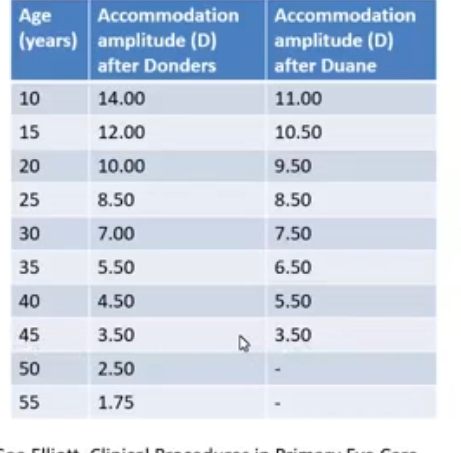
expected values of addition
addition= working distance (in D) -0.5*amplitude of accom
eg if the working distance is 40 cm and the amplitude of accom is 3.5 D;
Addition= ( 1/0.) - ( 0.5 × 3.5 )
0.75 DS
additions- range of clear vision
range of clear vision in the near add is defined as:
near point in the add- far point in the add
eg:
R: +1.00 DS add +1.75 DS
L: +1.00 DS add +1.75 DS
Amplitude of accom 2.50 D
far point in the add ( with accom relaxed) = 1/1.75 = 0.57 m = 57 cm
nearpoint in the add ( max accom) = 1 / (1.75 + 2.50)= 0.2 m = 24 cm
so total range of clear vision will be 54cm to 24 cm
mre on range of clear vision
range gets smaller as the add goes up
total range of clear vision through distance prescription
far point in the distance prescription = infinity
near point in the distance prescription = 1/ amp of accom
so for patient with 2.50 D amp of accom, and working distance of 0.4 m:
infinity ti 1 / 2.50 = 0.4 m = 40 cm
as amplitude of accom declines..
the addition power needs to increase. This will work against the patient to reduce the range of clear vision. eg:
R: +1.00 DS add +2.75 DS
L: +1.00 DS add +2.75 DS
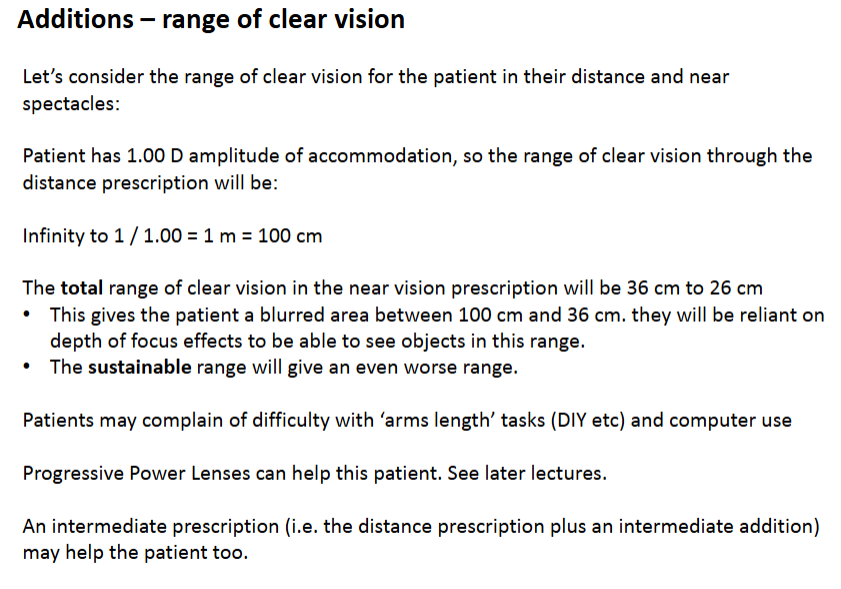
amplitiude of accom 1.00 D
far point in the add = 1/ 2.75 = 36 cm
near point = 1/2.75 + 1) = 26 cm
total range in the add will be 36 to 26 cm
sustainable range of clear vision ( from eg above )
youd use 0.5 x amp of accom, would be:
far point = 1/2.75 = 36 cm
near poinit with 0.5 accom exerted= 1/ (2.75 +0.50) = 31cm
so sustainable range of clear vision in the add will be 36 cm to 31cm
intermediate additions
as accom declines and the required near addition increases, an intermediate addition can be very usefulfor arms length tasks and computer use etc
intermed add usually between 50 5 and 70% of the near addition