Chapter 17 The Use of Ultrasound in the First Trimester
 Call Kai
 Learn
Learn Practice Test
 Spaced Repetition
 Match
Match Flashcards
 Knowt Play
1/88

There's no tags or description
Looks like no tags are added yet.
Name | Mastery | Learn | Test | Matching | Spaced | Call with Kai |
|---|
No analytics yet
Send a link to your students to track their progress
89 Terms
ALARA (as low as reasonably achievable) principle
Minimizing the risk of ultrasound-induced bioeffects by controlling acoustic output, scan modes, machine settings, and duration of exposure
Amnion
The membrane enclosing the amniotic cavity and embryo or fetus
Blastocyst
An early gestation consisting of a thin outer layer of cells (trophoblast), a fluid-filled cavity, and an inner cell mass (embryoblast)
Chorion
The membrane around the chorionic cavity, made up of trophoblast cells and extraembryonic mesoderm
Chorionic villi
Bud-like outward growths from the trophoblast, some of which will give rise to the fetal portion of the placenta
Conceptual age
The duration of pregnancy, counted from fertilization (conception), expressed in hours or days; also called embryonic age or postovulatory age
Conceptus
The product of fertilization, including all stages from zygote fetus
Corpus luteum
The progesterone-secreting structure formed by a follicle after releasing its oocyte
Crown–rump length (CRL)
Measurement of the longest axis of an embryo used to determine the gestational age
Decidualization
Changes in the endometrium to allow implantation of a blastocyst
Estimated date of delivery (EDD)
Due date calculated by adding 280 days to the first day of the last menstrual period (LMP); also called estimated date of confinement (EDC)
Estrogen
A group of hormones, primarily produced in the ovaries, which affect secondary sex characteristics and the menstrual cycle
Fertilization
Penetration of an oocyte by a sperm to form a diploid zygote
First trimester
0th day (the first day of LMP) to the end of the 13th week
Follicle-Stimulating Hormone (FSH)
A hormone produced in the anterior pituitary, which stimulates the maturation of ovarian follicles
Gamete
Haploid cell that, when merged with a gamete from the opposite sex, creates a diploid zygote
Gestational age (GA) (synonym: menstrual age)
The duration of pregnancy, counted from the first day of the LMP, expressed in weeks and days or fractions of weeks. A pregnancy typically lasts about 280 days, or 40 weeks, counted from the first day of the LMP and is commonly divided into three trimesters
Gestational sac
The first sonographic evidence of an intrauterine pregnancy, the fluid-filled blastocyst
Gravidity
The number of times a woman has been pregnant
Human chorionic gonadotropin (hCG)
A hormone produced by trophoblast cells of the blastocyst, which extends the life of the corpus luteum in the ovary; most pregnancy tests are based on the detection of hCG
LMP
The first day of the last menstrual period
Luteinizing hormone (LH)
A hormone produced in the anterior pituitary, which triggers ovulation in females
Mean sac diameter (MSD)
An average diameter of the gestational sac used to determine the gestational age
Morula
The solid cluster of undifferentiated cells formed by repeated cleavage of the single cell that resulted from the fusion of two gametes
Naegele’s rule
Calculation to find a patient’s EDD:
(1) Take LMP
(2) Add 1 year
(3) Subtract 3 months
(4) Add 7 days
Nuchal translucency (NT)
Subcutaneous fluid in the posterior region of the neck of embryos and fetuses up to 14 weeks’ gestational age. Abnormally large NTs have been associated with a higher risk of chromosomal and structural abnormalities
Oocyte
Female gamete (also called ovum or egg)
Parity
A summary of a woman’s pregnancy outcomes. The most common description of parity is expressed in four numbers. The first is the number of term deliveries; the second is the number of preterm deliveries (usually after 24 weeks’ gestational age); the third is the number of other pregnancies, and includes both spontaneous and therapeutic abortions; and the fourth number is the woman’s living children
Pregnancy-associated plasma protein A
(PAPP-A) A protein produced by the trophoblasts, abnormal levels of which may be associated with an increased risk of chromosomal abnormalities
Progesterone
A hormone produced by the corpus luteum and the placenta
Second trimester
14th week to the end of the 27th week
Spermatozoon (plural: spermatozoa)
Male gamete
Third trimester
28th week to the delivery
Umbilical vesicle (synonym: yolk sac)
A structure within the cavity of the blastocyst, which provides nourishment to the embryo and produces its first blood cells; the secondary umbilical vesicle (yolk sac) is the first structure to be sonographically identified within the gestational sac
Zygote
A single cell resulting from the fusion of two gametes
How many trimesters go into each pregnancy?
Three trimesters—dividing the normal 40 - week pregnancy into 12 - week sections.
When does the first trimester begin?
At week 1 and ends at week 12.
When does the second trimester begin?
At week 13 and ends at week 27
When does the third trimester begin?
At week 28 and ends at week delivery
What’s the term for a pregnancy that is undelivered by 42 weeks?
It’s considered postterm.
Why are human cells called diploid?
Because they contain two sets of chromosomes.
–23 maternal
–23 paternal
Mitosis maintains what?
Diploid cell number.
What causes haploid cells that contain a single set of 23 chromosomes?
When meiosis reduces the number of chromosomes by ½.
Haploid cells are what?
Gametes.
What are male gametes called?
Spermatozoa or sperm.
What are female gametes called?
Ova or oocytes.
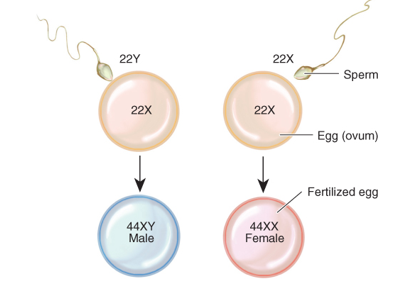
Gamete Formation
Inheritance of gender and the normal diploid chromosome count. Each ovum contains 22 autosomes and an X chromosome. Each sperm contains 22 autosomes and either an X or a Y chromosome; fusion of the genetic material results in the normal diploid chromosome count. The sex of the zygote is determined at the conceptual age by the combination of the sex chromosomes of the sperm (either X or Y) and the ovum (X).
Where does fertilization and Implantation occur?
In the ampullary portion of the fallopian tube 24 to 36 hours after ovulation, when the zona pellucida is penetrated by a single sperm.
Penetration by the sperm causes what kind of change in the zona pellucida?
Causes a change in the chemical composition of the zona pellucida so that no other sperm can enter the ovum.
What does the penetration by the sperm activate?
The completion of the second meiotic division of the ovum, forming a mature oocyte.
The genetic contents of the sperm merge with the ovum to form what?
A single diploid cell, the conceptus or zygote.
The developing zygote moves through?
The fallopian tube.
The developing zygote reaches the uterine cavity about how many days after fertilization?
4.
What does the zygote become after it implants into the uterus?
The blastocyst.
What are the three distinct parts of a blastocyst?
Trophoblast—thin outer layer which will become the embryonic portion of the placenta
Fluid filled blastocystic cavity
Inner cell mass or embryoblast, which will develop into the embryo
Normal implantation cannot occur unless the blastocyst meets what?
A receptive endometrium.
Two layers of the endometrium?
Basal layer, which is adjacent to the myometrium and function layer, which is connective tissue(stroma), glands, capillaries, which are covered by a thin layer of epithelial cells.
Ovulation results in _________ which allows implantation to occur.
endometrial decidualization
What’s an implantation window?
The period which the endometrium is able to receive the blastocyst and it begins 6 to 8 days after ovulation and lasts approximately 4 days.
What maintains the endometrium?
Estrogen/progesterone produced by the corpus luteum.
When does the blastocyst attach?
At 6 days.
What two layers does the trophoblast cells over the inner cell mass differentiate into?
Inner cytotrophoblast & outer mass, syncytiotrophoblast
—Produces hCg, which extends the life of the corpus luteum. The corupus luteum continues to secrete progesterone for several more weeks, preventing the uterus from shedding it’s endometrial lining and products of conception
The decidualized endometrium has what three distinct layers?
Decidua basalis, decidua capsularis, & decidua peritalis
What